
IMITAZIONE DI CRISTO (De imitatione Christi). – A medieval ascetical work, one of the most sublime and most widely disseminated in the world. It consists of four books or treatises: I, Admonitiones ad spiritualem vitam utiles, in 25 chapters; II, Admonitiones ad interna trahentes, in 12; III, De interna consolatione, in 59, in dialogical form between the Lord and the faithful soul; IV, De Sacramento Altaris, comprising 18, likewise in the form of a dialogue, through the formula “The Beloved speaks” (Vox Dilecti), “The disciple speaks” (Vox discipuli).
Each book may be regarded as independent of the others; but as they now appear, they form an organic and complete unity, almost a spiritual directory. In I, one usually finds general counsels; in II, more specific counsels for a more intense interior life, while in III, the finest of all, the life of grace appears in its fullness: in IV
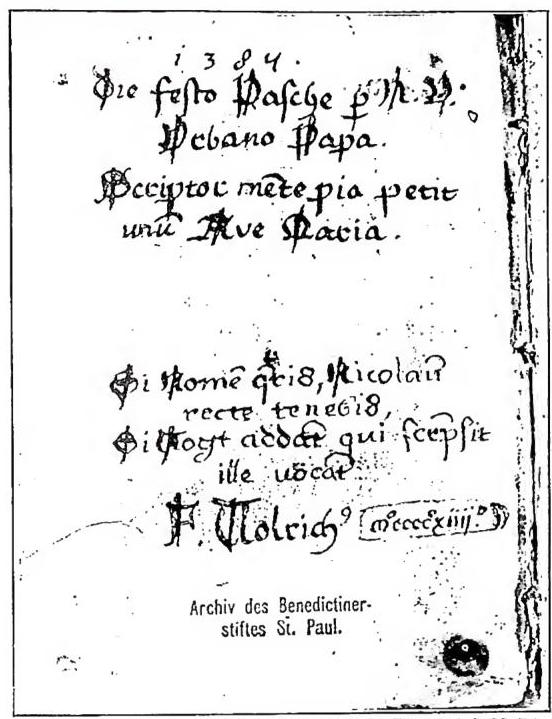
IMITAZIONE DI CRISTO – Codex Paulicianus or Willingensis, described by C. Wolfsgruber in 1880, transcribed by N. V. with the date 1384. F. Uolrichus established that the copyist was Nicolaus Voet, adding the date MCCCXXIII – Archive of the Abbey of St. Paul (Austria).
The divine nourishment is set forth therein. Thus the path of perfection is outlined according to the three “ways”: purgative, illuminative, and unitive. In-depth study of the I. of C. has revealed not only its Benedictine spirit but also its singular affinity with the Rule of s. Benedict. The two greatest medieval ascetical masterpieces complement each other: the Rule initiates souls into perfection, while the I. of C. points out and illuminates the spiritual heights to be attained.
Evidently, the I. of C. is a typical monastic work, written by a monk for monks (cf. I, 17-20 and 25, 1; III, 10, 2); but this in no way compromises its universality: through its profound knowledge of the human heart and the superior wisdom of its teaching, it is admirably suited to every state of life and to all the particular circumstances in which a soul may find itself.
Uncompromising in his doctrine, the pious author, although he shows himself familiar with the theological and philosophical teaching of his time, never embraces particular theories shaped by positive or scholastic theology: he remains outside and above every school, and his teaching is eminently practical. He does not ignore the heights and mystical joys of contemplation, nor does he ignore the painful trials that precede these divine favors, but he speaks of them only by alluding to them from an immediately practical standpoint. Thus the description of the “wondrous effects of divine love” (III, 5), a true spiritual canticle, applies fully to the charity produced in the soul by extraordinary contemplation, while the “exilium cordis” of bk. II (chap. 9) seems to herald the “dark night” of s. Giovanni della Croce.
Mortification, the practice of the Christian virtues, and constant union with Jesus Christ are the three fundamental points of the I. of C., embracing all Christian asceticism and suited to every soul. In this teaching the I. of C. reflects a tendency that may be called “affective”: the practice of the love of God as the dominant note of the entire work (“Magna res est amor, magnum omnino bonum,” III, 5, 3). Here lies one of the causes of its universality and unmistakable charm.
Since it has neither a scientific form nor a scientific purpose, the I. of C. transcends every limitation of category and time. It is universal and perennial: it exercises the deepest and most enduring influence on the life of souls and of the Church.
As regards the special theological importance of certain passages, its contribution to the problem of the discernment of spirits (“motus naturae et gratiae”) in chaps. 54 and 55 of bk. III should be recalled (cf. A. Chollet, Discernement des esprits, in DThC, IV, cols. 1385-88), as well as its clarification of Grace in I, 10 (for which cf. P. Debongnie, Debetur gratia, in Recherches de théologie anc. et méd., 12 [1940], pp. 145-54).
THE AUTHOR. — For centuries the question of the author has been disputed, and the history of the controversy itself is interesting. It may be asserted with sufficient certainty that the work was issued anonymously. Once taken beyond its place of origin, it was attributed to various writers (according to Fr. Brehm, there were “no fewer than two hundred”), among whom Gersen of Vercelli, Gersone of Paris, and Tommaso da Kempis hold pride of place.
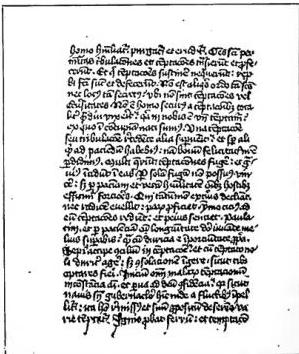
(from The Imitation of Christ, being the Autograph manuscript of Thomas a Kempis, reproduced in facsimile from the original by Ch. Rustens, London 1879)
IMITATION OF CHRIST – Codex of the I. of C. transcribed by Thomas a Kempis (1441), fol. 10, containing chapter 13 of book I. Brussels, Royal Library, cod. 5855–61.
The publication, however, of the Codex Kempesianus of the Royal Library of Brussels, which bears at its end the statement “Finitus et completus anno Domini MCCCCXLI per manus fratris Thomas [a] Kempis in Monte S. Agnetis prope Zwollis” (that is, written and completed in 1441 by Thomas à Kempis), together with the related studies of Pohl, who edited the critical edition of the entire Corpus Kempesianum (7 vols., Freiburg in Br. 1904–22), powerfully strengthened the thesis of the “Kempists,” to the point that many scholars came to regard it as definitive.
But the dispute remains as heated as ever. It is said that the aforementioned authentic note of the Kempis should not be taken as an author’s signature, but rather as that of a copyist (per manus). Moreover, the Codex is so full of inaccuracies, erasures, and errors that Denifle was led to say that “the great enemy of Thomas à Kempis is his autograph.” J. Van Ginneken, moreover, deprives the Kempis not only of the I. di C. but also of other minor works, attributing everything to his “Gerard Groote” (Amsterdam 1942), and is followed in this by J. Huby.
Thus even today there are those who, with Mansi, think that this is an insoluble question: “rem iacere sub lite, nunquam dirimenda.” Nevertheless, the “Gersenian” thesis is steadily gaining credibility and weight, and it is asserted that, despite their resistance, the supporters of the Kempis will one day have to “capitulate.” The oldest codices mentioned above, and others (Vercellensis, Brerensis, Vicentinus, Paulicianus, Georgianus or Patavinus, etc.), together with the earliest translations into the vernacular, demand an Italian, and specifically a “Gersenian,” origin for the I. di C. It is further maintained that the internal evidence is unfavorable to the Kempis; one is led to seek the homeland of the I. di C. in an old Italian abbey of the thirteenth century, in an eminently university environment such as the Vercelli of Gersen.
Indeed, the arguments advanced Gersen (v.) of Canabaco (Cavaglià, near Biella), abbot of S. Stefano of Vercelli between 1220 and 1240, create considerable difficulty for asserting that the author was Thomas à Kempis.
In favor of Thomas is cited the similarity of style and thought found between the I. di C. and his minor works. But while the proponents of the thesis speak of perfect resemblance, its opponents call it “superficial,” speaking instead of a “glaring, irreconcilable, irreconcilable contrast” (R. Pitigliani). In truth, the texts of the venerable Thomas are beautiful, but in them one senses something contrived and artificial in comparison with the author of the I. di C. The language of the I. di C. flows spontaneously, simply, directly, and so penetratingly that it immediately grips the spirit. The sentence is lapidary and concise. Every thought, one might say, is punctuated. And even when the ideas proceed by antithesis, almost in parallel, they are generally not linked with semicolons so as to form a long sentence, but with a full stop, which gives them greater autonomy. Nor does the author indulge in more or less prolix enumerations, repeating, for example, an adverb as many times as a different noun is repeated, as happens in Thomas (cf., for example, chap. 1 of the De disciplina clunstralium, which in the Kempisian codex immediately follows the books of the I. di C., and De imitatione Christi, I, 20, 6). In the Kempis, oratorical expression and a certain professorial tone occasionally emerge. The author of the I. di C., by contrast, listens to himself, but is never seen at the lectern. There is in him a tone of humility so ineffable that it wins over by the suggestive power of truth and compels one to meditate upon it as though it had reached the ear through a nonhuman intermediary (cf. ibid., III, 1). Conscious of his doctrine, the pious author always conceals himself (cf. ibid., I, 2, 3; 5, 1; III, 15, 4). For this characteristic too, one may say with G. Zanella that the I. di C. is “a work not human, but angelic, indeed divine.”
Moreover, there is in the I. di C. a cursus, a rhythm that might be called Benedictine, with nuances of cadence and thought that an exceptionally sensitive ear does not find in the other genuine works of Thomas à Kempis: indeed, as has been aptly noted, a “flow of free verses, similar to those of the sequences of St. Gall, with rhythms, assonances, and rhymes” (G. Prampolini). For example: “Melius est peccata cavere [quam mortem fugere]” (I, 23, 1). “Amana volat, currit et laetatur: [liber est et non tenetur.] Dat omnia pro omnibus [et habet omnia in omnibus]” (III, 5, 4). It is true that this style was common among the sons of the cloister in those times, especially in ascetic writing. Hence the difficulty of reaching an almost definitive conclusion on the basis of purely stylistic internal criteria. Nevertheless, from the simple and eloquent prose of the I. di C. one gains the impression of confronting an inspired soul that speaks with immediate spontaneity, tinged with a tenderness that knows no weakness and is unacquainted with the charms of affected and ornate language: it speaks because the spirit of God makes it speak, perhaps instructed by the long and arduous experience of a life lived before reclining, like Giovanni at the Last Supper, upon the heart of the Master, to drink from the rivers of the Infinite.
Indeed, the I. di C. appears to be “a fruit of perfect maturity” (Michelet). According to the “Kempisian” thesis, however, under which the date of the work would fall between 1415 and 1427, the I. di C. would be a youthful fruit of Thomas (1379–1471), while the other minor works would be the fruits of his maturity. Now, these certainly cannot be compared with the I. di C. without suffering by comparison. It is therefore very difficult to attribute to an almost youthful work by the same author an ascetic experience far superior to that revealed in the minor works written during the maturity of his years.
As for the Germanic idioms that some have detected in the I. di C., these have been countered by a much more abundant series of evident Italianisms.
Finally, the I. di C. has been regarded as the most genuine and representative expression of the devotio moderna. It must be observed, however, that although in method and doctrine it agrees with what is known Windesheim (v.), it does not necessarily follow that it was the product of that same school. Besides, this eminently traditional school disseminated medieval booklets through its scriptoria.
COMPOSITION. — The current order of the books composing the Imitation of Christ is the original one, consistently given by manuscripts of Italian (or "cisalpine") origin; in manuscripts of non-Italian (or "transalpine") origin, however, many anomalies occur in this regard. The Brussels codex, which the "Kempists" consider the archetype of the work, places Book IV before Book III. In other codices, the confusion is even greater, and the work is not always presented in its entirety (II-I-III-IV; III-II-IV-I; I-II-IV; III-II-I; II-III-I; etc.); indeed, the individual books are sometimes treated as independent of one another or entirely isolated, or, at times, with different booklets interposed (cf. Bambergensis codex).
The general title of the work was borrowed from chapter I (De imitatione Christi et contemptu omnium vanitatum mundi) of Book I, either in full or in part (both the first and the second part); the title of chapter I (De interna conversatione) of Book II was also used; likewise, the title of Book III (De interna consolatione), which passed into the famous French translation, L'Internelle consolation.
The division of chapters into paragraphs and biblical quotations were introduced in printed editions. The Benedictine Th. Erhard (18th century) introduced verse numbering into the text, as used for the Bible: this system was adopted in the edition of the Bibliotheca ascetica by Pustet (I, Ratisbon 1911), and, in Italy, by Dr. Sestili and A. Mercati; it was also accepted in the Italian edition by Hoepli, edited by Zumpini and Galbiati, though these wisely retained the traditional paragraph numbering as well.
DIFFUSION. — The great diffusion of the work is attested by the number of manuscripts: approximately 400 remain (of which 160 are Benedictine, and about 40 Augustinian or of the Canons Regular). With the invention of printing, editions multiplied rapidly, surpassing two thousand already in Hurter’s time (II, col. 978). The first is that of Augsburg (1472); in Italy, that of Venice (1483), under the name of Gerson.
Of the Kempis codex, reproduced in facsimile by Carlo Ruelens (Leipzig 1879), a critical edition was provided by K. Hirsche (Berlin 1891) and by M. J. Pohl in the Opera omnia of Tommaso da Kempis (II, De Imitatione Christi quae dicitur libri III cum coeteris autographi Bruxellensis tractatibus, Freiburg im Br. 1904). The editions of M. Hetzenauer (Innsbruck 1901) and A. Mercati (Polyglot Vatican 1925) depend on the same codex.
Translations are innumerable: in all European languages, and in many Eastern ones. An Italian vernacular version in fourteenth-century Tuscan, accepted by the Crusca as a language text, was published by C. Mella, with an extensive historical introduction (Rome 1775; Turin 1880). Among modern Italian versions, those of a literary nature by A. Cesari and C. Guasti stand out, as well as the more popular one by Cardinal E. Enriquez.
Among recent translations, those by O. Tescari (Turin 1929; 3rd ed. 1947), Abbot Placido Lugano (Rome 1932), Fr. G. Lottini (Rome 1932; 3rd ed. 1949), and that by Mons. A. Masini (Florence 1941), preferred by M. Cordovani in his Breviario spirituale secondo l’I. di C. (Rome 1950), are noteworthy. An excellent literary commentary is found in the reprint of Guasti’s work edited by Zumpini and Galbiati (Milan 1938). A. Levasti harmonized C. Guasti’s version with Pohl’s critical edition (Florence 1928).
In France, the translations by P. Corneille (in verse), Le Maistre de Sacy, Michel de Marillac, and Lamennais (v.) are celebrated, whose "reflections" are often included in the Italian editions of Cardinal Enriquez.
In other countries as well, translations of the Imitation of Christ are very numerous. A truly universal book, dear to all, because it brings light and comfort to everyone: a small yet immense book, powerful and gentle, highly beneficial to humanity. — See plate C.
Before Puyol, the following should be noted: G. de Grégory, Histoire du livre de l’I. de J
C. et de son véritable auteur, 2 vols., Paris 1843; K. Hirsche, Prolegomena zu einer neuen Ausgabe der «Imitatio Christi» nach dem Autograph des Thomas V. Kempen, 3 vols., Berlin 1873-94; L. Santini, I diritti di Tommaso da Kempis, 2 vols., Rome 1879-80; H. Denifle, Kritische Bemerkungen zur Gersen-Kempisfrage, in Zeitschr. für kath. Theologie, 6 (1882), pp. 692-718; 7 (1883), pp. 692-743 (cf. ibid., 9 [1883], pp. 193-96).
Among the more recent works: L. Dumas, L’I. de J
C., Paris 1913 (systematic exposition of the doctrine); P. Pourrat, La Spiritualité chrétienne, II, ibid. 1924, pp. 379-400 (Devotio moderna); J. Coumoul, Les doctrines de l’I. de J
C., Lille 1926; J. Huijsen, Les premiers documents historiques concernant l’«Imitation», in La vie spirituelle, years 1925-26, Suppl. to vol. XII, pp. 213-28 and to vol. XIII, pp. 1-17 and 96-116; id., Quelques objections contre Thomas à Kempis, ibid., Suppl. to vol. XIII, pp. 202-22; id., Gerson et l’«Imitation», ibid., 1934, Suppl. to vol. XXXIX, pp. 146-65; to vol. XL, pp. 28-47 and 90-104; E. De Schaepdrijver, Qui est l’auteur de l’«Imitation»?, in Revue d’asc. et de myst., 9 (1928).
Book III
How one should not be curious:
Sarum Use: 1) humble imitation;
2) dividing one’s own faith
almost entirely. Ch. 5.
It is good for you to turn away from
curiosity and to humble yourself in
profound veneration if you do not wish to fall
into public disgrace. It is better to be despised
than to be praised. Let it not matter to you to be wise
3) or to understand more than
is necessary. It is better to have a pious 4) humble
understanding of the truth, always prepared
5) to walk simply through the
streams of divine words. Leave behind
the subtleties that suffice for no one; follow a
plain and firm path to reach the middle
of God’s will. Those who wish to know
too much have lost much. A sincere life
is better for you than the height of intellect
or the depth of divine mystery. If you do not understand
nor grasp what is below you, how will you comprehend
what is above you? Submit yourself to God and humble
yourself, 5) submit your senses to Him, and you will find
peace and rest. Why do some greatly desire knowledge
and holiness, but this is not for their own good—rather,
it is for the enemy’s. Take care not to engage with vain
thoughts nor respond to the devil’s subtle
suggestions: but turn away from them with words of faith
and 7) flee from the snares of the enemy. For many
have perished 9) by following their own will.
Faith 7) and humility do not feel
the blows as keenly: faith is
a strong shield in the midst of battle.
Proceed with simplicity 7) and diligence in faith 7)
with simple reverence approach the sacrament.
If you cannot understand, do not seek to know
too much. For it is better for you to be simple
than to trust too much in yourself. Rejoice in all things 6)
with simplicity and humility, 7) with a pure
and childlike mind, abandoning all curiosity 7)
and pride. For human weakness is frail 7) and can be deceived:
but faith 6) cannot be deceived by falsehood.
Every reason and natural understanding must yield
to faith: it should neither precede nor contradict II. For
faith 7) and love, there the greatest things happen 7)
and the most wonderful effects of this most holy 7)
and most excellent sacrament operate. The gift of immense 7)
and infinite divine power works great and
unfathomable things in heaven 7) and on earth: nor is there
any understanding of the miracles of God’s works
so that 6) human reason may easily grasp them:
they are not marvels nor ineffable things
to be sought.
Here ends the fourth book and
the work on the sacrament of the altar.
The little work of Giovanni Gerson,
chancellor of Paris, is completed
and this opuscule is finished.
M. 100. 1) 1) 1) 1) 1) 1) 1) 1) 1) 1) 1) 1) 1) 1) 1) 1) 1) 1) 1) 1) 1) 1) 1) 1) 1) 1) 1) 1) 1) 1) 1) 1) 1)
L. 100 Dec.
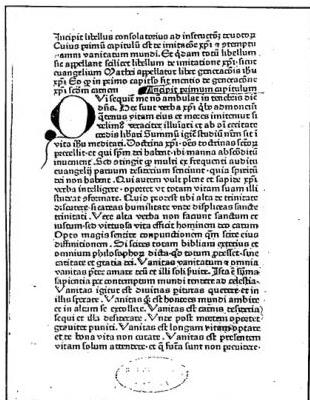
IMITAZIONE DI CRISTO - Prima edizione dell'I. di C., pubblicata in Italia (Venezia 1483). Fine del I. IV - Esemplare della Biblioteca Vaticana.
pp. 209-11; F. Vernet, La spiritualité médiévale, Parigi 1920, pp. 59-60; P. Debonngie, Un témoignage méconnu en faveur de Thomas à Kempis (de ms. 4338 de Vienne), in Revue d'hist. eccl., 26 (1930), pp. 109-15; id., Les thèmes de l'imitation, ibid., 36 (1940), pp. 289-344; id., Henri Suso et l'Î. de J.-C., in Revue d'asc. et de myst., 21 (1940), pp. 242-68; id., Orchrift ou Remaniment ? l'imitation de Lubek, in Rec. d'hist. eccl., 44 (1940), pp. 488-507 (a proposito dei lavori del p. van Ginneken; cf. ibid., 43 [1948], pp. 608-10); R. Pitigliani, Contributo di documenti nuovi alle controversie sull'Î. de C.: Saggio bibliografico-critico, in Aevum, 9 (1935), pp. 321-429; F. Meda, Le traduzioni italiane del « De J. C. », in Conversium, 9 (1937), pp. 215-23; Piergiovanni di G. e M. (d. Giovanni Bonardi), L'autore italiano della I. de C.: Giovanni Gerson, Biella 1938 (cf. recensione di P. Ferraris, in Civ. Catt., 1939, I, pp. 151-154); I. Schuster, L'ascetica benedettina e la I. de C., in La scuola cattolica, 67 (1939), pp. 273-93; M. Lewandowski, Une énigme de l'histoire : l'auteur inconnu de l'Î. de J.-C., con pref. di P. Pourrat, Parigi 1940; J. Huby, Les Origines de l'Î. de J.-C., in Science religieuse, 1943, pp. 102-39; 1944, pp. 211-44; M. Batllori, Las ultimas aportaciones al problema de la I. de C., Palma de Maiorca 1944; J. Mahieu, Le bénédictinisme de l'Î. de J.-C., in Ephém. Theol. Lavaniennes, 22 (1946), pp. 376-94 (a proposito dell'art. del card. Schuster); T. Lupo, Kempis o Gerson ?, in La scuola cattolica, 75 (1947), pp. 220-37. Igino Cecchetti