
CORNEILLE, PIERRE. - Tragic poet, b. at Rouen on 6 June 1606, d. in Paris on 30 Sept. 1684.
His biography, scarcely eventful, offers the vigorous profile of an intense inner life. A pupil of the Jesuits (1615–22), from a classically and Christianly oriented education he drew his ethical vision of life. He began a legal career, soon withdrawing from it in order to follow his poetic vocation freely. At the age of 30 he staged the Cid with triumphant success. Admitted to the Academy in 1647, in 1663 he was granted a royal pension, which was subsequently maintained only with difficulty. He spent his final years in solitary sadness, amid declining fortunes.
He made his début in 1630 with a pastoral comedy, Mélite, followed by Clitandre, La veuve, La Galerie du palais, La Place royale and La suivante. The first tragedy, Médée, with its pronounced Baroque projection, dates from 1635. L'illusion comique, a comedy of 1636, contemplates the life of actors with witty complacency.
The cycle of C.’s great tragic production extends from 1636 to 1642 and consists of four works, the Cid, l'Horace, le Cinna, and le Polyeucte, which, by the analogy of their formal characteristics and their high substantive value, constitute the “Cornelian quadrilateral.”
The dramatic quality of the Cid derives from the conflict, in the soul of the protagonist Ximena, between her love for Rodrigo and her honor, wounded by him through the killing of her father.
In l'Horace, on the other hand, which has a classical subject, love comes into conflict with civic duty, and Camilla dies so that Rome may live. The Cinna, likewise classical in subject, is centered on the magnanimous wavering of the sentiments of the emperor Augustus.
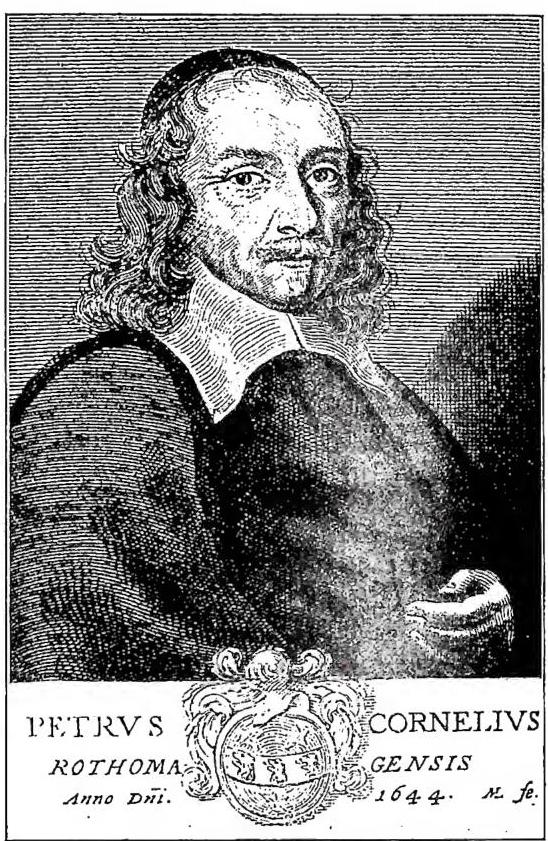
(from E. Picot, Bibliographie Corneliere, Parigi 1856)
CORNEILLE, Pierre - Copperplate-engraved portrait (1644).
agrees, but the intrigues of Felice, ambitious for imperial favor, oppose his magnanimous intention, and Poliuto serenely faces martyrdom.
There followed the tragedies La mort de Pompée (1643), Rodogune (1643), and l'Héraclins (1647), in addition to the witty comedy Le menteur (1644). Nicomède (1651) and Pertharthe (1652) mark C.’s decline; thereafter, apart from some belated dramatic revivals of little interest, he devoted himself to a verse version of the Imitazione di Cristo (1656) and of the Ufficio della Madonna (1620), and composed lyrics chiefly on sacred subjects. He also wrote three Discours on the Aristotelian unities in dramatic poetry.
C.’s figure assumes historical importance because of the decisive innovations he introduced into the traditional forms of tragedy, both by purging it of intrusions of comic elements and by transferring its dramatic essence from the external fatality of conflicting events to the inner clash of passions and wills, within a free and conscious moral dialectic.
Cast in incisive and severe forms, the Cornelian tragedies do not indulge in calligraphic refinements, but all their elements converge tightly upon the decisive moment, in which the poet breathes most freely, revealing his predilection for the heroic and his contempt for the vain and the banal; hence his admiration for the great men and political events of his time. Love is for the most part rejected by C. as an element disturbing serene determination, because it belongs to an instinctive world that escapes the dominion of reason. The essence of the Cornelian conception lies in the subjection of passion to judgment through the will. The highest human motives (death, the vanity of things, honor and duty) and superhuman ones (faith and martyrdom) solemnly inform the tragedies of the “quadrilateral,” culminating in the exquisite completeness of Polin, where the Stoic ethics of l'Horace and the classical equanimity of le Cinna are rekindled and sublimated in the light of Christian spirituality.