
PARIGI, ARCIDIOCESI of. — City and archdiocese, capital of France in the department of the Seine, coinciding with the ecclesiastical territory of the archdiocese.
The archdiocese comprises 227 parishes, divided into four archdeaconries (Notre-Dame, Ste-Geneviève, St-Denis, Sceaux). The number of priests listed in the Ordo of 1952 is 2,109. Between the minor and major seminaries there are 700 seminarians. The latest official census, of 1946, gives the population of the department of the Seine as 4,775,711 inhabitants. The diocesan statistical commission estimates the Catholics of the archdiocese at 3,312,000.
During the last 20 years, 70% of newborns in the diocese have received the Sacrament of Baptism. But this proportion is, in all likelihood, lower than the actual figure, because many Parisian children are baptized in the countryside, where they spend their early years. The proportion of Baptisms in relation to births is currently increasing. The Catholic schools of the diocese have 50,000 pupils. Religious practice varies greatly according to the different areas of the city. In P. itself, the proportion of practicing Catholics is higher than in the more proletarian areas; but it nevertheless remains insufficient, because the principal obstacle to religious life is the population density, which makes pastoral work very difficult.
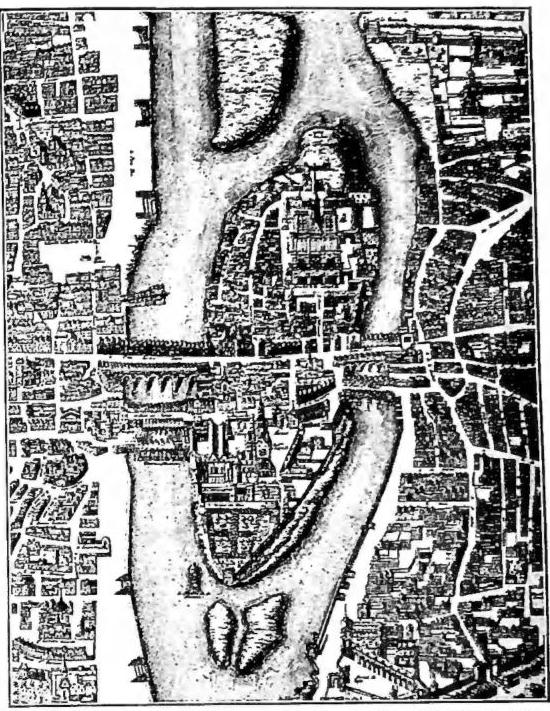
(from V. JALABERT, LOUIS, Le Bréviaire de Philippe le Bon. Bréviaire Parisien du XVᵉ siècle, Bruxelles 1929, plate E)
the specialized movements of the Jeunesse catholique for both sexes (Jeunesse étudiante, Jeunesse indépendante, Jeunesse ouvrière), the Scouts and the Guides, the youth clubs, and the Cœurs vaillants and Ames vaillantes. Throughout the archdiocese, there are approximately 200,000 members among all the Catholic Action groups under the authority of the Direction des oeuvres diocésaines.
One of the characteristics of P. is the existence of an administration diocésaine des étrangers directed by an auxiliary bishop, assisted by a vicar general. This subdivision of the diocese comprises 508,945 souls and includes 27 churches, chapels, and missions intended for the faithful of 35 nations and different rites; 70 priests belonging to the various nations and rites are assigned to this ministry. The most important of all the missions is the Italian one directed by the Scalabrinian Fathers. This mission distributes more than 10,000 Easter Communions to the faithful of peninsular origin.
I. ORIGIN AND HISTORY OF THE DIOCESE
The old Gallic city of Lutetia Parisiorum (Λογκατζικίλ Περταίων), already mentioned by Caesar (52 B.C.: De bello Gallico, VI, 3), was situated on one of the islands of the Seine. In Roman times the city’s extent was subsequently enlarged south of the river, on the slope of the hill of St. Geneviève, and P. became, owing to its geographical position, a strategic and commercial center of primary importance in the Lugdunensis Senonia. Christianity must have appeared there quite early, but until the end of the 2nd century P. was no more than a presbyteral “parochia” of Lyon, the sole diocese of Gaul. It was organized as a diocese around the middle of the 3rd century, and its first bishop was St. Dionysius, whom Gregory of Tours (Hist. Franc., I; In gloria Martyrum, 71: ed. W. Arndt-B. Krusch, in MGH, Script. rerum Merov., I, pp. 48, 535) places among the seven bishops who came to Gaul in 250. Of this Saint, probably martyred under Valerian (258) and listed in the Auxerre recension of the Martir. geronimiano on 9 October together with the presbyter Eleutherius and the deacon Rusticus (Martyr. Hieronymianum, pp. 547-48), very little is known, and legend soon took possession of his personality. Before St. Gregory of Tours, St. Dionysius was treated in the legendary Passio of pseudo-Fortunatus, known by its incipit, Gloriosae (BHL 2171), which has him sent to Gaul “a successoribus Apostolorum,” and in the Vita Genovefae, 17 (BHL, 3335), written around 520, where, in recension A, apparently interpolated, this successor is identified with Pope St. Clement. These two documents, whose biographical value for the Saint is extremely slight, have the merit of attesting to the existence of the cult of St. Dionysius in P. at the end of the 5th century (the church erected over his tomb by the Parisians at the urging of St. Geneviève dates from around 475) and at the beginning of the 6th century; this cult, moreover, was known around 520 also at Bordeaux, where Bishop Amelius built a basilica in honor of the Saint (cf. Venantius Fortunatus, Carmina, I, 11: ed. F. Leo-B. Krusch in MHG, Auctores antiquissimi, IV, I, p. 13).(on account of the Services officiels du Tourisme français)
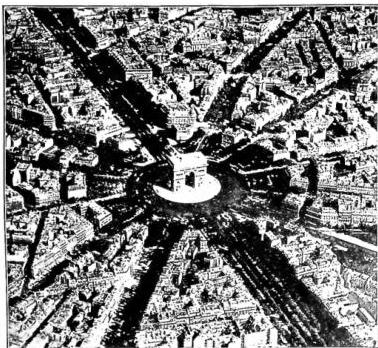
PARIS, ARCHDIOCESE of – Aerial view of the city of P.
At the beginning of the 9th century, the first bishop of Paris Dionysius the Areopagite (v.), and the well-known scene of the cephalophory was added to his martyrdom (v. MARTIRIO E MARTIRE, vol. VIII, cols. 241-42). The documents on which these two new legends are based, subsequently regarded as indisputable historical facts until the 17th century, are the anonymous Passio, known by its incipit, Post beatam et gloriosam (BHL, 2178), written around 825 and translated into Greek before 833 (BHG, 554), and Ilduin’s Passio ss. Dionyssi, qui a loco Ariopagita et Sociorum (BHL, 2175), written by Ilduin, abbot of St-Denis (814-40), one of whose sources is precisely the aforementioned anonymous Passio.
After Dionysius, the Church of P. entered a period of obscurity. Nevertheless, in 360 a Council presided over in person by St. Hilary was held on the banks of the Seine. Clovis and St. Clotilde, who converted France to Catholicism, were to be buried at P. In the Merovingian period, great bishops such as St. Germanus of P. and St. Landericus, and great figures such as St. Audoenus and St. Eligius, maintained P.’s religious prestige. The Carolingian era marked a certain decline of the Cathedral; the only figures deserving mention are the intellectual influence of the abbey of St-Denis and, at the time of the Norman invasions, the heroic attitude of Bishop Gozlin (884-86), defensor civitatis.
At the beginning of the second millennium, the University of P. was founded (v. IV), where the greatest doctors of the Middle Ages would teach. Suffice it to mention St. Albert the Great, St. Thomas Aquinas, St. Bonaventure, Alexander of Hales, and Duns Scotus. Among their students, the Parisian schools counted several popes, including Innocent III. Among the bishops of P. were the eminent theologians Peter Lombard (1157-60), Maurice de Sully, builder of Notre-Dame (1160-96), William of Auvergne (1228-49), and Stephen Tempier (1268-79). Odo of Sully (1196-1208) was a highly esteemed canonist, author of the first synodal statutes, which would be imitated in several dioceses.
In the 14th and 15th centuries, despite their erroneous ideas concerning the relations between popes and councils, Cardinal Peter d’Ailly and the chancellor G. Gerson still brought distinction to the University of P. Decline became apparent in the 16th century. Yet P. counted among its students St. Francis de Sales and St. Ignatius, and among its professors St. Francis Xavier. The spiritual level of the people was lowered by the Wars of Religion. Illustrious bishops such as Cardinals Stephen de Poncher, Jean du Bellay, and Pierre de Gondi were more notable for their literary, political, and diplomatic gifts than for pastoral zeal. By contrast, the 17th century marked a renewal of Catholicism in P.
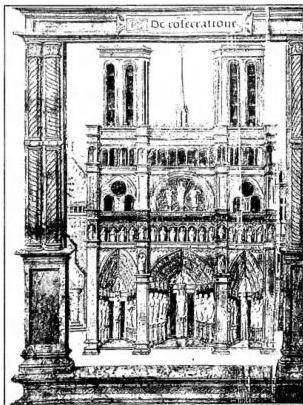
(from V. Laroqueis, Les pontificaux manuscrits..., Paris 1887, pl. 122)
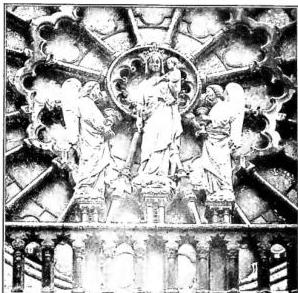
PARIS, ARCHDIOCESE of – Façade of Notre-Dame. Miniature from a Roman Pontifical (early 16th century) – Paris, National Library, ms. lat. 1226, vol. II, fol. 1r.
The statesmen (generally Voltairians) implemented the Concordat in a manner unfavorable to Catholicism. Nevertheless, the 19th century was a period of renewal: in 1830 St. Catherine Labouré made her Marian visions known to the world; from the pulpit of Notre-Dame, Lacordaire once again presented the great truths of the faith to the educated classes of Paris; all the religious orders suppressed by the Revolution reappeared; and a vigorous effort was made in free primary and secondary education, and later also in higher education. New great churches were built (La Madeleine, St-Augustin, La Trinité, etc.), and chapels were opened in the suburbs. The 19th century ended without, however, fulfilling all its promises. The finest work of the century’s end was the Basilica of the Sacred Heart at Montmartre, whose construction was decreed by the National Assembly in 1871.
In the 20th century, P. and all France experienced the religious persecution unleashed by Combism. Cardinal Richard, a courageous defender of the rights of the Church, was expelled manu militari from his episcopal residence. But between the two wars (1918–39), a genuine religious renewal manifested itself in P. Catholic youth organizations flourished; the University partially regained its Christian character; and great Catholic writers restored the Church’s intellectual prestige. Cardinal Verdier (1929–40) founded about a hundred new centers of worship.
The Second World War, the German occupation, and the Liberation made their effects felt on religious life in Paris. But the achievements of the preceding period were preserved. In September 1951, the vote of the National Assembly, which made the situation of independent education less precarious, demonstrated the Catholic vitality of P. and France.
II. ABBEYS, SHRINES AND RELIGIOUS MONUMENTS
The diocese of P. has had many male and female abbeys, some of considerable importance in the history of the Church. The oldest of all is the abbey of St-Denis, two leagues from Paris. Its Basilica, erected through the efforts of s. Genoveffa (5th cent.), was rebuilt by Dagobert (7th cent.). The Benedictines entered it in 656 and remained there until the Revolution (1789). In the 9th cent. St-Denis was the center of the Carolingian renaissance, with Ilduino, Abbone and Incmaro; in the 12th cent. it reached the height of its prosperity under the abbot Sugero, regent of the Kingdom; he had the present Basilica built, completed by s. Luigi. Most of the kings of France were buried there. The abbey of St-Germain-des-Prés, founded in 558 by Childeberto and dedicated to the Spanish martyr s. Vincenzo, later took the name of the Parisian bishop who had consecrated it and was buried there for a long time. The abbey was destroyed several times and acquired its definitive form in the 11th cent.; it is one of the oldest monuments of P., and its monastery was home to the most learned Benedictines of the 17th cent., MABILLON, JEAN (v.), Montfaucon (v.) and their confrères.Among the monasteries of the Canons Regular are the abbey of S. Vittore, from the 12th cent., erected by Bishop Galon (Ugo and Riccardo di s. Vittore, Guglielmo di Champeaux, the “Victorines”), and the abbey of S. Genoveffa. Over the course of the centuries, the Carmelites of the Place Maubert, the Dominicans of St-Jacques, established there by s. Domenico himself, the Capuchins of St-Honoré (Benedetto di Canfeld), and the Jesuits of the Faubourg St-Antoine distinguished themselves.
At present P. has religious belonging to most of the various Orders or Congregations. The most important monasteries are those of the Benedictines of S. Maria “de la Source,” the Franciscans and the Dominicans. The most celebrated convents for women in P. were those of St-Martial, founded by s. Eligio on the Île de la Cité; the Franciscans of Longchamp of the b. Isabella; Port-Royal (an abbey flourishing in the 17th cent. but fallen into Jansenism); Val-de-Grâce; Montmartre; and the Carmel
(from Y. Christ, Epilies parisiennes, Paris 1857, pl. ??)
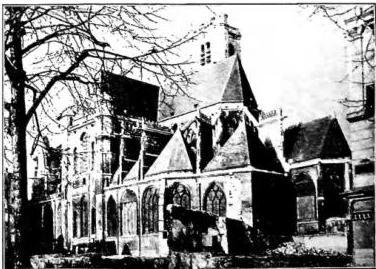
PARIGI, ABCIDIOCESI di - South side and apse of the church of St-Gervais (ca. 1494).
of Notre-Dame des Champs. All these convents have now disappeared, but P. today has 400 religious houses. In addition to the churches already mentioned, P. contains important shrines. The first of these is the cathedral of Notre-Dame. The laying of the foundation stone was carried out by Pope Alessandro III in 1163; the building was erected by Bishop Maurizio di Sully in the Cité, on the site of the ancient église de Paris, repeatedly destroyed and rebuilt.
Among the most distinguished monuments of P. not yet mentioned, it is necessary to recall, in the Romanesque period, the ancient church of St-Martin des Champs; in the Gothic period, the churches of St-Severin, St-Merry, St-Gervais, St-Laurent and, above all, the Ste Chapelle of the Palais de Justice, erected by s. Luigi to serve as a reliquary for the crown of thorns brought from Constantinople in 1239. At present, however, the relic is in the Treasury of Notre-Dame of P. The Ste Chapelle is adorned with immense multicolored stained-glass windows from the 13th cent., forming a remarkably harmonious ensemble. During the Renaissance, many notable buildings were erected, such as St-Eustache and St-Etienne du Mont. The classical period, too, produced important monuments, such as the chapels of Val-de-Grâce (by Mansart), the church of St-Sulpice (by Servandoni), the former church of Ste-Geneviève or Pantheon (by Soufflot), and the Madeleine (by Constant d'Ivry).
Cardinal Verdier (1929-40) had numerous churches built in a modern style, a large part of which are still unfinished. One of the most notable is the church of St-Esprit, the work of the architect Tournon. Also noteworthy are those of St-Pierre de Chaillot, Ste-Agnès d'Alfort, and St-Rédempteur de Vanves, the work of dom Remy Belleau.
III. THE COUNCILS OF P
This term encompasses national and provincial councils, synods, assemblies, councils of bishops, etc., held in P. or in its vicinity,convened by ecclesiastical authorities (occasionally by the pope or the papal legate) and also, especially in more remote times, by civil authorities (the kings and emperors of France). There were mixed councils, both with regard to the issues and to the persons participating in them, since, in addition to the clergy, laypeople also took part. Owing to the uncertainty of the sources and the lack of a definitive study, it has not yet been possible to establish a precise list of the years and number of the Councils of P., which are of the greatest importance because of the questions they addressed and also because of the political, religious, and scientific position
(University) of the city, not only for France but also for Europe. The influence of the conclusions, decrees, and canons was often felt throughout the Christian West.
Some of the principal ones may be mentioned. At the Synod held in the year 360 (or 361), the Church of France condemned the formula of faith accepted at Rimini, maintaining the positions of the General Council of Nacca, ca. 557, and 10 canons were enacted concerning marriage, the election of bishops, etc. The Council of 825 was convened on account of the Western iconoclastic controversy. That of 829 is important for its ordinances concerning the clergy, civil authority (the duties of the king toward his subjects and vice versa), the laity, etc. In 1051, the errors of Berengario and Scoto Eriugena concerning the Eucharist were condemned; in 1147, Pope Eugenio IV presided over the Council that examined the doctrine of Gilberto de la Porrée on the Most Holy Trinity; in 1185 and 1188, Councils were convened for the Crusades; in 1212 (or 1213), reforms were enacted concerning the secular clergy, religious men, religious women, bishops, feasts, etc.; in 1224 and 1226, measures were taken against the Albigensians; in 1310, the case of the Order of the Templars was considered; in 1395 and 1408, Synods were held to facilitate the end of the Western Schism; in 1528, the errors of Luther were condemned. In 1811, Napoleon convened the so-called National Council in order to exert pressure on Pio VII, but the Council declared itself incompetent to deal with the questions submitted to II. In 1849, a Synod was important for its far-sighted views; and those held at the beginning of the twentieth century for the position they took regarding the laws directed against the freedom of the Church.
IV. THE CENTER OF STUDIES
P. is one of the major cultural centers in the world, owing to the quantity and variety of its schools, academies, societies, libraries, bookshops, museums, and scientific and artistic collections.1. The ancient University
In the Middle Ages there were 3 schools at P.: that of the cathedral of Notre-Dame, where the 4 liberal arts had been taught for centuries according to the ancient method; that of St. Victor, where Guglielmo di Champeaux, Ugo, and Riccardo taught; and that of St. Geneviève, made famous by Abelardo. Today it is held that the University was not the fusion of the three schools, but the(from A. Chagny, L'Ordre hospitalier de St-Jean-de-Ducy en France, I, Lyon 2001, pp. 5-10)
development of that of Notre-Dame (also called insulana, because it was on the “island”), brought distinction by the “magister Sententiarum,” Pietro Lombardo: its documents date back to the year 1200; and soon afterward it appears as Universitas magistrorum et scholorium. Alongside the school of arts (or philosophy), the Faculties of theology, canon law, civil law, and medicine soon developed there, presided over by the “deans.” Its general head was the “chancellor” of Notre-Dame, from whose jurisdiction the University would later seek to become independent. The number of students was great, predominantly ecclesiastical, and they were divided, according to their origin, into four “nations”: Gallicani, Normandi, Picardi, Angli, or Alemanni. Each national association was headed by a “procurator”; the “procurators” elected the “rector,” their general representative and head of the faculty of arts, who later also centralized the powers of the “chancellor.” As lodging for the poorer students, and also for teachers, collegia, also called studia dotata, were established; these later became teaching institutions as well, the most famous being that founded in 1257 by Roberto de Sorbon, chaplain to the king s. Luigi (hence the name “Sorbonne”). Various religious Orders likewise founded houses for their students; thus the Studia generalis of the Dominicans and Franciscans arose. At first the professors belonged solely to the secular clergy; with the rise of the mendicant Orders, religious gradually won chairs as well. A reaction ensued, degenerating into a “struggle,” led by Guglielmo di St-Amour, whose opponents were Alberto Magno, Bonaventura, and Tommaso. In 1256 Pope Alessandro IV declared in favor of the religious. The numerous privileges granted by the Popes and Kings helped make the University an independent corporation, a kind of third power after the Papacy and the Empire, especially during the great Western schism (so that the Studium was regarded, for France, as a counterpart to the Germanic Imperium and the Italian Sacerdotium).
From the 13th to the 14th century, the University of P. was the principal center of theological science for the whole of the West, and Scholasticism there attained its greatest splendor. Then its decline began, influenced by various factors (wars, schism, competition from other schools, and growing dependence on the French crown). It fought Jansenism but favored Gallicanism. Since around 1700 it had been inclining toward the Jansenists, and the Pope reduced its privileges; it gradually lost its scientific primacy. With the French Revolution it was suspended (1793). Under Napoleon its new period of life began within the general framework of the “imperial University”; in 1896 it resumed, with juridical personality, the name “Université de Paris.”
2. The Catholic University
The spiritual heritage of the glorious past has been gathered up by the “Institut catholique” (cf. the letter of Pius XI, Si per hoc, of 28 Oct. 1925, for the fiftieth anniversary of the Institute, in AAS, 17 [1925], p. 573 ff.). Established in 1875, by virtue of the law of 12 July 1875, as a “free institution of higher education,” it was housed in the historic “couvent des Carmes.” Its first rector and true founder was mons. M. d'Hulst ([v.] 1875-96), followed by mons. P.-L. Péchenard (1896-1907), and then by mons. A. Baudrillart ([v.] 1907-42), made a cardinal by Pius XI.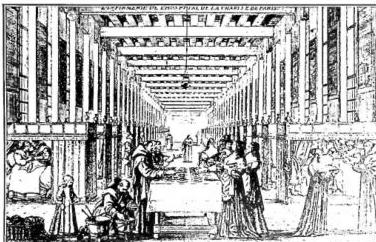
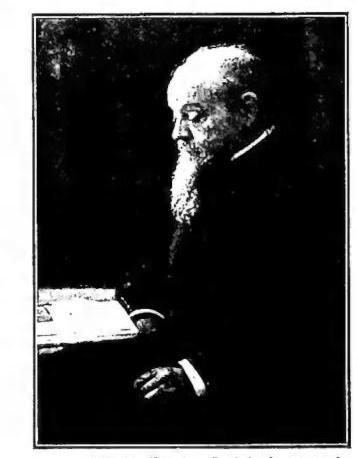
Igino Cecchetti
3. Other institutions
a) The OBSERVATOIRE NATIONAL, established by Louis XIV in 1667. The building erected by Cl. Perrault (1667–72) was constructed so that its four façades correspond to the cardinal points; the parallel of the southern façade gives the latitude of P., and the meridian, which divides the building in two, is that of P., although today it is aligned with Greenwich. The palace houses the Bureau international de l'heure, a library, and a museum of ancient instruments; b) the ECOLE POLYTECHNIQUE, founded by the Convention on 11 March 1794 and reorganized in 1852; admission is by competitive examination; at the end of the two-year course, one may enter the corps of State engineers, engineers of bridges, roads, aeronautics, the engineering corps, etc.; c) the ECOLE NORMALE SUPÉRIEURE, created by the Convention on 30 Oct. 1794 and organized especially by the decree of 17 March 1808, which established the Imperial University in order to train the best teachers by the most rigorous methods. It is divided into two sections, humanities and sciences; d) the ECOLE SUPÉRIEURE DES MINES, for the training of mining engineers, founded in 1783; it occupies the former Hôtel Vendôme; attached to it are a museum of mineralogy and geology and a library; e) the INSTITUT NATIONAL DE FRANCE, founded on 22 pp. 1795 with the mission “to collect discoveries and perfect the arts and sciences.” The law of 25 Oct. 1795 divided the Institute into three classes (physical and mathematical sciences, moral and political sciences, literature and fine arts). After further modifications, a royal decree of 21 March 1816 reorganized it into four Academies, and another was added by royal decree of 26 Oct. 1832: the ACADÉMIE FRANÇAISE, which had originated in meetings held from about 1629 at the home of the man of letters V. Conrart, but took definitive form on the proposal of Cardinal Richelieu, by Louis XIII in 1635. Its members initially numbered 28, then were fixed at 40, known as “les 40 immortels.” It was charged with compiling a dictionary of the French language, a rhetoric, a poetics, and a grammar; the ACADÉMIE DES INSCRIPTIONS ET BELLES LETTRES descended from the “Petite Académie” founded in 1663 by J. B. Colbert. It was given its present title by Louis XV in 1716. Today it consists of 40 titular members, 15 free academicians, 12 foreign associates, and 70 corresponding members, of whom 30 are French and 40 foreign; the ACADÉMIE DES SCIENCES, also founded by Colbert in 1663, is divided into 11 sections and today has 68 titular members, including 2 perpetual secretaries, 10 free academicians, 12 non-resident members, six members with the same prerogatives as the free academicians, in the division created on 23 Jan. 1918 under the title: “Applications de la science à l'industrie”; 12 foreign associates and 116 corresponding members; the ACADÉMIE DES BEAUX-ARTS, which was founded in 1795, comprises 41 titular members, eight for(courtesy of the « Services Officiels du Tourisme français »)
PARIS - Trocadéro Square, with the equestrian statue of Marshal Foch and the Eiffel Tower.
each of the 55 sections, plus 1 perpetual secretary; the ACADÉMIE DES SCIENCES MORALES ET POLITIQUES, founded in 1795, suppressed in 1803, and reinstated in 1832; it comprises 40 titular members divided into 5 sections; it has 10 free members, 12 foreign associates, and 60 corresponding members. The Institut de France, with its 5 Academies, resides in the palace founded by Cardinal Mazzarino as the residence of the Collège des Quatre Nations, designed by L. Le Vau (1662-68). Each Academy meets separately once a week; on October 25, the public assembly of the five Academies takes place. Outside the Institut de France, the following were founded: in 1820, the Académie de médecine, with 6 sections; in 1898, the Académie internationale d'histoire des sciences; f) the CONSERVATOIRE DE MUSIQUE ET DE DÉCLAMATION, founded by Sarrette. The Convention made it a national institution in 1795. It occupies the former Jesuit College on rue Madrid and contains an instrumental museum and a music library; g) the CONSERVATOIRE NATIONAL DES ARTS ET MÉTIERS, established by the Convention on October 10, 1794, occupies part of the former priory of St-Martin-des-Champs, where practical courses and free public lectures on sciences applied to industry and the arts are held; it has a rich library and collections; h) the COLLÈGE DE FRANCE, founded in 1530 by Francis I at the request of French humanists, particularly G. Budé (1468-1560); it was then called the Collège des lecteurs royaux, renamed Collège royal de France in the 17th century, and given its current name during the Revolution. The free, public, and gratuitous courses are of university-level advancement and taught by government-appointed professors. It has 3 sections: mathematical, physical, and natural sciences; philosophical sciences and sociology; philological and archaeological sciences; its seat is in Place Marcellin-Berthelot, and on the entrance door one reads: « Docet omnia »; i) the BIBLIOTHÈQUE NATIONALE has ancient origins; Charles V had assembled a library at the Louvre, later dispersed and taken to England; Louis XI reconstituted it at the Louvre. Louis XII enriched it with a collection taken from Naples; Francis I with Oriental, Greek, and Latin manuscripts; Henry IV with 800 manuscripts inherited from Catherine de' Medici. Great acquisitions were made under Louis XIV and XV. After various relocations, between 1721 and 1727 it was moved to rue Richelieu in the Hôtel de Nevers, where it remains today. After the Revolution, the Library received all the collections of the suppressed abbeys and religious institutions; and from 1793, first one copy and then two of every work printed in France, as legal deposit. It is one of the richest in the world and is divided into four departments: printed works (ca. 5,000,000 vols.) and maps (300,000); manuscripts (125,000) and parchments; engravings (3,000,000); medals and coins (ca. 250,000) and antiquities; it has a public reading room and various study rooms; l) LES ARCHIVES NATIONALES, established by the Assembly in 1789 and housed in 1808 in the former Hôtel Soubise, built by Delamair between 1705-1709; since 1927 also in the former Hôtel Rohan. It is an imposing collection of documents ranging from a diploma of Clotaire II (625) to the present day. On the first floor is the Musée des archives, displaying the most notable documents; m) the CITÉ UNIVERSITAIRE, begun in 1920 with a donation of 10 million francs by the Deutsch de la Meurthe couple, with 7 pavilions in Norman style designed by architect L. Bechmann, to house university students from various French provinces. Additional pavilions were added for Canadian, Belgian, Argentine, English, Japanese, Dutch, Indochinese, Cuban, Armenian, Danish, and Swedish students. There are also foundations from Monaco, Greece, Switzerland, the United States, and the Institut National Agronomique; a Spanish College; an International House; and the Church donated in 1936 by Mrs. P. Lebaudy; n) the BIBLIOTHÈQUE DE L'ARSENAL occupies part of the former Palace of the Grand Master of Artillery (1723, with 19th-century modifications). Founded in 1757 by the Marquis d'Argenson de Paulmy, it was enlarged by the Revolution with the Archives of the Bastille and the collections of convents; in 1797 it became the BIBLIOTHÈQUE NATIONALE DE L'ARSENAL. It comprises 12,000 manuscripts, a million printed works; ca. 120,000 prints; and the richest collection of all dramatic works from the origins of theater in France, a fund of ca. 350 documents.
o) Museums: MUSÉE DU LOUVRE, in the former royal palace, was established in 1791 with the royal collections; enlarged with donations, war spoils, and acquisitions. It is divided into several sections: Egyptian, Asian, Greco-Roman antiquities, the Middle Ages and Renaissance, 17th-19th centuries. The most notable is the painting section for the Italian and French schools. MUSÉE DU LUXEMBOURG is dedicated to French Impressionist and living artists, and the MUSÉE JEU-DE-PAUME, in the Tuileries, to foreign schools. MUSÉE DES MONUMENTS FRANÇAIS is located in the Palais de Chaillot, where the « Direction des musées nationaux » is also housed. It is a precious collection of casts of ancient French monuments and life-size reproductions of medieval pictorial cycles. MUSÉE GUIMET, named after its founder Emile Guimet (d. 1918), who had established in 1879 in Lyon a museum of religions, history, and art of the Far East, along with a specialized library. It was transferred to Paris in 1888. MUSÉE GALLIERA or MUSÉE BRIGNOLE-GALLIERA, from the former name of the duchess; used for temporary exhibitions. MUSÉE ENNERY, named after its founder, who collected Far Eastern art objects. MUSÉE DE LA PAROLE contains the history of the record and phonograph, with collections of discs of famous voices, dialects, and folklore. MUSÉE DES PHARES ET BALISES contains an optical collection, lighthouses, plastic works, buoys, and their applications. MUSÉE POSTAL, with documents on the history of the postal service, philatelic collections, and temporary exhibitions. MUSÉE JACQUEMART-ANDRÉ: the painter Nélie Jacquemart (v. Edouard André) left to the State upon her death in 1912 the palace built by H. Parent, with a superb collection of statues, paintings, ceramics, glass, bronzes, and tapestries from the Italian Renaissance to the 18th century. MUSÉE BALZAC, in the house where he lived on rue Raynouard; contains mementos of the novelist's life and work. MUSÉE CLEMENCEAU: in the apartment inhabited by the statesman on rue Franklin. MUSÉE MARMOTTAN: in the palace of its founder P. Marmottan, art historian, containing furniture, statues, paintings, tapestries from the Renaissance, the First Empire, and modern works. MUSÉE MOREAU: contains paintings, drawings, and sketches by the painter Gustave Moreau (1826-98). MUSÉE CERNUSCHI, founded by its namesake, who established a collection of Chinese and Japanese art. MUSÉE DES TRAVAUX PUBLICS: contains plans, dioramas, and models of major works of art executed by French engineering. MUSÉE DE L'AIR: a collection of historic aircraft, scale models, aviation engines, aerostats, and their documentation. MUSÉE CARNAVALET: named after the Renaissance palace, it houses the Historical Museum of the city of Paris. MUSÉE DES THERMES ET DE CLUNY: in the former Roman thermal building where, in the Middle Ages, the abbots of Cluny adapted their residence in Paris, it contains a precious collection of medieval art. MUSÉE DES GOBELINS: a collection of tapestries from the 15th to the 19th century; their display is periodically renewed. It includes a manufactory and a restoration workshop; p) within the Ministère de l'éducation nationale, there are the following commissions: des sciences économiques et sociales; des travaux historiques, d'histoire et philologie, de géographie, which together form a Comité; notable is the Bulletin archéologique du Comité des travaux historiques, published since 1882.
The Centre national de la Recherche promotes the publication of a group of scientific periodicals, including: Revue archéologique, founded in 1844; Revue de l'histoire des religions, which in 1951 reached vol. 140; Bibliothèque de l'École des Chartes, which in 1951 was at vol. 109; Annales du Musée Guimet; Revue des études byzantines, 9 vols. by 1951; Archives de l'Orient chrétien; Gallia. Fouilles et monuments archéologiques en France métropolitaine, since 1943. Under the auspices of the Société archéologique de France, the Bulletin monumental has been published in Paris since 1836, and since 1834 the proceedings of the Congrès archéologiques de France. The Fondation Eugène Piot has been the publisher of Monuments et mémoires publiés par l'Académie des Inscriptions et belles lettres since 1894. Journal des Savants, founded in 1665, was revived in 1816 by the Académie des Inscriptions et belles lettres. This academy has published its Comptes rendus since 1857, which were preceded by Mémoires et histoires de l'Académie royale des Inscriptions et belles lettres and, since 1815, Mémoires de l'Académie des Inscriptions et belles lettres publiés par divers savants. The following scientific publications should also be mentioned: Archives des missions scientifiques et littéraires, from 1850 to 1891, after which they became Nouvelles Archives des missions scientifiques until 1924; the Société de l'Art français published Les Archives de l'art français from 1851-52, later renamed Bulletin de l'art français; the Société de l'histoire de Paris published Mémoires from 1851. Gazette des beaux-arts has been printed since 1859. The Bibliothèque des Écoles françaises d'Athènes et de Rome was founded in
1876. In 1951, the Revue des arts was launched
Vedi tavv. LXVII-LXIX.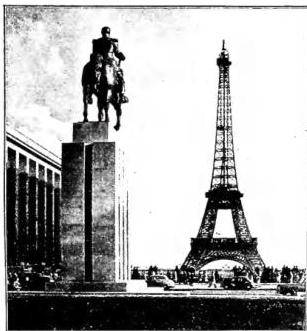
BIBL.:
A. Franklin, Les anciennes bibliothèques de Paris, Paris 1867-73; H. Stein, Manuel de bibliographie générale, Paris 1897; Catalogue général des livres imprimés de la Bibliothèque nationale, Paris 1897 ss.; Bibliographie de l'histoire de Paris, Paris 1894 ss.; Répertoire méthodique de l'histoire moderne et contemporaine de la France, Paris 1898 ss.; Bibliographie annuelle de l'histoire de France, Paris 1953 ss.; Bulletin des bibliothèques de France, Paris 1956 ss.
P. PASCHINI
---
PARIS, CONFERENZA DI (1856)
Conferenza internazionale tenuta a P. dal 25 febbraio al 30 marzo 1856 per porre fine alla guerra di Crimea (v. CRIMEA, GUERRA DI). Vi parteciparono i rappresentanti delle potenze belligeranti (Francia, Gran Bretagna, Russia, Turchia) e quelli dell'Austria e della Prussia. La conferenza si concluse con la firma del trattato di P. (30 marzo 1856), che sancì la neutralità del Mar Nero, la libertà di navigazione sul Danubio, l'autonomia dei principati danubiani (Moldavia e Valacchia) sotto la garanzia delle potenze firmatarie, e l'integrità dell'Impero ottomano. La conferenza segnò anche l'ingresso della Turchia nel concerto delle potenze europee e rappresentò un successo della diplomazia francese sotto Napoleone III.
BIBL.:
H. Temperley, The Crimea War and its Lessons, London 1939; A. J. P. Taylor, The Struggle for Mastery in Europe 1848-1918, Oxford 1954; P. Renouvin, Histoire des relations internationales, VI, Paris 1955.
A. MARTINI