
MEAUX, DIOCESE of. — City and diocese in the department of Seine-et-Marne (France). It has an area of 5,664 sq. km, with 407,137 inhabitants, of whom 350,000 are Catholics. The diocese is divided into 2 archdeaconries, 5 archpresbyterates, and 29 deaneries, with 531 parishes served by 301 secular and 21 regular priests; it has 8 male and 83 female religious communities (Ann. Pont., 1951, p. 267). It is a suffragan of Paris.
Meaux, too, had an episcopal catalogue at the end of the 9th century, recalled by Bishop Ildegarius in the life of St. Faron. The first bishop was Desiderius, the 19th Valdebertus, the 20th Faron, and the 36th Ildegarius; but Desiderius, placed first in the lists, was instead bishop of Paris, while Valdebertus was abbot of Luxeuil. The following may be recognized as bishops of Meaux: Rigomerus, commemorated on 28 May in the Hieronymian Martyrology; Medovecus, present at the Council of Orléans (549); Gundoaldus, who took part in the Councils of Paris (614) and Clichy (627); Burgnodofarus (643), commemorated on 28 May in the Hieronymian Martyrology, and Hildebertus on 27 May; Erlingus, known from a privilege of 683; Romanus, to whom Pope Zacharias wrote in 748; Vulfranus, present in Rome in 769; Hubertus, present at the Councils of Soissons and Verberie (853); Ildegarius, at the Council of Senlis (856); Ragenfridus, at that of Ponthion (876); Sigimundus, taken prisoner by the Normans in 888 when they conquered Meaux; and Agelrandus, present at Reims for the consecration of Bishop Eriveus. In more recent times, the bishops J. du Drac (1459–73), G. Briçonnet (1516–33), D. Segnier (1637–59), and Cardinal De Ligny (1659–81) are remembered. Bossuet (v.) was bishop of Meaux from 7 February 1682 until his death (1704).
Meaux formed part of the Kingdom of Austrasia; it was subsequently taken by the Normans in 887, who burned the city and took Bishop Sigimundus prisoner. In the 10th century, Theobald, Count of Troyes, also became Count of Meaux; his son Odo I incorporated it into the County of Champagne. Meaux then acquired commercial importance. It was later reunited with the French crown by Philip the Fair in 1285. In 1385 it suffered during the revolt of the Jacquerie. In 1422 it was taken by Henry IV of England; reconquered in 1439, it suffered during the Wars of Religion; in 1562 the Huguenots sacked the churches.
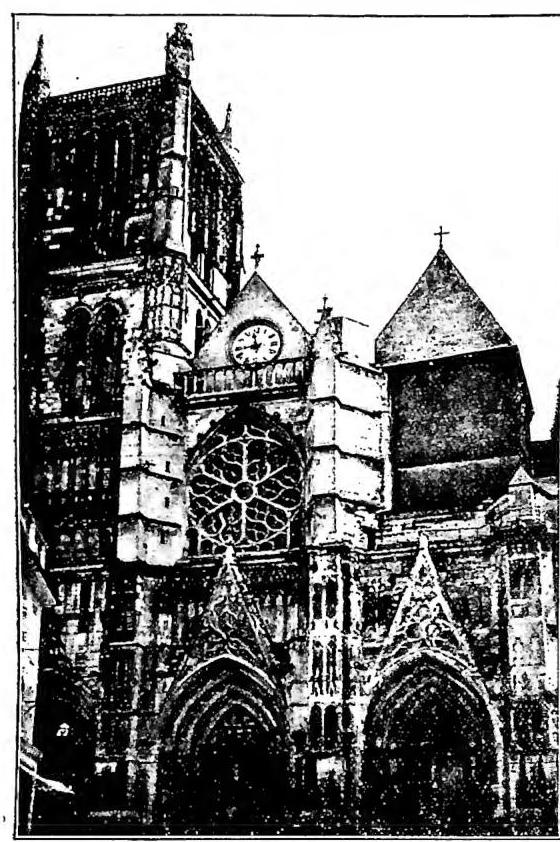
The cathedral is dedicated to St. Stephen. In the mid-9th century, Bishop Ildegarius, in the life of St. Faron, speaks of the church of Meaux. Its origins, however, remain obscure. In the 12th century there were already several canons. In 1723, Cardinal de Bissy, excavating to construct a burial place for the bishops, discovered beneath the cathedral a crypt, remains of columns, and a capital from the 11th century; other remains of similar columns were found in 1840, together with traces of calcined materials and ashes that suggested the fire set by the Normans. It is certain that in 1798 Marie of France, daughter of Louis VII and wife of Count Henry I of Champagne, was buried there. Between 1225 and 1235, the architect Villard de Honnecourt drew the « presbyterum Pharanonis in Miasus » and « les ligements de l'église Miasus de St-Etienne ». The building, however, was rebuilt in 1253 under Bishop
MEAUX, DIOCESE of — Cathedral (14th–15th century).
Peter de Cuisy, and the architect was Gautier de Varinfroy. A new chapel and other works were nevertheless commissioned in 1322 by Charles the Fair; Rose, a wealthy merchant of Meaux, added the chapel of the Blessed Sacrament. More noteworthy were the restoration begun in 1335 according to a design by Nicolas de Chaume, which continued beyond 1390, and new works from 1459 to 1500. Then came the damage inflicted by the Huguenots in 1563, the destruction of the reliquaries of the Treasury, the choir, the statues, etc.; this was followed by the alterations carried out by Cardinal De Bissy (1723–31). Good restorations in the first decades of the 20th century restored the cathedral to its original design.