
HUGUENOTS. — This name designates the French Protestants, to whose theology and ecclesiastical constitutions Calvinism contributed above all, to such an extent that the various French Protestant confessions united by drawing inspiration from the synodal and consistorial organization of Calvin’s Geneva; the first Synod of the French Reformed churches was held in 1559 at St-Germain.
From the point of view of dogma, the creed of the Huguenots does not present any particular interest; rather, it does so in its relations with the State: both among the theorists, who, in opposition to royal centralization, came to advocate a democratic political conception (in which the sovereign is conceived merely as the first magistrate, bound to respect the contractual relationship between God and the people, which precedes that between God and the king), and among the men of action, who succeeded in giving the Huguenot union an extremely solid military and political-administrative foundation (the stages of this organization were at Milhau, with the assembly of 1573, and at La Rochelle, with the meetings of 1588). The primitive ethical-religious superiority of the Synod, however, gradually declined as the political and military organization became increasingly deci-
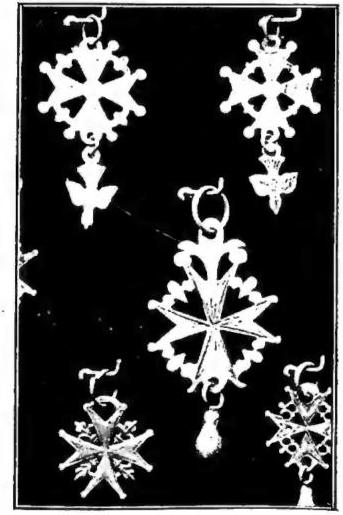
UGONOTTI — Huguenot crosses from the Collection of Dean Raoul Allier — Paris, Exposition de livres anciens, souvenirs historiques at the Bibliothèque d'histoire du protestantisme français.
firmly taken over by the more powerful nobility in its struggle against the French monarchy. To rewrite the history of the Huguenots means rewriting the history of more than a century of French life, precisely because the strengthening of royal absolutism was achieved through the fierce struggle against the Huguenots, who came to constitute a veritable State within the State. The stages of this struggle were the opposition of the Guises and the Condés; the apogee of Huguenot power, when in 1570 the monarchy granted, through the Peace of St-Germain-en-Laye, autonomy to the strongholds of La Rochelle, Cognac, Montauban, and La Charité; MEDICINA (v.), which led to the night of St. Bartholomew (v. BARTOLOMITI, notte di san); the clash between the Navarre and the Guises; the assassination of Enrico III; IV (v.), who, Nantes (v.) of 1598, granted the Huguenots freedom of worship and several places de sûreté; the bitter war waged by Richelieu, culminating in the fall of the last Huguenot stronghold, La Rochelle (1628); the subsequent political decline of the Huguenots; the revocation of the Edict of Nantes, carried out by Luigi XIV in 1685; and the final flashes of Huguenot resistance, when in 1702–1705 they took up arms against Luigi XIV (v. CAMISARDI). The revocation of the Edict of Nantes was of particular importance in European economic history, because it drove from France skilled artisans in the textile industries, who gave a considerable impetus to manufacturing outside France (Germany, Ireland, the Netherlands, North America).
BIBLI: L. Romici, Catholiques et huguenots à la cour de Charles IX, Parigi 1924; J. Vienot, Hist. de la réforme française des origines d'Édit de Nantes, ibid. 1926; id., Hist. de la réforme française de l'Édit de Nantes à sa révocation, ibid. 1934; K. Manoury, Die Gesch. der Hugenottenkirche, 2 vols., Berlino 1940–41; B. Narbonne, Jeune d'Albret reine des Huguenots, Parigi 1945; A. Ducasse, La guerre des Camisartés: la résistance huguenote sous Louis XIV, ibid. 1946; R. Stephan, L'épopée huguenote, ibid. 1946. As an example of the economic productivity of the Huguenot exiles, see A. W. Ellinger, Les réfugiés huguenots en Saxe-Weimar, Gap 1933, and A. Carré, L'influence des huguenots français en Irlande aux XVIIe et XVIIIe siècles, Parigi 1937. On political thought, G. H. Dodge, The political theory of the huguenots of the dispersion, Londra 1947. On the revocation of the Edict, J. Orcibal, Louis XIV et les protestants, Parigi 1951. Massimo Petrocchi