
NANTES, DIOCESI di. – City and diocese of Brittany, prefecture of the department of Lower Loire, 60 km. from the Atlantic Ocean.
The diocese has an area of 6,980 sq. km., with 662,000 inhabitants, of whom 550,000 are Catholics. It has 277 parishes served by 937 secular and 150 regular priests, and 2 seminaries; it has 59 male and 461 female religious communities. It is suffragan to Tours and has as its patrons the martyrs Donaziano and Rogaziano.
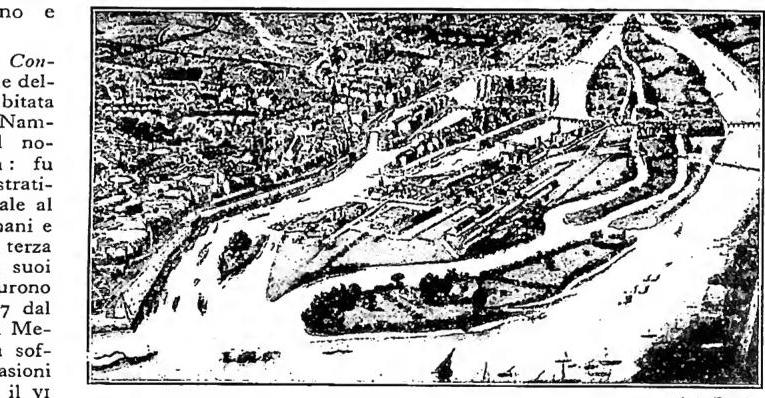
It is the ancient Condivicum, capital of Armorica, inhabited by the tribe of the Namneti, whence the name of the city: it was an administrative and commercial center in Roman times and formed part of Lugdunensis Tertia; its magistrates were driven out in 407 by the Breton Conian Meriadec. It suffered from invasions during the 5th and 6th centuries. In 560 Clotario I entrusted its administration to Bishop Felice. The Normans occupied it in 843. After Salomone, king of the Bretons, was assassinated in 874, the Duchy was reconstituted in 936 by Alano Barba Torta, who drove out the Normans. Pietro di Dreux made N. the capital of his Duchy, fortified it, and defended it in 1214 against Giovanni Senza Terra. In 1342 the duke of Normandy occupied N., taking Giovanni di Montfort prisoner there. The city was unsuccessfully besieged by Edoardo III of England in 1345. Anna di Bretagna, on marrying Carlo VIII in 1491, brought him the Duchy as her dowry. In the 15th and 16th centuries N. was struck by epidemics. In 1598 King Enrico IV signed the famous “Edict of N.” concerning relations between French Catholics and Calvinists. In the 17th and 18th centuries it was a center of conspiracies; in 1789 it took part in the Revolution. N. was severely damaged by aerial bombardments in 1943 and 1944.
The catalogue of its bishops is given by five collections: the two of S. Albano (Aubin), the first extending to Gualtiero (1008-41), the second to Roberto (1170-85); that of the cartulary of Quimperlé; the collection of Roberto di Torigny, which extends to Bernardo (1148-69); and the great chronicle of Tours, which also includes Stefano de la Bruère (1213-1227). L. Duchesne recognized in the cartulary of Quimperlé traces of an older redaction contemporary with Bishop Adelardo. First on the list is s. Claro, followed by Emius (?) and Similiano (mentioned by Gregory of Tours [*In gloria martyrum, 59]), who had a church dedicated to him there from the time of Clodoveo and is commemorated in the Hieronymian Martyrology on 16 June; Eusebio, who took part in the Council of Tours in 461; Nonnechio, at that of Vannes; Epifanio, at that of Orléans in 511; Eumerio, at those held in the same city in 533 and 541 (his epitaph was composed by Fortunato [Carmina*, IV, 19]); Felice (549-82), descended from an illustrious family originating in Aquitania that had produced consuls and prefects of the praetorium, attended the Councils of Tours in 567 and Paris in 573; after 565 he dedicated the Cathedral and had many works carried out in the city. In more recent times, mention may be made of Cardinal Roberto Guibé in 1507; Cardinal Giovanni di Lorena, apostolic administrator between 1542 and 1553; Carlo di Borbone (1550-54); Mons. Cospeau (1621-36); J. P. Duvoisin (1802-13); and A. L. Laroche (1893-95).
The martyrs of N. were the holy brothers Rogaziano and Donaziano, whom the Hieronymian Martyrology commemorates on 24 May. Rogaziano is said to have been martyred while still a catechumen, because of the sacerdotis absentia fugitiva, according to the Passio (BHL, 2275); the basilica of the two martyrs is mentioned by St. Gregory of Tours (In gloria martyrum, 59), who also points out, in the territory of N., a basilica dedicated to the Milanese martyr St. Nazario (ibid., 60), in vico quodam, today St-Nazaire, a subprefecture of Lower Loire.
The Cathedral, built of white stone, is dedicated to the apostles Peter and Paul. Begun by his predecessor, Bishop Felice completed it around the year 567. Venantius Fortunatus, who was Felice’s guest at his villa on the Loire, dedicated a poem to the grand basilica with its three naves
(photo Rory)
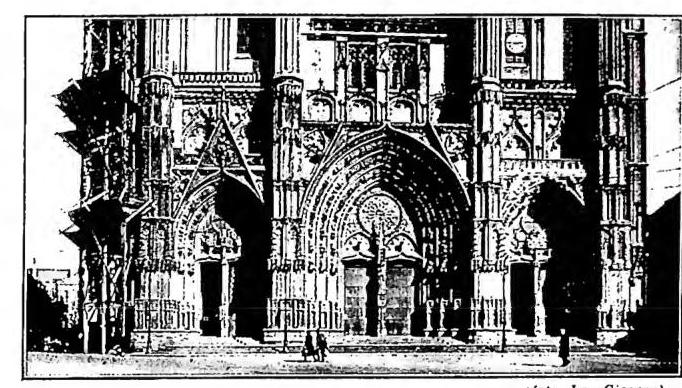
Duke Giovanni V began the Gothic cathedral in 1434, following the designs of Mathelin Rodier; the whole was completed only between 1840 and 1893. It contains the tombs of Francesco II of Brittany (d. 1488), of his second wife Margherita di Foix, of Arturo III, duke of Brittany, and of General Lamoricière ([v.] 1806-61). The portals depict episodes from the lives of the apostles Peter and Paul and of the holy Donaziano and Rogaziano. The Cathedral suffered greatly from the bombardments of 1944, in which the sacristy, the Library, and the Chapter Archive burned. Along the southern side of the Cathedral stands the Chapter house known as the Piallette, dating from the 16th century and now used as a museum of religious art. The nearby St-Pierre gate contains a “Musée de N. par l’image,” with a collection of iconographic documents relating to the history of the city and its architectural transformations. Excavations carried out near the Cathedral brought to light two pools, identified as two successive baptisteries, belonging to the ancient church of St. John, known in the 9th century (A. Cahour, Découverte du baptistère primitif de la cathédrale de N., in Bull. de la Soc. archéol. de N., 1876, p. 273 ff.; G. Durville, Les fouilles de l’évêché de N. en 1910-11, in Bull. archéol. du Comité des travaux histor., 1912, pp. 222-64; L. Maître, Observations sur les fouilles de la cour de l’évêché et de la porte St-Pierre, in Bull. de la Soc. archéol. de N., 1913, pp. 469-99).
Other churches of N.: that of S. Similiano; the present church occupies the same site as the primitive one beneath it, and had three naves divided by four columns on each side; more than 150 tombs, superimposed in three layers and consisting of sarcophagi of stone or limestone or of slate slabs, have been found there; the upper layer had been devastated (L. De Lasteyrie, Les fouilles de St Similien de N., in Bull. archéol. du Comité des travaux histor., 1896, pp. 500-11; L. Maître, L'église de St-Similien de N., in Bull. de la Soc. archéol. de N., 1896, pp. 174 ff.); that of the Immaculate Conception, founded in 1460 by Duke Francesco II; that of S. Croce, founded on the ruins of a pagan temple (the three-naved interior dates from 1685, as does the portal; the choir dates from 1840); that of Notre-Dame-de-Bon-Port or S. Luigi (with a dome), built between 1844 and 1858; that of S. Anna, on the hill of the Ermitage; and that of S. Nicola, erected in 1844 in the Gothic style. In the suburb of N., in the cemetery of S. Donaziano, stands the church of S. Stefano, near which many superimposed limestone sarcophagi were identified. Among the sanctuaries venerated in the diocese, those in N. itself include Notre-Dame-du-Bon-Secours and, in the church of S. Similiano, Notre-Dame-de-la-Miséricorde; in the church of S. Similiano, Notre-Dame-de-la-Miséricorde; a
Orvault, Notre-Dame-de-Bon-Garant. L'abbazia di Melleray, fondata da Alano di Maidon nel 1145, prima dei Cistercensi e dal 1817 dei Cistercensi riformati, ha la chiesa del sec. XII con facciata del sec. XV e coro del XVI (Cottineau, II, col. 1813). Un cimitero merovingico con otto sarcofagi in pietra bianca e due con lastre di ardesia si rinvenne durante gli scavi del 1910-13 sotto l'antico episcopio a nord della Cattedrale; uno dei
sarcofagi era decorato con una serie di croci; nell'interno si raccolsero monete di Carlomagno, di Ludovico il Pio e Carlo il Calvo. Diciotto sarcofagi violati d'età merovingica furono scoperti nella cappella di S. Andrea (G. Durville, Les cercueils mérovingiens de la chapelle de St-André, in Bull. de la Soc. archéol. et hist. de N., 1923, pp. 47-94).
L'antica residenza dei duchi di Bretagna fino dal sec. XIV, imponente fortezza gotica e del Rinascimento, accoglie oggi i musei di arte decorativa e d'arte popolare regionale. Il Museo Dobrée (1820-95), inoltre, contiene una ricca raccolta di archeologia, di pittura, di arazzi, di smalti e di manoscritti miniati; quello municipale « des Beaux Arts », costruito nel 1893, raccoglie una ricca serie di quadri delle varie scuole flammunghe, italiane e specialmente francesi dai primitivi al sec. XIX. È incrementato dalla locale « Société des Amis du Musée ».
BIBLI. Eubel, I, pp. 355-56; II, p. 198; III, pp. 252-53; IV, p. 252; G. Menier, Essai sur l'hist. de la ville et du comté de N., Nantes 1872; J. Lallié, Le diocèse de N. pendant la Révolution, ivi 1883; B. Maitre, De la forme et de l'âge des premières églises chrétiennes dans la Loire infér. in Bull. archéol. du Comité des travaux hist., 1893, p. 30 seg.; G. Boyle, The Irish College in N., Londra 1901; L. Maitre, Les substructions du chevet de la cathédrale de N., in Bull. archéol. du Comité des travaux histor., 1906, pp. 261-81; L. Duchesne, Faites épisc. de l'ancien. Gaule, II, 2e ed., Parigi 1910, pp. 360-71; G. Durville, Les familles de l'évêché de N. (1910-13), supplém. al Bull. de la Société archéol. de N. et de la Loire infér., 1913; M. Du Halgaut, N. Ses relations commerciales avec les îles d'Amérique au XVIIIe siècle, Parigi 1940; A. Durand, N. dans la France de l'Ouest, ivi 1941; Guide de la France chrétien. et missionn., 1948-49, ivi 1948, pp. 365, 652-46, 1065-68. Enrico Josi
equality of civil rights, access to all offices, participation in schools and charitable institutions, the right to receive donations, and special guarantees in the Parlement of Paris and, in part, in the other parlements and in legal proceedings. Moreover, they were entitled to retain under their control for eight years the towns, fortresses, and castles that they occupied in 1598, approximately 150, appointing their governors. Thus the Reformed, in addition to being a religious sect, constituted a political party: a state within the state. It is therefore unsurprising that the Edict aroused the protests of the Holy See and the opposition of the parlements, which the sovereign succeeded in overcoming; but he was unable to overcome the factionalism of the Reformed, who, after his death, continued to hold political assemblies, although these were expressly forbidden to them, and also to organize militarily in 1670 with the support of England, fomenting conspiracies and revolts. Forced to surrender the places they held, they barricaded themselves in Montauban and La Rochelle, from which Louis XIII drove them in 1628. However, the Edict of Grace (Nîmes, July 1629) that followed, although it reduced the political importance of the Edict of N., still recognized the free exercise of Reformed worship with a view to their peaceful conversion. Cardinal Richelieu in fact thought that he would succeed in this, while as early as 1629 they were seeking help even from Spain. And since their seditious agitation and relations with foreign powers showed no sign of ceasing, Louis XIV in 1661 adopted a repressive system toward them, intended to accompany the work of persuasion carried out by the most distinguished ecclesiastics, such as Bossuer, Bourdaloue, and Fénelon. The ordinances on the matter worsened the condition of the Reformed from year to year, until the notorious dragonnades were reached. These consisted in forcing the Reformed to lodge passing troops in their homes and in turning a blind eye to the excesses the troops might commit, in the hope that this would lead to the conversion of the most obstinate, in view of the harassment to which they were subjected. This method, begun in 1681 in Poitou and Béar, was extended in the following years to other regions as well, despite the protests of many Catholics. The number of conversions obtained was exaggerated, and certainly not all of them were sincere.
(photograph La Cigogne)
NANTES, DIOCESI di — Detail of the façade of the Cathedral (15th century).
As such measures followed one another with increasing frequency, Protestantism was practically eliminated from the official life of the country, and the assembly of the clergy had no further request to make except that the few surviving concessions to the Protestants be prohibited. The king’s final resistance was overcome by the united efforts of his confessor, Fr. La Chaise, the archbishop of Paris, Madame de Maintenon, who had become the king’s wife, and the chancellor Michel Le Tellier, who prepared the text of the revocation, which the king signed on 18 Oct. 1685 and the parlements registered four days later.
By this act he prohibited the exercise of Reformed worship, ordered the destruction of the temples, and commanded the pastors to leave France within 15 days. Other ordinances then followed, intended to prevent the Reformed from leaving France and to restrict the new converts to observance of the precepts of Catholicism. Many Reformed preferred to take refuge abroad, and their number is estimated at 200,000, causing undeniable harm to French industry and commerce; not a few enlisted in the armies of France’s enemies and of their allies. The decree of 1685 was generally received favorably by the French, perhaps mindful of the Huguenots’ abuses, and, although subsequently mitigated, remained in force until 1789, when the Reformed were placed on an equal footing with the other citizens.