
BATTISTERO. – The word is used by Pliny the Younger with the meaning of a bathing pool (Ep., II, 17, 11), and is likewise employed in the same sense by Sidonius Apollinaris as a synonym for piscina (Ep., II, 2: PL 58, 473). The deacon Filippo baptized the minister of Queen Candace in the water he found along the route they traveled together (Act. 16, 13–45); s. Giustino writes that Baptism is administered in a place where there is water (Apol. I, 61: PG 6, 420); so too Tertulliano (De corona, 3: PL 2, 79)
(phot. Deconelot)
BATTISTERO - B. with mosaic revestment (6th century). Tunisia, Sbeitla.
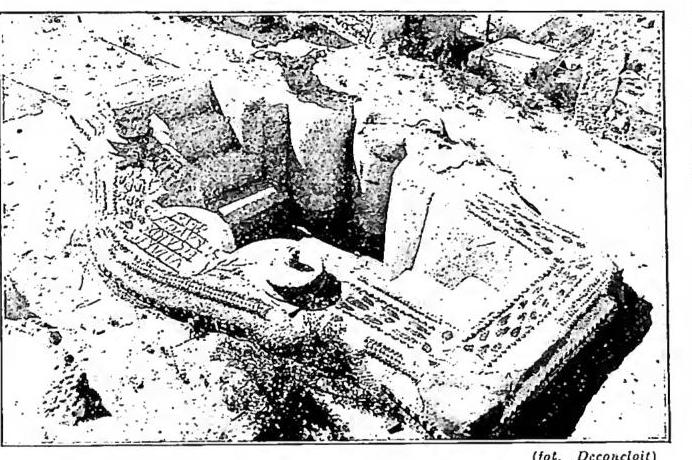
The essential use of water in the administration of the Sacrament inspired the architectural forms of public or private thermal buildings, without any uniformity, but rather with the greatest variety; there were therefore b. with central, circular, pentagonal, hexagonal, or octagonal plans, in the form of a Greek cross, with vaulted or domed roofs, but all alike containing in the center of the room a pool 70 to 75 cm deep, into which one descended by means of steps and where the water flowed from above, from lambs, deer, the jaws of a lion, etc.; at the bottom of the basin was an opening for the outflow of the water.
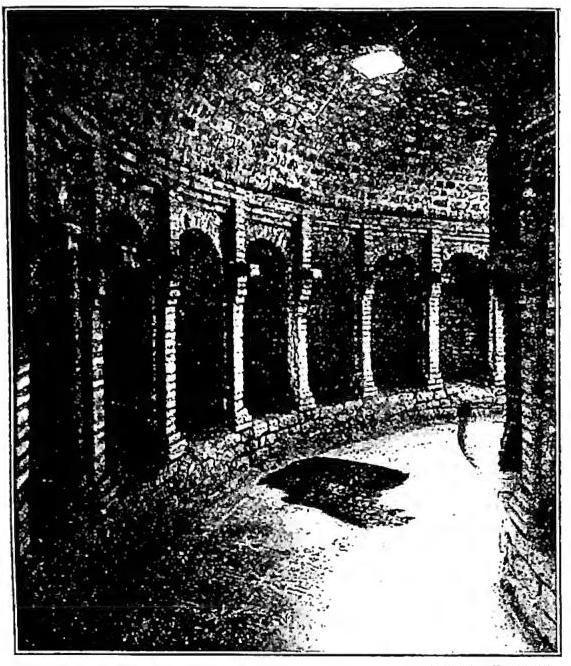
Sometimes a balneum with pools for the bathing of catechumens before the ritual immersion was attached to, or adjacent to, the b., as shown by the examples discovered at Fréjus and Marseille in France, or at Gentilah and Timgad in Roman Africa, or by those attested in documents for Rome and Ravenna (v. BAGNI).
The oldest known b. Europa (v.) in Mesopotamia, dating from before A.D. 256. In a few isolated cases, the b. was located within the basilica itself, as, for example, in St. Peter’s in the Vatican and in S. Crisogono.
In Rome there are, in addition to the monumental b. of the Lateran (G. B. Giovenale, Il battistero lateranense nelle recenti indagini della Pont. commissione di archeologia sacra,
(progr. E. Josi)
BATTISTERO - B. with ambulatory (6th century) - Gemilah.
The chronicles of the bishops of Naples mention a baptisterium fontis maioris and another fontis minoris, the former S. Giovanni in Fonte near S. Restituta (G. Stuhlfauth, Das Baptisterium S. Giovanni in Fonte zu Neapel und seine Mosaiken, in Reinhold Seebergs Festschrift, II, Berlin 1930, pp. 181–212), the latter near the Stephania (erected by Bishop Stefano).
At Nocera dei Pagani, the large columned rotunda contains an octagonal pool; in Calabria, at S. Severina, the rotunda likewise has a ring colonnade (P. Lojacona, Il b. di S. Severina, in Boll. d'Arte [1934–35], pp. 174–85).
At Milan, the basilica Baptisterii, south of the new basilica near S. Tecla, dates from the time of s. Ambrogio; it was called sanctus Johannis ad fontes or fons S. Theclae. From Ennodio, the b. of S. Stefano is known; in the Middle Ages, that of S. Giovanni was used for men, the other, of S. Stefano, for women. A notable group of b. of the Riva S. Vitale type is found in many places in Lombardy (F. Reggioni, Dieci b. lombardi minori dal sec. V al sec. XII. I monumenti italiani. Rilievi raccolti a cura della R. Accademia d'Italia, I, Rome 1935). At Albenga and Ventimiglia, the octagonal form is found (G. De Angelis d'Ossat, I b. di Albenga e di Ventimiglia, in Boll. delle R. Deputazioni di Storia patria per la Liguria, 1936).
At Ravenna, two b. are preserved: the one erected beside the Cathedral by Bishop Neone (ca. 458), and the one of S. Maria in Cosmedin, built by the Arians under Teodorico. At Cividale, the b. dated from the time of Patriarch Callisto (737), while at Aquileia it had 5 steps in the pool. At Parenzo, the octagonal b. with hexagonal pool is, like the Cathedral, the work of Bishop Eufrasio (ca. 530); at Salona, too, the b. was octagonal, with a square pool.
Southern France offers a series of ancient b. of great architectural importance, with rows of columns supporting the vaults or dome, as at Aix in Provence, Angers, Baptiste, Fréjus, Le-Puy, Marseille, Riez, and Saint-Rémy. The pool is hexagonal at Lemenc
(Chambéry); square at Aire sur l'Adour; in the form of a Latin cross at Grenoble in S. Lorenzo; and cruciform at Montcaret (Dordogne).
In Spain, the b. of Calahorra was erected, according to the testimony of Prudenzio (Perystephanon, 8), on the site of the martyrdom of the ss. Emetero and Celidonio. Gregorio di Tours records that in a city of Portugal there was a sumptuous b. in the form of a cross, richly faced with marble (De gloria martyr., I, 24: PL 71, 725).
In Albania, the b. at Butrinto is round; in Greece, the one at Navarino is octagonal with porticoes; in Jerusalem, the pilgrim of Bordeaux already saw in the 4th century the balneum behind the basilica of the Anastasis, where infantes lavantur (P. Geyer, Itinera Hierosolymitana, Vienna 1898, p. 23). Recently, a round b. was discovered at 'Ajn el-Ma'mūdūjch near Hebron (A. M. Steve, Le désert de Saint-Jean près d'Hebron, in Revue Biblique, 53 [1946], pp. 547–75). In Syria, a series of b. is now being studied by J. Lassus, Sanctuaires chrétiens de Syrie, Paris 1947, passim.
Eusebio mentions the supplementary buildings of the basilica of Tyre in Phoenicia for those who must be purified in water and in the Holy Spirit (Hist. Eccl., 4: PG 20, 808).
In Egypt, in the Byzantine basilica of Abū Mīnā, the b. is quadrilateral on the exterior and octagonal within; at Luqsor it has an apse and a truncated-conical basin; at Medamūd it has a round basin. Examples of b. in Roman Africa are extremely numerous, from Carthage to Uppenna, from Scefetula and Hammām el-Lif to Tebessa, from Gemilah to Tigzirt, from Tipasa to Castiglione, from Timgad to Annonna, etc. They display the most varied forms, with a tegurium supported by four columns and rich mosaic decoration.
Enrico Josi
DECORATION OF EARLY CHRISTIAN BAPTISTERIES. — The rites of ancient Christian initiation exerted an influence not
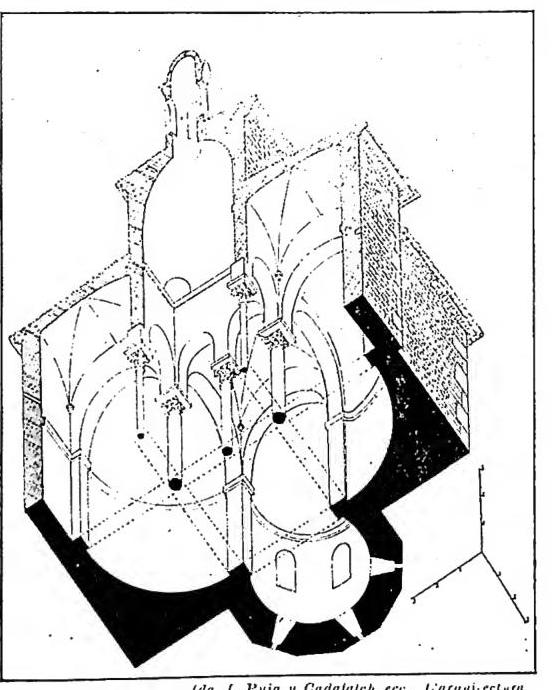
(from J. Puig y Cadabira et al., L'arquitectura románica a catalunya, Barcelona 1909, p. 286) BATTISTERO - B. of Tarrassa (9th century). Axonometric perspective.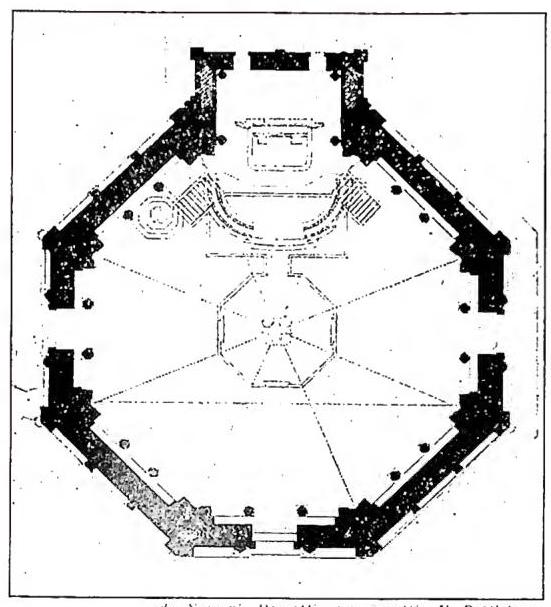
A simple comparison between the iconography of the b. of Dura Europos and that of S. Giovanni in Naples is sufficient to show how, despite the fact that the two monuments are more than a century and a half apart, they draw upon an almost identical iconographic repertoire: the starry sky, the Good Shepherd, and a selection of biblical scenes, some of which allude to the great Paschal event, the Resurrection, and others to the waters of Baptism. At Naples one also finds scenes with Eucharistic significance and the Traditio legis, while the monogrammatic cross illumines its sky, recalling both the illuminatio and the consignatio in the name of Christ. It is noteworthy that, whereas basilicas and martyria prefer the cross as the centre of the starry sky, the b. often inscribe there the monogram of Christ. The final figures belonging to this primitive repertoire are the Apostles and the Evangelists, as continuators of Christ’s work.
The themes supplied by the further development of baptismal iconography likewise follow the same ideological line: the deer at the spring, the acanthus, the crosses, the divine Lamb, the doves, the tree of life, the four altars with the books of the Gospels, the Baptism of the Lord, the crowns and thrones awaiting them in paradise—all allude to one of the fundamental concepts already present from the beginning. The negative aspect of Baptism, that is, the remission of sins, so often recalled in inscriptions, is rarely mentioned. Attention was directed much more toward the positive aspects of illumination, sealing, and regeneration, which vie with the concepts of peace and refreshment. With the passage of time, as at Ravenna, the most notable themes would be combined into a firmly constructed whole, in which hieratic and liturgical intentions achieve their full effect.
THE B. FROM THE SEVENTH CENTURY ONWARD - The architectural forms of centrally planned buildings used predominantly for b. and which, from the early Christian period to the seventh century, had evolved through a process involving simplification in relation to the models of classical architecture and the assimilation of certain essential values—above all, the values of illumination—of Eastern art, assumed new inflections in some Italian regions precisely between the eighth and ninth centuries. This occurred especially in northern Italy, that is, in those territories where, on the one hand, ancient models were less pressing and Eastern influences less direct, while, on the other, contacts with central Europe—already then in the full ferment of cultural and spiritual life—were more vigorous. Thus, while in Calabria the b. of S. Severina, near Catanzaro (eighth century), with a domed vault divided into segments resting on eight columns and counterbalanced by the vault of the ambulatory, repeats a Byzantine architectural scheme that had no further development among us, in northern Italy those forms were gradually being elaborated which, in the ninth-century b. of Agliate and, later, in those of Biella and of the Pieve di Galliano near Cantù, which dates from the eleventh century, genuinely anticipate the forms of the Romanesque age. These latter buildings are still centrally planned, with a dome resting on plastic masses clearly articulated on the exterior, while inside there is a sense of a rhythmically enclosed space within complex yet logical stone forms. Indeed, here in Italy during the Romanesque period, especially in the north, the numerous b. took up and developed the same architectural themes that had previously appeared in the buildings mentioned, with that greater freedom and self-assured skill in posing and resolving even difficult problems of structural technique that are characteristic of the period.
Nevertheless, some b. of the Romanesque age also develop fairly simple themes, such as that of a polygonal hall, sometimes with projecting niches or apses, covered by a dome. This is the case at Lenno (Como), at Novara near the Cathedral, at Ventimiglia, and especially at Cremona. Here, however, the broad pointed dome gives a sense of spaciousness, while the arches of the first order and the windows of the two upper orders suggest a theme that certainly derives from more complex models. That is, from those buildings—in our case, always b.—in which the structures were divided into two concentric spaces by columns or pillars, sometimes surmounted by galleries; the dome then rested on the walls of the central space, which at Cremona seem to have been pushed back toward the perimeter wall. B. built between the eleventh and twelfth centuries, with colonnades, matronea, or small galleries, are found at Arzago, Agrate Conturbia, and Asti, where the b. is octagonal, with a central space covered by a dome resting on a high drum supported by massive columns with characteristic cubic capitals.
In the b. of Concordia Sagittaria (Verona), which is a centrally planned building with small apses, Byzantine elements are combined with those more characteristically Lombard.
Of particular interest for the history of architectural forms are also the b. near the cathedral of Ascoli Piceno, consisting of a lower cubic element and an octagon concealing the dome, and, the most famous of all, the b. of Florence. This octagonal building (with a «scarsella», or rectangular space, opening in the wall opposite the door
of Ghiberti, called the Gates of Paradise, which in 1202 replaced an apse) is unquestionably a very ancient building, erected over Roman structures. Nevertheless, apart from the remains of the Roman constructions, what can be seen in it today does not appear to predate the Romanesque period, nor have the excavations conducted even in recent times entirely clarified the building’s earlier appearance. Here the marble inlay covering, both exterior and interior, is admirable, as is, inside, the mosaic decoration of the vault of the “scarsella” and of the dome, a work of the thirteenth century, as well as the baptismal font of 1371, which replaced Dante’s. And this is to mention only in passing the marble-inlaid pavement, the monument to the antipope Giovanni XXIII by Donatello and Michelozzo, and the three famous doors, that of Andrea da Pontedera and the other two by Ghiberti. The b. of Pisa, begun in 1153 by an architect named Diotisalvi, has two domes, one fitted inside the other. The exterior decoration, to which Giovanni Pisano also contributed, was continued during the fourteenth century; inside, the font is the work of Guido Bigarelli (1245), while the pulpit was signed by the great Nicola Pisano in 1260. The octagonal b. of Volterra, begun in 1283 by a certain Giroldo da Como or Lugano, is also still Romanesque in character (the dome is sixteenth-century); octagonal but Gothic in form are the b. of Pistoia, begun in 1337 by Cellino di Nese to a design by Andrea Pisano, and that of Parma, begun during the twelfth century and covered during the thirteenth with a very slender pointed-arch dome having highly pronounced ribs. Characteristic of Parma is the exterior decoration with superimposed arcades, while the thirteenth-century pictorial decoration inside, with representations of the Old and New Testaments, is particularly beautiful. The b. of Siena Cathedral, on the other hand, is housed in a building that forms, as it were, the crypt of the Cathedral, serving as the base for its extension on the side of the apse. It arose during the fourteenth century. Inside is a rectangular hall divided into three naves by two piers, with ogival vaults and a polygonal apse. The hexagonal font is a creation of Iacopo della Quercia, but various sculptors collaborated on it in complete harmony, among them Donatello and Ghiberti. It is one of the masterpieces of Tuscan sculpture at the beginning of the fifteenth century.
With the fifteenth century, the practice of constructing separate baptismal font (v.) disappears altogether. Now that even the memory of Baptism by immersion has been lost, the font, having become a basin surmounted by a water reservoir, is placed in a chapel almost always near the entrance to the church, or simply in one of the side aisles—sometimes set against a wall or pier, sometimes raised somewhat above the floor in the middle of the aisle itself, or beneath one of the arches separating it from the central nave. Thus, for example, in Orvieto Cathedral, where the baptismal font consists of a red-marble basin supported by eight crouching lions, a work begun in 1390 by Luca di Giovanni Senese, continued by Pietro di Giovanni da Friburgo and a certain Cristoforo Teutonico, and then completed by Iacopo di Pietro Guidi in 1403, while the octagonal pyramid, surmounted by a statuette of the Baptist, is signed and dated by Sano di Matteo.
Since the baptismal font was placed inside churches, the spaces housing it have not differed architecturally from the other chapels, all the more so because, many times, the same b. contains an altar and the font is not placed in the center of the space. Thus the character of the space is essentially determined by that of the fonts (v.).
Among the b. of the Baroque period, famous is that of the Basilica of S. Pietro in Rome, designed by Carlo Fontana, with the font formed by a porphyry basin that had once served as the lid of the sarcophagus of Ottone II in the ancient Vatican basilica. The gilded-bronze cover is the work of Fontana himself (1698).
Interesting for its unified character is the chapel used as a b. in the Basilica of S. Maria in Trastevere, the work of Filippo Raguzzini and later renovated in the time of Benedetto XIV. Sometimes the b. is housed in a contiguous though distinct space, as in the Basilica of S. Maria Maggiore, in a rectangular hall near the antechamber to the sacristy, designed by Flaminio Ponzio (1605), which had formerly been the canons’ choir. The font, consisting of a porphyry basin adorned with gilded metalwork and a statuette of the Baptist, was executed to a design by Luigi Valadier in the time of Leone XII. The paintings on the vault are by Passignano, while the Assumption on the altar is the work of Pietro Bernini (1606–11).
The architectural theme of the b., by virtue of the basin placed at the center of a relatively small space, offers modern architects very considerable possibilities for elegant solutions.—See Plates LXVI–LXVII.