
VOLTERRA, DIOCESE of. – A city in the province of Pisa, in Tuscany, and a diocese comprising parts of the provinces of Pisa, Livorno, Grosseto, Siena, and Florence: it extends over 1,913 sq km, with a population of 113,600 inhabitants, all Catholics; 112 parishes, 140 diocesan priests, and 22 religious priests; it has one seminary, 5 male religious communities, with a total of 26 members; and 34 female communities with 275 members (Ann. Pont. 1953, p. 491).
Leaving aside legends that do not withstand even the most benevolent criticism, V., a very ancient and celebrated Etruscan city, was an episcopal see in the second half of the 5th century, as documented by a letter of Pope Gelasius I (492–96; MGH, Auct. antiq., XII, p. 389 n. 2), and was fully organized with its movable and immovable property – praedia mancipia – and with the presence of the archdeacon and the legal and administrative guardian. Among its bishops are Elpidius, who was in Rome in 501–502 (ibid., pp. 436, 454); Gaudentius, during the time of Pelagius I (558–60); Peter under Stephen V (886); Roger under Paschal II (1105–15) and Callistus II (1119–24); and Galgano under Eugene III (1151) and Adrian IV (1154–59).
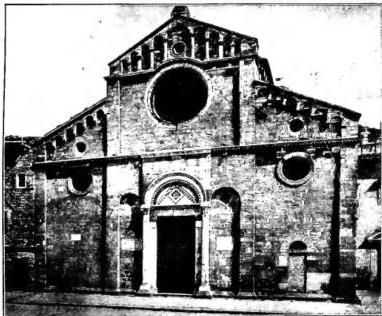
(Alinari photograph)
VOLTERRA – Façade of the Cathedral, rebuilt in 1254.
In the Middle Ages the bishops, counts, and princes of the Holy Roman Empire also exercised civil jurisdiction; the earliest information dates from 821; by imperial privilege they minted coinage. Characteristic of the period was the existence of a Universitas Cleri, that is, the corporation of the diocesan clergy, including the exempt clergy, established in 1265 and still active in 1454.
Another statistical account dates from 1596: 49 pieves, no longer parish churches, 223 churches with pastoral care, 44 sine cura, 15 in ruin, 24 oratories, and 23 hospitals; in addition, the monasteries: in V. S. Girolamo (1445), a House of Benedictine nuns (1548–1821), the Capuchins (1573–1922); subsequently, the Piarists (1711–1935), where the young Mastai Ferretti, later Pius IX, was educated; and also the Capuchins in Peccioli. When the pieve of Colle d'Elsa was made a diocese in 1592, V. immediately lost 80 parish churches; then in 1782 another 52, including the celebrated castle of S. Gemignano.
Among the notable figures, only the saints need be recalled. Apart from s. Lino, successor of s. Pietro and principal patron of the diocese, whom tradition says was from Volterra, there were Antonio of Monticiano, Vivaldo of S. Gemignano, Galgano of Chiusdino, Giacomo of Montieri, hermits, Attinea and Greciniana, and Bishop Ugo.
The Cathedral was always dedicated to the Virgin, and from the earliest parchments of the ninth century in the precious episcopal and canonical archives it is learned that it is S. Maria di mezzo ag.: the foremost civic feast, with economic and social characteristics and with a complete, most solemn liturgy of the first class and an octave. It was consecrated on 20 May 1120 by Pope Calliato II. The façade, attributed by G. Vasari to Nicola Pisano, is rather the work of Pisan architects. The interior has three naves divided by monolithic columns with sixteenth-century capitals; the pulpit is from the thirteenth century, restored with bas-reliefs depicting episodes from the Old and New Testaments; on the left portal, a terracotta bust of s. Lino by Giovanni della Robbia; the arch of s. Ottaviano by Raffaele Cioni of Settignano. In the principal chapel are two angels bearing candlesticks by Mino da Fiesole. The octagonal Baptistery (1283) is the work of Girolamo di Jacopo da Como or Lugano; on the exterior it has alternating isometric layers of white and green marble; the portal is Romanesque; the ciborium is by Mino da Fiesole, made in 1467–71; until 1590 it stood in the Duomo. The church of S. Michele has a Romanesque façade inspired by those of Pisa. The church of S. Francesco has a fresco dated 1410 by Cenni di Francesco di ser Cenni, depicting the Rinvenimento della S. Croce. One kilometre from V. S. Girolamo, from the fifteenth century with later alterations, containing two terracottas by Giovanni della Robbia dated 1501 and a panel by Benvenuto di Giovanni bearing signature and date, 1470, with the Annunciazione and, above, the Eternal Father, as well as ss. Michele, Caterina d'Alessandria, and the donor. The Guarnacci Museum was begun with the collection of can. P. Franceschini: it took its name from the munificent mons. Mario Guarnacci (1701–85), who donated his rich collection to the Municipality in 1781. It contains one of the most remarkable collections of Etruscan art, including more than 600 cinerary urns from the third century B.C.
The Municipal Picture Gallery in the Palazzo dei Priori is rich in works by Tuscan painters. Particularly noteworthy are the panel with the Annunciazione by Luca Signorelli, dated 1491; the Redentore in Gloria by Domenico Ghirlandaio, with ss. Benedetto, Romualdo, Attinia, and Greciniana, and in the right-hand corner the donor, Abbot Buonvicino; the wooden Deposizione della Croce by Rosso Fiorentino, from 1521; and the Presepio by Benvenuto di Giovanni (1470).
The Guarnacci Library has more than 30,000 volumes, 500 manuscripts, and 233 incunabula. The Municipal Historical Archive contains documents dating from 907 and manuscripts dating from 1219; the Statuti are particularly valuable; it also has a rich numismatic collection.
In the Piazza Maggiore stands the thirteenth-century Palazzo dei Priori, with the coats of arms of the Florentine commissaries; and the Palazzo pretorio, with the tower known as that of the Porcellino, from the sculpture at its summit. At S. Dalmazio, between Pomarance and Larderello, there remain the ruins of the pieve and of the Romanesque church with Gothic elements. In the parish church there is a Robbian tabernacle. At Silano stands a grand fortress of the bishops of V., which had a triple circuit of walls and a polygonal keep. At Monteverdi marittimo are the ruins of the abbey of S. Pietro in Palazzolo. The ancient pieves of Cellori and Ghianni d'Elsa are celebrated.
From its origin the diocese of Volterra was and remained, by privilege, a Roman province and therefore immediately subject to the Holy See. Pius IX united it with Pisa and, in compensation, granted the privilege of the pontifical pallium. – Vedi tav. CLV.