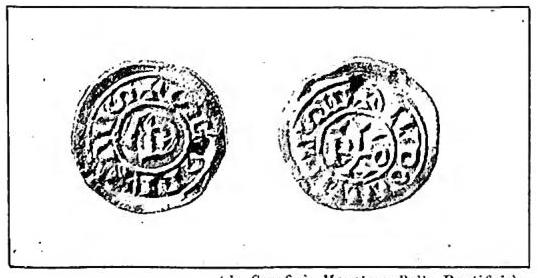
ADRIANO IV, POPE. — He is the only Englishman to have ascended the papal throne; his name was Nicola Breakspear, and he was the son of Roberto, a cleric of Bath.
Having failed to obtain admission to the monastery of S. Albano in his homeland, he went to France and studied in Paris, although he was in extremely poor financial circumstances. He subsequently became a canon regular of S. Rufo near Avignon, and in 1137 became prior of the house and perhaps later its general abbot. But he was denounced in Rome and had to go there to justify himself; Eugenio III kept him at his side, having recognized his fine personal qualities, made him cardinal bishop of Albano, and in 1150 sent him as a legate of the Holy See to the Scandinavian countries to reorganize the ecclesiastical hierarchy there. The mission was fully successful, and Nicola also brought back many offerings for S. Pietro; thus, shortly after his return in 1154, Anastasio IV having died in December, he was elected Pontiff on 4 December under the name of A. IV.
The conditions of the city of Rome were at that moment extremely troubled, because Arnaldo da Brescia held sway there, inflaming the people with classical memories and inciting them against papal rule; acts of violence frequently occurred, and a cardinal had even been wounded. A., who held a lofty conception of papal rights, placed the city under interdict in order to compel it to expel Arnaldo, but the Senate refused to yield. The people, however, unwilling to renounce the celebration of reli-