
ADRIANO (Imperator Caesar Traianus Hadrianus Augustus), ROMAN EMPEROR. — Publius Aelius Hadrianus was born at Italica (in Baetica) in A.D. 76 of a distinguished family; he was Trajan’s cousin and was adopted by him as his son. Cultivated and courageous, he combined the fruits of Greek and Roman civilization in a fine synthesis, but was dissolute, egoistic, and ambitious. During his reign (117–38) he undertook many inspection tours throughout all the provinces of the empire, providing for the defense of the frontiers through grandiose works; he reformed the administration, rapidly directing the State toward absolutist forms and diminishing the importance of Rome in favor of the provinces. Among his artistic constructions, the Mausoleum (today Castel S. Angelo) and the villa at Tivoli deserve mention.
A determined adversary of Judaism, he waged a harsh three-year war against the Palestinian insurgents led by Simon Bar-Kökhebâh (132–35); he built a temple to Jupiter on the ruins of the Temple of Jahweh and founded a colony in place of the destroyed Jerusalem (Aelia Capitolina); no fewer than 580,000 Jews were killed, and severe sanctions were imposed on the others, very many of whom were sold into slavery. Toward the Christians, on the other hand, he showed tolerance: following Trajan’s example, he replied to a magistrate, C. Minucius Fundanus, proconsul of Asia, that anonymous denunciations should not be acted upon and that no one should be condemned unless there was a specific offense. This act, reported by St. Justin (I Apologia, 68) and recalled by Melito (cf. Eusebius, Hist. eccl., IV, 26, 10), and subsequently reproduced by Eusebius (ibid., IV, 9), was at times considered a forgery, but its authenticity is now no longer doubted; through
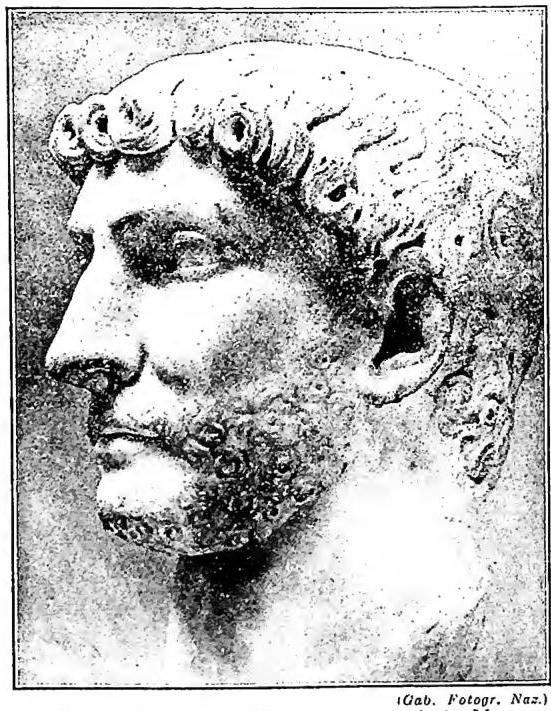
(Gab. Fotogr. Naz.)