
TRAJAN (M. Ulpius Traianus), ROMAN EMPEROR. — Born in Italy, modern Santiponce near Seville in the province of Baetica. He was the first emperor not born in Italy, and the liveliness with which Cassius Dio notes this fact shows how it must have been greeted with satisfied pride by the Roman citizens of the provinces. Spain, moreover, was one of the regions most thoroughly permeated by Latin civilization.
Trajan preferred the hard service of the military camps to honorary and lucrative offices, and for ten years he was tribune on various frontiers of the Empire. Having then begun his civil career, he was praetor under Domitian, commanded legions, and later governed Upper Germany. While performing these duties, he received news of the assassination of Domitian, the elevation of Nerva to the throne, and—altogether unexpectedly—his own adoption and the consequent assumption of a kind of co-regency which the elderly Emperor, who had always lived amid legal studies, had deemed necessary to remedy his own lack of military experience (AD 97).
Trajan, however, neither then nor when Nerva died shortly afterward, interrupted his work on the German frontier, with roadworks, fortifications, and shrewd agreements with independent tribes, ensuring the tranquility of that dangerous border. Thus, when in the summer of AD 99 he deemed it necessary no longer to delay his entry into Rome, he was able to withdraw a third of his troops from the Rhine frontier, and for more than a century no military expeditions were needed in those regions, while flourishing centers of civil life arose almost up to the border lines.
Equally fruitful in good results were the early years of his reign spent in Rome. Having restored cordial and sincere relations of collaboration with the Senate, swept away the noxious weed of informers, and promoted public welfare not so much through free distributions of grain as by securing, through every kind of provision, an increase in production and a lowering of prices, and by initiating great public works—especially roads and harbors—the peace reigned supreme and beneficial over the entire vast Empire. Original was one of the remedies adopted against the decline of morals and the reluctance to have children despite the abundance and tranquility of life. Two large inscriptions found, one near Parma and the other near Benevento, inform us about what were called the alimentary institutions. By these, Trajan allocated substantial sums from the imperial treasury to be lent at low interest to landowners in Italian cities, devoting the interest to the support of poor boys and girls in the city. The principle and the method of the institution were doubly beneficial, for they not only aided needy families by helping them educate their children but also provided capital on favorable terms to small private landholdings.
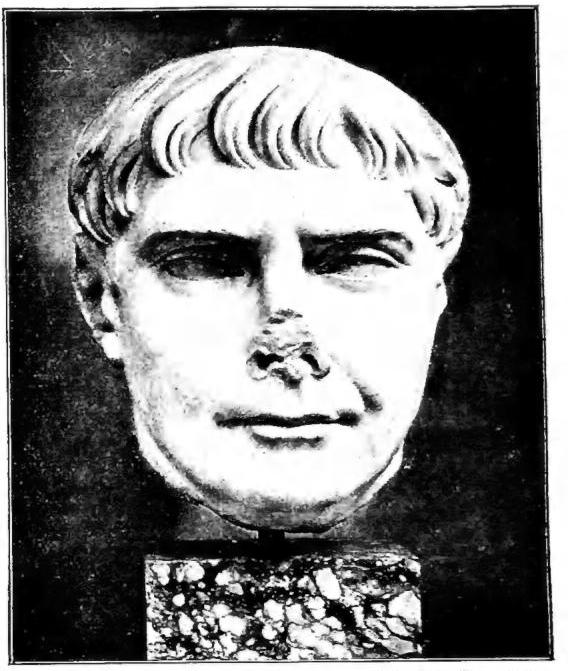
(photo Gab. Fot. Naz.)
TRAIANO, ROMAN EMPEROR - Portrait (1st half of 2nd century). Ostia, Museum.
In these works there is a notable spirit of sincerity and justice, which in the work of art sought a faithful, truthful illustration, far removed from any bombast or exaggeration, generous and chivalrous towards the vanquished, full of nobility and humanity. Immediate and fervent effort was devoted to the organization of the new territory: the daring wooden bridge thrown across the Danube during the war was replaced with a stone construction, large masses of colonists were brought into the new province, roads were opened, and cities were founded. In a few years, Trajan succeeded in creating in eastern Europe a Latin civilization, just as Julius Caesar and Augustus had founded it in the West. And so vivid and profound was the imprint of Romanitas that centuries of stormy events have not sufficed to erase II.
Trajan had to deal with another universal force, contrasting with the Empire in certain respects: Christianity. In this matter, he did not rise above the suspicious and hostile conceptions of his predecessors, but in the repression he sought to remain within the limits of equity and decorum. A precious document regarding Trajan’s conduct and attitude toward Christians is preserved in the famous letter of Pliny, governor of Bithynia, and in the reply from the imperial chancellery (v. PLINIO IL GIOVANE).
One last grave problem remained: that of the eastern frontier, burdened by the Parthian Empire, heir to the once vast Persian Empire. For two centuries, Rome and Parthia had clashed in Armenia, Cappadocia, and Syria, and the aged Emperor deemed it his duty to confront this problem now with the full strength of the Empire. He had already succeeded, through his legate Cornelius Palma, in reducing Arabia to a province, thus tightening the grip on the Parthians from the south and opening to the Romans a new commercial outlet on the Red Sea to the east of the peninsula.
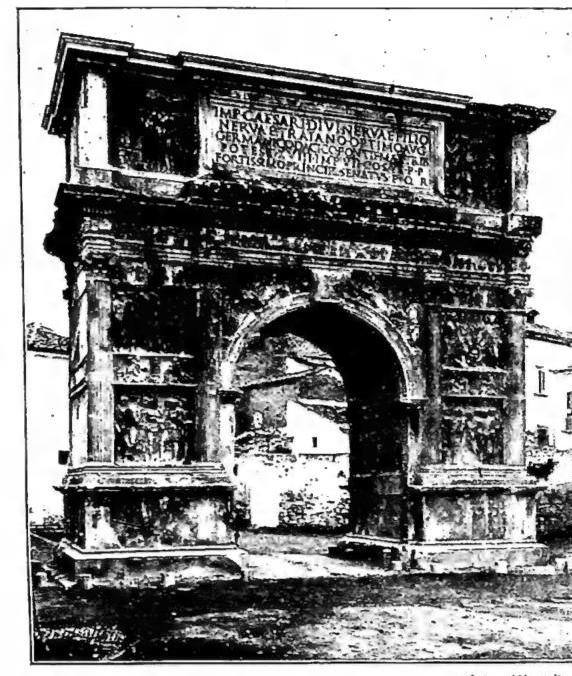
TRAIANO, ROMAN EMPEROR - Arch of T. - Benevento.
Physical exhaustion and moral disillusionment triumphed over his robust constitution, and at Selinus in Cilicia, probably struck by an apoplectic fit, Trajan died almost suddenly (September 117). The three new provinces he had created beyond the Euphrates were immediately abandoned by his successor Hadrian and were never again reconquered by Rome.