VANDALI. – A population of Germanic stock, according to the earliest references (Pliny, Nat. hist., IV, 99; Tacitus, Germania, 2 and 43), settled on the shores of the Baltic between the Elbe and the Vistula. From there, apparently moving upstream along the Oder, in the 2nd century A.D. they advanced as far as the Danube, that is, into contact with the Roman “limes.” When the barbarian pressure against this frontier became more intense and urgent, the V. Marcomanni, fighting alongside them, and were checked by Marcus Aurelius, only later to return to peace with Rome, which regarded them as its protégés in the peace negotiations conducted by Commodus with the Marcomanni in 181.
They were divided into two principal groups: the Silingi and the Hasdingi, each with its own king. Later they were granted permission to settle in Dacia on the condition that they provide two thousand cavalrymen. Under the reign of Caracalla they were at war with the Marcomanni (Dio Cassius, LXXVII, 20), and, in their restlessness, some of them moved upstream along the Danube toward the Rhine frontier, where they were fought by the emperors Probus and Maximian. Constantine assigned them lands in Pannonia, but half a century later, driven on by the Huns, they were once again on the Rhine. Favored by Stilicho, who belonged to their stock, and even more by the almost complete absence of Roman troops summoned to Italy for the invasion of Radagaisus, they crossed the Rhine and invaded Gaul (406), which they were able to ravage and plunder with impunity. After several attempts checked by the mountain populations, they invaded peaceful and prosperous Spain, which until then had remained almost untouched by barbarian devastation. Suebi and Alans also descended into Spain, and while the Suebi and the V. Hasdingi settled in Gallaecia and the Alans in Lusitania, the V. Silingi occupied Baetica, from which they left the name Andalusia. And the exhausted Roman Empire accepted the situation in 411, recognizing the invaders of Spain as federates. Disputes and conflicts were not lacking among them or with the Visigoths who arrived later; but through these struggles the V. state in the southern part of the peninsula became more firmly consolidated than ever, thanks also to the intelligence, energy, and cunning of King Genseric (v.). He turned his eyes toward the nearby provinces of Africa and urged his people to take to the sea, soon giving rise to a naval power that for decades dominated the western Mediterranean.
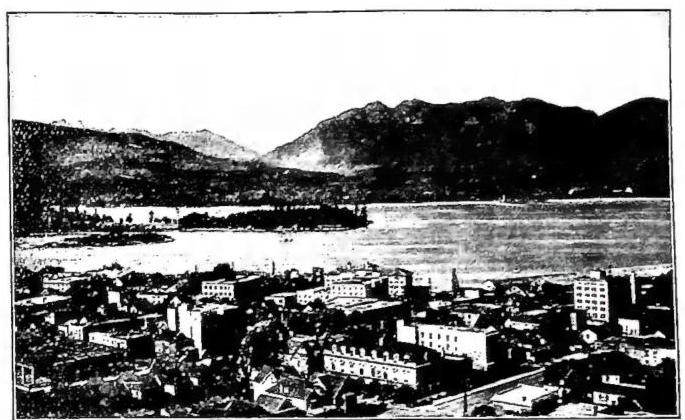
(of L. Hamilton, Le Canada, Berlin 1916, plate 121)
VANCOUVER, ARCHDIOCESE OF – Panorama of the city.
After Valentinian III was assassinated in 455, Genseric found an excellent opportunity to appear in force before Rome, where he entered without a fight and spared the city neither depredation nor plunder, especially to the detriment of Catholic churches and patrician houses. He departed after fourteen days, taking with him, in addition to the bulk of the booty, Valentinian’s widow Eudoxia, together with her two daughters and many senators and men of consular rank. Repeated Roman embassies secured the release of the Empress and her daughter Placidia, while the other daughter, Eudocia, was given in marriage to Huneric, son of Genseric, who naturally demanded an enormous dowry. Attempts at military expeditions by the emperors Majorian and Leo I of Constantinople against the V.’s intolerable arrogance had no happy outcome; and they gave the diabolical Vandal a reason to resume his savage acts of piracy in full force along the Mediterranean coasts, to establish his dominion over the Balearic Islands, Sardinia, Corsica, and part of Sicily, and to return to a policy of persecution against Catholics, who were suspected because of their devotion to Rome. Genseric eventually succeeded in concluding friendly treaties with the two emperors, Zeno of the East and Romulus Augustulus of the West, and with Odoacer, who had brought the Western Empire to an end. With his death (477), the power of the V. declined. His immediate successors, the incompetent Huneric, his son (477–84), and Godamund, his grandson (484–96), continued the policy of persecution against the Catholics, a policy that weakened their state, while the ancient vigor of the Vandal people simultaneously declined, enfeebled by the African climate and by the excesses permitted by their undeserved prosperity. Some revival of energy occurred under King Thrasamund (496–523), who remained very close to the Ostrogoths of Italy and to Theoderic, whose daughter he had married. At the same time, however, the dangers arising from the unrest of the barbarian tribes of the interior grew more serious; these tribes won notable victories on two occasions. The new king Hilderic attempted to reach agreements with the Empire of Constantinople, but found no support among his people, especially not from a great-grandson of Genseric, Gelimer, who succeeded in deposing him and holding him prisoner after having blinded him. This event gave Justinian the desired opportunity to intervene. And the expedition entrusted to Belisarius succeeded brilliantly. Aided by a rebellion of the Sardinians
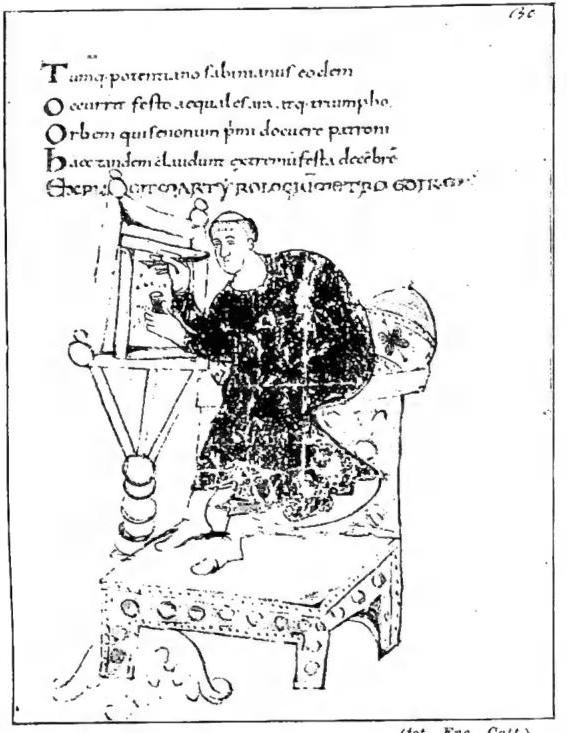
(photo: Enc. Cutt.)
VANDELBERTO DI PRÜM – Explicit of the Martyrologium metricum. The miniature depicts the monk V., in the act of writing his work – Vatican Library, cod. Reg. lat. 438, f. 30° (9th–10th centuries).