
TACITO, CORNELIO (Cornelius Tacitus). — Historian, born around 55 A.D. (at Terni?); praetor under Domitian, consul in 97, died in 120 (cf. Tacitus, Histor., I, 1; Annal., XI, 11; Agric., 45). He was a great friend of Pliny the Younger, who in several of his letters (I, 6, 20; II, 1, 11; IV, 13; VI, 16, 20; VII, 20, 33; VIII, 7; IX, 10, 14) describes his character.
He wrote the Dialogus de oratoribus, wrongly denied to him, in which the causes of the decline of Roman eloquence are discussed; De vita et moribus Iulii Agricolae, his father-in-law (98 A.D.), whose expedition in Britain and dignity of character he extols; De origine et situ Germaniae (98), which is the earliest source of information on the German nation, its character, and its political constitution; Annales and Historiae, conceived by T. as a single history in 30 books, from the death of Augustus to that of Domitian. Of the Historiae, which extended over 14 books, there remain the first four and half of the fifth, from Galba to Domitian (69-96); and of the Annales, which ran ab excessus divi Augusti to Nero and comprised 16 books, the first four, part of the fifth and sixth, and the fragmentary books 11-16. His intention of carrying the narrative as far as Nerva and Trajan remained unrealized (Agr., 3; Hist., I, 1; Ann., III, 24). His historical work proceeds according to the annalistic method. A profound psychologist and austere moralist, faced with the evils afflicting his age, which seem even graver to him when he compares them with the virtues of the past, his patriotism cannot refrain from lamentation and a pessimistic view of the future. An impartial and truthful writer, he has a vigorous style, at times obscure through excessive concision, but full of animation and pictorial colour, certainly the most original in the whole of Latin literature. T. believes in the divinity presiding over human events, while nevertheless regarding it as indifferent to men’s good or evil actions (Ann., IV, 1; XIV, 2; XVI, 33; Hist., I, 3). His fortune and fame, dormant during the Middle Ages, revived during Humanism and the Renaissance.
T. AND CHRISTIANITY. — T.’s judgment of Christianity is hostile, as is evident from his description of the fire of Rome on 19 July 64, which devastated the Circus Maximus, the commercial district of the Velabrum, the Forum, and the Carinae. He reports that, according to the opinion of the historians from whom he draws, without naming them, in accordance with his practice when they are in agreement (cf. Ann., XII, 20, 3), the fire was accidental or was attributed to Nero’s perfidy (forte an dolo principis incertum); and he clearly emphasizes how the suspicions of the citizenry weighed upon Nero, to divert which the Emperor substituted the Christians’ name for his own (subdidit reos). But he demonstrates
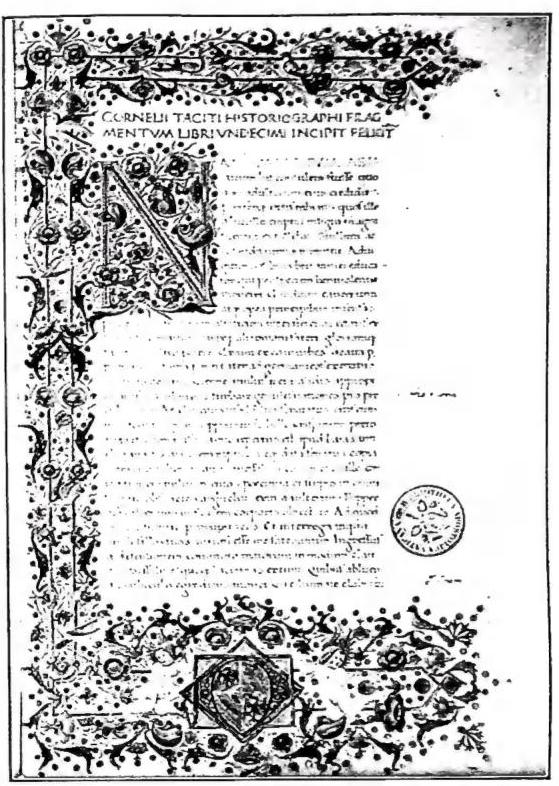
Although hostile to Christianity, his integrity as a historian not only prevents him from explicitly accusing them, but also suggests that the true culprit in the disaster was Nero.