
MIDDLE AGES. – Term used in the historiography of European civilization to denote the centuries between antiquity and the modern era.
I. HISTORY.
SUMMARY:
I. The value of the term
II. Chronological limits of the Middle Ages
III. Characterization of the Middle Ages
IV. Romano-Germanic relations
V. The role of the Church and the Papacy
VI. The Empire
VII. Monasticism
VIII. The Church’s struggles for freedom
IX. The expansion of the Church
X. Church and Empire
XI. Culture
XII. New spirit and new horizons
XIII. Art.I. THE VALUE OF THE TERM
The term has been consecrated by a now centuries-old tradition to indicate the period that, in the historical development of Romano-European civilization, lies between antiquity and the modern age. Already during the Renaissance, awareness emerged of the separation between classical civilization and its renewal, divided by an intermediate era marked by the ruin of the Roman Empire and of all ancient civilization, by the decline of letters and the arts, and by the invasions of barbarian peoples. Thus, between the splendors of Greco-Roman civilization and those of the Renaissance, the Middle Ages were judged not only as a transitional age but also as one of barbarism, ignorance, and darkness. This negative judgment was rejected by nineteenth-century historicism, which viewed the Middle Ages as an era full of spiritual and economic activities of the highest value, a time rich in laborious yet precious constructive effort, fundamental to the development of civilization. Therefore, the idea that the term Middle Ages could be used to indicate transitional and obscure periods within other civilizations (Egyptian, Japanese, etc.) must be rejected; such usage, determined by superficial and misleading analogies, is entirely inadvisable due to the errors and misunderstandings it entails.II. CHRONOLOGICAL BOUNDARIES OF THE MIDDLE AGES
The chronological boundaries of the Romano-European Middle Ages remain a subject of debate among scholars of so-called periodization, dictated by religious, political, or economic presuppositions. The German scholar Christoph Keller (Cellarius), who appears to have been the first to publish a Historia Medii Aevi in 1688, placed it between the age of Constantine and the Turkish conquest of Constantinople (313–1453), combining two dates of differing significance—one religious, the other political. In other periodization schemes, none of absolute value, the beginning is marked by the end of the Roman emperors in Ravenna (476), the Lombard descent into Italy (568, the start of the peninsula’s political fragmentation), or the triumph of Islam in the Mediterranean (c. 700). For the end of the period, the usual dates are Charles VIII’s descent into Italy (1494), the discovery of America (1492), the religious revolution of Luther (1517), or the Peace of Cambrai (1529).
Modern studies, however, have demonstrated the impossibility of admitting a clear break between the Middle Ages and the eras that precede and follow II. For Fustel de Coulanges, there is continuity between the imperial age and that of the Romano-barbarian monarchies; for Dopsch, the barbarian invasions do not interrupt the historical process of Germanism between Caesar and Charlemagne; for Pirenne, only in the 8th century did an economic revolution occur in the Mediterranean that would define the true Middle Ages—the age of natural economy, without outlets. Similarly, between the Middle Ages and the Renaissance, previously overlooked connections are now recognized, due to the characteristic religiosity of the Renaissance and certain medieval attitudes within II. Even the Catholic "Reformation" and the Lutheran "pseudo-Reformation" reveal vital links with the Middle Ages.
III. CHARACTERIZATION OF THE MIDDLE AGES – The problem of continuity is closely tied to the more serious question of a medieval era possessing its own distinct and unmistakable characteristics. For the study of the period reveals, at first glance, seemingly opposing and even contradictory aspects, as well as the succession of ages each with its own traits: the age of Romano-barbarian monarchies, the Carolingian Empire, feudalism, the communes, and the monarchies of a national type. Nevertheless, it seems undeniable that the medieval era, taken as a whole, possesses a unitary character: the close union existing within it between Roman civilization and the Christian religion, upon which the new faith comes to rest the
MEDIEVAL PERIOD - The towers known as «Garisenda» and «degli Asinelli» (12th century) - Bologna.
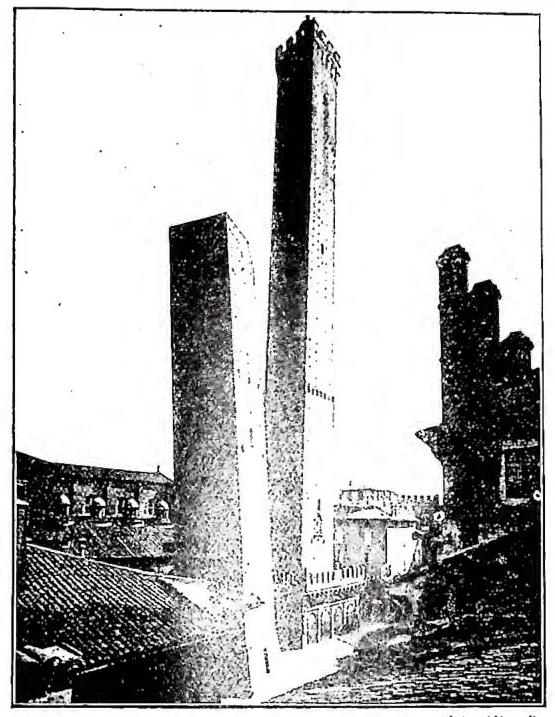
The unity of the Roman world persists in the medieval period, but it is no longer justified by the arms and law of Rome; rather, it is upheld by the new religion that transforms the old, vague ethical universalism of Stoicism into a new religious universalism springing from universal brotherhood in the love of God, the common Father. Christianized Romania overflows the imperial limes and tends to embrace all the barbarian peoples reached by the faith of Christ. In the period when the ancient and medieval ages still overlap (4th-5th centuries), Christianity presents itself as the quintessential Roman religion, the imperial religion that the Roman State supports and from which it receives support. Yet already a new halo of sub-Roman Christian civilization surrounds the old imperial world. In 476, the emperors of Ravenna, with their political organization in the direct tradition of Rome, disappear; now the great Roman capital of the East sees the eyes and minds of all Christian populations, Roman and barbarian, turned toward II.
The transition from the ancient to the medieval age is marked by the formation of this Constantinopolitan politico-religious schema: the ecclesiastical organization is contained within the framework of the imperial organization, just as the new Romano-barbarian political entities align themselves in the juridical and moral dependence on the imperial power of Constantinople. However, this Romano-Christian unity is undermined by the tendency of the barbarian kingdoms to assert their independence and by the formation of Arian national Churches, against whose opposition the effort of Emperor Justinian to reconstitute imperial unity is shattered. The consequence of this conflict
is the profound fracture that manifests in Romania in the 8th century: Byzantium stands opposed to Rome, Hellenism resists Latinity; alongside the Slavo-Byzantine world emerges the Latin-Germanic world, in which the Romano-Italian traditions of language, writing, letters, arts, law, and economy persist most strongly.
IV. ROMANO-GERMANIC RELATIONS
In this Romanized environment, Germanic populations live alongside Roman populations: they intermingle, but do not merge. Certainly, the barbarian invasions of the 5th century had great significance: Roman cultural centers were largely destroyed; the provincial peoples were deprived of the possibility of rising from the decay in which the Empire found itself through their own efforts, thus preventing the formation of a harmonious community of Roman and Romanized peoples. After the invasions, Romans and Germans coexist, tolerating one another while each people preserves its own laws and customs; they are united by the Roman economic system, which the Germans adopt without destroying or transforming II.Two opposing conceptions clash regarding the relations between the two races in the Middle Ages. Germanists assert that, faced with the decay of Roman civilization, only Germanic ethnic elements could bring that fresh and vigorous vitality to which whatever is alive and new in medieval civilization is owed. Romanists oppose this view, denying any Germanization: the Roman populations would have preserved their traditions of life and civilization; the invasions would not have led to Germanization but only to a barbarization, a return to the conditions of those who were no longer the Germanic peoples admired by Caesar and Tacitus, but merely the remnants of the long struggles that for centuries had ravaged the northern lands and had survived the storm of the Hunnic invasion. Currently, a more balanced judgment tends to prevail: the influence of Germanic elements would vary by region—strong in areas of little or superficial Romanization, less perceptible and even negligible in deeply Romanized areas.
Moreover, assessing ethnic contributions in a new and original civilization like the medieval one is difficult, if not impossible: ethnic differences gradually fade into a simple distinction of social classes; by the 8th century, in Italy as in Gaul, there are no longer victors and vanquished, but only landowners. Indeed, the Roman land organization persists: the Middle Ages, like antiquity, continues to be dominated by landed and military aristocracies over masses of coloni, serfs, and small landowners.
V. THE FUNCTION OF THE CHURCH AND THE PAPACY
In the levelling of peoples and classes, the Catholic Church fulfils a preeminent function through its centre, the Papacy, and the episcopate of the provinces. Crushed by the Arian Germanic monarchies, the various Churches of the West, rather than turning to Constantinople, rely on the Apostolic See of Rome, whose superiority now appears as a refuge and defence. Thus, Romanity and Catholicism come to correspond perfectly, distinguishing themselves both from Byzantine Romania and Arian barbarism: a new Roman unity takes shape in the West, the community of all peoples who venerate in the Pope of Rome the master of faith and the moral head. The apostolic tradition had already made the Roman See the guardian of the purest orthodoxy: as the holder of spiritual powers, it asserted itself as the inexhaustible source of a new life, animating and consoling populations deprived of the legal guidance of the emperors.This Western Latin Romania undergoes great transformations between the 7th and 8th centuries. Old imperial provinces such as Africa, Spain, Sicily, and Sardinia are overwhelmed by the Islamic wave; moreover, the Arian Churches of Italy and Spain disappear,
MEDIEVAL PERIOD - Hall known as • Dei Notari • (early 13th century) - Perugia, Palazzo dei Priori.
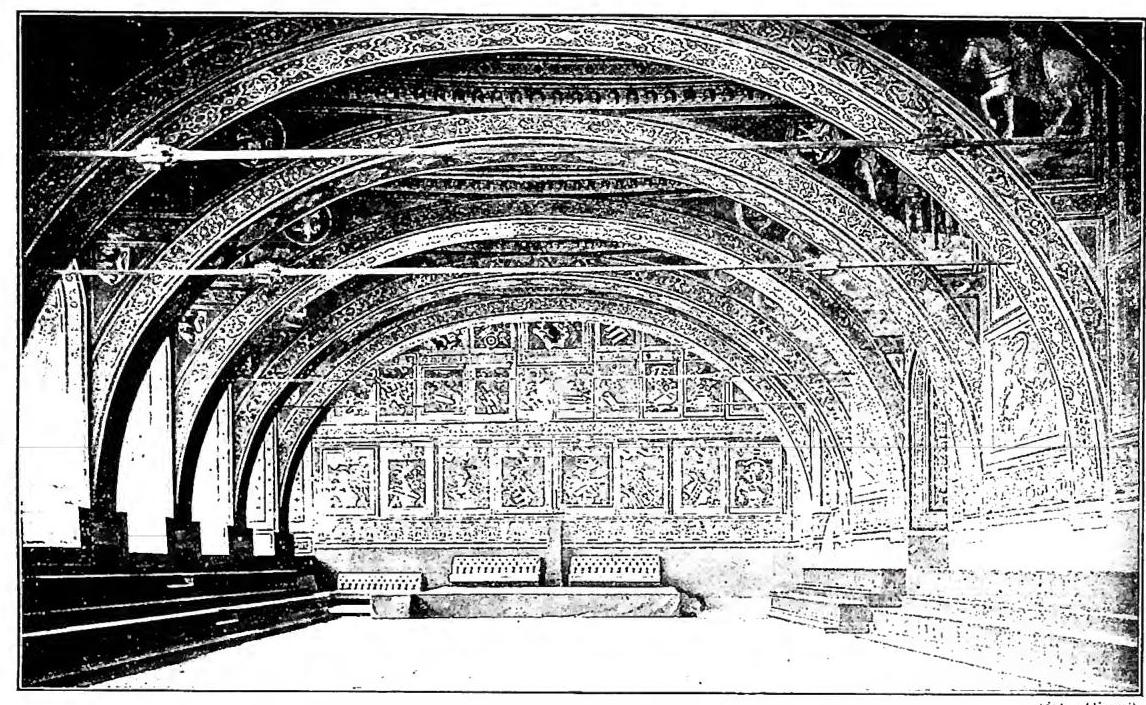
Thus emerges a new Christian world in which countries of Roman traditions and countries of Germanic traditions associate: a religious empire, a Res publica christiana, heir and continuator of the Res publica romana, foreshadowing the future Europe politically divided but morally united. The Roman Papacy dominates within it through its magisterium and spiritual powers, but later the insufficiency of public powers, the imperial concessions obtained from Constantine to Justinian—right of property, fiscal immunity, privilege of forum—lead it to exercise a preeminent political function in European society. This function was greatly strengthened by the formation of the temporal state in Rome, supported by the patrimonial wealth of the Roman Church, the moral and religious prestige of the popes, and their social and humanitarian activity. The hierocratic government that thus arises in Rome (to which the false "Donation of Constantine," composed between 750 and 760, will provide particular juridical foundation) becomes the basis and guarantee of the Catholic jurisdictional system and finds the impetus to extend its authority over all the countries that obey its bishops.
VI. THE EMPIRE
Under the shadow of this Roman religious universalism, the Christian Roman Empire of Charlemagne was established at the end of the 8th century. The Romano-barbarian political organizations, which had attempted to reconcile Roman legal conceptions with Germanic individualism, had indeed fallen: everywhere their inability to maintain internal organization and external defense had become evident.All the Roman and Germanic countries of the West became part of the vast territorial complex created by the Franks through arms: Charlemagne sought to justify his conquests by affirming a civilizing religious mission. The Carolingian Empire, despite the coronation in Rome on Christmas Day of the year 800, retained only superficial and vague Roman attitudes; it was instead the secular manifestation of papal Christian universalism.
The problem of the relationship between the two powers—civil and religious—already discussed in the post-Constantinian era, resurfaced. The dualistic principle of Gelasius I was reaffirmed: Church and Empire were the two aspects of the same political reality, for religious life and civil life were the two modes of being of social life. Yet above this dualism, the Church asserted the supreme necessity of the ordinatio ad unum: the ultramundane ideal, the supreme purpose of life and society, brought the apparent dualism to substantial unity. After the disappearance of Charlemagne and the inability of his successors to preserve his program, the Church claimed dominance over the Empire, which was to be reduced to purely ministerial functions, since the authority of princes and kings derived from the pope, vicar of Christ. The unity that the Empire had let slip away was gathered by the Papacy, and under Nicholas I, the prefiguration of Christendom as the 11th century would realize it took shape.
Charlemagne, for his part, opposed claims clearly Caesaropapist in nature, following the Byzantine Justinian tradition, but his successors failed to maintain this program in the face of the Papacy. Nicholas I proclaimed the papal mission as the supreme defense of peace and justice, and the Pseudo-Isidorian texts of the mid-9th century were later adduced as proof of the antiquity of this conception of primacy.
The Carolingian Empire collapsed, having lasted less than a century (800–888), without having succeeded in resolving the problem of the political organization of the Christian world or that of social order. The plurality of peoples associated within it corresponded to a plurality of national laws. The administrative organization of counties and marches of Merovingian origin had been unable to strengthen the structure of such a vast state. Order and social discipline were consequently entrusted to the formation and development of those personal bonds between the powerful and the weak upon which, in the 9th century, the feudal system was built. From the Frankish region where it first developed, this system spread to all the countries of Western Europe, assuming forms and characteristics conforming to local tendencies and needs. The feudal organization, though apparently a state of disintegration, was in reality a systematization and coordination of the fundamental social cells for the future political and economic formation of Europe; it was also a school of social discipline: observance of duties, inviolability of sworn commitments, loyalty in the execution of freely undertaken contracts.
With the fragmentation of the Carolingian Empire, its territories reunited into agglomerations centered around descendants of the great Emperor; France, Germany, Italy, and Burgundy formed dynastic units that foreshadowed the European monarchies of national tendencies in the subsequent era. Feudal life, with its dense development, obscured the authority and power of these dynasties but preserved their juridical value. From the 10th century onward, the Christian European world presented two characteristics that it would retain for several centuries: political disintegration and religious-moral unity through the work of the Catholic Church. The Empire indeed resurged through the efforts of the German Otto I in 962, but it now embraced only the Germanic, Italian, and—after 1032—Burgundian lands. The German emperors vainly aspired to resume the unifying mission of Christian society according to the Carolingian tradition.
Feudal disintegration, territorial monarchies, and the Romano-Germanic Empire constituted serious difficulties for the religious universalism defended by the Roman Church. Against these dangers, the Church began, in the 11th century, its most tenacious struggle. It fought for its freedom, for its independence from political organizations, from the feudalization that stifled it, and from the Germanic conception of the private Church that destroyed hierarchical bonds. The Church now possessed a great force: monasticism in a phase of renewal, which also sought to escape the bonds of feudal society.
VII. MONASTICISM
Monasticism, which arose in the Roman era as an affirmation of absolute evangelical spiritualization against the superficiality of mass-converted Christianity, preserves in the Latin Middle Ages, in the forms of Italian Benedictinism, all its fresh originality.Within the Catholic-Roman system, it performs a work of capital importance: not only does it serve the elevation of those who aspire to the sublimation of their own spirit, but through prayers and penances it attends to the formation of that treasury of graces which must be the basis of the eternal salvation of the community. A mystical function, yet in a certain sense already social: to this is added another, that of acting within European society through cultural, economic, and welfare activities. In this way, monasticism represents the deep penetration of faith into the masses, where the episcopal organization could only attend to a predominantly external disciplinary action (v. MONACHISMO). The new Benedictine congregations that arise from the 10th century onward—the Cluniacs first, then the Carthusians, and later the Cistercians—represent new attempts to preserve the faithful interpretation of the master’s rule while adapting to the spiritual and material needs of European society. Thus, St. Francis and St. Dominic would not hesitate to seemingly break the old rigid frameworks of ecclesiastical tradition, consecrating in new rules the Christian program of an exemplary social preaching, in which all the impulses of the youngest European generations resonate.
VIII. THE CHURCH'S STRUGGLES FOR FREEDOM
Meanwhile, monasticism permeates the entire Church with its spirit, imposing its own conceptions and its own program of spiritual freedom and independence, contrasting with the corrupting influences of the profane world and political society. This purer religious spirit drives the Church in the 11th century toward profound renewal. The movement is led by the Roman Papacy: the Dictatus Papae of Gregory VII, whatever its intended purpose,MEDIEVAL PERIOD - Allegories of the months of the year. Sculptures (12th century) - Ferrara, cathedral.
(fot. Alinari)
represents the program that the Roman Church intended to carry out to bring Christian society back to evangelical principles, as it interprets and implements them.
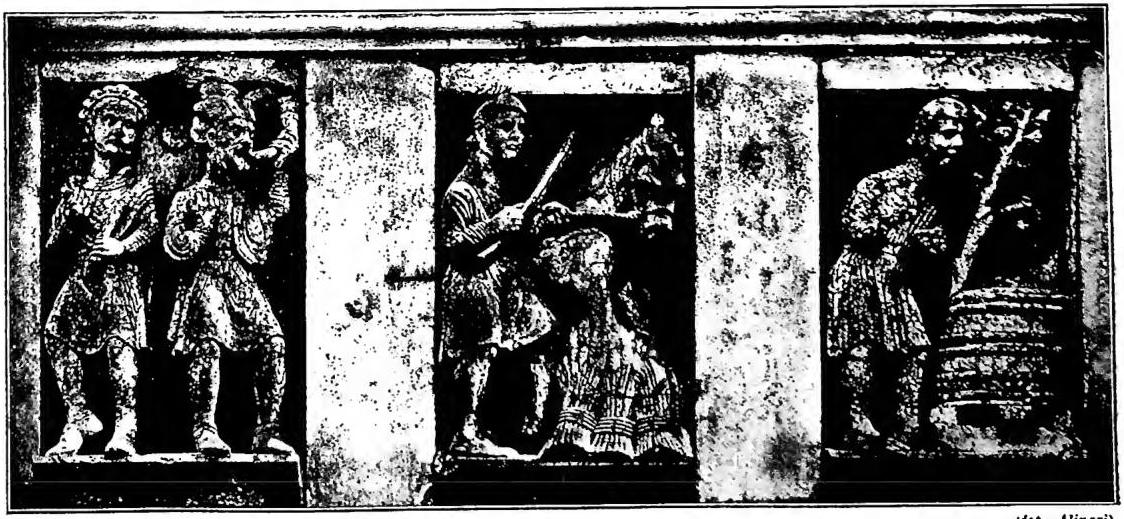
More arduous is the task of freeing the secular and regular clergy from the bonds of lay investiture. The struggle against such investiture is preached and intensified, as it is seen as the primary cause of simony and nicolaitism; the anti-Catholic conception of the particular Church is assailed; the Papacy frees itself, in the Roman Council of 1059, from all dependence on the Empire, then proclaims and imposes its theocratic principle in the serious struggle with Henry IV and Henry V. The Concordat of Worms (1122), however, showed the impossibility for the Church to abandon its ties with political organization through the feudal institution: European society remained faithful to the tradition of the dual religious and civil character and demanded the preservation of bonds between Church and State, giving rise to new conflicts between them for superiority and dominion over the world. Through new struggles with the Empire, the Roman Papacy in the 12th century directs its action toward the complete submission of all manifestations of social life to religious principles: its ideal is the absolute fusion of the Church and political society, that is, the realization in worldly life of the Civitas Dei.
To this end, the solemnly proclaimed theocracy must serve; the most important means is the administration of spiritual goods; the communion of the faithful is the same as civil society; whoever withdraws from the authority of the Church is deprived of the enjoyment of charisms and finds himself at once outside the Church and society. Such is the function of the system of excommunications and interdicts. Within this framework lies the struggle against any theory that distorts orthodoxy; the presence of heretics in a region is a danger of disintegration for the episcopal organization and consequently for civil and state life.
Heresy is first combated by local religious and civil authorities, then a centralized inquisitorial organization arises, generally entrusted to the two new religious Orders: the Franciscans and, even more so, the Dominicans, while civil power limits itself to a purely ministerial function (secular arm) based on imperial constitutions (Frederick I, Frederick II) that rely on ancient Justinian legislation.
The awareness of having to defend the justice of God and social peace justifies the Church in its program of substituting for deficient state organisms in the necessary work of repressing the anarchy resulting from feudal private wars. From the episcopal organization, already invigorated by the monastic spirit, comes the search for means of pacification, consecrating immunity from all war offenses not only for ecclesiastics but also for the weak (widows, orphans, pilgrims, merchants) with the "Peace of God," and suspending war operations during certain periods of the year with the "Truce of God."
Thus, the humanization of war is sought by imposing on combat the defense of persons and religious principles, establishing a religious and moral code of chivalry to which war is presented only as the defense of truth and justice.
IX. THE EXPANSION OF THE CHURCH
The Church, however, is concerned with directing the fervor of the faithful toward the cause of spreading the Faith. Recovering the territories lost in previous centuries due to the Islamic revolution is the program proclaimed in the 11th century and synthesized in the Crusade for the conquest of the Holy Sepulcher (1099); but this is accompanied by struggles to curb the expansion of Muslims in the Italian islands and the Iberian Peninsula. Meanwhile, efforts intensify for the conversion of the Scandinavian populations in the north and the Slavic peoples of Eastern Europe; the German episcopate, supported by the Germanic feudal nobility, attends to this task; a hierarchical episcopate directly dependent on Rome arises; monastic Orders such as the Cistercians spread their religious-economic system. The boundaries of Roman Catholicism expand to those that will become the limits of modern Europe. The Crusades in Syria, however, fail, from which the Latin element is entirely expelled before the end of the 13th century (fall of Acre: 1291); the only outcome is the overthrow of the Byzantine Empire (Fourth Crusade: 1204), but in the Balkan regions, papal hegemony is fleeting, as it disappears with the progressive withdrawal of Latin dominations; yet the revival of Byzantine civilization under the Paleologi is also short-lived, as they vanish before the triumph of the Ottoman Turks (fall of Constantinople: 1453).With the collapse of the military and conquering framework of the Crusades, however, what remains is their fundamental idea: the propagation of the faith, carried out through the peaceful missions that Franciscans and Dominicans begin under the direction of the Papacy in the Asian continent around the mid-13th century. The preaching of the Gospel from Mongolia to China, and even to Japan, seems by the end of the 13th century destined for great success and relegates the problem of the Holy Land to a secondary position.
X. CHURCH AND EMPIRE
By the end of the 13th century, under the guidance of the Roman See, that civil Europe which would endure until the modern age had fully taken shape: it was composed of three groups of peoples—Neo-Latin, Germanic, and Slavic—who drew from the spirit of Catholicism the primary elements of their religious and moral life. The fruits of that Christian-driven Romanization of the masses, which had occurred before the year 1000, were now evident. Every region, every city was the center of its own vigorous and distinctive activity. While the Church preserved Latin as its official language and supported a Latin literary activity fundamentally continuing the classical tradition, everywhere—as a manifestation of this vitality—new vernacular languages were forming; in the 12th century, literary activity in the vernacular emerged in various areas, the first assertion of the nation slowly taking shape; it became richer and more substantial in the 13th century.While the Holy Roman Empire failed in its program of political unification of the Christian world and was reduced to a mere juridical institution of scant practical importance—contested even in the theoretical sphere—old and new feudal dynasties became the initiators and organizers of vast state entities: France, England, Scotland, Portugal, Aragon, Sicily, Hungary, Bohemia, Poland, Denmark, Sweden.
The Roman Church, while combating the Empire over its domineering claims, favored the rise of territorial monarchies, which it nonetheless sought to bind to itself with feudal ties; by virtue of the ratio peccati, it asserted the right to intervene as the supreme tribunal in conflicts between monarchs, replacing its judgment—based on religious and moral concepts—with the crude conception of the ordalia (judgment of God), upon which the justification of medieval warfare essentially rested.
The Christian unity of Europe reached its period of greatest splendor in the first half of the 13th century, between the pontificates of Innocent III and Innocent IV. This was the moment when the Papacy decided the fate of the Empire between Philip of Swabia and Otto of Brunswick; it elevated Otto IV and then deposed him, elevated Frederick II and then excommunicated him, deposed and replaced him, destroyed the Swabians and succeeded them in Sicily, while fostering a new imperial schism in Germany that fatally undermined the prestige of the Holy Roman Empire.
XI. CULTURE
Under the auspices of the Roman Church, Christian cultural life reaches its highest peaks in that half-century. After the collapse of Roman learned society during the age of barbarian invasions, culture, books, and education had found refuge in monastic schools and later in cathedral schools; the educated class had become identified with the clergy. In the 12th century, the great Studia of Bologna and Paris were formed, and in the following century, universities encompassing the various faculties multiplied: alongside Roman law, canon law now emerged, alongside theology, philosophy and the arts. The Church protected these great centers of learning, considering them a manifestation of its own vitality: in the 13th century, culture was still distinctly ecclesiastical. At the University of Paris, Franciscan and Dominican masters, inspired by the dominant principles of their Orders, introduced new and fruitful methods, concepts, and sentiments.Yet the attempt to gather all forms of European social life within the ambit of the Church was fleeting: it vanished even as it was being realized. While the Church had admitted, with due reservations, the study of Aristotelian thought, and St. Thomas Aquinas represented the reconciliation of ancient thought with Christian thought—so much so that he may be considered the highest culmination of the triumph of the Roman Church—already in St. Thomas’s own age, the second half of the 13th century, culture tended to become secular, passing into the hands of an educated class that lived outside the Church. From the University of Bologna, knowledge of Roman law spread throughout Europe, just as from Paris the new Aristotelian philosophy, freed from patristic tradition, spread; and the union of these two influences formed the theoretical basis of late medieval European society. A new class of jurists, in the service of feudal monarchies, sought to free them from the bonds of the Christian conception. A new formula now arose: Rex in regno suo est imperator. Every prince thus possessed, within his kingdom, the same prerogatives of absolute sovereignty that Roman tradition attributed to the emperor; thus, the Aristotelian naturalism taught by the neo-Aristotelians led to the assertion of the State’s complete autonomy in its activity and ends from any religious presupposition. These new conceptions came into sharp conflict with the demands of the Church as a universal religious and moral organization, as the regulator of all political activities to guide them toward the ultimate ends of human society. The European monarchies, armed with this new thought, were induced to reject any dependence on the Church, to confine within the framework of their political interests all the moral and economic activities of their subjects. This is the meaning of the conflict between Philip the Fair and Boniface VIII, which ended with the defeat of the Papacy (Anagni, 1303), on the very morrow, one might say, of the publication of the bull Unam Sanctam (1302), which was the most solemn and absolute proclamation of papal theocracy. On the other hand, the struggles between Clement V and Henry VII, between John XXII and Louis the Bavarian, represent the dissolution of medieval politico-religious universalism in its two antithetical forms, the Papacy and the Empire.
Freed from ideological political superstructures, Christian universalism nonetheless remained the pivot of European society in its religious essence. It was even strengthened by the Franciscan religious movement, which appealed to the inexhaustible source of love and piety in the Christian faith, softening what was still angular and harsh in the old episcopal organization, which necessarily retained its connections with worldly interests, fiefs, and monarchies. Now that religious and civil society were becoming absolutely distinct and growing ever more distant, and that the Papacy’s relations with the monarchies were loosening, Franciscanism, by resuming in the realm of sentiment the work of popular penetration abandoned by the old monastic orders—too isolated from the world—performed an action of the greatest importance.
XII. NEW SPIRIT AND NEW HORIZONS
The last two centuries of the Middle Ages, from the mid-13th to the mid-15th century, present a Europe already entirely transformed. The economic environment displays a most lively activity. Great commerce opens new routes across the continent; all regions are renewed in their local economic life, opened to European commercial movement; where once there was the small market and the barter economy, now one re-enters the framework of commerce based on money. Merchants from Lombardy and Tuscany, those from Flanders and the Hanseatic cities, transport goods throughout Europe; their trades mark the beginning of banking organizations and money exchange; the appearance after the mid-13th century of the Florentine gold coin (florin) and later the Venetian one (ducat) transforms the European market; Christian economic conceptions of the just price and the prohibition of profiting from money—MEDIEVAL PERIOD – Statutes of the Mercanzia. Illuminated codex of the 14th century – Siena, Municipal Archive.
the borrowed money gave way to the great natural law governing the relationship between supply and demand: a new economic life emerged, fostering the development of the modern bourgeois spirit—skeptical, selfish, and quintessentially anti-Christian. Soon, the echoes of this new life would also be felt in national literatures, to the detriment of religious and moral influences.
By the 14th century, feudal and communal atomism had already disappeared, giving way to nations that found expression in the vernacular that had prevailed among all dialects, representing the aspirations and interests of an ever-widening range of regions. These new nations supported the great monarchies, which rapidly perfected the central and peripheral organs of government, employing noble and bourgeois elements indifferently, for the principle of seeking technical competence now dominated. Across the continent, a dense network of international relations took shape: each state pursued a policy of cordial or hostile relations with neighboring states according to dynastic, territorial, and economic needs. The difficulty of resolving problems directly led to the establishment of diplomacy to negotiate in peacetime, the creation of permanently organized armies for warfare, and the formation of diplomatic and military coalitions that were initially fleeting but, as problems persisted, tended to assume a continuous character.
Meanwhile, the Papacy, forced by the European political situation into a long exile in French territory (Avignon Papacy: 1305-77), upon its return to Italy suffered the severe shock of the Great Schism, caused by the conflict between various national tendencies within the Church. At the Council of Constance, the clash between the centralizing, monarchical tendency of the Papacy and the centrifugal, disintegrative tendency—aimed at making periodically convened councils the fundamental governing body of the Church—became evident. The Papacy managed to overcome the opposition of the councils, but by relying on European princes, with whom it initiated the dangerous system of concordats that divided authority over local churches between the Roman Curia and the monarchy. Already during the Avignon period, the Papacy had created a robust juridical-financial organization of its own, on which it now based its authority over the entire ecclesiastical structure. Through new religious Orders or the transformation of old ones, it sought to preserve and strengthen its most precious authority—control over spirits—while responding to the demands, already expressed in the 14th century and with greater urgency in the 15th, for a reform of the Church's organization and customs in capite et in membris. In contrast to this tendency, however, was the other to which the Roman Curia adhered in the 15th century: the transformation of papal authority in a more rigidly monarchical sense.
Despite internal crises, deficiencies, spiritual rebellions, and wars, Europe retained the consciousness of belonging to a whole that was still Christian and Roman, still the res publica christiana. Christianity was considered an essential characteristic of all European peoples, a bond that united them and distinguished them from infidel peoples.
For individual questions, see also the entries: CHIESA; IMPERO; FEUDALESIMO; COMUNI; COSTANTINOPOLI; CROCIATE; GERMANIA; RINASCIMENTO.
XIII. ART
1. Origins. - Roman compendiary painting (from the Flavian era) tends to summarize the visible world (the spectacle) in a few detached notes (stenographically), which in reality consists of an uninterrupted series of chiaroscuro and chromatic transitions; to substitute patches for nuances. A method of vision and representation that is rapid and whimsical, differing from the slow and meticulously imitative art of the more properly classical tradition, and constituting, in a sense, a first rupture of figurative morphology, a first disarticulation of the connections of normal vision. Hence a sort of impressionism, of which numerous examples appear even in the catacombs. This innovative art clashes with common taste and provokes the censures of traditionalists from Vitruvius to Petronius and, probably, Horace himself.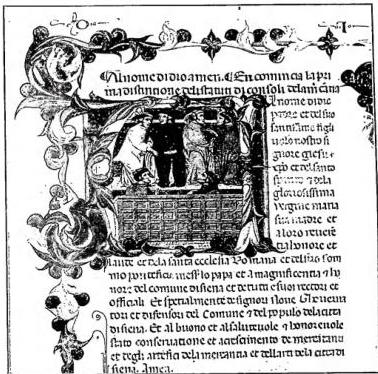
The first clear signs of expressionistic taste appear in the paintings of the seasons in the catacombs of SS. Pietro and Marcellino (De Witt). In sculpture, the process, already underway for decades, seems completed in Tetrarchic art—coinage—and above all, after notable anticipations, in the Roman art of Provence (Le Blant), in the Constantinian parts of the Arch of Constantine (L'Orange, Castelfranco, Bovini, etc.). Multiple spiritual motives, also of a general nature and parallel to other activities, underlie these figurative outcomes: 1) the anti-academic reaction of taste, according to the usual oscillations of "fashion." 2) The continuous resurgence, especially driven by socially inferior strata, of anti-classical tendencies, rich in popular spontaneity and rooted in the deepest and oldest attitudes of Roman spirituality insofar as it is Italic. 3) The general shift from "haptic" or tactile vision to "optic" vision, from the plastic to the pictorial, so well (though perhaps somewhat mechanistically) outlined by Riegl. 4) And above all, the irresistible impulse of the new Christian spirituality, which from within effects the disintegration and renewal of the old pagan mentality.
The abhorrence of "Aphrodisiac" nature undoubtedly plays a role in the formation of Christian taste. Whether this represents a revolution or an evolution in the figurative arts is a question historians debate (v. especially Dvorák); probably both at once. The new Christian spirituality completely shifts the relationship between the scene and light. In the ancient vision, the spectacle, the world, the "thing" is placed "under" light, "before" light. Hence precisely the prevalence of plastic values. In Christian spirituality, the spectacle is set "against" light; the world is referred to the backdrop of supernatural luminosity, the sole end of the soul, against which it is projected as a shadow.
This explains many things: the crystallization of the human figure into a fundamental schema, to which all the infinite variations of attitudes are more or less reduced, and which is, in essence, nothing but the mimetic transposition of the subject's state of mind, a sort of "confession" of the author, in the act of adoration, motionless in the ecstatic fixity of enormous, wide-open eyes. The transformation of mosaic backgrounds from blue (reality of sky) to white and gold (symbol of light). Against this gold, having overcome the ambiguity and incongruity of ancient spatial relationships between foreground and background, the representation of space is nevertheless fully realized, because the indefinite becomes the infinite, mist becomes splendor; and the world no longer has thickness, no longer weight, but only vibrations of light, boundaries of lines and planes of color.
The new Christian basilica undoubtedly assimilates multiple elements and motifs from various types of pagan buildings, but transforms them all into a decisively original organism, determined by the spiritual foundations and the exigencies of the new liturgical practice: the convergence of attention, the unity of sentiment of the entire gathered people toward that moment and that point which is the supreme end of the ecclesia, where the rite is celebrated.
And this, too, is in a certain sense an "expressionistic" outcome. The same holds for the type, rather rare but now confirmed, especially in Illyria, of the "open basilica" (Digwe).
With an ever more intimate and precise understanding of liturgical exigencies and the introduction of a symbolism, then clear and eloquent, intended to evoke even in architectural members the sacred mysteries, religious architecture, in the tendency to unify into a single organism spaces originally distinct and aggregated, assumes an increasingly particular physiognomy in the period from Constantine to Theodosius, during which many distinguished figures of the Roman ruling class transfer their activity from the civil and political sphere to the ecclesiastical one, such as S. Ambrogio and S. Paolino da Nola and S. Agostino. And it is precisely to these great men of government that a powerful impulse to the construction of sacred buildings is owed, as recent research reveals (De Capitani d'Arzago, Arslan, Villa, Chierici) both for the Pauline churches in Nola and for the Ambrosian ones in the Milanese capital.
2. Byzantine Architecture
That "position of the object against light" mentioned earlier also clarifies many aspects of that particular development of Romano-Christian architecture which is Byzantine architecture (v. ARTE).Like a geode, a poor pebble on the outside that contains within its heart a cavern resplendent with amethysts, rubies, or sapphires, the Byzantine building, with a rough and almost unadorned exterior crust, encloses within itself treasures not only of precious and gleaming materials but also incomparable magnificences of highly poetic and suggestive architectural imaginings. Then the golden glare of the mosaics transfers the luminous source to the interior of the spaces, transforming the wall into a mere diaphanous screen. An ambiguous boundary; one might say a limitless or "infinite" limit; a fusion with the infinite; a boundary ideally, indeed visibly—though not tangibly—crossable. And here again is a figurative element (the parietal plane) set against light and, ultimately, absorbed into light. In the sublime effort to transcend matter, to attain the Divinity directly by sensibly expressing the ineffable, which unites architecture with the other medieval arts, the mosaic thus becomes, in its chromatic and luministic values, a necessary element of the Byzantine architectural organism, just as, but in a diametrically opposite sense—that is, plastic—the column had been for the Greeks.
BIBL.:
For general orientation: J. Strzygowski, Orient oder Rom, Leipzig 1901; O. Wulff, Altchristliche und byzantinische Kunst, Berlin-Neubabelsberg 1914-1918; C. R. Morey, Early Christian Art, Princeton 1942; A. Grabar, L'empereur dans l'art byzantin, Paris 1936; id., Martyrium, Paris 1946; G. Bovini, S. Vitale di Ravenna, Roma 1950; H. P. L'Orange, L'impero romano e la scultura tetrarchica, in Symbolae Osloenses, 1938; E. Kitzinger, The Mosaics of the Cappella Palatina in Palermo, Palermo 1950; for the catacombs: J. Wilpert, Die Malereien der Katakomben Roms, Freiburg 1903; for the basilicas: R. Krautheimer, Early Christian and Byzantine Architecture, Harmondsworth 1965 (1st ed. 1942); for the mosaics: E. Diez - O. Demus, Byzantine Mosaics in Greece, Cambridge (Mass.) 1931; for the spiritual background: H. Rahner, Griechische Mythen in christlicher Deutung, Zürich 1945; M. Dvořák, Geschichte der italienischen Kunst im Zeitalter der Renaissance, München 1927-1928; for the liturgical aspects: J. A. Jungmann, Missarum Sollemnia, Wien 1948; for the Ambrosian churches: A. De Capitani d'Arzago, Le basiliche ambrosiane, Milano 1940; for the Pauline churches: G. Chierici, Le basiliche paleocristiane del Napoletano, Napoli 1941. Carlo Cecchelli
3. Figurative Expressionism
The expressionistic violence that constitutes such a significant part of the art of late antiquity and the early Christian period finds even more exacerbated developments at the periphery of the cultivated world. Not so much in that Balkan art (s. Soldaten Kunst, "Danube art," etc.), which may simply be proto-barbaric and below the level of art (perhaps with the sole exception of the stele of Scarabantia and the Tropaion of Adamklissi), but rather in Egypt, where, under the strongest pressure of popular and indigenous traditional elements, it gives rise to Coptic art. This art exhibits an ever-increasing tendency toward the disintegration of figurative morphology and syntax, alongside a progressively accentuated abstract decorativism, now calligraphic, now chromatic (beautiful effects of macchia in fabrics). This evolution is also influenced by the increasingly penetrating suggestion of nearby Islamic art. It continues to live—or rather, to vegetate—according to traditional formulas even after more than a millennium and a half in Ethiopian lands.In the new heart, or rather brain, of the Byzantine Empire, however, the ancient subtle spirit of the Greeks and the persistent taste for typifying idealization work upon the new figurative heritage that crystallized in the expressionistic, "Plutonic" moment. They take it as a given, as a motif, as a "world," and elaborate it into precious stylistic refinements, into formulas more rigid than those of the old canons. They create the new "ideal beauty" (codified in celebrated manuals) with the contents of the "characteristic ugly."
Certainly, the panorama of Byzantine art is less uniform than was believed until recently, as it is differentiated in space by metropolitan and provincial currents and in time by the succession of two golden ages: the Justinian and the Macedonian, separated by the great iconoclastic crisis, to which one may add, though of lesser significance, the third age of the Comneni. Yet it is perhaps still an obscure thrust of atavistic Eastern forms that finds its courtly systematization here.
4. Islamic Art
Beyond the eastern and southern frontiers of the Empire, the Islamic world seethes and soon overflows in a phase of powerful expansion and rapid cultural growth. In accordance with a more properly Eastern taste, it directs the impulse toward abstraction into schemes of pure ornamentation.This eminently decorative taste is realized entirely on the surface, resolving sculpture into embroidery (famous example: Mšattā); painting into pure linear development (the arabesque, precisely) or into mere juxtaposition of colors or values (carpet). Architecture, too, obeys the same impulses, as it avoids a synthetic and syntactic organization of space, unfolding the architectural discourse in paratactic form, with a series of similar members that follow one another without conclusion: coordination rather than subordination of elements. An example is the Mosque of Córdoba.
Richer in historical content, and thus in naturalistic representations, is painting, especially Persian miniatures (influenced by the Far East), which were certainly known in the West as well.
5. Barbarian Art
Along the northeastern frontiers, the barbarian world reveals the same operative impulses with regard to art, though it is debatable whether one can speak of art in the barbarian world in the proper sense of the word (v. ARTE). The barbarian has no proper figurative world, neither historical nor logical: and his language is a stammering, largely driven by an automatism that materializes in horror vacui, of fragments drawn from classical culture and often distorted with absolute incomprehension of the model. The decorative automatism is evident in much of Scythian goldsmithing, which is perhaps the greatest pride of barbarian production, with the repeated punchings, on the body and at the edges of the object, of the few now-fixed motifs of whole animals or limbs. On the other hand, even the famous flechtbandornament, the entrelac, or interlace, is nothing more than a vulgarization of classical motifs (braid) or Byzantine ones (basket capitals), rather than Coptic.Nor is it accurate, as is often repeated to explain the almost total absence of the human figure, that barbarian art tends to express itself in an abstract language through the representation of a world reducible to pure geometric elements and relationships in defiance of any naturalistic reference. While in its initial stages there is rather a process of degradation and disintegration of misunderstood naturalistic forms (which assimilates Gothic and Lombard fibulae to bracteates), in the final stage, one can often detect the imprint of a vigorous imaginative power.
In often highly refined execution, this style appears in Scandinavian goldsmithing, niello work, and later in the Oseberg ships, giving rise to the supposition that this conquest of barbarian art belongs to the more northern Germanic world. However, regarding Oseberg, we find ourselves in a relatively late period, certainly later than that of some marvelous creations of that miniature art once considered Irish but which the convincing research of Masai indicates as pertaining rather to that high-level culture achieved by Romanizing Christianity in Northumbria.
Not only in the inexhaustible felicity and fertility of ornamental inventions but also in the—albeit rare—representation of the human or animal figure (symbols of the Evangelists, Crucifixion), this art succeeds in grafting decorative rhythms onto naturalistic cues with a stylistic rigor and an inventive élan of astonishing efficacy in the exacerbated intensity of expressionistic transfiguration. And with autonomous means and highly original outcomes in enamel, it develops the suggestions of technique. It is only in contact with an elevated Christian spirituality in this first fruitful encounter that the obscure forces of the barbarian sentiment find the light of a truly and highly artistic expression and become a new and powerful contribution to civilization.
The Lombards, who ignore the later and more complex developments of this style, monotonously repeat its most elementary formulas. A modest rekindling of interest in the arts manifests itself precisely toward the decline of Lombard power with Liutprando and the last kings, and with the dukes, especially those of Friuli.
6. Carolingian Art and the "Magistri Comacini." — Carolingian art (v. ARTE) attains a high level, particularly in miniature painting, ivory carving, and goldsmithing, in service of an evidently political program. A splendid flourishing, undoubtedly, but undeniably artificial—a planned culture. This is clearly confirmed by the variety of directions (all reflective) of the various schools or workshops. A certain resumption of building activity, culminating in the Palatine Chapel of Aachen, openly draws on Ravennate models.
Moreover, that the art of building, abandoned for nearly two centuries between the mid-sixth and mid-eighth centuries, survived only through the sustenance of a thin current of tradition—more manual than artistic—Roman in origin, is not only probable but obvious from multiple indications.
The magistri comacini (v. MAESTRI), who constituted true building enterprises mentioned in Lombard sources, are nothing more than the continuators of the craftsmen from the period of greatest splendor of Roman Milan, when it was the capital of the West. When the capital moved to Ravenna, the center of greatest building activity also shifted there, where, due to its geographical position and contacts with the East, while still drawing on common Roman sources, it developed with a particular accent.
It is highly probable that the Lombard conquest and brief domination in Ravenna caused these Ravennate workshops to disperse throughout the rest of the Po Valley, spreading that particular stylistic accent. The only two buildings that are customarily assigned with some probability to the second half of the 8th century (more specifically to the time of Desiderius), the San Salvatore in Brescia and the small temple of Cividale, present constructive and decorative features of such markedly Ravennate, indeed late Roman, character that they even give rise to the hypothesis (though historically difficult to accept) that they might date back to the 6th century. Ravennate forms, as Fiocco has keenly observed, penetrate and endure longer along the upper Adriatic coasts, in the art he suggestively defined as "Exarchal."
7. Ottonian art (v.). — After that of Anglo-Irish illumination, the other great contribution of the early Middle Ages to figurative civilization is Ottonian art. And with far greater variety and richness of expression, though within a great unity of taste and style, and with a much deeper and broader efficacy in space and time. It can truly be said that here lie the foundations of a new language, a complete and lucid expression of that synthesis of various and sometimes contrasting movements which, after so much struggle, marks a new season of the human spirit: that of the full Middle Ages, which in the figurative arts is commonly called Romanesque.
And once again, it is the spiritual climate of Christian religiosity that, unraveling the knot of barbarism, allows these obscure primitive forces to find the way to expressive capacity, and the brute impulses of violent passion to clarify themselves in the light of poetry. A surge and warmth of rough, virile, heroic sentiments, overflowing in dramatic vivacity, stirs mystical aspirations from the depths and, with overwhelming dynamism, transforms the fixed ecstasy of Paleochristian and even Byzantine art into an exacerbated, visionary hallucination.
Certainly, just as the expressionism or even surrealism of these artists may trace back to the Carolingian vein of Reims and Corbie, so too, especially at moments of greater political intertwining between the two Empires due to the marriage of Otto II with Theophano, Ottonian art also draws nourishment from the current cultural contributions of aulic Byzantium, which after iconoclasm was in its second flowering (hence, for example, the coexistence of the two styles in the Codex Aureus Escurialensis). On the other hand, particularly with regard to mural painting, the examples elaborated on the stem of the very ancient Paleochristian tradition by the broad-reaching and exquisitely cultured activity of Benedictine fresco painters (San Angelo in Formis) and Roman artists (San Clemente) are not without effect, as is clear, for example, in the Oberzell of Reichenau.
8. Romanesque art. — In the 11th century, partly due to the irresistible rise of social life and partly due to the necessary repair of the latest barbarian devastations, the Hungarian ones, there is in the West an almost sudden, impetuous, imposing resumption of building activity. This occurs simultaneously in Italy, especially in the Po Valley, as well as in Germany, France, and Spain, where, in the non-Arabized part, the Asturias, there had been a singular flowering parallel to the Carolingian one, but with markedly original characteristics (Santa María de Naranco). The primary limit and condition of this activity becomes the predominant problem of covering large church buildings.
While the Byzantine East, always steadfast in its preference for centralized types, still struggles with the construction of domes, but, having generally reduced the size of the building, now delights in the decorative chiseling of walls, even externally, with polychromies and brickwork; and while Armenia whimsically multiplies spatial articulations with schemes that are said—though not without exaggeration—to have influenced the West; while Rome generally remains faithful to the old basilical type with timber roofing, in the Po Valley the first large-scale experiments in stone vaulting with barrel vaults seem to take shape. In this fervor of works, characteristics of the artistic process begin to emerge that will become essential in further historical development, and indeed determining for the Renaissance: above all, the reaffirmation of artistic "consciousness," which is to say the "personality" of individuals, though harmoniously coordinated within collective labor.
a) Painting. — As in the fresco cycles already mentioned in central and southern Italy, regions tied to the Papal See by closer religious or political bonds, a sense of measure in representation appears, a cordiality of motifs that distinctly differentiates them both from the subtle intellectualism and abstract refinements of Byzantine art (which in Italy asserts its most precise dominion in the mosaics of Sicily, from the solemn models of Daphni, and of the upper Adriatic) and from the pathetic exaggerations of Northern expressionism. And in this balanced concreteness, in this respect and understanding of the human person as both motive and representation, model and module, it is possible to recognize the distinctive character of Italic—or one might say Latin—art in general, and of this period in particular, a full and perfect realization in the realm of fantasy and especially in the figurative arts of the doctrine and most wise practice of the Catholic Church.
b) Architecture. — Then in architecture, perhaps also due to the suggestion of the old traditional type of the basilica, always present to Italian builders, schemes of simple, clear, and relatively slender partition prevail. Florentine architecture, even in decoration, traces back to Paleochristian models; Pisan architecture to Ravennate ones (not without Oriental influences). But even Lombard builders, though fully attentive to the problem of vaults and the systems consequent to their solution, always aim for spatial clarity.
Yet particularly in France and Germany, the great religious authorities, both secular episcopal and monastic, seem to seek a tangible manifestation of their power in the complicated grandiosity of enormous buildings extraordinarily rich in articulations; already from the second half of the 10th century, and for this reason it has been said that the Romanesque is rooted in the Ottonian. One need only think of the Cluny (v.) in its final phase; of the vastness and movement of masses in Saint-Riquier; of the massive imposingness of those, more like citadels than churches, that are the Rhenish cathedrals of Worms, Speyer, and Mainz.
c) Sculpture. — While in France a curious current of Orientalism asserts itself in the Périgord, Burgundy, Aquitaine, and Provence (in close ties, particularly Saint-Gilles, with Pisa) draw extensively, sometimes pedantically for the decoration of architectural members, from the heritage of provincial Romanity. A taste almost classicistic that in Aquitaine and Provence also entirely dominates sculpture, from Toulouse to Moissac, from Arles to Saint-Gilles; not without some singular exotic vein, such as the Indianisms of Souillac. In Burgundy, for example, Autun, alongside the strict classicistic imitation of architectural modules, the figures lengthen and twist with a pathetic intensity that foreshadows the Gothic.
Thus, great German sculpture develops expressionistic modes of Ottonian illumination and carving, in works of stripped-down essentiality, of exceptional dramatic power in anatomical accentuations, such as many crucifixes or the bronzes of Hildesheim.