
MUSULMANA, ARTE. — As the Arabs extended their religious and political occupation over the territories of North Africa and the Middle East, they appropriated and unified the culture and art of the peoples they dominated. In Spain, the local tradition gave rise to a composite style called Mozarabic (musta‘ribah = “Arabized”) when it was produced by Christians working in Muslim lands; and Mudéjar (mud-dahar = authorized to dwell) when it was produced by Arabs active in lands reconquered by the Christians.
I. ARCHITECTURE
It was above all Persia that extended its influence throughout the whole of Islam, and from it derive certain distinctive constructive features: the dome connected by pendentives over a square plan, blind arcades to lighten the walls, and horseshoe arches, raised and pointed. The architectural structure is often covered with sumptuous decoration, consisting chiefly of stucco, polychrome majolica tiles covering entire surfaces, and, less frequently, colored stone. Fantastical effects are achieved through the decoration of vaults with stalactites (mugammas). Religious architecture had as its principal theme the construction of minarets and mosques, in which, however, plan and elevation varied according to the different regions and periods. Civil architecture left sumptuous examples in the royal palaces, whose most common type had a defensive character on the exterior. The entire building was arranged around the central courtyard with fountains and pools; at the far end of the courtyard were the reception apartments, and behind them the baths and private quarters. In Sicily, the palaces built during the Fāṭimid domination no longer exist, but those erected in Palermo during the Norman period—the Cuba and the Zisa—are largely the work of Arab architects. In Spain there remains the most splendid and famous example of princ-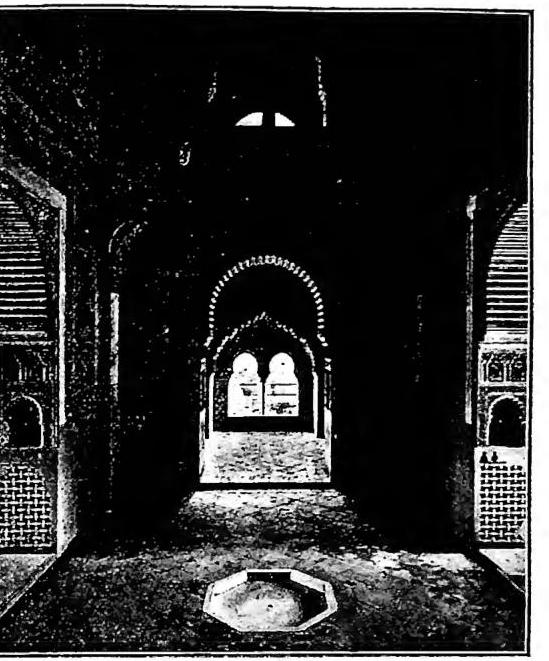
II. SCULPTURE
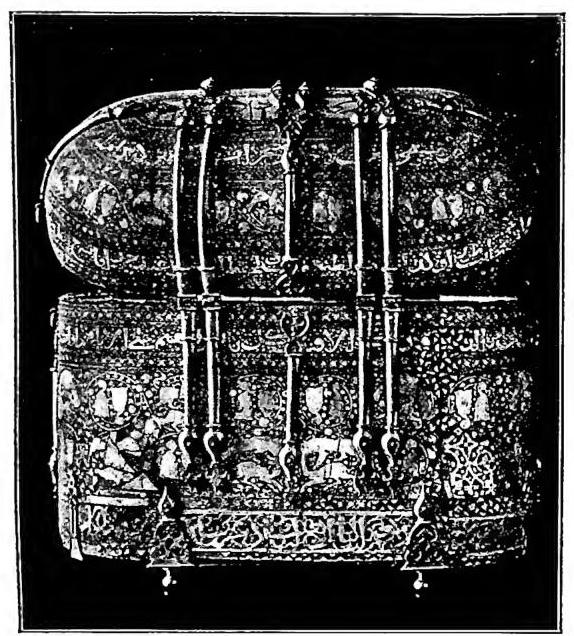
The plastic arts had as their principal task the decoration of buildings: predominantly geometric ornamental motifs are found under the 'Abbāsids, and floral and foliate motifs under the Mamelukes. Stucco was chiefly used; sculpture in stone was not much employed and was limited to the decoration of architectural elements.Figurative representations from the Seljuk period at Conia (Asia Minor), with winged genies and combats between horsemen, are altogether exceptional; they still reveal Sassanid influences. Even rarer are sculptural elements independent of architecture, such as the rather roughly executed lions that give their name to the famous courtyard of the Alhambra. Bronze was also used, not only for utilitarian objects such as animal-shaped aquamaniles, but sometimes also for large decorative sculptures. The ivory sculptors display great expertise: they were already active in Mesopotamia from the 8th century and were later summoned to Spain by the caliphs of Cordova (10th–11th centuries). Works of a secular nature also depict human figures, as in the precious casket of 'Abd al-Malik (1005, now in the cathedral of Pamplona), with scenes of hunting and combat that reveal the influence of Sāsānid art. Christian princes, too, made use of the skill of Muslim ivory sculptors (the ark of S. Millan de Cogulla, the cross of S. Fernando in the Archaeological Museum of Madrid, from the beginning of the 11th century); the techniques of openwork and inlay were also employed in ivory, the latter especially in Sicily (the casket of the Palatine Chapel in Palermo, 13th century).
III. PAINTING
Ancient Arab writers have left accounts of frescoes existing in mosques and palaces; nevertheless, the only surviving pictorial ensemble is the decoration of several rooms in the Royal Palace of Palermo, executed after the fall of Arab rule by Muslim craftsmen. Yet those representations convey only a very vague idea of the wealth of imagination and technical refinement attained by miniature painting.MUSULMANA, ARTE - Inlaid casket (13th century) - Palermo, Palatine Chapel.
In North Africa it was applied to the illustration of religious books, in which the elegance of the script and the sumptuousness of the geometric decoration predominate; in the richness of its imagination, the latter rivals carpets. In Persia, miniature painting displayed a splendid variety of compositions from the beginning of the 13th century to the end of the 18th. Three great schools succeeded one another there, corresponding to the three dynasties that ruled Irân: the Mongols, the Timûrids, and the Safawids. Following the Mongol invasion of the 13th century, the influence of Chinese painting penetrated Persia and determined particular characteristics of miniature painting, which reached a high level especially under the Timûrids, great lovers of letters and art. In the first half of the 15th century, the prince Băşungur, grandson of Tamerlane, founded an academy of the book at Herât, from which works of great beauty emerged; the foremost personality of this school was Kamâl ad-din Behzâd, who had disciples at Herât and Tabriz. The subjects most commonly treated are scenes of battles, hunts, and banquets. Despite the continued interest of princes (the sâh 'Abbâs I had sent young painters to Rome for the purpose of study), the decline began in the 18th century.
IV. MINOR ARTS
The impetus given to the art of the book also encouraged the perfection of the technique of bookbinding, of which the most frequent type is in leather incised with gilded geometric ornament. Persia was also particularly active in the field of the textile arts, producing light silks, brocades, velvets, and continuing the Sassanid tradition of floral ornament and motifs of confronted animals. But the most important product of the East in this field was the carpet, at first a popular handicraft and later an industry organized in court workshops, soon much sought after and exported also to Europe (it can already be seen reproduced in Italian paintings of the first half of the sixteenth century). This art flourished in Anatolia, the Caucasus, and above all in Persia, where it reached its greatest development under the Safawids. The most precious examples belong to this period, with designs of flowers, gardens, hunts, and animals (the carpet in the Poldi-Pezzoli Museum in Milan, dated 1521).In Muslim countries, metals were decorated with damascening, according to a technique that spread from Mesopotamia
not only into Persia but also into the West, as far as Venice. The use of enamel on metal, by contrast, is extremely rare and derives only from Byzantine sources. As in painting, Chinese art also influenced the decoration of majolica. The production of vessels was immense, and they were exported and sought after also in the West. The decoration was not only painted but was sometimes also incised. The most common forms are long-necked flasks, cups, bowls, and “albarelli,” whose model was imitated in Italy and gave its name to pharmacy jars. An Islamic discovery was the lustreware with metallic reflections, which apparently originated around the ninth century in Mesopotamia and spread to Persia, Egypt, and Spain, where there were numerous production centers: Majorca (whence the name majolica), Valencia, Seville, and Malaga, whose workshops produced the great vase of the Alhambra. Arab craftsmen continued their activity in Spain after the expulsion of the Muslims, and Mudejar production is immense.
BIRL.: G. Migeon, Manuel d'art musulman, Parigi 1927; R. L. Holson, Guide to the Islamic pottery of the Near East, Londra 1932; E. Kühnel, s. V. Islamismo, in Enc. It., XIX (1933), p. 616 ff., with a rich bibliography. Cesare Botti