
CORDOVA, DIOCESE of. — City, provincial capital, and diocese of Spain in Andalusia; the Cordoba of the Romans in Baetica (Hispania ulterior). Since this city was so flourishing in the first centuries of the Empire, it may be presumed that it received the Christian religion at an early date.
The martyrs of C. are thus commemorated by Prudentius: «Cordoba Acisclum dabit et Zoillum tresque coronas» (Peristephánon, IV, 19-20). The Hieronymian Martyrology commemorates the martyr Acisclus on 18 November; two manuscripts add the note «hac die rosæ ibidem colligantur». The inscription engraved on the column of Carmona (6th century) says of him: «donní Aciscl» (E. Hübner, Inscriptiones Hispaniae Christianae, Berlin 1871, no. 374). The calendar of 961 shows that St. Acisclus had three churches in C., one over his tomb, «in ecclesia Carceratorum», another belonging to the parchment workers, and the third in the monastery of Armila (M. Ferotin, Le «Liber ordinum» en usage dans l'Eglise visigothique et mozarabe d'Espagne, Paris 1904, p. 487). Zoilus is listed on 27 June by the Hieronymian Martyrology, the Mozarabic calendars, and the liturgical books (M. Ferotin, op. cit. pp. 568-69). The martyr was buried «in vico Cris»; he was later translated to the city «in ecclesia vici Tiraceorum».
St. Victoria, now co-patroness of C., first appears together with St. Acisclus in the prologue of the León antiphonary, which dates from 1066 (E. Florez, España Sagrada, Madrid 1747-75, V, pp. 288-303).
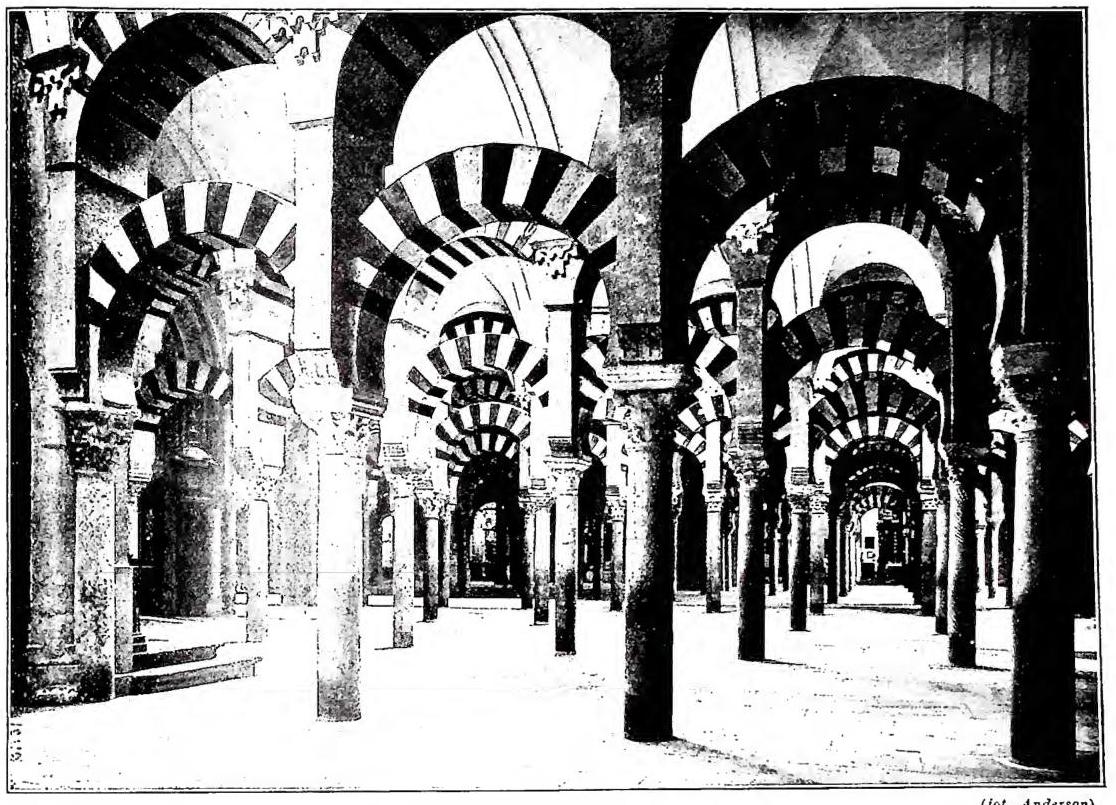
(Anderson photograph)
CORDOVA—Interior of the Mosque, begun in 785, enlarged in the 10th century, and transformed into a church in 1523.
The name of Severo, bishop of C., is mentioned in the second half of the 3rd century, but nothing certain is known; on the other hand, the apostolate of the great Osio, confessor of the faith, is most celebrated in the history of the Church. He attended the Council of Elvira (ca. 300) and was president and papal legate at the First Ecumenical Council, held at Nicaea in 325 against the Arians; he also presided over the Council of Sardica (342 or 343). When Osio died at the age of one hundred in Sirmium in 357, after sixty years of glorious pontificate, he was succeeded by Igino, or Adigino, the first opponent of the Priscillianist heresy according to the testimony of Sulpicius (although he later passed over to the opposing party, which earned him excommunication and exile), and also an adversary of the Luciferians. In certain catalogues of Spanish bishops, Gregorio and Isidoro are given as the successors of Igino, despite several difficulties that remain unresolved; it is certain, however, that in 504 a prelate of that diocese was named Stefano and was present at the Roman Council held that year by Pope Simmaco. During the period of Visigothic Arian rule, nothing is known of the diocese or its bishops; at the Second Council of Toledo in 588, where the total conversion of the Spanish people together with their sovereign Clodoveo was proclaimed, a bishop of C. named Agapio appears once again; he also subscribed to the First Council of Seville after s. Leonardo. During the episcopate of Bishop Zaccheo, the Moorish invasion took place (711), and the Moors made C. the capital of their kingdom for several centuries; the Christians then suffered greatly, and not a few became martyrs, especially under King 'Abd ar-Rahmān II (ca. 824). On the occasion of the persecution provoked by the zeal of certain Christians, a council was convened at C. in 852, at which the voluntary offering of oneself for martyrdom was prohibited. Shortly thereafter, under Bishop Sauli, another council was held to end a schism among the city’s faithful; his successor Valenzio held a third (ca. 862). After C. was conquered by King s. Ferdinando in 1236, the episcopal see was restored, after almost three centuries of vacancy, under Bishop Lupo de Fitero. At that time the great mosque was transformed into a church; it had been begun in 785 by 'Abd ar-Rahmān and incorporated columns from the city’s Roman monuments; it had been enlarged in 961 by al-Hakam II. The transformation was carried out in 1593 by Hernan Ruiz, who erected the bell tower on the minaret. Other noteworthy churches are: S. Marina, S. Lorenzo, S. Nicola de la Villa, S. Andrea, S. Agostino, S. Paolo, S. Marta, the Crucifix, S. Michele, built on the site of the Senate in the Roman period, and the church of S. Giacomo, erected on the Roman circus; the church of All Saints on the theater, S. Nicola on the temple of Apollo, and the Trinity on the temple of Bacchus. The monastic communities withdrew from C. during the fierce Arab persecution of 852. The church of S. Michele de Escalada was built by monks from C. who had taken refuge there in 914 (Gomez Moreno, Iglesias Mozarabes, Madrid 1919, pp. 141–61; V. Lamperez, Historia de la Arquitectura cristiana española, I, Madrid 1930, p. 256). Notable sanctuaries of the diocese are those of the Most Holy Virgin de la Sierra, founded in the 13th century; of the Most Holy Virgin de Araceli in Lucena (feast 8 September), founded in 1600; of the Most Holy Virgin de Luna in Pozoblanco (feast on Pentecost Sunday); and of Our Lady de Guia in Alcaracejos.
Of Roman origin is the great bridge over the Guadalquivir in C. (240 m long, with 16 arches), disfigured during the Arab period. The bridge had been defended ab antiquo by a fortress, the Calahorra.
The diocese is suffragan to Siviglia; it covers an area of 15,097 sq. km., and has 126 parishes, 195 diocesan priests, and 90 religious priests; out of 995,150 inhabitants, 995,000 are Catholics (1948). The patrons of the diocese are s. Aciselo and s. Vittoria.
Enrico Josi-Giuseppe Pouy Marti