
TOLEDO, ARCIDIOCESI of—Archdiocese and capital city of the province of the same name in Spain.
It has an area of 26,802 sq. km. and a population of 765,220 inhabitants, almost all Catholic, distributed among 364 parishes served by 323 diocesan priests and 80 religious priests; 18 male and 106 female religious communities (Ann. Pont. 1953, p. 425). It is the primatial see of Spain and has as suffragan dioceses Coria, Cuenca, Madrid, Plasencia, and Sigüenza. Its patrons are Sts. Eugenio and Ildefonso.
T. is Toletum, a Roman municipium mentioned by Livy. Occupied first by the Alans and then by the Goths, the latter made it the center of a new empire united with Gallia Narbonensis, and Leovigild I in 579 became the first of a dynasty that remained there until 709, when, after violent struggles, the infante don Rodrigo ascended the throne. But two years later the Arabs, led by Taric, occupied the city, which for three centuries was subject to the caliphate of Córdoba. In 1012 the governor of T. revolted against the Umayyads, proclaiming himself king. But Alfonso I reconquered the city in 1085; it was unsuccessfully besieged by the Muslims in 1197 and 1205, and in 1212 the Saracen invasion was finally repelled. In 1470 T. was visited by King Ferdinand and Queen Isabella, who founded there the votive convent of «S. Juan de los Reyes». At the beginning of the reign of Charles V, T. was the center of the agitation of the «comuneros», who defended the privileges of the municipality under the leadership of Juan de Padilla; when the city was besieged, its resistance was led by his widow, Maria Pacheco. But Charles V made it the capital. Philip II abandoned it for Madrid; nevertheless, the city retained the title of «imperial y coronada» city. T. endured a heroic siege from 21 July to 27 September 1936.
The origin of the diocese is traced back to the first century, and St. Eugenio is said to have been its first bishop; but documents are lacking for the first three centuries, and the first certain information is found only in the celebrated Council of Illiberis (ca. 300; V. ELVIRA), where Bishop Melantius signed the acts. It was not suppressed under the Arabs, who preserved the city’s splendor; indeed, thanks to that dominion, the obstinate adoptionist heretic Elipandus was able to defy the thunderbolts of Pope Adrian I and Charlemagne. It attained even greater splendor, however, after the city’s conquest by King Alfonso VI in 1085. The Councils of Toledo are famous: the first dates from 400, the second was celebrated in 531, and the third, the most celebrated of all, in 589, with the participation of the Visigothic king Recaredo, brother of the martyr St. Ermenegild and son of the cruel Arian Leovigild. At that Council the Catholic religion was recognized and the religious unity of the Kingdom affirmed. The glory of this Church includes Sts. Ildefonso, Giuliano, Eulogio (elected bishop), and Eugenio. It was also illumined by Cardinals Egidio Albornoz (restorer of the Papal States in the fourteenth century), Francesco Ximenez de Cisneros (the great governor and patron at the beginning of the sixteenth century), Gaspare di Borgia (Spanish ambassador in Rome), and many others, since from the sixteenth century the archbishop of Toledo was almost always a member of the Sacred College. The non-cardinal prelates Roderico Ximenez de Rada and Bartolomeo Carranza, who died in Rome in 1576 after a sensational trial, are also well known.
The Cathedral was founded in the sixth century under the Gothic king Recaredo. Transformed into a mosque by the Arabs, its reconstruction was begun in 1227 by King Ferdinand and completed in 1493. The first architect was a Petrus Petri, called Pedro Pérez; it is in the French Gothic style, with later modifications. It is entered through five monumental doors and three secondary ones. The main façade, begun in 1418 and completed at the beginning of the sixteenth century, has three portals. The central one, called «del Perdono», has a large ogival arch adorned with figures of angels, prophets, and saints; in the tympanum is the Virgin presenting the chasuble to St. Ildefonso; above it is the Last Supper. The two lateral pillars are adorned with statues. On the left is the pillar called «del Infierno» or «de la Torre»; on the right, that called «de Escribanos» or «del Iuicio». To the left of the façade rises the tower, 90 meters high, erected between 1380 and 1440 by Rodrigo Alfonso and Alvaro Gomez. On the southern side are the «puerta Liana», in the Ionic order, erected in 1800, and the «puerta de los leones», with six columns surmounted by lions bearing heraldic shields, the work of A. de Egas of Brussels, decorated by Juan Aléman and restored in the eighteenth century; the bronze doors date from 1545. On the eastern side, large red inscriptions bearing the names of the doctors of theology (sixteenth and seventeenth centuries) are fixed to the walls. On the northern side are the «Puerta de Presentación» of 1585, with a 1565 bas-relief of the Presentation in the Temple; the «Puerta de S. Catalina» from the end of the sixteenth century, with the scene of St. Catherine’s burial; and the «Puerta de la Feria», also called the «Reloj» (the clock) or «Niño perdido», from the beginning of the fourteenth century, decorated with figures of angels and prophets. The interior measures 113 × 57 meters and is 30 meters high; it is divided by 16 groups of columns into five naves, opening onto 22 chapels, and is illuminated by 750 windows with scenes from the New Testament and figures of saints painted between 1480 and 1560 by J. Dolfin, I. d’Utrecht, and A. di Olanda.
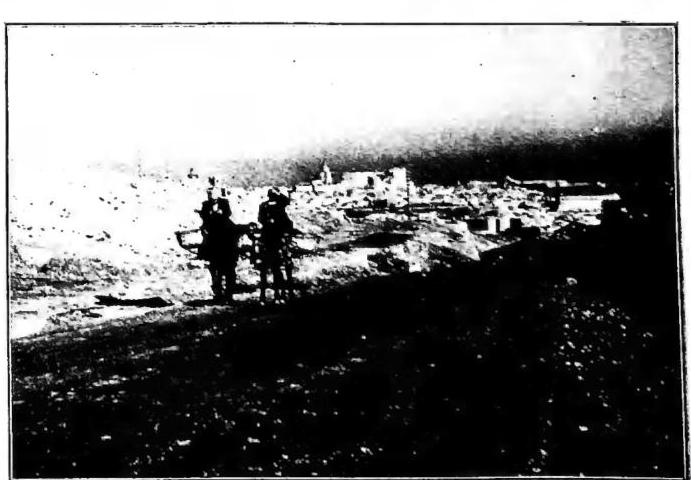
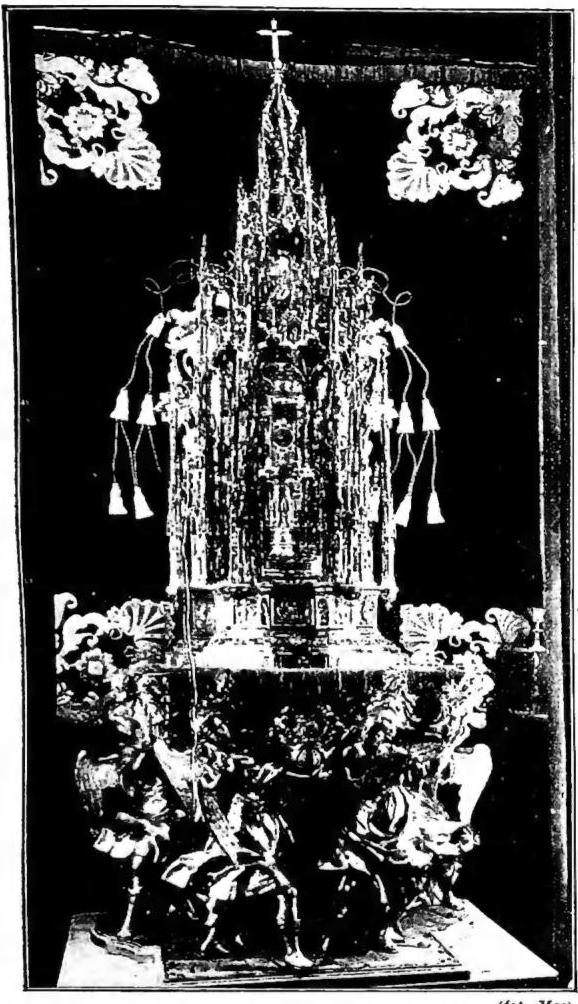
(photo by Mas)
The «capilla mayor» was enlarged by Cardinal Ximenez around 1498; it has a wooden altarpiece in the Flamboyant Gothic style designed by the Burgundian. On either side of the altar are the tombs of the Kings (Sanchez II, Alfonso VI, Alfonso VIII) and of Cardinal P. Gonzalez de Mendoza (d. 1495); on the right, one descends to the underground chapel called the Chapel of the Holy Sepulchre. In the choir, the wooden stalls were carved by R. Aleman in 1495; the 54 bas-reliefs depict episodes from the conquest of the Kingdom of Granada. On the archbishop’s stall is the alabaster group of the Transfiguration; each stall is separated by red-marble columns. Above runs a frieze with marble medallions representing the genealogy of the Lord. In the middle of the choir, the two large bronze pulpits are carved with episodes from the Old Testament (the work of N. di Vergara, 1570). On the altar stands the marble statue of the «Virgen de la Blanca», a French sculpture of the twelfth century. In the sacristy one can admire the portal of Cardinal Borxa y Velasco (d. 1645), by Velázquez. On the central altar of the Trascoro is the statue «de la Virgen de la Estrella» from the fourteenth century. In the right-hand nave is the Mozarabic chapel, built in 1504 by Cardinal Ximenez and designed by E. de Egas; it was restored in 1922. Every day Mass is celebrated there according to the Mozarabic rite, a rite that, by special agreement, continued during the period of the Arab invasion in six churches of the city. On the altar, the mosaic of the Blessed Virgin and Child was executed in Rome in 1794; there is also a fresco representing the capture of Oran in 1509, executed by Gregorio di Borgogna in 1514. In the chapel of St. Eugenio, the statue of the holy bishop is by D. Copin; there is also the tomb of Bishop F. di Castiglia, who died in 1521. In the transept, the interior of the «porta dei Leoni», of ogival architecture, contains 35 carved wooden panels: on the door is the tree of Jesse in high relief, and a medallion with the Coronation of the Virgin, the work of Gregorio di Borgogna.
In the ambulatory is the chapel of St. Lucia, in thirteenth-century Gothic style, followed by the chapel «de Reyes vejos», or of the Holy Spirit, erected in 1290. One then enters the chapter house, whose coffered ceiling was carved and painted in 1508; its walls bear frescoes by Gregorio di Borgogna and portraits of the archbishops of T., from St. Eugenio to Cardinal Moreno.
In the apse are the octagonal chapel of S. Ildefonso, transformed by Cardinal De Albornoz, who is buried there (d. in 1364 at Viterbo), and the tomb of the archbishop J. Martinez de Contreras (d. in 1431). The chapel of Santiago is hexagonal, decorated in the florid Gothic style; it was erected in the mid-fifteenth century by the constable don Alvaro De Luna, who was buried there; it also contains the tomb of the archbishop J. De Cerezuela (d. in 1448). The chapel of «Reyes nuevos», erected between 1531 and 1534, contains the funerary monuments of Henry II and Henry III and statues of John I and II. The sacristy was frescoed by Luca Giordano and El Greco; in the room called the vestment room are canvases by Rubens and El Greco; it preserves a precious series of sacred vestments belonging to Cardinals Mendoza, Cisneros, Fonseca, Albornoz, as well as the Bible known as that of S. Louis, a French illuminated manuscript of the thirteenth century in three volumes; some leaves of the Apocalypse are now in New York in the Pierpont Morgan collection. To the right of the ambulatory is the tomb of Cardinal De Portocarrero (d. in 1709). Next are the chapels called «de los Doctores» or of S. Marina, and the chapel «de la Virgen del Sacrario», with the venerated image of the Madonna. In the left transept are the chapels of S. Peter, erected by the archbishop Sancho De Rochas (d. in 1422), who is buried there; the chapel «de la Pila Bautismal»; the chapel «de la Virgen de la Antigua», so called from an ancient icon of the Madonna; and the chapel «de la Descensión», erected in 1533 on the site where the Madonna appeared to S. Ildefonso.
The chapel of the Tower, also called «de S. Juan» or «de los Canónigos», below the tower, contains the Cathedral Treasury. On the north side of the building, through the «del Mollete» doorway, one enters the cloister, begun in 1399 and consisting of two levels: opening onto it is the summer chapter house of the fifteenth century, the chapel of S. Blas with the tomb of the archbishop Tenorio (d. in 1399), to whom the cloister is owed; the vault has frescoes by Arnaldo of Cremona. One also has access to the Chapter Library, rich in manuscripts and illuminated choir books. A covered gallery leads to the archiepiscopal Palace (eighteenth century), whose lower floor is occupied by the Provincial Library. This Cathedral enjoys many papal privileges, and its canonical dignitaries have the right to use the mitre. A major chaplain and several other chaplains and beneficiaries carry out the Mozarabic rite, restored with royal generosity by Cardinal Ximenez de Cisneros at the beginning of the sixteenth century in the said chapel, after he had commissioned several learned investigators of the ancient codices to reconstitute the liturgy, of which T. had been the center and defender until, under Gregory VII, it was obliged to yield its place to the Roman rite.
In T. there are the major seminary, formerly the Pontifical University of S. Ildefonso, founded in 1848 by Cardinal Inquanza, and the minor seminary of S. Tommaso da Villanova, formerly the University of S. Caterina, a building enlarged in 1917 by Cardinal Guisasola and in 1926 by Cardinal Reig.
Among the churches, mention should be made of those of S. Andrea, of
« S. Juan de la Penitencia », with an attached convent founded in 1514 by Cardinal Cisneros; it is of mixed architecture, with a cedar-wood dome and pendentives covered with stalactites; it contains the tomb of Bishop F. Ruiz (d. in 1528); the Mozarabic church of S. Luca, recently restored; the church of « S. Juan de los Reyes », attached to a convent erected in 1746 by the Catholic Monarchs, after the victory at Toro, according to the design of the Flemish architect J. Guas; the interior has a single nave. The cloister is a fine example of florid Gothic; remains of frescoes have recently been discovered on the walls; on the friezes and above the capitals are inscriptions praising the Catholic Monarchs. S. Maria « la Blanca » is the oldest synagogue in T. (around 1180), transformed into a church in 1405; S. Vincenzo Ferreri preached there; it has recently been restored. Our Lady of the Transit is another synagogue transformed into a church in 1492 and then called « S. Maria de los Pobres »; it has a single nave and still contains inscriptions in Hebrew characters praising the God of Israel. The following should also be mentioned: the Church « del Salvador », where the doctors of the University met in the chapel of S. Catalina; the church of « S. Tomé », from the fourteenth century, with an interior restored in the eighteenth century, which contains El Greco’s celebrated canvas depicting the burial of Gonzalo Ruiz, Count of Orgaz, and the apparition of SS. Stephen and Augustine. The church of « S. Domingo el antiguo » likewise contains five canvases by El Greco.
The church of « Santo Cristo de la Luz » is the ancient tenth-century mosque Bib el-Mardom, transformed into a church with the addition of a transept and an apse. The church of « Santiago del Arrabal », in the Toledan style of the thirteenth century, was transformed in the eighteenth century. The church of « Cristo de la Vega », the basilica of S. Leocadia, is modern. The church of « S. Vincente », erected in 1595, is now used as a parish museum and contains sacred vestments from the fifteenth to the eighteenth century; Brussels tapestries of the seventeenth century; a Mozarabic missal of Cardinal Cisneros; sculptures from the thirteenth century onward; tombstones from the fourteenth century and later; maiolica, goldsmiths’ work, and canvases by various artists, not a few of them by El Greco, including the Assumption.
Cardinal P. Gonzalez de Mendoza had the hospital of S. Cruz erected by E. De Egas between 1514 and 1544; it was damaged in 1936. It is one of the most notable Renaissance buildings in Spain, with a richly decorated portal showing the founder in adoration of the Holy Cross, between SS. Peter, Paul, and Helena; above it is the Visitation. The interior is now used as the Provincial Museum. The hospital of S. Giovanni Battista, or « de Afuera », was founded by Cardinal J. De Tavera; it is the work of Bustamante (1541–99). Its interior now houses the museum established by the Duchess de Lerina, who has reconstructed there an aristocratic residence of the sixteenth century: furniture, period tapestries, and canvases by Ribera, Luca Giordano, Tintoretto, Zurbaran, El Greco, Sanchez Coello, etc. In the church is the tomb of Cardinal J. De Tavera (d. in 1545).
The Alcazar must also be mentioned, a fortress erected by Alfonso VI over a Roman camp of the third century; Alfonso X gave it its quadrilateral form with four corner towers; Charles V had it rebuilt by A. De Covarrubias, who erected the north façade, while the south façade is the work of J. De Herrera under Philip II. Burned in 1710, it was restored under Charles III by V. Rodriguez (1744–74); until 1776 it housed the « Real Casa de Caridad ». It was burned again in 1810, restored between 1867 and 1882, and burned once more in 1887; rebuilt, it became the seat of the infantry academy, which from 21 July to 28 September 1935 endured a heroic siege there.
On the Tagus there still stands the bridge of Alcantara, built by the Romans; restored in 997 by the Arabs, rebuilt in 1258 by Alfonso the Wise and again at the beginning of the fifteenth century; it is preceded by a Baroque portico erected in 1721. At its western end rises a tower completed in 1484, bearing the coat of arms of the Catholic Monarchs. The ancient Roman circus outside the city has now been transformed into a garden.
Near T. are the hermitage « de la Virgen de la Cabeza » and that « de la Virgen del Valle », where, before the Arab conquest, the monastery of SS. Peter and Felix stood. But the most celebrated monastery of T. is that of SS. Servando and Germano on the Tagus, erected around 1090 by King Alfonso (F. Fita, El monasterio toledano de S. Servando en la segunda mitad del siglo XI, in Bulletin de l'Accademia histórica, 49 [1906], pp. 280–331; R. De Los Rios, El castillo y monasterio de S. Servando en Toledo, in Rivista dos archivos, bibliothecas y museos, 15 [1911], pp. 167–88).
At the western extremity of the diocese, which forms part of Extremadura, lies the marvelous monastery of Our Lady of Guadalupe, founded in the fourteenth century, the largest cenobium of the Hieronymite monks before the construction of the gigantic Escorial, who held it until 1836, when the Friars Minor succeeded them. The church and the complex of surrounding buildings belong to the fourteenth century and the following one. The great Arabesque cloister, unique in the world in this style, with its most graceful little chapel, produces a striking effect: begun in 1380, it was completed in 1406; the other cloister dates from a century later. To the many works of art in the church must be added the very considerable wealth of illuminated choir books (not surpassed by that of any other churches, not even cathedrals), the vestments of the fifteenth and sixteenth centuries, and the paintings by Zurbaran.
They were an institution unique of its kind, a distinct type of mixed assembly, fundamentally a legislative and episcopal body, but at times also the court of the kingdom and a supreme tribunal in numerous matters of a purely civil order. They have been compared with the meetings of the Campus Martius among the Franks or the war assemblies of Pavia among the Lombards, but they surpass both in their ecclesiastical character; with the Witenagemot of the Anglo-Saxons, though in favor of the Spanish assemblies there was a greater episcopal predominance; and with the Synods of Merovingian Gaul, with regard to the concord of ecclesiastical and civil powers, although among the Visigoths this concord was closer and more harmoniously fused than in other countries.
The memory of Constantine, expressly mentioned by Biclarensis in the presence of Recaredo at the Third Council of T., indicates that the Visigothic king seemed to perpetuate the imperial prerogative. From another point of view, Justinian’s law, in his Pragmatic Sanction of 554, introduced into the Byzantine region of the Levant and later into Visigothic law, invested the bishops with control over justice and with superior jurisdiction in broad areas of civil affairs. The bishops, fathers of the Council by right of their office, intervened in every kind of matter, whereas the Gothic magnates, elected by the king’s free decision, decided only in civil cases. This entirely particular character of the Councils of T. makes them a distinctly indigenous institution.
Their literary and social activity was extraordinarily splendid and fruitful. In them the Mozarabic liturgy was formulated and sanctioned—a liturgy exceedingly rich and varied in content, oriental in the richness and splendor of its language, intimate and delicate in the theology of its piety, precious in its style and at times concerted, on certain occasions grandiloquent and elevated, always noble, sincere, and fervent. Begun at the end of the fifth century by Peter of Lérida, it developed throughout the Visigothic period with the cooperation of all its great writers, from St. Leander to St. Julian, whose traces are visible in its formulas. The Liber Ordinum, the Liber Comicus, and the Liber Sacra-
mentorum are the principal monuments of this literary treasure. Several salient episodes in ecclesiastical and civil history originated in the activity of these Councils: the condemnation of Priscillianism at the First (400); various provisions concerning celibacy and clerical seminaries at the Second (527 or 531). The Third, with the participation of St. Leander, proclaimed the renunciation of Arianism by Recaredo and the Gothic people. The Fourth (633), under the presidency of St. Isidore, unified the liturgy and prescribed remedies for various abuses. The Fifth (636), Sixth (638), Seventh (646), and Eighth (653) Synods contain provisions and penalties against crimes against the fatherland and against the majesty of the king. The Twelfth (681) confirmed the new king Ervigio. The Fourteenth (684) condemned Monothelitism. The Fifteenth and Sixteenth, under the presidency of St. Julian, clarified various dogmatic formulas of this great theologian.
The Councils of T. thus constitute a kind of indication of the close union between the Church and the Visigothic monarchy, consecrated from the conversion of Recaredo onward. Political questions were frequently addressed in them. The distinction between Visigoths and Hispano-Romans gradually disappeared: Christianity merged with the population; the laws, in their unity, followed a single disciplinary code. Only the Jews remained resistant to fusion and persisted in maintaining themselves as an irreducible element that would soon join the invading enemy.
Theological criticism takes pleasure in weighing the precision and clarity of their statements; it emphasizes their immense patristic erudition and exceptional theological assurance, and admires the skill and mastery of thought which, while going no further than the limits of a traditional compilation, fuses the purified heritage of the past with harmonious synthetic homogeneity.
Except in certain particular cases, the occasion for drafting those symbols was provided simply by the Spanish Church’s singular devotion to the traditional faith which, in the century immediately following the conversion of the Visigothic people to Catholicism, inaugurated its most solemn acts with a profession of faith, as the portico of its conciliar decisions.
After Symbol I, which followed Arianism and Priscillianism with the anathemas completed in 447 by Bishop Pastore, Symbols IV, VI, XI, and XVI succeed one another in an organic chain with unmistakable characteristics, preserving the same familiar aspect in the Spanish symbolic tradition. Symbol IV, surrounded by the glorious memory of s. Isidoro di Siviglia, president of that council, establishes in definitive terms the Spanish theological foundation concerning the Trinity and Christology. It is followed by VI, with the same orientation, adding to it the profession of faith in the Catholic Church, the Body of Christ, which, together with its head, must reign eternally in the kingdom to come. XI gathers together the currents of IV and VI and increases its content with various patristic quotations concerning the relations of the three Divine Persons, Augustinian psychological theology of the Trinitarian processions, and other aspects, in order to formulate a profession of faith—a brief theological treatise on those mysteries, rich in precision of concepts and symbolic formulas. XVI, finally, expands the content of XI with new clarifications concerning the psychological explanation of the Trinity, the two wills in Christ, the perpetual virginity of Mary, etc., always within the grand style of a symbol-treatise initiated by Symbol XI, whose formulas it largely repeats.
The patristic sources represented in them are, in order of importance: s. Agostino, Fulgencio di Ruspe, Isidoro di Siviglia, s. Ambrogio, Gregorio di Elvira, the Quicumque, etc.
Contrary to Künstle and others, who attributed some of these symbols to earlier periods, it has now been possible, through the study of their sources and the history of the circumstances surrounding them, to prove that they are the work of the councils whose names they bear, drawn up by the Fathers of the Visigothic Church who have remained anonymous. The use that Theology has made of their precise theological formulation concerning the principal dogmas proves that they are regarded as an important manifestation of the traditional ecclesiastical magisterium. — Vedi tav. XXIII.