
JESSE, ALBERO di. — From the passage of Isaiah, “egredietur virga de radice Jesse et flos de radice eius ascendet” (11:1), medieval iconography generally imagined the patriarch J. reclining on a bed or asleep; from him rises a great tree whose branches support the kings descended from him, according to the genealogy of Mt. 1:1–17 or Lc. 3:23–32, extending to Giuseppe, spouse of Maria, and to Gesù Cristo. Sometimes, especially in the 13th century, at the top of the tree is the Eternal Father with the Child Gesù, as in the cloister of Silos; or Maria most holy with the Divine Child (the Psalter of Queen Ingeburga, now in Chantilly at the Musée Condé). At the sides of the tree are often the Prophets, and at times also Virgilio and the Sibyls, or even Mosè and the Synagogue set in opposition to Pietro and the Church (the Bible of St-Bertin of St-Omer: Bibliothèque nationale of Paris, cod. Lat., 1647, fol. 7).
In one of the stained-glass windows of St-Denis, commissioned by Abbot Sugero in 1144, the seven doves, symbols of the gifts of the Holy Spirit, soar above; the divine hand or the dove above the Prophets indicates that they are inspired; this window still exists, but has been extensively restored (E. Mâle, L'art religieux en France, I, Paris 1925, p. 169, fig. 133). A copy was made around 1150 in one of the stained-glass windows of Chartres Cathedral (op. cit., p. 170, fig. 134).
(Int. Alinari)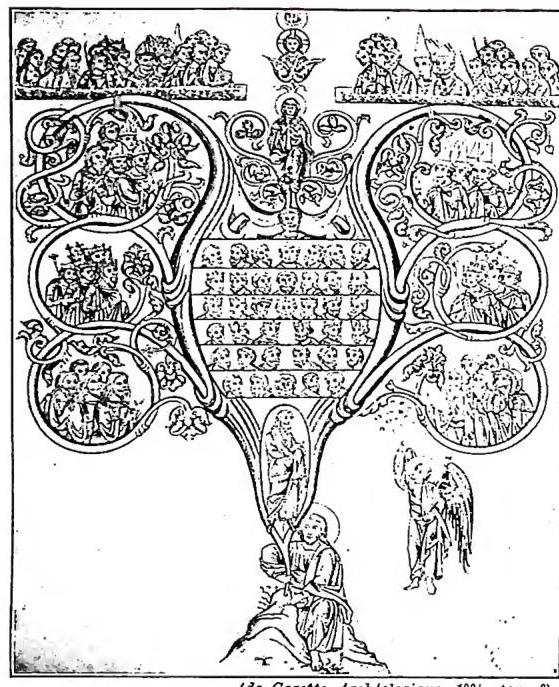
But in the chronicle of Guglielmo di Thorney it is stated that Abbot Ugo di Fleury had purchased on the Continent in 1901 a large bronze candelabrum “quod Jesse vocatur” for Westminster Abbey. According to E. Mâle, the representation of the a. of J. derived from representations of prophets, based on a sermon attributed in the Middle Ages to s. Agostino, which were held in France on Christmas Eve or on New Year’s Day. Yet as early as a manuscript of the 10th century from S. Marziale of Limoges, there is a representation of the a. of J. with Virgilio and the Sibyls.
It may therefore be that the origin of the scene is to be sought rather in the miniatures that fused the concept of Isaiah’s prophecy with the genealogy of the Savior, and thus in the commentaries of certain Fathers of the Church who identified Maria with the branches of the tree and Gesù with the flower blossoming at the top.
Certainly, especially in France, the theme was frequently reproduced in the 12th–16th centuries in cathedral windows, frescoes, portals, tapestries, enamels, ivories, illuminated Bibles, Evangeliar, Psalters, Books of Hours, etc.
In Germany it is found on the ceiling of Hildesheim (12th century); in Austria, on the vault of the central nave of Maria Saal (ca. 1480). In Italy, on the Romanesque pulpit of S. Piero in Scheraggio, now in S. Leonardo in Arcetri near Florence; on the portal of Genoa Cathedral, in the baptistery of Parma, on the door of S. Zeno in Verona, in a fresco in the cathedral of Naples, on a pillar of Orvieto Cathedral, etc.
In Spain, on a pillar of the cloister of S. Domingo de Silos, on the portal of Glory of S. Giacomo di Compostella, in the cloister of the cathedral of Pamplona in Burgos, in the Chapel of the Conception erected by Bishop Luis de Acuña, attributed to Diego la Cruz; at Zamora, on the tomb of the canon Juan de Grado (d. 1507).
In England, in York Cathedral. In 1169 the Crusaders commissioned the mosaicist Ephrem to execute the a. of J. in the church of Bethlehem, as is learned from a 16th-century copy by the pilgrim Quaremius. The a. of J. is also painted on the exterior of the church of Suscevitza in Bukovina. — Vedi tavv. XXXVII-XXXVIII.