Machine translation of the 1948–1954 Italian original. The original text is authoritative.
SILOS. - A Spanish Benedictine monastery in the diocese and province of Burgos, dedicated first to St. Sebastian and later to the abbot St. Dominic, probably founded in the Visigothic period and endowed by Count Fernán González in 919.
Its glory in the Middle Ages was the abbot St. Dominic (1041-
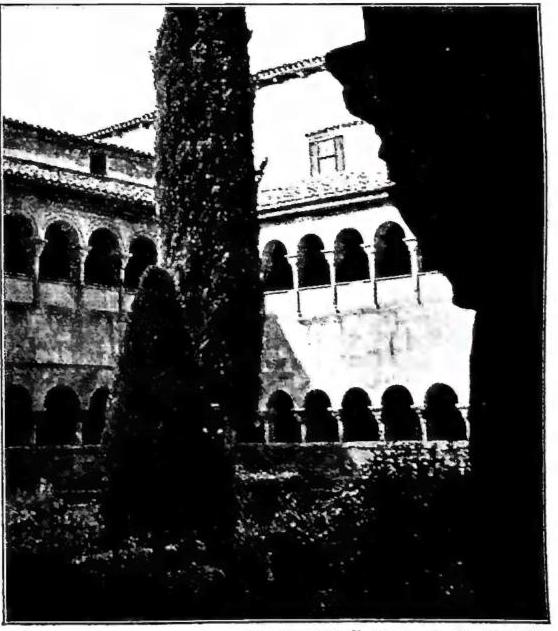
(courtesy of Msgr. A. P. Frutes) SILOS - Romanic courtyard (11th-12th centuries) - Silos.1073), who began the construction of the ancient church and the magnificent Romanic cloister, which still exists and is rich in characteristic sculptures from the 11th-12th centuries. In the Middle Ages, S. was an important cultural center. Suffice it to recall its Chronicon by Grimaldo, the activity of its copyists who left at the beginning of the 13th century a treasure of about 200 manuscripts, many of which are still preserved. Also noteworthy are the collection of art objects, the archive, and the library. The monastery of S. joined the Benedictine Congregation of Valladolid in 1512 and was suppressed by the liberal government in 1835; in 1880 it was restored by the Benedictines of Ligugé. Currently S. is known as a center of liturgical and historical studies; among other things, the journal Liturgia is published there.
BIBL.: M. Férotin, Recueil des chartes de l'abbaye de S., Parigi 1897; id., Hist. de l'abbaye de S., ivi 1897; L. Serrano, El real monast. de S. Domingo de S. (Burgos), su hist. y tesoro artist., Burgos 1926; W. Witchill - I. Pérez de Urbel, Los manuscritos del real monast. de S. Domingo de S., in Bol. de la Acad. de la Hist., 95 (1929), pp. 521-601; Cottineau, II, coll. 3036-37. Anscario Mundò
Cite this article
“SILOS.” Enciclopedia Cattolica, vol. XI (1953), p. 367. Azione Romana digital edition, https://azioneromana.com/article/silos.