
ROMANICA, ARTE. – The term “Romanesque” denotes that particular period of European artistic culture, spanning the 11th and 12th centuries, which stands midway between, on the one hand, Ottonian art (v.) and the Carolingian art (v.), and, on the other, the Gothic art (v.).
(photo: Bildarchiv d. Ö. Nationalbibliothra)
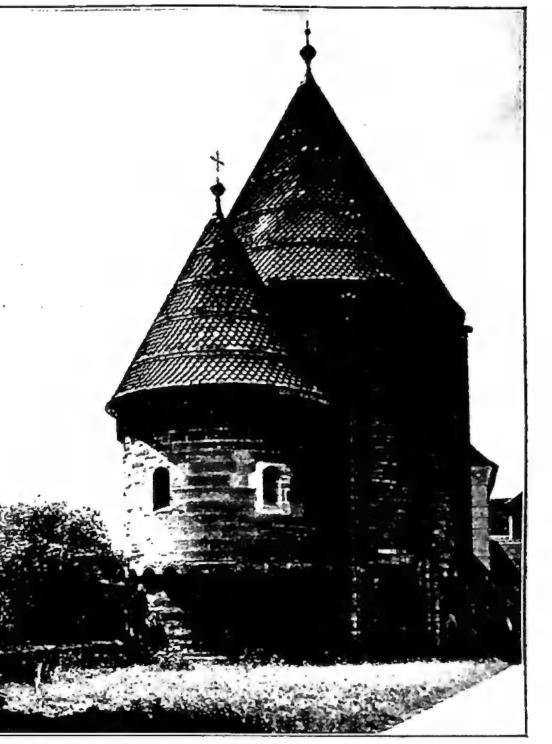
ROMANICA, ARTE – Ossuary in the late Romanesque style with recent restorations; the interior is decorated with frescoes – Hartberg (Styria).
It is not surprising that at the same time, in Spain, England, Sicily, and northern Latium, decorative forms of an unmistakably Arab character should appear; that in France, Pisa, and Apulia the same architectural forms deriving from Asia Minor should be encountered; that Lombard architects should reach as far as Scandinavia, or Roman sculptors be summoned to London to carve the tombs of the English kings, while those erecting churches in Burgundy or on the banks of the Rhine were confronting problems similar to those of those erecting churches in Milan and Bari.
(from Trésors d'art du moyen âge en Italie, Paris 1898, pl. 69)
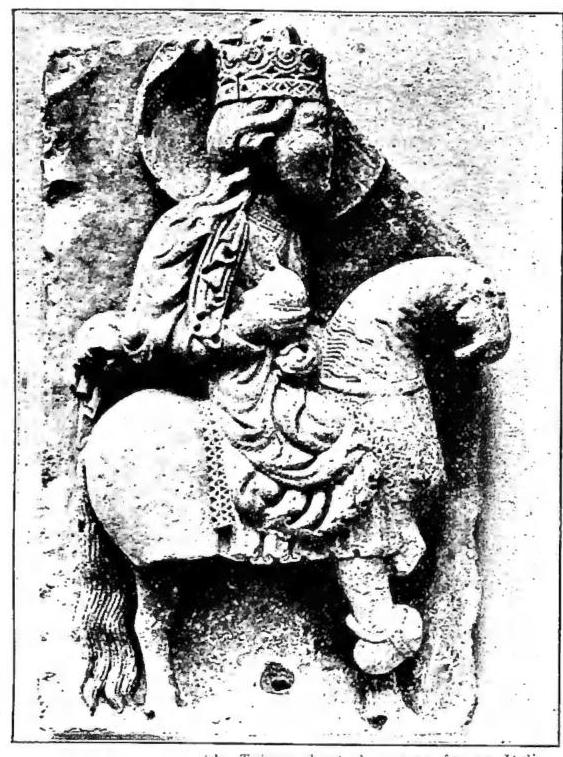
ROMANICA, ARTE - Fragment of an Adoration of the Magi. Tuscan art of the second half of the 12th century, originating from Lucca, Florence, Museo Bardini.
from the East, of Roland, of Alexander the Great, and evoke Rome la Grant, Thebes, and Troy.
In the field of architecture, one witnesses the definition and then the development of certain themes of the Carolingian period founded upon the tradition of Roman classicism. This applies above all to constructional technique, that is, to the manner of building pillars, vaults, arcades, and so forth. At the same time, elements drawn both from antiquity and from Byzantine and Iranian-Syrian sources are employed, the latter having entered France chiefly through Spain. Thus, from Catalonia there came to France a certain Eastern manner of vaulting, such as that found in the church of S. Filiberto at Tournus. The essential characteristics of French Romanesque architectural taste reveal themselves in different forms according to the region, although a sense of austere, ponderous grandeur is constant, as is the extremely widespread practice of vaulting over pillars, especially in the side aisles. Thus in Normandy, in the ancient ruined abbey church of Jumièges, in that of the Trinity, and in S. Stephen at Caen. In Poitou, on the other hand, the buildings have a more inward and restrained tone, as do the church of Notre-Dame and that of S. Ilario at Poitiers, the latter with seven naves and five domes. At the same time, in Burgundy, the great architectural school established in the gigantic structures of the ancient abbey of Cluny heralds, in the extremely slender lines of the central naves, the advance of Gothic taste. In Auvergne, the use of red, white, and black coloured stones then gave the buildings a wholly distinctive, often festive character. Thus in Notre-Dame at Clermont, in Notre-Dame du Puy, and in S. Paolo
Romanesque sculpture underwent a similar development, likewise marked by the qualitative superiority of French works over those of the other northern regions of Europe. Indeed, during the 11th century, although production was fairly abundant, the stonecutters seem to have struggled to draw from the marble human forms still marked by naivety and roughness. Yet the compositional sense is already harmonious, and sculpture, whose purpose is eminently decorative, subordinates every intention of naturalistic representation to this purpose, even in depictions narrating episodes from the Bible and the New Testament. In the 12th century, however, the sculptural forms that in the various French regions had already conformed to the taste and spirit of the architecture—and one should think of the Christ in Glory decorating the apsidal ambulatory of St-Sernin at Toulouse and the other sculptures in that church, as well as the sculptures of the cloister of the Badia and of S. Pietro at Moissac, or those of Notre-Dame la Grande at Poitiers, and of the portal of St-Trophinae at Arles, or that of Chartres Cathedral—increasingly incline toward the elegance, projection, upward surge, and spirituality of Gothic forms. In the anthropomorphic monsters of the gargoyles, in the dragons chasing one another up the façades of the cathedrals, and in the minute carving of friezes and cornices with vegetal motifs, often animated by an extraordinarily lively form, one can also clearly perceive the wholly Romanesque taste for the complex game of setting oneself problems bristling with technical difficulties; but perhaps even more evident is the desire to resolve in image form what until then had been the object of ancient barbaric terrors. In England, as in Spain, Romanesque sculpture, apart from the development of certain elements by then traditional in those regions, is for the most part indebted to the diffusion of French sculptural taste. In certain respects, the same may be said of Germany. Here, however, certain works, such as the wooden doors of the church of S. Maria del Campidoglio in Cologne, testify that, in wood sculpture, Germany was initially by no means behindhand
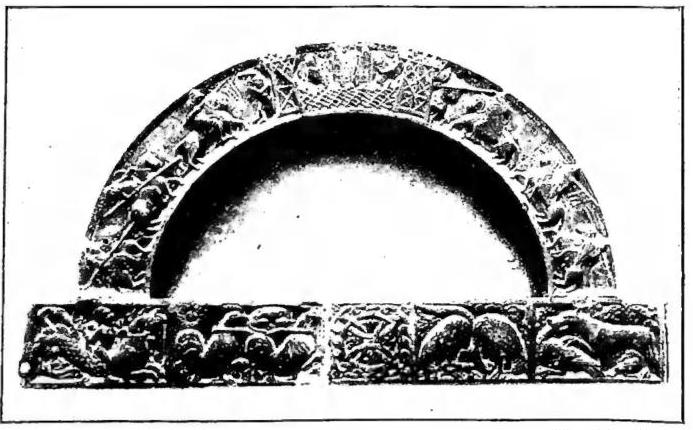
ROMANICA, ARTE - Scene from the Breton Cycle: a castle stormed by King Artù and his knights. Below: Aesopian fables. Sculptures by Niccolò (1099–1106) - Modena, Duomo, porta della Pescheria.
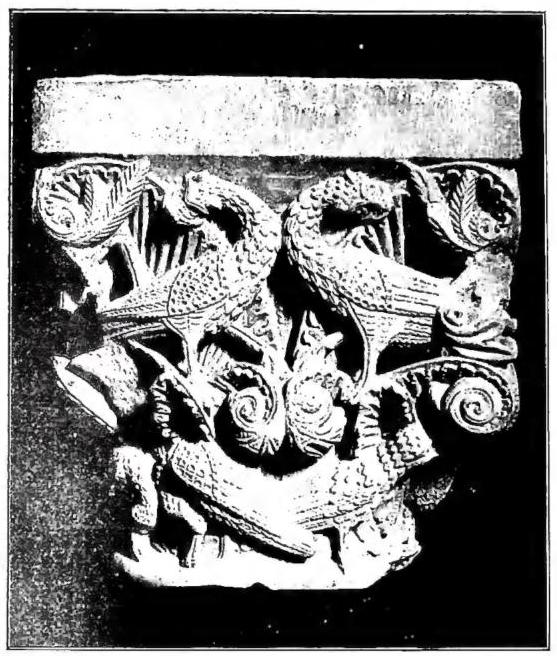
ROMANICA, ARTE - Capital of the cloister of the ancient cathedral of Lérida, discovered in 1925.
in comparison with France. This is particularly true of what, in the plastic arts, was then the reflection of the extremely lively Ottonian taste for figuration.
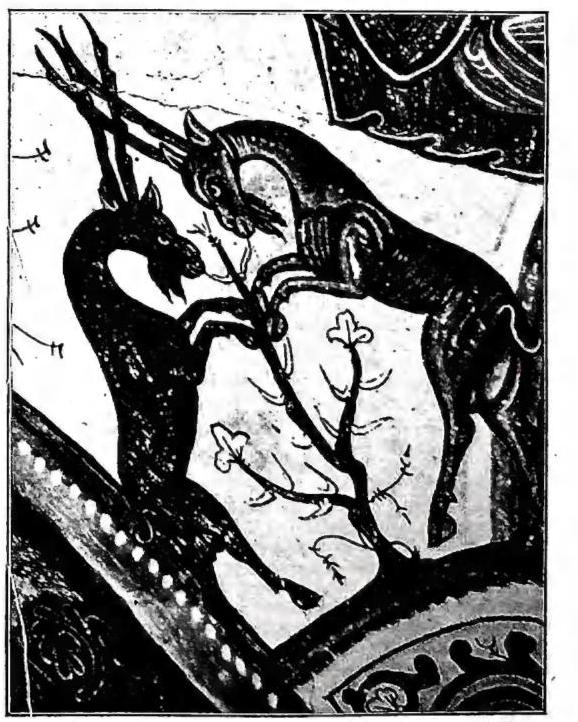
In painting too, what was produced in the European regions north of the Alps and in Spain seems, above all, to have been the logical prelude to the development of Gothic forms. The paintings that covered entire interiors and that, owing to a series of circumstances, have reached us only in very small part were, especially in the 11th century, executed in flat, uniform colours, in a very limited number of hues distributed within fields clearly defined by precise outlines. In such paintings, the foundation was very often, and not merely iconographically, provided by miniatures, whether of Eastern origin or derived from the major Carolingian or Ottonian centres of production. In Spain, the paintings of Tahul now in the Museum of Barcelona; in France, those of the abbey church of St-Savin (Vienne); in Germany, what remains of ancient paintings in the churches of the Rhineland—all testify to the same tendency to confine every expression within a narrative rhythm, within an arabesque that, soon, in the second half of the 12th century, would announce the new spirit of the Gothic taste. Italian figurative civilization, while maintaining during the centuries of the early Middle Ages its own logical mode of development and its own individual character, had come to be shaped chiefly according to the contributions made to it by the various contemporary cultures, whether Byzantine, barbarian, or Carolingian in character, with which it had come into contact. Upon reaching the 11th century, however, this figurative civilization, while by no means renouncing the contribution of every new element capable of enriching it, also acquired a new independence in relation to what was being done in the other regions of Europe. At that time, in fact, in Italy (v. ITALIA, VI. Arte, 3), while architectural forms, depressed for centuries, were being reunited in the almost sudden and widespread revival of building activity, painting and sculpture, which had likewise become extremely active, assumed distinctly new tones and increasingly conformed, in their direct modes of expression, to the character and temperament of the Italians.
In architecture, two distinct currents can then be discerned in Italy. The regions of the Po Valley (Piedmont, Lombardy, part of the Veneto, Emilia), as well as, in many respects, the regions east of the Apennines, participate, though with different accents and spirits, in the same architectural orientations characteristic of the regions of central Europe; whereas the regions facing the Tyrrhenian Sea, especially Campania, much of Lazio, and Tuscany, rework, with a new mentality and a new clarifying spirit, certain forms that sprang from the inner depths of the classical tradition, often humiliated but never extinguished in the immediately preceding centuries. Thus, while in the northern regions and in those on the Adriatic side there appears a constant use of, or aspiration to, raising complex buildings with pillars supporting ribbed vaults, loggias, and galleries, which, in an intricate interplay of shadows and light, emphasize the new values of architectural space then in the process of definition precisely at the heart of Europe, in the regions on the Tyrrhenian side there prevails, together with a love of the clear harmonies of columns, arches, and entablatures following one another toward the lofty, luminous apses, a love of broad, smooth walls, on which painters, inlayers, and mosaicists spread their beautiful chromatic fantasies. But alongside these two tendencies, sometimes fused with them and sometimes pure, with independent forms and accents, especially in the principal coastal centres and maritime cities, Eastern art in its various gradations also asserted itself, and with extraordinary richness of motifs. Thus in Sicily, in Apulia, in Campania, at Pisa, and above all at Venice, in that prodigy which is the basilica of S. Marco.
The profile of sculptural activity is no less lively and varied. In it one first observes a thorough clarification and differentiation of the decorative schemes of the early Middle Ages; then, also through the progressive elimination of the old symbolism, one arrives at a concrete vision of reality, whereby the human figure, as a new expression of beauty, frees itself wholly from the marble.
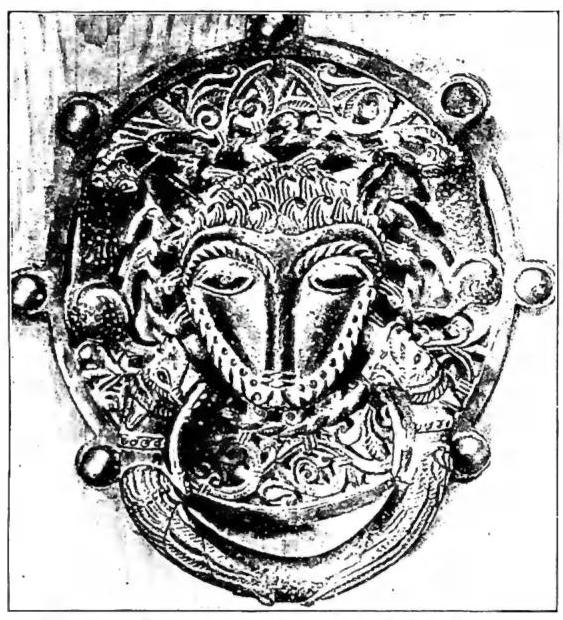
(from Trisors d'art du moyen âge en Italie, Paris 1932, vol. 2) ROMANICA, ARTE - Bronze door knocker, with a lion’s head (11th–12th century) - Susa, Cathedral Treasury.
Analogous movements were taking place in the field of painting. Here too, the problems that arise for anyone wishing to outline as clear a picture as possible of this development are infinite and extremely complex. A truly infinite number of frescoes, mosaics, and painted panels bears witness to the vitality and richness of a production often of the highest quality. There are so many such testimonies that one might say that between the eleventh and thirteenth centuries the covering of the walls of churches and palaces, and even of caves, with vivid colors had become a common practice among Italians. Italy was then a country of painters—painters who knew how to narrate with lively accents and clarity the stories and miracles of saints, as well as human actions and activities, in compositions where the human figure, the essential motif of the representation, assumed an expressive, spontaneous, and at the same time highly accomplished immediacy. Naturally, in Italian painting at that time, as in contemporary architecture and sculpture, the elements of earlier and contemporary cultures, both Eastern and Northern, often had essential importance; yet it is equally true that those same elements, which at times seem to dominate it, changed their tone in the very act of being adopted by Italians to narrate with liveliness and clarity, becoming themselves consonant with the mentality of those who expressed themselves through them with complete spontaneity. It thus becomes evident that the character assumed by the various pictorial currents of the Romanesque age in Italy possessed the same value and importance in the literary field as the « dolce stil novo », from which the new language of Dante was precisely to emerge out of dialectal forms.
Pietro Cavallini, Duccio di Buoninsegna, and Cenni di Pepi, known as Cimabue, are the three formidable individualities who bring the great cycle of Romanesque painting in Italy to a close. They conclude an age, but also announce a new one. And their gigantic figures then dominate the great cycle of art as those of the true patriarchs of that modern painting which recognizes in Giotto its first master. - Vedi tavv. LXXIX-LXXXII.