
PUGLIA. –
I. GEOGRAPHY
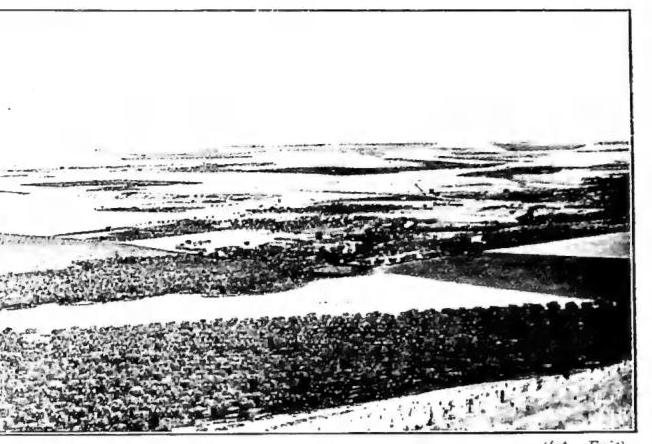
Historical region formed by the Adriatic slope of the Apennines SE of the Fortore and by the Salentine Peninsula.Four distinct natural units come together here: the Tavoliere, a vast alluvial plain between the Ofanto, the Fortore, and the Gargâno, in which the original steppe, populated by flocks of sheep, has been transformed into a granary; the Gargâno, a projecting limestone massif whose wooded ridges (M. Calvo, 1056 m) descend toward the Adriatic in terraces, clothed at lower levels with citrus groves (the Tavoliere and the Gargâno form the old Capitanata, or province of Foggia); the Murge (the land, or province, of Bari), likewise a karst plateau, interrupted by basins (dolines), and bounded to the E. by a flat and fertile coastal strip; and the Salentine Peninsula, which continues this plateau toward the S., between the Adriatic and the Ionian Sea, likewise descending in steps to the sea and with gentler hilly undulations (the Serre).
Extremely poor in surface water and with scant average annual precipitation (less than 500 mm in the lower Tavoliere and on the Taranto coast), concentrated moreover in the autumn and winter period, P. is territory suited to pasture (Murge) and agriculture, with a clear predominance, in the latter, of tree crops (especially olives and vines) over herbaceous crops (wheat; oats: one fifth of national production; tobacco in the Salentine Peninsula). P. supplies approximately one third of the oil produced in Italy, and holds first place on the national market for grapes and wine (in quantity). The production of dried fruit (almonds, figs), destined mostly for export, is also significant. Because of an absolute lack of energy and mineral raw materials, industry is limited to food processing (oil, wine, and milling); the mechanical industries concentrated in the naval port of Taranto are an exception. Fishing and commerce are active, aided by the great extent of the coastline and railway network.
(from S. P., De Jure naturae et gentium libri octo, Oxford 1911, opposite the title page)
PUFENDORF, SAMUEL von – Portrait. Anonymous, seventeenth century.
(Alinari photograph)
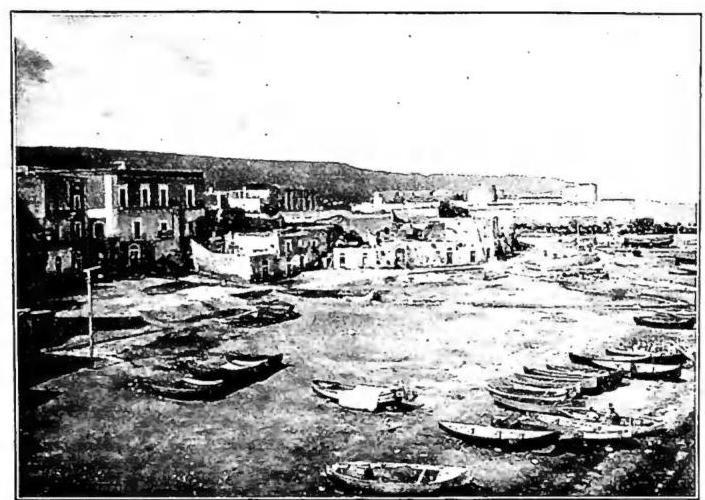
PUGLIA — View of Manfredonia. In the background, the Gargano promontory.
| Province | Area in sq. km | Population Census 1936–1 Jan. 1950 (in thousands of inhabitants) | Density per sq. km | Population of the provincial capital (in thousands of inhabitants) |
|---|---|---|---|---|
| Bari | 5,129 | 987 1,166 | 227 | 270 |
| Brindisi | 1,838 | 253 307 | 167 | 61 |
| Foggia | 7,184 | 523 644 | 90 | 90 |
| Jonio (Taranto) | 2,436 | 338 438 | 180 | 193 |
| Lecce | 2,759 | 514 599 | 217 | 62 |
| Puglia | 19,346 | 2,615 3,154 | 163 | — |
Giuseppe Caraci
II. HISTORY
During the course of more than two centuries, from the 3rd to the 4th century, Christianity spread throughout the region of Puglia: first the bishoprics of Ecana, Canosa, Siponto, Venosa, Acerenza, Gnazia, Trani, Erdonia, Carmignano, and perhaps Bari arose; later, those of Brindisi, Oria, Lecce, Gallipoli, and Taranto. After the fall of the Western Empire, possession of Puglia was long contested among the Byzantine emperors, the Lombards, and the Saracens; but the former always maintained a notable superiority over the other claimants and in the 10th century were able to reestablish their dominion over most of the country.P. was then governed by a “catapan” (or resident governor), from whom the territory directly governed by him took its name: “Catapanate” (later, in Italian, Capitanata). During this Byzantine predominance, the local churches, like those of Calabria, came under the jurisdiction of the patriarchs of Constantinople. In 1008 the Greek government ran serious danger because of an insurrection led by Melo of Bari, but it subsequently succeeded in suppressing II. In any event, not many years passed before the Normans arrived in the region; they were not slow to assert their power and erase the signs of Byzantine domination. At the outset of this new period, which was also that of the free communes, the maritime cities of Bari, Molfetta, Trani, Monopoli, etc., celebrated for their commerce with the East, adorned themselves with great basilicas and magnificent monuments. In 1043, Guglielmo d’Altavilla, known as Braccio di Ferro, the first to assume the title of count of P., established his residence—that is, the capital—at Melfi. In a short time this city rose in importance above the others, so much so that the popes themselves judged it suitable for the assembly of various councils. The Emperor Henry III granted the Normans investiture of the lands they had occupied; but Pope s. Leone IX offered the most vigorous resistance and would have continued it for years, had adverse fortune not advised him to accommodate himself to the accomplished fact. In 1059, after occupying Calabria, Roberto il Guiscardo assumed the title dux Apuliae et Calabriae, with the Church’s full recognition. The conquest of Sicily and the establishment of the Kingdom followed: thus, at the end of the 11th century, P. entered that phase of southern history in which the formation of a strong feudal monarchy yoked the various peoples inhabiting the lands from the borders of Lazio to Sicily to the same destiny. Norman domination was succeeded by that of the Swabians, then by Aragonese, Spanish, and Bourbon rule. The age of Federico II is among the most memorable in the region’s civil and artistic history and in its economic life: masters of the school of Foggia flourished at the Court, and magnificent monuments and splendid cathedral churches arose in various cities, such as that of Bitonto. In 1265 Pope Clement IV, reserving the Duchy of Benevento to the Church, invested Carlo d’Angiò with P., Calabria, and the Kingdoms of Naples and Sicily, together with an annual feudal payment of 8,000 ounces of gold and the church. At the death of Giovanna II (1435), P. suffered the consequences of the struggle fought over the succession between the Angevins and the Aragonese. Heavy taxes and ordinary and extraordinary levies continued for a long time and did not diminish even when, in the general Parliament of Naples, the cities swore allegiance to the new king Alfonso d’Aragona (1456). In the years 1479–80 the Turks raided the coasts, and in order to confront and repel them the inhabitants submitted to the gravest sacrifices. In the following years there were hostile acts on the part of the Republic of Venice, followed by a general internal insurrection that entered history under the name of the Conspiracy of the Barons. The region’s general conditions deteriorated greatly during Spanish predominance: latifundism, malaria, judicial and administrative disorder, and feudal tyranny weighed upon the population. In the 18th century, Puglian men of intelligence and learning took a significant part in the movement for the Kingdom’s civil renewal. During the reactionary movement of 1799, all P. was reoccupied by the forces of Cardinal Rufio, by various indigenous “mass leaders,” and by the allied troops. During the decade of French domination, various reforms were introduced, foremost among them the abolition of feudalism. Finally, in 1860, after the collapse of the Kingdom of the Two Sicilies, P. too became part of the Kingdom of Italy, remaining divided among the three ancient “justiciarates,” that is, the three present-day administrative districts: Capitanata, Terra di Bari, and Terra di Otranto.
III. CONCILIAR REGION
In accordance with the provision of the S. Congr. Concistoriale of 15 February–22 March 1919 (cf. AAS, 11 [1919], pp. 72–74 and 106), supplemented by that of 29 September 1933 (cf. AAS, 25 [1933], p. 466), P., as a conciliar region, is constituted by the union of several dioceses, but not of all those included in what is traditionally known as P. The present division, in fact, comprises the territories of four provinces (Bari, Brindisi, Lecce, and Taranto), bordering to the north, through the boundaries of the diocese of Cerignola, on the Benevento conciliar region, and to the east on the Lucanian and Calabrian region.The conciliar region comprises five metropolitan sees with their respective suffragans: Bari with Conversano, Ruvo, and Bitonto; Brindisi with Ostuni; Otranto with Gallipoli, Lecce, and Ugento; Taranto with Castellaneta and Oria; Trani and Barletta with Andria and Bisceglie; and nine immediately subject sees: Gravina and Irsina, Molfetta-Giovinazzo and Terlizzi; Monopoli, Nardò, and the nullus dioeceseos prelatures of Altamura and Acquaviva delle Fonti. The metropolitan church of Manfredonia, with the suffragan see of Viesti and the episcopal sees of Foggia and Troia, initially aggregated to the Apulian conciliar region, were subsequently united and assigned, together with their territory, to the Benevento region.
The Apulian regional seminary, established at Lecce and transferred to Molfetta, remained there with its various theological and secondary-school courses for the formation of the secular clergy; the seat, instead, of the courts of first instance, unified into a regional tribunal for matrimonial nullity cases in accordance with the motu proprio Qua cura of 31 December 1938, is Bari, with ordinary appeal to Benevento, the seat of the tribunal of the Benevento conciliar region. In P., all the metropolitans are residential archbishops and enjoy the special rights listed in can. 274 ff. of the CIC, as well as the distinctive vesture of the pallium.
IV. ART
Testimonies of prehistoric and protohistoric civilization document an intense life in the region, preceding its direct contacts with Greece. Various architectural structures, certainly very ancient, such as the so-called Centopietre of Patù—a small town near the site of the Messapian city of Veretum, destroyed by the Saracens in the 9th century—which is a small rectangular building formed of enormous squared blocks joined without mortar and covered by 26 large stones arranged in a double-pitched roof; or such as the remains of gigantic walls in other Messapian cities, such as Muro Leccese, Gnazia, and Manduria, are related to proto-Doric constructions, although, according to some scholars, in certain cases those walls may be regarded as works of the 4th and even the 3rd century B.C. Architectural structures of this kind are instead very rare and of little significance.(photo Gall. Muri Vaticani)
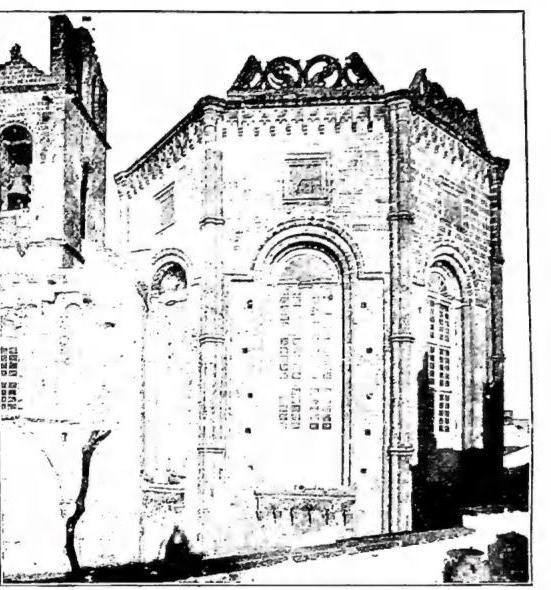
PUGLIA – Exterior of the octagonal dome of S. Caterina (1384–91). Galatina.
of purely Hellenic taste—a taste, moreover, abundantly attested throughout the region by the rich harvest of Greek vases, from the finest period, discovered in the necropolises, especially near Taranto. From these derives that magnificent flowering of the art of pottery which occurred in the region even during the period of Roman rule, partly connected precisely with Hellenic models, such as the Tanagra-type terracottas of Taranto, and partly, instead, a manifestation of a highly vigorous indigenous expressiveness.
(Alinari photograph)
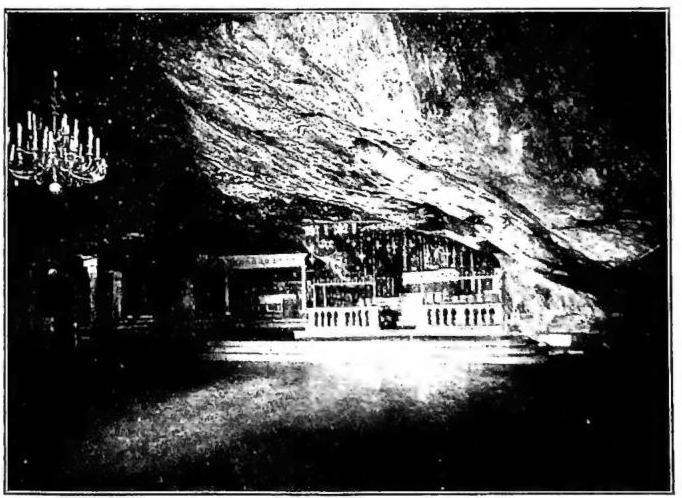
PUGLIA – Sanctuary grotto of S. Michele – Monte S. Angelo, Gargano.
(phot. Andersen)
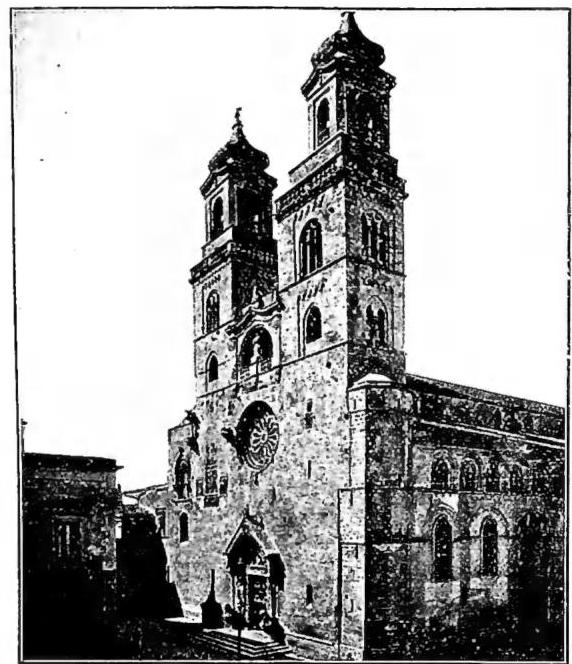
PUGLIA – Façade of the Cathedral (1316 and superstructures of the seventeenth century) – Altamura.
Through this, P. during the Romanesque period appears among the most interesting centres of architectural activity in all Europe. It was precisely the place where elements, tastes, and inventions bearing a northern imprint encountered others deriving from the Hellenistic East, and with them, rather than simply joining together, fused, blended, and resolved themselves in different spirits.
And it is in maritime P., where the architectural forms that were simultaneously flourishing in Lombardy seem to have prevailed—in Trani, Bitonto, Ruvo, and Bari—that the architectural members acquired a new upward thrust. While façades displayed pointed profiles flanked by those great square towers that also flank the apses, everywhere there was a sense of projection that seemed to herald the Gothic. But this constant characteristic of maritime P. disappears along the shores of the Gulf of Manfredonia and in Capitanata, where instead the clear spatial cadences of the classicism of the contemporary and older Hellenistic architecture of the coasts of Asia Minor prevail; at the same time, through a similarity of relations with the East, this architecture influenced the formation of Pisan architecture.
These classicizing and Oriental characteristics of the art of Capitanata, like the northern ones of maritime P., nevertheless remained confined to neither of the two territories. At times they mingled with one another, reduced to a highly expressive and richly coloured architectural language, fused through the activity of the stonecutters. These craftsmen too, curious and eager for the new, and highly skilled carvers, mingled Oriental and northern modes with classical reminiscences.
The masterpiece of Romanesque architecture in maritime P. is S. Nicola of Bari (eleventh–twelfth century), originally crowned also by a dome similar to the one visible at the crossing of the transept of the cathedral of the same city. The type of church created in S. Nicola was repeated, with greater or lesser degrees of originality, in other buildings of Puglia: in Bitonto, Trani, and Ruvo, in their respective cathedrals. An exemplary monument of Romanesque architecture in Capitanata is instead the cathedral of Troia, likewise begun in the eleventh century, as was the tomb of Bohemond at Canosa, with clear reflections of models from Asia Minor. They also appear in S. Leonardo and S. Maria of Siponto, in the cathedral of Monte S. Angelo, and in that of Foggia.
But in addition to these forms, others of an unmistakably Byzantine character also flourished in P. They appear in domed buildings such as the cathedral of Venosa, S. Andrea and S. Francesco of Trani, S. Pietro of Otranto, S. Margherita of Bisceglie, the cathedral of Molfetta, and S. Benedetto of Brindisi. Especially interesting is the so-called tomb of Rotari in the Gargano, surmounted by a very high dome and recalling forms derived from northern and Oriental influences, but above all Arab ones, both in its structure and in its decoration. During the Romanesque period P. was a highly vital centre of sculptural activity, of the greatest importance because of the influence it was later (in the thirteenth century) to exert throughout Italy. Byzantine, Muslim, and even northern elements that had flowed into the region in the eleventh and twelfth centuries were first elaborated with renewed vigour and a popular character. This is attested by the work of Accetto, who in the eleventh century carved the pulpit of the cathedral of Canosa, and by that of his contemporary Romualdo, who in the same cathedral carved the episcopal throne supported by two elephants. In 1088 the throne of S. Nicola of Bari was also executed, in which northern elements (the exaggerated caryatids), classical elements (the screens), and Muslim elements (the undercut friezes) create an ensemble full of strength and character.
Muslim reliefs are again found in capitals and portals in the cathedral and in S. Nicola of Bari, in the cathedral of Trani, in S. Nicola of Lecce, in the portal of Ruvo, and in the pulpit of the cathedral of Bitonto, a work of 1226 by a master Nicola. But already during the twelfth century, the appearance of human figures of a workmanship increasingly close to classical forms became more and more frequent in Puglian decoration. And while Puglian artists such as Barisano da Trani became skilled in casting large bronze doors, following methods used in Byzantium, classical forms appeared in the same portal of the cathedral of Troia, which in other respects recalls Muslim works; they also appeared in that of S. Nicola of Bari and in its marvellous window. Once again, serene classical forms appear in the figures of certain corbels of Castel del Monte, in others of the cathedral of Ruvo, in the portal of Anseramo da Trani, and in the portal of the church of the Rosario at Terlizzi; finally, they triumph solemnly in the pulpit of the cathedral of Ravello, in the image of Sigilgaida Rufolo carved by Nicola di Bartolomeo da Foggia (1272). These are the works known in the milieu from which emerged the sculptor who set Italian sculpture on new paths: Nicola da P., Nicola Pisano (v.).
Then, between the twelfth and thirteenth centuries, numerous buildings of a civil and military character were also constructed and decorated in P., including palaces, castles, and fortifications. Among them are the castles of Bari, Gioia del Colle, and Lucera, and, finest of all, Castel del Monte, built by Federico II near Andria, whose sculptural decorations also display elements of that Gothic taste which was to penetrate P. only later, almost always through the activity of Campanian decorators and builders.
Painting of the Romanesque period has left insufficient evidence in P. to permit a historical profile to be drawn. Whatever appears there from that period, like the earlier painting of the Basilian caves, is a dialectal or popular version of Byzantine themes. The activity of the mosaicists who executed the great pavement of the cathedral of Otranto and the fragmentary one of the cathedral of Trani is nevertheless interesting. In both, the cultural elements encountered are the same as those found in contemporary sculpture.
During the fourteenth century there was likewise little that was new in painting, except for the Tuscanizing elements derived from Neapolitan art, which recur here and there in works of lesser importance and find their fullest expression at the beginning of the fifteenth century in the paintings covering the interior of the church of S. Caterina of Galatina. It was then also that paintings from northern Italy, from the centres on the Adriatic slope, began to arrive in P. Such is the Madonna known as della disfida, which is in the cathedral of Barletta, a work by the Modenese painter Paolo Serafini.
But during the fifteenth century and thereafter in the sixteenth, whatever good painting P. possessed came entirely from Venice, and the little produced by local craftsmen bore a Venetian imprint. The Gentile Bellini in the cathedral of Monopoli, the Giovanni Bellini in the town hall of the same city, the works by Bartolomeo Vivarini in the cathedral of Modugno, in the Musco, and in S. Nicola of Bari, Palma il Vecchio in the cathedral of Monopoli, as well as the Tizianesque S. Francesco di Paola of Montrone, the Madonna by Paolo Veronese and the S. Rocco by Tintoretto in the cathedral of Bari, where there is also a Paris Bordone, while another painting attributed to that artist is in S. Maria Nuova of Terlizzi, where there is also a Nativity by Giovan Girolamo Savoldo, testify to the lively and intelligent interest that the people of Puglia then showed in the finest Venetian painting.
But during the Baroque period, while in architecture—especially at Lecce, in exceedingly sumptuous motifs that reveal affinities with contemporary works in Sicily and Spain—P. continued to assert its own independence and creative strength, and in sculpture the activity of local masters was confined precisely to the sculptural decoration of buildings, in painting the people of Puglia recognized Naples as the liveliest center of their interests. Thus, while a Ferroglio, a Luca Giordano, and a Bonito were active in P., Carlo Rosa of Bitonto, the Fracanzano family of Barletta, and above all Corrado Giaquinto of Molfetta made their fortunes in Naples in the field of art. Even during the nineteenth century, ties with the major artistic center of southern Italy remained alive, not only because of the few and mediocre buildings erected in P. by Neapolitan architects such as Alvino, but also because the finest artists from Puglia went to Naples to train and consequently took part in Neapolitan artistic life. Such were Antonio Bortone, a sculptor from Lecce (1844–1932), and the painters Saverio Altamura of Foggia (1826–97), Gioacchino Toma of Galatina (1838–91), and Giuseppe de Nittis of Barletta (1846–84).
V. FOLKLORE
The popular traditions of the Apulian region present a predominantly maritime character. The old customs of the fishermen’s work and life still survive, especially in the small ports.Precise customary rules govern relations between the boat owner and the crew, as well as the distribution of the catch, remuneration, and food. Traditional, too, are the methods of fishing with paranze (pairs of boats) and the procedures for selling fish, through an experienced auctioneer called siolecare. A lively religious sentiment impresses itself upon the whole popular maritime life of the people of Puglia. Thus, the formula for calling the teams of sailors to their night shift is «S. Nicola»; and images of the Saint and the Virgin, or of the Holy Family, are sometimes painted on the sides of the boats. Sea processions are also numerous: among the most characteristic are those of the Virgin of the Martyrs at Molfetta (8 Sept.), of S. Nicola at Bari (8 May), and of S. Teodoro at Brindisi (Aug.): the sacred image, placed upon an altar entrusted to a paranza decorated for the feast, is taken out to sea for a couple of miles, followed by hundreds of small boats, and returns triumphantly to the port.
(photo by Michele Ficarelli)
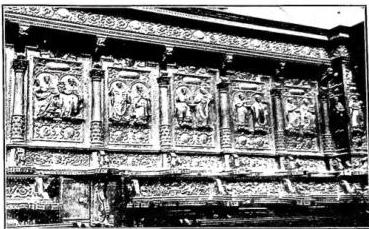
PUGLIA – Wooden choir of the Cathedral (17th century), from the Benedictine abbey of S. Maria dei Miracoli, near Andria – Bisceglie.
These mysteries, sometimes quite numerous and accompanied by a retinue of costumed characters, occur either in the simplest forms of dramatic processions with wooden statues, or in the more complex forms of genuine sacred performances, such as, for example, those held in the countryside around Taranto at Christmas (La sonata dei pastori) or at Epiphany (Il viaggio dei Re magi). Agricultural life, too, offers interesting folkloric aspects in P.: among rural constructions, mention should be made of the trulli, or casedde, which at Alberobello and in other small towns of the Ionian province form entire, highly distinctive urban clusters with their cupolas topped by gleaming white peaks. The olive harvest is governed by ancient work customs, as is the reaping in the sun-baked Tavoliere: it concludes with a cape canale, an ample meal offered by the landowner; during the grape harvest, distinctive lyrical songs resound. The tarantella originated in P.; it is a courtship dance performed by one or more couples to the sound of castanets. It takes its name from the city of Taranto, not from the tarantula, a poisonous spider whose bite often poses a grave danger to life. There is, indeed, also the dance of the tarantolati, which sometimes continues for twenty or thirty hours, but it has a therapeutic purpose and is clearly different from the graceful tarantella. The forms of folk art in P. often attain considerable expressive value: mention may be made of the saddle-panniers woven on household looms; embroideries and lace with characteristic motifs, such as, for example, the girandola; the rustic ceramics of Grottaglie, Ruvo, and other centers; and the tastefully carved chests and coffers. There is also an abundant harvest of songs and legends, which often display a profound elaboration of setting, even though they reflect patterns, themes, or models common to other regions. - Vedi tavv. VI-VIII.