
TARANTO, ARCHDIOCESE of. — Metropolitan see and capital city of the province of the same name in southern Italy (Apulia). It has an area of 1,100 sq km and a population of 338,000 inhabitants, of whom 337,000 are Catholics, distributed among 44 parishes served by 153 diocesan priests and 57 religious priests; it has one seminary, 12 male and 33 female religious communities (Ann. Pont. 1953, p. 416). Its suffragan dioceses are Castellaneta and Oria.
Many legends have arisen concerning the apostle Peter’s landing in this place, but there are no ancient documents on the subject.
A document from the eleventh or twelfth century (BHL, 1652–53), as in the case of other cities such as Gallipoli, Pisa, Pozzuoli, etc., relates that Peter came here in the year 45 from Antioch and that, immediately after landing, he cured a sick gardener named Amasius, later the first bishop of T., while the evangelist Mark, his traveling companion, evangelized an initial group of the
population. Now, apart from the doubt as to whether this Amasius ever really existed, not only is there no information that would lead us to believe he was a bishop, but there is no basis for crediting the legend itself, which certainly seems to have arisen long after the events it narrates. A second and later legend (the Iter Tarentinorum sanctorum Petri et Marci: BHL, 6679) changes the name of the first bishop and replaces Amasius with a Cataldus, who is rightly regarded as doubtful by modern historians. In reality, the latter would have been an Irish bishop of Rachau who came to T. in the seventh century (according to others in the fifth or even the eighth, though no period is supported by reliable data), either returning from the Holy Land or preparing to embark for it, but instead dying suddenly and being buried in the Cathedral.
The dramatic vicissitudes of the struggle against the Saracens, culminating in the bloody sack of 927, and the arduous reconstruction of the city favored the creation of the legend. In 1094, among the ruins of the ancient Cathedral, the Saint’s body was discovered
together with a small gold cross bearing his engraved name. The Saint’s fame assumed inconceivable proportions. Miracles and legends then arose which, rapidly disseminated, spread his cult to the most distant localities of southern Italy. Thus St. Cataldus became the city’s patron and was made its first bishop.
Leaving aside other minor accounts and the difficult problem of the origins, it must be observed that, even for the first successors who occupied the Tarentine see, Masona and Renovatus, mentioned in the catalogue, no document authorizes us to regard them as having existed. We must therefore come to the end of the fifth century to find at last an otherwise unidentified figure, documented in an epistle of Gelasius I (Jaffé-Wattenbach, 647), in which the Pope announces to the clergy and people the imminent consecration of the new bishop Peter (493), elsewhere erroneously cited under the name Innocentius. Then, for another century, no name is known. There is, it is true, mention of a Cataldus II—who would again be the well-known saint—but, in the absence of sources, there is disagreement as to whether he should be assigned to the sixth century or a later period, while it remains to be established that he was truly a bishop of T. Thus we arrive at 593, the year in which an Andrea appears (ibid., 1249–50), accused by Gregory the Great of an illicit way of life; he was followed by: Honorius (603; ibid., 1889)—and not the Giovanni mentioned in a false diploma (ibid., 1366)—who obtained from the same Pope permission to use the baptistery he had built in the church of S. Maria; Giovanni, present at the Lateran Council of 649 held by Martin I; Gervasius (659); Germanus, who took part in the Council of Constantinople in 680; and Caesarius, who appears at the Roman Council of S. Zaccaria (743). From the eighth to the tenth century there is no information. The city, terrorized by the Saracens, despite the assistance of Venice and the Emperor of the East, shared the fate of nearby Oria and was completely devastated. Twenty years later the Hungarians would not dare touch that heap of ruins. With the accession of Nicephorus Phocas to the throne, reconstruction of the city began in a safer location. Its revival must have been so rapid that, barely fifteen years later, not only was episcopal authority restored, but it had even been raised to archiepiscopal dignity. In 987 there is already mention of the first archbishop, Giovanni, who succeeded in having Pandulf I and Landulf III, princes of Benevento, grant the prelate of that city the church of S. Michele Arcangelo on Monte Gargano, together with its adjoining castle. The great authority with which the archbishop of Taranto appears to have been invested, certainly favored by the Byzantine monarch, has led some to think that for a certain period the Byzantine rite prevailed in T. But no source, so far as is known, offers evidence in this regard; on the contrary, everything seems to confirm that, despite the political situation, the prevailing rite was always the Latin.
After Giovanni, the Church’s catalogue is almost complete; a brief mention of the most notable figures and events will therefore suffice. In 1040 the archbishop Alessandro Faccipecora had to intervene to quell the tumult in Mottola, provoked by the election of the archdeacon; Drogone rebuilt the Cathedral in 1050 and in 1071 was present at the consecration of the church of Montecassino performed by Alexander II. Gualterius (1120–25), a Neapolitan, not only received concessions from Constance and Bohemond II, but was appointed by Roger, count of Sicily and, by the investiture of Pope Honorius, duke of Apulia, political and military governor of Benevento, where he built the basilica of S. Gennaro. Filippo (1138), elected by the antipope Anacletus II, was deposed the following year by the Roman Council; having withdrawn as a Cistercian to Clairvaux in France and been consecrated by St. Bernard, he received considerable assistance from him with Pope Eugene in order to obtain pardon, but, despite living a holy life, he was granted only the diaconate. His replacement, Giraldo, gathered the relics of St. Cataldus in a silver casket and settled the dispute between the archbishop of Brindisi and the Benedictine nuns of that city.
In 1217, upon the death of Gualterius II, elected the previous year, the Chapter, evading the papal regulations, appointed his successor; but Honorius III intervened and elected Nicola (1219), who four years later took part in the consecration of the church of Cosenza and in 1225 granted the Cistercians of S. Maria de Ferraria of Teano permission to found two monasteries in the diocese. Fr. Giorgio da Capua was Boniface VIII’s choice in 1301; after setting aside the Chapter’s two nominations, he came to heal a dangerous schism. He was a prudent man and counselor first to Charles II, then to Robert and to Filippo, prince of T.
A confused situation arose in the diocese upon the death of Giacomo d’Adria (1378), murdered by a certain Biagio Torto, apparently as a result of the worsening disagreement with the Chapter. Urban VI transferred Marino del Giudice there, but he was accused of conspiring against the Pontiff in favor of the antipope, deposed, imprisoned, and thrown into the sea near Genoa, enclosed in a sack. His successor is uncertain; some names have even been taken from another see. Finally, in 1391, Boniface IX elected Belisario, Benedictine abbot of S. Maria di Gualdo in Benevento. A few years later, T. found itself governed by three prelates belonging to opposing factions: Matteo or, according to others, Cardinal Francesco De Caris (1408), on the side of Benedict XIII; Rinaldo Brancacci, also a cardinal, on that of John XXIII; and the legitimate Ludovico Bonito, from Girgenti, elected by Innocent VII (1406). Of the first, who apparently stripped the Tarentine Church of various fiefs, nothing is known of his ultimate fate; the second, however, when peace had returned to the Church, resigned his dignity to Pope Martin V and died in Naples, where he is buried in the church of S. Angelo a Nido.
Many cardinals governed the see of Taranto. It will suffice to mention Cardinals Latino Orsini of Rome (1472) and his successor Giovanni d’Aragona (1478), son of Ferdinando, king of Naples; another Orsini in 1491 and Raffaele Riario (1504?), nephew of Sisto IV; Antonio Sanseverino (1528), Marco Antonio Colonna (1560), and, last but not least although he was not a cardinal, the Theatine Tommaso Caracciolo (1637), who died in the odour of sanctity. From 1703, the year in which Cardinal Francesco Pignatelli was transferred to Naples, the see remained vacant for a full ten years because of interference by the Emperor of Austria, and only in 1713, transferred from Potenza, did T. again receive its bishop in the person of Giambattista Stella of Modugno. There were numerous religious Orders in the diocese, whose convents and monasteries largely date from the 13th and 14th centuries; but there were also older communities, such as those of the Basilians and Benedictines, who occupied the two islands in the gulf known respectively as those of S. Pietro and S. Paolo.
MONUMENTS. — Goths, Byzantines, and Saracens passed through the city, and more than once the occupier and the pillager wreaked havoc on its monuments; one can therefore speak only of vestiges. Such is the Duomo, which rises in the heart of the old city. Its origins are shrouded in legend, and the dates that from time to time have been thought to establish them are likewise conjectures. It is known that the primitive church was dedicated to S. Maria del Popolo and that the Saracen sack brought about its almost total ruin.
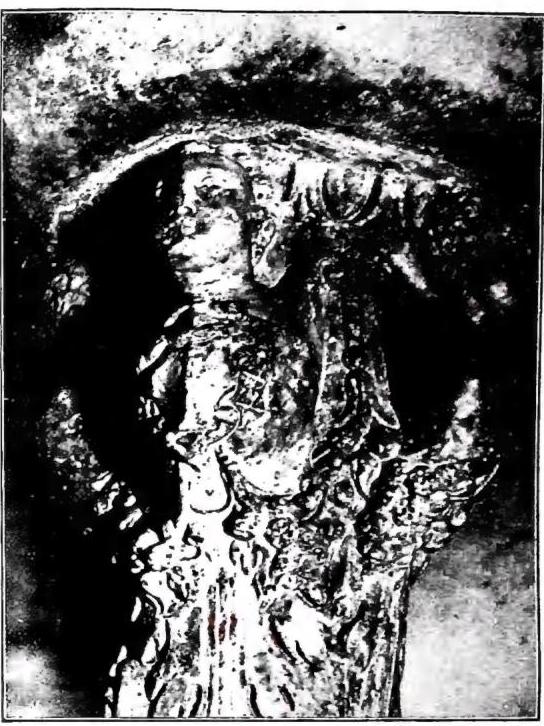
(phot. De Vincentis)
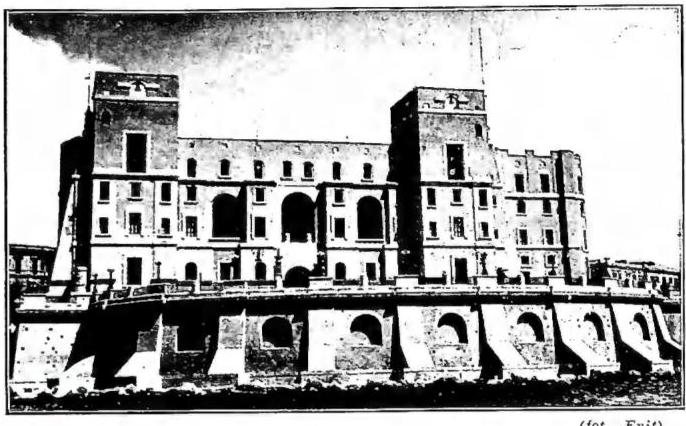
a parchment evangelary, various reliquaries, and the Saint’s pectoral cross, perhaps dating from the 7th–8th century. A stone inscription, now set into the wall near the bell-tower door, records that the Duomo once contained the tombs of illustrious figures, such as Filippo II d’Angiò and his wife Elisabetta d’Ungheria, Raimondello Orsini, etc., before they were destroyed during the various restoration works.
Among the other churches of T., that of S. Domenico deserves mention. It was founded by Federico II and given to the Benedictines, and was entitled s. Pietro Imperiale before passing to the Dominicans. Only the façade with its rose window and fine portal has remained intact, while the interior was transformed during the 16th–17th centuries.
Under the same Swabian Emperor, the abbey of s. Maria della Giustizia also arose in the vicinity of T.; it is mentioned in a bull of Paschal II dated 1113. The church, flanked by a tower, is now in ruins, and of the ancient structure it preserves only the single-gabled façade and two slightly ogival 13th-century portals, ornamented with Oriental motifs. Also in the vicinity of the city, in the village of Solito, there remains a Basilian crypt called S. Maria di Murivetere, with surviving frescoes, among which the Savior and the figures of the Virgin and the Baptist stand out; another cenobitic sanctuary is located in the district of «Le Petrose», and a third crypt, called S. Onofrio, with numerous fragments of frescoes, lies near the Todisco farmstead. Numerous other hermit caves are scattered throughout the province. — Vedi tav. CXXIV.