
TEATINI. — Chronologically the first of the Congregations of Clerics Regular to arise in the 16th century, it was founded in Rome on 14 September 1524 by St. Gaetano Thiene (v.), whose first companions were Gian Pietro Carafa, IV (v.) and already bishop of Chieti (Teate, whence the name T.), Bonifacio De' Colli, GHISLERI, MICHELE (v.). All four members of the Roman Oratory of Divine Love, they aimed at the reform of the clergy and the Christian people through an exemplary priestly life and the exercise of an austere apostolate.
The foundation, previously approved by Clement VII by a brief of 24 June 1524, not only authorized the founders to take their vows, but placed the nascent Order “under the immediate jurisdiction and special protection of the Holy See”; it granted them the faculty, after a year of probation, to receive other candidates, to establish their own constitutions, and conferred upon them the privileges of the Lateran Canons Regular. On the following 14 September, all four made their solemn profession in the Vatican Basilica, and Carafa was elected superior. They first lived on Via Leonina near S. Nicola ai Prefetti; they then moved to the Pincian Hill. Among the guests of the Clerics Regular were Lodovico da Fossombrone, a follower of Matteo da Biscio, and Paolo Giustiniani with Pietro Gabrielli da Fano, for whom Carafa smoothed out at the Court the difficulties surrounding the reforms of their respective Orders that they were then promoting. Ill-treated by the soldiery during the sack of Rome in 1527, they took refuge in Venice, where they established a permanent residence at S. Nicola da Tolentino. In September
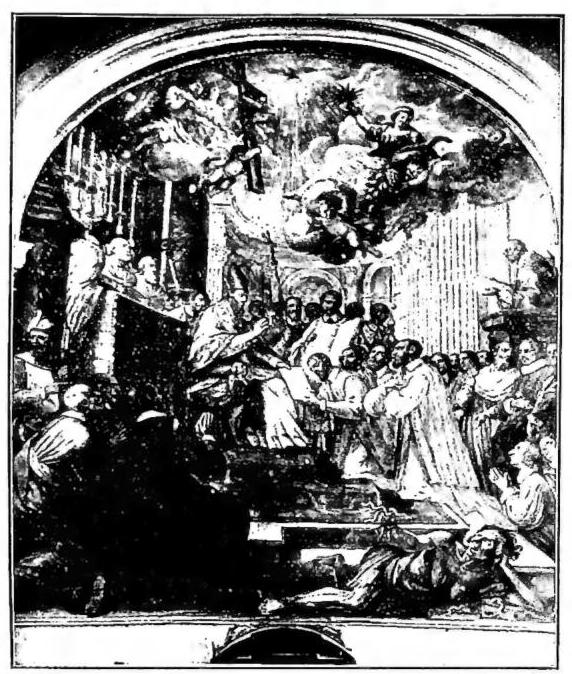
TEATINI - S. Gaetano, together with his companions, founds in the basilica of S. Pietro in Vaticano the Theatine Regular Clerics. Tempera by C. Maiola (1625–64?) - Ferrara, church of S. Maria della Pietà.
In the same year Gaetano Thiene succeeded Carafa as provost of the Congregation.
What distinguished Theatine life from the outset was the refusal to aspire to ecclesiastical benefices and the resolve to live in perfect poverty, without possessing revenues even in common, trusting in Providence for their sustenance. The T. devoted themselves to promoting among clergy and laity the ascetic life through frequent Communion, then very little practiced, and the exercise of charity toward the poor and the sick, as was also envisaged in the programme Divino Amore (v.), promoted and assisted by them. They were likewise concerned for the purity of Catholic doctrine and the dignity of worship, also devoting themselves to the revision of the books of the Roman liturgy in accordance with the authorization granted them by Clement VII (briefs of 24 June 1524 and 21 Jan. 1529).
After almost a decade of life, the T., by a brief of 7 March 1533, received full establishment and approval from Clement VII. In the same year s. Gaetano, the b. Giovanni Marinoni (v.), and other associates founded the first house in Napoli, where in 1538 they received from the viceroy Pedro de Toledo the church of S. Paolo Maggiore and there carried out a broad programme of reforms. The innovators Ochino, Valdés, and Vermigli found in them their most determined adversaries. They devoted themselves unstintingly to the hospital of the Incurabili, to the reform of women’s monasteries (the Domenicane della Sapienza, the Francescane di S. Maria in Gerusalemme, the Convertite agli Incurabili), and to social assistance: the Monte di Pietà, from which the Banco di Napoli derived, regards Thiene and Marinoni as its inspirers. Having increased in number, the T. always stood beside the Apostolic See in the reform of the Church. An active part in the Council of Trent was played by the English Theatine Tommaso Goldwel (1500–85), bishop of S. Asaph, to whom the thorny questions concerning England were entrusted; while in Roma the fathers Geremia Isachino and Bernardino Scotti, later a cardinal, Sirleto (v.) to important conciliar affairs. The primary part played by the T. in the reform of the Breviary, subsequently sanctioned by Pio V (1568), is documented, as is AGELIO (v.) and Vincenzo Massa in the Greek edition
of the Septuagint and in the revision of the Vulgate and the Martirologio romano. In 1588 the T., who until then had had the annual general chapter as their supreme governing body, elected Father Giambattista Milani as their first superior general. In 1604 the Constitutions drawn up in the General Chapters were approved by Clement VIII (28 July). Eminently commented upon by A. Caracciolo, they were reprinted in Paris by card. De Bérulle for use in the ecclesiastical reform he promoted. Updated and revised in accordance with the new Code, they were approved anew by Pio XII on 12 July 1948.
The Order is divided into provinces, houses, and residences. The superior general is elected for six years, the provincial and local superiors for three. Characteristic is the « vocalate », composed of fathers elected by the General Chapter on account of their personal qualities; they form the Provincial Chapter, which is charged, among other duties, with electing delegates to the General Chapter.
After the founder’s death, the Order, which had only the houses of Venezia, Napoli, and Verona, received from Paolo IV the house of S. Silvestro al Quirinale (1555), and then spread rapidly throughout Italy, where by the end of the seventeenth century it had more than fifty houses. Its expansion abroad was slower. In Spain, which received the T. in 1622, it established itself in Madrid, Saragozza, Barcellona, Salamanca, Alcalá, and Palma di Maiorca. There followed foundations in Parigi (1647), Lisbona (1648), Monaco di Baviera (1662), Praga (1663), Leopoli (Collegio Armeno, 1663), Varsavia, and Salisburgo (1663). At the same time the T. began their missionary activity. Father Michele Ghisleri, whose spiritual son was the founder mons. Giambattista Cives, played an important part in the establishment of the Collegio di Propaganda Fide; Urbano VIII entrusted to the T. its direction and the education of its students (1641). In 1626, led by the ven. Pietro Avitabile, they founded the missions of eastern Georgia and subsequently those of Mingrelia, Guria, and Imeretia, where 41 religious laboured unstintingly for more than seventy years. Famous GAETANO (v.), to whom is due the foundation of the Armenian Colleges of Costantinopoli and Leopoli, the latter being a centre of the union of the Armenians with the Roman Church. Other missionaries, led by Father Avitabile himself, settled in 1646 at Goa (Portuguese Indies), and thence in the regions of Golconda, Idalcan, Gerlim, and Coromandel. The ven. Antonio Ventimiglia evangelized Borneo, while other brethren went on to Sumatra (1702) and as far as Meliapur and Manila. Under the political conditions of nineteenth-century Europe, the Order underwent the fate common to the other religious families. Some houses in Italy withstood the suppressions until, through the protection of the b. Pio X, the Order revived; today, with houses in Italy, Spain, the United States, Argentina, Mexico, and Brazil, it is experiencing a confident rebirth.
In the new current of Christian spirituality, the T. are represented by the Combattimento spirituale Scupoli (v.), one of the fundamental treatises of modern spirituality. Particularly venerated by the T. is the Madonna della Purità, patroness of the Order, while the devotions practiced are those of the blue scapular of the Immacolata and of the vow in favour of the souls in Purgatory, explained and propagated by Father Gaspare de Olden (v.). The Order always continued its original concern for the splendour of divine worship and liturgical life, as is evident in its writers on these subjects, such as Tomasi and Merati, and in the magnificent churches built for the most part by Theatine architects (Grimaldi and Guarini [v.]).
The Order has two saints: ANDREA AVELLINO, SANTO (v.); three blesseds: Giovanni Marinoni (v.), Paolo card. GUIDO D'AREZZO (v.), and Giuseppe card. Tomasi; and a considerable number of venerables. It has produced one pope, Paolo IV (Carafa), eight cardinals, and more than 250 bishops, for which reason it deserved in its early days the appellation of « Seminary of bishops ». Many others, moreover, have distinguished themselves in sacred and secular learning and in the arts: theologians (Diana, Pasqualigo, Verani), biblical scholars (Agelli [v.]), liturgists, orientalists (Galano [v.], Lamberti), philosophers (Ventura [v.]), historians (A. Caracciolo [v.], Silos, Paciaudi), mathematicians, astronomers (Piazzi [v.], Cossali), architects, and painters (Zoccolini, Galletti).
The habit of the T. is that of ecclesiastics, with a sash hanging from the right side; their coat of arms: the Cross upon the three mounts; their motto: Quaerito primum Regnum Dei.
Teatine. - S. Gaetano did not establish, under his own Rule, any female congregation. The religious women of the Congregazione dell'Immacolata, founded by the ven. Orsola Benincasa (1547–1618), are, however, Theatines; from their very beginnings they have been entrusted to the care and direction of the T. and have their Constitutions. They devote themselves to the education of youth and to missionary works. - Vedi tav. CXXXI.
Sources: the manuscript sources for the history of the Order are held in the principal archives: the General Archives in Rome and the Archives of the T. in Naples (National Library, T. collection, and State Archives, suppressed monasteries, S. Paolo Maggiore). Fundamental works: G. B. Del Tufo, Ist. della religione dei Padri Chier. Regol., Rome 1609; id., Supplemento all'Istoria..., there 1614; A. Caracciolo, De Vita Pauli IV, Pont. Max., Cologne 1612; G. Silos, Historiarum Cleric. Regul..., 3 vols., Rome-Palermo 1650-1666; B. Ferro, Ist. delle missioni dei Chier. Regol. T., 2 vols., Rome 1704-1705; A. F. Vezzosi, Scritt. de' Chier. Regol., 2 vols., Rome 1780; De Maulde-Salvadori, S. Gaetano da Thiene e la Riforma catt. ital. (1480-1527), Rome 1911; P. Paschini, S. Gaetano Thiene, Gian Pietro Carafa e le origini dei Chier. Regol. T., Rome 1926; C. Wessels, De Theatijum op Borneo en Sumatra (1688-1764), in Histor. Tijschrift, 9 (1936), pp. 205-43; the lives of s. Gaetano by P. Chiminelli (Vicenza 1948) and by A. Veny-Ballester (Barcelona 1950), and the periodic studies in Regnum Dei - Collectanea Theatina, quarterly journal, Rome (since 1945); F. Andreu, I T., in Ordini e congregaz. relig. edited by M. Escobar, I. Turin 1952, pp. 365-607. Francesco Andreu