
SARAGOSSA (ZARAGOZA), ARCHDIOCESE of — City and metropolitan archdiocese of Aragon (Spain), situated in the civil province of the same name and in a large part of that of Teruel. It has one parish in Navarre, while the parish of S. Engratia, in the city of S. itself, belongs to the diocese of Huesca. The city of S. was defined by Isidore of Seville as «loci amoenitate, deliciis prestantior civitatibus Hispaniae cunctis».
The area of the archdiocese is 20,409 sq. km., with a population of 570,000 inhabitants, all Catholics, distributed
among 371 parishes, served by 474 diocesan priests and 257 religious priests. It has three seminaries: the Royal Seminary of S. Charles Borromeo, founded in 1588 and entrusted to the Jesuits, who remained there until their expulsion under Charles III; the Pontifical Seminary of S. Valerius, founded in 1788; and the minor seminary of Belchite. There are also 22 male and 105 female religious communities (Ann. Pont., 1952, p. 369).
The city on the right bank of the Ebro was inhabited by the Cantabri and was called Salduba or Salluvia; destroyed in 45 B.C., it was rebuilt by the Romans, who called it «Colonia Caesar Augusta». It was invaded in 409 by the Vandals; in 452 by the Suebi; around 466 by the Visigoths; and around 714 by the Arabs, who called it Saraquetah, whence its present name. The Arabs made it the capital of one of the states that arose after the destruction of the Caliphate of Cordoba. Contested by the kings of Aragon and Castile, it was conquered by Alfonso I of Aragon, known as the Batallador, on 19 December 1118; it then flourished until it became the centre of Aragonese political life, a primacy it lost with the formation of the Kingdom of Spain. It revolted unsuccessfully at the end of the sixteenth century; Philip II deprived it of a large part of its fifteenth-century administrative constitutions, which had served as models for other cities of the Kingdom of Aragon. Having recovered in order to support Charles of Austria, it was exhausted by Philip V. In the war against Napoleon, almost half of its citizens fell during two months of heroic siege, which earned the city the title of «siempre heroica».
Christianity in S. is attested from the middle of the third century; in 254 s. Cyprian calls its bishop Felix «fidei cultor ac defensor veritatis» (PL 3, 1066 A; ed. G. Bayard, II, Paris 1925, ep. 67, 6, p. 231). At the beginning of the fourth century the bishop of S. appears at the Council of Elvira.
Among the bishops of S. before the Arab invasion are remembered Maximus (c. 592–619), who was present at the Synods of Barcelona and Egara; he was succeeded by s. Braulius (v.), who attended the Fourth, Fifth, and Sixth Councils of Toledo; then by Samuel Taio (v.), who attended the Synods of Toledo in 653, 655, and 656 and was the author of the Libri Sententiarum (PL 80, 727–990; Z. García Villada, Historia eclesiástica de España, II, 11, Madrid 1933, pp. 90 ff.). During the Arab invasion, the bishops known are Senior (c. 850), Elna, who took refuge in Oviedo in 890, and Paternus, who, having been sent to Cluny, later introduced its reform into the abbey of S. Juan de la Peña and at S. Salvador de Leyre. After the reconquest, the first bishop was Pedro de Librana, confirmed by Callistus II. Among his successors is remembered Bernardo (1138–52), who instituted canons in the two cathedrals of S. Saviour and Our Lady of the Pillar. In response to the requests of King James II of Aragon, Pope John XXIII elevated the diocese of S. to a metropolitan see on 18 June 1318, assigning to it as suffragans the sees of Calahorra, Tarazona, Pamplona, Huesca, and Segorbe. The Concordat of 1851 brought further modifications; today its suffragans are Albarracin, Barbastro, Huesca, Jaca, Pamplona, Tarazona, Teruel, and Tudela. The first archbishop of S. was P. Lopez de Luna; his successors belonged to the house of Aragon for approximately a century, namely John (1458), Alonso (1478–1520), John II (1520–30), and Fernando (1539–75), formerly abbot of the Cistercian monastery of Veruela (Cottineau, II, cols. 3349–50). Archbishop García Fernández de Heredia was murdered in 1411 by Antonio de Luna.
Among the archbishops raised to the cardinalate are notable Guilelmo Campfullas (1347–51), Manuel García Gil (1858–1881), who was one of the theologians at the First Vatican Council, Fr. de Paula Benavides y Navarrete (1881–94), and Cardinal J. Soldevila y Romero, assassinated in 1923 (AAS, 15 [1923], p. 605).
Synods and Martyrs. — In 380, with the participation of 10 Spanish bishops and 2 from Gaul, the first Synod against Priscillianism was held; the second was held on 1 November 592 by Bishop Magnus, the third in 691 under Bishop Valdaredo, and a fourth by Archbishop Andrea Santos (1578–85) for the implementation of the canons of the Council of Trent. Vincent (v.), martyred in 304 at Sagunto, belonged to the clergy of S.; this is attested by Prudentius, who dedicated to him poem 4 of his Περιστεράνων. The same poet recalls the names of 18 martyrs of S., namely Optatus, Lupercus,
Successus, Martial, Urbanus, Julius, Quintilian, Publius, Fronto, Felix, Caecilianus, Evotus, Primitivus, Apodemus, four named Saturninus, and three confessors: Engratia, Caius, and Crementius (ibid., vv. 145–64). The four bearing the name Saturninus are replaced by Eugenius of Toledo with Cassianus, Januarius, Matutinus, and Faustus (Carmen de Basilica sanctorum XVIII martyrum, IX, 15–20, in MGH, Auctores antiquus., XIV, p. 240), names that recur in the Mozarabic Sacramentary (M. Ferotin, Le liber mozarabicus Sacramentorum et les manuscrits mozarabiques, Paris 1912, p. 276). H. Delehaye observes that the names Faustus, Januarius, and Martial correspond to the three martyrs of Cordoba (Les origines du culte des martyrs, 2nd ed., Brussels 1933, p. 364). In 1250, at the time of Bishop A. de Peralto, the Jews crucified the child s. Dominguito del Val, whose relics are preserved in the chapel dedicated to him in the Cathedral.
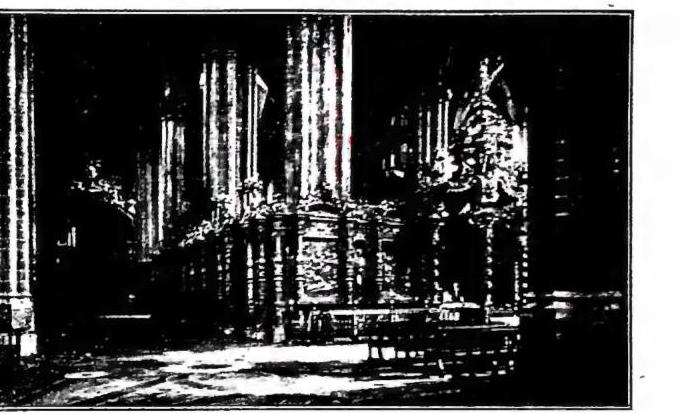
(Int. Garrabella)
SARAGOZZA (ZARAGOZA), ARCIDIOCESI di “Side nave of the “Seo” (1490 and following years) — Saragozza.
The University was founded by Pope Sixtus IV in 1474. It received privileges from King Carlo I and from Popes Giulio III and Paolo IV. The building was erected in 1593 through the munificence of P. Cerbuna, but it was damaged by the French in 1809, when the Library was also destroyed; it was later reorganized. S. also has a Provincial Archaeological Museum, a Museum of Paintings, a Commercial Museum of Aragona (1910), and the ethnographic section (Casa Ansoana). — Vedi plate CXXIII.