
OVIEDO, DIOCESIS of. – Capital city of the province of Asturias and seat of the homonymous diocese in Spain, which also encompasses a large part of the provinces of Lugo, León, Zamora and Santander.
It has an area of 13,560 sq km, with a population of 1,300,000 inhabitants, of whom 1,200,040 are Catholics, distributed among 1,150 parishes served by 737 diocesan priests and 180 religious priests; it has a major and a minor seminary, 20 male and 95 female religious communities (Ann. Pont., 1952, p. 306).
The diocese was founded in 805 under Alfonso II. Around the 10th century it was raised to metropolitan status; subsequently it lost this dignity and became, as it still is, a suffragan of Santiago de Compostella. In 1105 Pope Paschal II exempted it, and it remained so until the Concordat of 1851. The Cathedral is Gothic, with a transept and choir; it has three portals on the main façade, erected in 1388–1498 to replace the earlier one built in 802.
Its tower is the finest in Spanish Gothic, having been seriously damaged in the Spanish Civil War but re-
(phot. May)
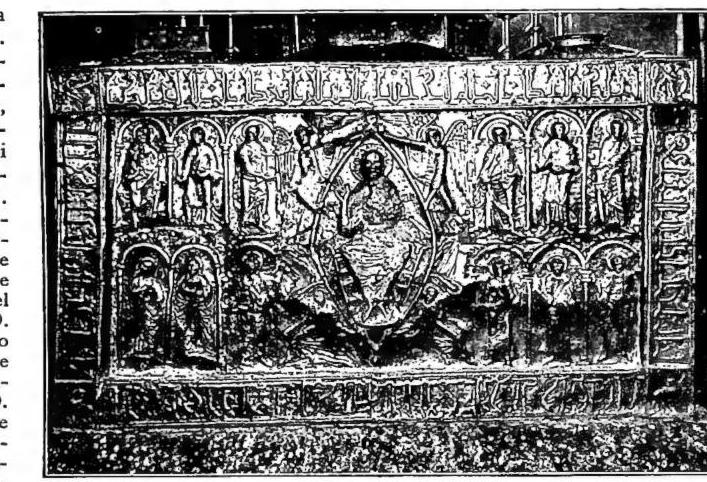
OVIEDO, DIOCESIS of. – Side of the reliquary chest in repoussé silver, with an inscription in Arabic and Latin, a gift from Alfonso VI (ca. 1075) – Oviedo, Cathedral, «Cámara santa».