
MICHELE, ARCANGELO. -
I. IN SACRED SCRIPTURE
M. (Hebr. Mīkhā’el “Who [is] like God?”) appears four times in the Bible. In Dan. 10:13, 21 he is presented as “one of the chief princes” and as the particular protector of the Jewish people (tarkhem). In Dan. 12:1 the character of “M., the great prince, who stands guard over the children of the people” of Israel is specified more fully; he is assigned the task of defending the elect at a dramatic moment which, as emerges from the context, coincides with the general resurrection connected with God’s judgment. In the New Testament M. is mentioned in Iud. 9 (where he is called an archangel, a more precise designation than the periphrasis used by Daniel and in Apoc. 12:7).Jude alludes to a struggle between M. and Satan over the body of Moses. The episode is unknown to the Old Testament, and today it is commonly admitted, as it was by Origen (De principiis, III, II, 1: CB, V, 244), that the inspired author is referring to the account in the apocryphal Assumption or Ascension of Moses. Whether or not literary dependence is acknowledged, it may be held that Jude uses a Jewish tradition as an argument ad hominem, without pronouncing on its historical value. The episode is also affirmed by the Slavonic recension of the Wisdom of Moses (16), while the midhrā' Deut. (Dēbharim) Rabbā' 11 (207 c) speaks of an altercation preceding the death of Moses.
In Apoc. 12:7 another struggle between M. and Satan is described, more fierce and momentous. M. is generally identified with the archangel who, in I Thess. 4:16, is described as the great summoner of the dead on the day of the resurrection and judgment. A smaller number of biblical scholars see the work of this archangel mentioned in the famous “obstacle” (ὁ χάτζησις; II Thess. 2:7) that hinders the activity of the Antichrist.
Jewish tradition insists greatly on M.’s character as protector of Israel (Ethiopic Enoch, 20:5; Assumption of Moses, 10:2) and as intercessor with God (Ethiopic Enoch, 40:9; Testament of Levi, 5:6; Testament of Dan, 6:2). He is the head of the archstrategoi of the armies of the Lord. He is “revealer, executor of justice, and also guardian of Israel” (G. Bonsirven, Il giudaismo palestinese al tempo di Gesù Cristo, Italian trans., Turin 1950, p. 30). At times he is also called the teacher of Moses and the high priest; much more often he is presented as the guide of souls after death, or psychopomp (ψυχοσχετὰς).
M. receives analogous attributes in Christian tradition. For example, as early as the Epistola Apostolorum he is called ἀρχιστράτηγος, or chief of the heavenly strategoi (C. Schmidt, Gespräche Jesu mit seinen Jüngern nach der Auferstehung [Texte und Untersuchungen, 43], Leipzig 1919, p. 285). He is the protector of the Church. In the Ascension of Isaiah, 53:16, M., defined as prince of the Angels, removes the stone from Jesus’ tomb; and in the Transitus b. Mariae Virg., 16 (C. Tischendorf, Apocalypses apocryphae, Leipzig 1866, p. 135), he performs the same act with regard to Mary’s tomb.
Sacred Scripture he is explicitly mentioned only three times, always in the role of defender and warrior: Dan. 10:13, 21; 12:1 (“princeps magnus,” in contrast with the prince of the Persians); Iud. 9 (dispute with the devil); Apoc. 12:7 (battle with the “dragon”). From these references there subsequently developed the distinctive character of the cult of s. M.
1. East
The first Christian center of the cult of s. M. was located in Asia Minor, in Phrygia, at CheroTopa (near Colossae), which may date back to the earliest centuries; in the same region there was later the sanctuary of Chonae, known since the 4th century.On the Bosporus the sanctuary of Sosthene arose, while in the new capital Constantinople Constantine himself built the Michailion, which was subsequently followed by at least another fifteen churches dedicated to the holy Archangel. His feast was celebrated on 8 November. Another very ancient center in the East was Egypt, especially Alexandria, where the feast, on 12 June, was associated with the rising of the Nile, a matter of the greatest importance for the life of the country. The Copts and Syrians also venerate s. M.; the former have marked him in the calendar no fewer than seven times, the latter on 6 September.
2. West
The cult of s. M. in the West was almost certainly imported from the East. Very ancient churches, attested as early as the 5th century, are found in Italy—for example, in Milan, Piacenza, Genoa, Ravenna, Perugia, Spoleto, and especially Rome. The present feast of 29 September is precisely a feast of Roman origin.The Leonine Sacramentary, under the date of 30 September, offers five Mass formularies commemorating the dedication of a basilica of S. M. on the Via Salaria, at the sixth milestone (Castel Giubileo). In the Gelasian and Gregorian Sacramentaries, by contrast, the anniversary of the dedication is found on 29 September. The Hieronymian Martyrology likewise records on 29 September the dedication of the basilica on the Salaria; under the same date it appears in the Mozarabic calendars and in the Neapolitan Marble Calendar.
The Sanctuary of the Salaria is also mentioned in the itinerary da locis (R. Valentini and G. Zucchetti, Codice topografico della città di Roma, II, Rome 1942, p. 117). In Rome, Pope Symmachus (498–514) enlarged the basilica of the archangel M. in the vico Patricio (Lib. Pont., I, p. 262). At the summit of Hadrian’s mausoleum, an oratory was supposedly erected, according to Ado, by Boniface IV (608–15) in honor of s. M. A deaconry “in foro piscium,” near the Portico of Octavia, was erected by Theodore, uncle of Hadrian I (between 755 and 770; Lib. Pont., I, p. 514, n. 2).
An oratory in his honor, dating from the 8th century, was also located in the vestibule that connected with the Vatican Basilica the mausoleum transformed into the church of S. Petronilla (ibid. p. 97). S. M. “de portico,” near St. Peter’s, belonging to the Schola Frisorum, is mentioned in a bull of Leo IV of 854; it is now called SS. M. e Magno.
An oratory of S. Angeli de Augusta was also built atop the mausoleum of Augustus, as attested by bulls of 951 and 962 and by church catalogues up to the 15th century. Another oratory stood on the Janiculum near S. Pietro in Montorio, mentioned in a bull of Callistus II of 1123 and in catalogues up to the 16th century. There was also a church of S. Angeli da Renicco or prope montem Iordanum, which appears in a bull of Urban III of 1186 and is now SS. Celso e Giuliano. In all these churches the feast of s. M. falls on 29 September and includes in its formulary, besides s. M., all the angelic choirs.
Later recensions of the Hieronymian Martyrology introduce the notice of the sanctuary of S. M. on Mount Gargano. The Synods of Tours, 558 (can. 61), and Mainz, 813 (can. 36), attest the feast in the Frankish and Germanic regions; in 995 it became a feast of obligation; Ethelred, king of England, prescribed for it in 1014 a vigil and a three-day fast. In 1917 the feast was raised to a double of the first class.
The second feast of s. M., that of 8 May, was
originally a purely local feast of the Church of Siponto, now Manfredonia, and concerned a rural sanctuary situated within one of the many caves of Mount Gargano. It is certain that on 8 May 663, near Siponto, a naval battle took place between the Lombards and the Saracens; the victorious Lombards attributed the victory to s. M., who was greatly venerated in these parts, precisely in his Gargano sanctuary. A fabulous legend, which later also entered the various medieval martyrologies (the primitive Hieronymian Martyrology knows nothing at all of a feast of s. M. on 8 May), recounts the “inventio basilicae S. Angeli,” which was subsequently dated as far back as 8 May 492 or 494. But, as everything suggests, this is simply the anniversary of the dedication of the Gargano sanctuary, certainly already in existence in the 6th century. This local feast subsequently spread, through the Lombards, into Lombardy and beyond, and thus became a universal feast. Benedict XIV, in his attempted liturgical reform, was determined to reduce this feast once more to a local feast of Siponto. The present Roman Martyrology, following the medieval martyrologists, confuses everything, assigning to 8 May an apparition of s. M. and to 29 September the anniversary of the dedication of the church on Mount Gargano; the memory of the Roman feast has been lost. Finally, another extremely important center of the cult of s. M. must be mentioned, on Mount Tumba in Normandy, famous under the name of Mont-St-Michel. The Sanctuary, like the one at Gargano, was founded in 709 and became a center from which that cult spread throughout the Germanic countries and peoples, where it subsequently achieved immense diffusion. It may generally be stated that the churches of S. M. are among the oldest churches.
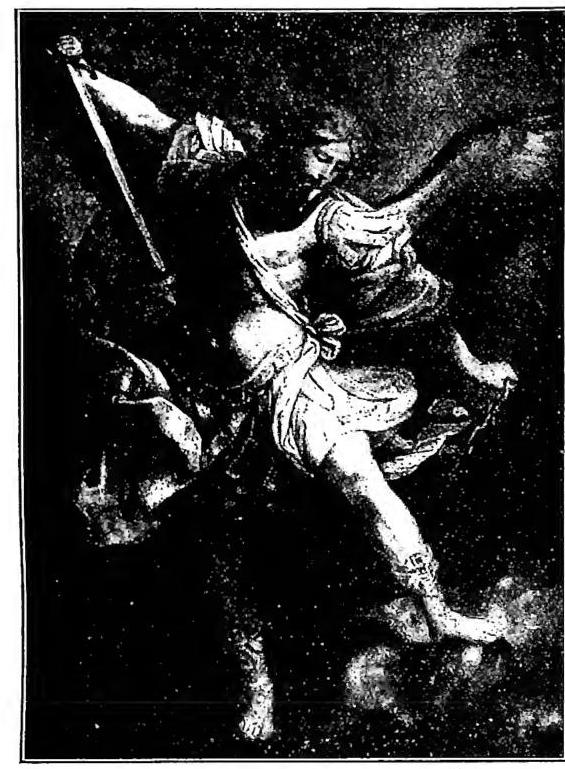
Another specific aspect of s. M. is his role as the celestial thurifer. The angel of the Apocalypse (8:3), who carries the golden censer of prayers before the heavenly altar, was subsequently identified with s. M. In this capacity he appears above all in the solemn incensation of the altar during the solemn Mass (“Per intercessionem sancti Michaelis arcangeli...” ). It should be noted, however, that in that prayer s. Gabriele was originally named (Lc. 1:11–18). But since, on the feast of s. M., in the Mass and the Office, this archangel appears (in the antiphon and offertory) as that celestial thurifer, he gradually took his place also in the prayer recited during the incensation. In the Middle Ages, the legend
(phot. Gab. fot. naz.)
MICHELE ARCANGELO — M. the triumphant archangel chains the Demon. Painting by G. Reni — Rome, Capuchin church.
that St. M. would celebrate Mass in heaven every Monday (a day sacred to the angels in the Middle Ages) contributed to his veneration.
Finally, St. M. appears, in the liturgy and in popular belief, as guide of the souls of the dead. In the Hellenistic age, the idea of “psychopomp angels,” supernatural guides of souls, was widespread as a result of the various currents of the mystery religions. The rabbis too attributed to St. M., protector of their people, the task of guiding souls into the afterlife. Jesus himself seems to allude to this popular belief when he has the soul of poor Lazarus carried by angels into Abraham’s bosom. It was therefore natural that many apocryphal and subsequently also liturgical texts should continue to cultivate the idea of St. M. as guide of the souls of the dead and, consequently, guardian of paradise. In the Mass and the Office, St. M. is still invoked «ut non pereamus in tremendo iudicio». In the commendation of the soul, which in substance dates back to the 7th–8th century, St. M. (and the angels) are invoked precisely for the soul’s passage. The chapels (ossuaries) of cemeteries are ordinarily dedicated to him.
But the most explicit expression concerning St. M. as guide of souls is found in the Offertory of the Masses for the dead: signifer s. Michaël repræsentet eas in lucem sanctam: the great heavenly standard-bearer saves souls from infernal attacks and leads them into paradise.
III. ARCHAEOLOGY
The name of the archangel M. is invoked several times in inscriptions. Thus it is found in a sixth-century inscription from Rouis, now in the Museum of Tebessa (S. Gsell, Inscriptions latines de l'Algérie, Paris 1922, no. 3670); in a tabella defixionis discovered at Carthage (E. Diehl, Inscriptiones latinae christianae veteres, Berlin 1924–31, no. 2388 a); in an inscription from Sorrento (CIL, X, 761); on a slab from Sofia (E. Diehl, loc. cit., no. 2430); in the dedication dated 545 of the church erected by Bacaudia and Giuliano urgentarius in S. Michele in Frigiselo at Ravenna (CIL, XI, 288). In Egypt, it occurs in an epigraph dated 409 from Alexandria (G. Lefebvre, Recueil des inscriptions chrétiennes d'Égypte, Cairo 1907, no. 49); on Coptic stelae from the Thebaid (C. M. Kaufmann, Handbuch der altchristlichen Epigraphik, Freiburg im Breisgau 1917, p. 150); in a Greek inscription from Egypt now in the British Museum (id., loc. cit., p. 279 and fig. 186); and on a Coptic stele in the Cairo Museum (W. E. Crum, Coptic Monuments, Cairo 1901, pl. 56). On several occasions, monuments from Syria, Egypt, and Rome bear the letters X, M, Γ, that is, Χριστός, Μύχαηλ, Γεβριήλ, Christ, M., Gabriel (G. B. De Rossi, Di un curioso sigillo impresso su un frammento di mattone trovato nell'emporio romano, in Bull. d'arch. crist., 2nd series, 1 [1870], pp. 7 ff. and pl. 3,2). In Egypt, clay lamps were found bearing the inscription in Greek: S. M. (H. Numier, in Annales des Antiquités de l'Égypte, 17 [1917], pp. 160–61).G. B. De Rossi illustrated a “bell with a dedicatory inscription dating approximately from the eighth or ninth century, found near Canino” (N. bull. d'arch. crist., 5 [1887], pp. 82–87, now in the Lateran Christian Museum); engraved upon it is a votive inscription in honor of N. S. G. Christ and of s. M. archangel, to whom a bell was also dedicated at the abbey of Fontanelle in the eighth century. G. De Jerphanion identified the origin of the type of s. M. trampling the dragon in Coptic art (G. De Jerphanion, L'origine copte du type de st Michel debout sur le dragon, in Comptes-rendus de l'Acad. des Inscr. et belles lettres, 1938, pp. 367–81).
Enrico Josi
IV. ICONOGRAPHY
In Italy, images of St. M. are found in the sixth-century mosaics of Ravenna, specifically those of S. M. in Africisco, later transferred to Berlin, and in the others at S. Apollinare in Classe, where he is beardless, haloed, winged, and wearing a cloak; in his right hand he holds the labarum, on which the word holy is written three times in Greek (ATIOC). In the Treasury of S. Marco in Venice, a precious bas-relief in enamel and gold represents the archangel standing, haloed, with outspread wings and a youthful head in high relief; in his right hand he holds the sword, and with his left he supports the globe (tenth–eleventh century); the archangel is likewise standing and haloed in the upper part of the golden altarpiece of the same basilica (C. Diehl, Manuel d'art Byzantin, 2nd ed., Paris 1926, p. 727, fig. 356; p. 348, fig. 701).At the end of the eleventh century, in SS. Giovanni e Paolo, he stands beside the Savior with St. Gabriel; he is identified by the inscription S. MIHAEL AR(cangelus) (Wilpert, Mosaiken, pl. 243); likewise in S. Clemente, near the ancient tomb of St. Cyril (Wilpert, Le pitture della basilica primitiva di s. Clemente, in Mélanges d’arch. et d’hist., 26 [1906], p. 260 ff., pl. 11), in the large fresco of Christ enthroned between M., Gabriel, and Popes Clement I and Nicholas I (Wilpert, Mosaiken, p. 546 and pl. 242), and in S. Angelo in formis near Capua.
In the church of the abbey of St-Chef in the Dauphiné, an altar was dedicated to the Redeemer, to the three archangels M., Gabriel, and Raphael, and to St. George, as attested by the inscription, still preserved, from the second half of the eleventh century, contemporary with the frescoes representing them in the apse.
Two bas-reliefs depicting the same scene are preserved in the Louvre Museum, one from the twelfth and the other from the fourteenth century. A Byzantine banner bears the image of St. M., before which Manuel, son of Eudoxia, is prostrate (G. B. De Rossi, in Bull. d’arch. crist., 4th series, 6 [1888–89], p. 82). In Constantinople, in the thirteenth century, a bronze group could be seen depicting Michael VIII Palaeologus at the archangel’s feet. In the East, he is found very frequently during the early Middle Ages, when his image also began to appear in Carolingian and Ottonian art as a warrior in the act of striking down the dragon.
He likewise appears as the dragon’s combatant on the door of the sanctuary of S. M. at Monte Gargano, cast in Constantinople in 1076 on behalf of Pantaleone of Amalfi, and on that of S. Zeno in Verona, ca. 1100. Images of St. M. bringing down the dragon were frequent in France. A fresco from the second half of the eleventh century represents him in the cathedral of Puy; at the end of the eleventh century, in the portico of the church of St-Savin-sur-Gartempe; and later, in the church of S. Martino at Vic (Indre), from the beginning of the twelfth century (P. Deschamps, La date des peintures de St-Savin-sur-Gartempe, in Comptes Rendus de l’Aconé, des inscripte et belles lettres, 1949, pp. 73–80). Romanesque art, and subsequently that of the Gothic period, left numerous images of the archangel M. It suffices to cite Cimabue’s fresco in the basilica of Assisi, Giovanni Pisano’s sculpture for the pulpit of the cathedral of Pisa, and the images on the portals of the cathedrals of Notre-Dame in Paris, Autun, Amiens, and Bruges. But the iconographic type did not change.
The iconography’s introduction of St. M. into scenes of the Last Judgment was inspired especially by Thess. 4, 16, and by Apoc. 12, 7–9, for M.’s victorious combat against the great dragon, «serpens antiquus qui vocatur diabolus et Satanas».
St. M. as the weigher of souls and in opposition to Satan appears on a capital from the beginning of the twelfth century in the Museum of Toulouse, on another in the church of S. Eutropius at Saintes, and on a third in the abbey of St-Pons; and on a fourth in S. Nettario in Auvergne (E. Mâle, L’art religieux du XIXᵉ siècle en France, 3rd ed., Paris 1928, p. 413). In the fourteenth and fifteenth centuries such representations are very frequent in Italian and German art (wooden statues in the Museum of Lübeck). In the Middle Ages, M. was also chosen as patron of merchants and apothecaries.
Among the best-known and finest images of the archangel M., those to be recalled for the Renaissance are Raphael’s (Louvre), and for the Baroque period Guido Reni’s (church of the Capuchins, Rome) and the other cast in bronze by Werschaffei at the top of Castel S. Angelo (Rome).
V. FOLKLORE
The sanctuary of the archangel on the Gargano is still a destination for crowded pilgrimages, especially on the days of the two feasts: 8 May and 49 Sept. The pilgrims, organized into “companies” led by a lay “prior” or by the parish priest, flock from all over central and southern Italy, undertaking extremely long journeys on foot, at times barefoot and with little food. The “company” of Potenza, famous for its intense devotion, has the privilege of being greeted, upon its arrival, by the ringing of the bells. According to a very ancient custom, on ascending to the Sanctuary the faithful place their foot or open hand on the steps and trace their exact outlines, marking them with the date and the initials of their first and last names, so that the entire staircase is covered with these outlines of feet and hands: this commemorates the imprint of the foot that, according to legend, s. M. left when he appeared to the Sipontines victorious over the Goths. Also characteristic are the cross-shaped staffs with tufts of pine leaves at the top (mazzareddi): in years of fervent devotion, more than 15,000 pilgrims’ staffs have been purchased. Among other souvenirs, the faithful also take home statuettes of the Archangel in Gargano stone or alabaster, made by local craftsmen known precisely as sammecalere. The spectacle offered by the multitude of the faithful, dressed in their characteristic regional garments in lively colors, is among the most picturesque. Through the influence and example of the sanctuary of the Gargano, in places displaying similar features, mountain peaks, caves, chapels, and temples were dedicated to the saint: in Abruzzo alone there are seven caves of s. M.; the one near Civitella del Tronto is famous for its popular cult.The conflict between s. M. and the demon is a motif that inspires many sacred and popularized popular representations in Irpinia and Apulia. In Campania too, where an apparition of the Archangel in the sky over Naples is recounted, spectacular celebrations are held in his honor: at Arzano the popular drama is performed in prose; at Ottaiano, on 8 May, the traditional flight of the angels takes place in the square, attracting a large crowd from the Vesuvian municipalities as well. In Sicilian popular tradition, s. M. is the most beautiful thing imaginable in stature and nobility of form, hence the saying: “he is a s. Micheli arcancilu.” Caltanissetta venerates him as its principal protector and recounts an apparition of his that saved the city from the plague. There are numerous popular prayers invoking the Saint to obtain liberation from earthly evils and the salvation of the soul. An apocryphal prayer of s. M. with a superstitious character, and therefore condemned by the Church (Appendice all'Indice dei libri proibiti di Clemente XI), also circulates among the common people. Devotional in character, on the other hand, is a Istoria bellissima dove si tratta di quando l'arcangelo M. discacciò Lucifero, disseminated through popular prints of the early nineteenth century. – Vedi tav. LXI.