
SAINTES. — Ancient diocese and city, seat of the subprefecture of Charente maritime in France. It is the ancient “Mediolanum Santonum,” capital of the Santoni (whence its present name), one of the cities richest in Roman monuments in ancient Aquitania (the triumphal arch in honor of Tiberius, known as the Arch of Germanicus; Roman amphitheater).
It was destroyed by the barbarians, rebuilt, and conquered by Pepin; it then passed to the kings of France. Plundered in 1330 by Carlo d'Alençon, it was ceded to the English by the Treaty of Brétigny in 1360 and retaken in 1371 by Du Guesclin. It suffered during the Wars of Religion, the Revolution, and the bombardments of 1944.
Christianity in S. is attested by the list of its bishops, which begins with Eutropius, who seems to have lived in the second half of the fourth century. An oratory soon arose over his tomb, together with the veneration of the saint; it was restored in the sixth century by the bishop Leonzio II of Bordeaux, as recorded by Venanzio Fortunato (Carm., I, 13). At the end of the same century, Bishop Palladio built a basilica in the city, to which he transferred the relics of s. Eutropius. On this occasion, two abbots, when opening the sarcophagus, believed that they recognized traces of an axe blow on the bishop’s skull. Gregorio di Tours (In gloria Martyrum, 55) emphasizes that until then “non aderat historia passionis.” The sarcophagus bearing the inscription evrnopivs, rediscovered at S. in 1843, cannot be the one seen by Gregorio di Tours (E. Le Blant, Inscriptions chrétiennes de la Gaule, I, Paris 1856, no. 579).
The account of his passion is found in a thirteenth-century manuscript that repeats the information given by Venanzio Fortunato and Gregorio di Tours (Catal. Hagiograph. Paris., II, p. 223), and in another manuscript, of which the Bollandists reproduced several fragments: a pious romance derived from the Liber Calixtinus or S. Jacobi of the twelfth century. This Passio, without historical value, is more or less directly influenced by that of s. Dionysius (cf. B. De Gaffier, Les sources de la Passion de st Eutrope de S. dans le « Liber sancti Jacobi », in Anal. Bolland., 69 [1951], pp. 57-66).
After Eutropius the following are listed: Ambrogio; Bibiano, commemorated on 28 August in the Hieronymian Martyrology; for him, Bishop Eusebio built a basilica between 533 and 550, completed by Leonzio II of Bordeaux (Venanzio Fortunato, Carm., I, 12); Pietro, who attended the Council of Orléans in 511; Troiano, buried near Bibiano and known to Gregorio di Tours (In gloria confessorum, 58); Eusebio, who took part in the Councils of Orléans in 533 and 549; Emerio, who is also mentioned by Gregorio di Tours (Historia Francorum, IV, 26). In 586 Bishop Palladio sent a priest to Rome to obtain relics, and Gregorio Magno sent him a letter (Jaffé-Wattenbach, 1430–31); Odeberto attended the Council of Paris in 614; Leonzio the Council of Clichy in 628; Agneberto the Council of Bordeaux (673–75); Ato, who had previously been abbot of S. Ilario di Poitiers, at the end of the eighth century; Freculfo was bishop around the year 864.
(photo by Yvon)
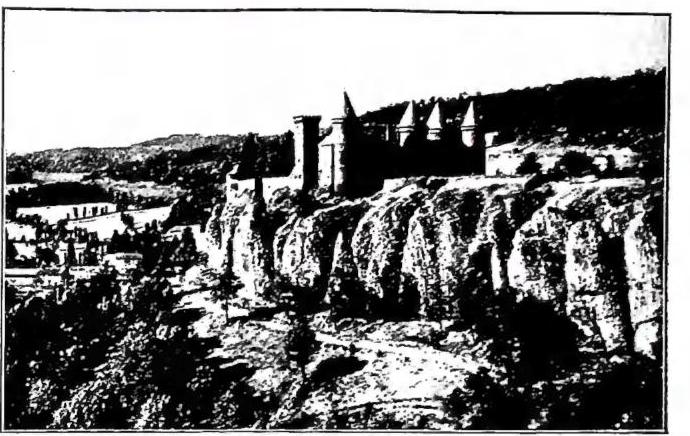
SAINT-FLOUR, DIOCESE of — Château of Sailhant (fourteenth century) in the vicinity of St-Flour.
Paris on 2 September 1792 and beatified in 1926. He closes with his sacrifice the list of the bishops of S., since the diocese was suppressed by the Revolution and, under the Concordat, its territory was placed La Rochelle (v.).
The church of S. Pietro, the former cathedral, was rebuilt after a fire between 1117 and 1127 by Bishop Pietro de Confolens; its reconstruction was begun again in 1450 but was devastated in 1568 by the Huguenots. The central nave was rebuilt between 1585 and 1595. The façade, from the end of the fifteenth century, has a Gothic portal with statuettes of s. Eutropius, s. Louis, etc., and the bell tower dates from the same period. The interior is divided into three naves by cylindrical pillars; nine chapels open onto the ambulatory, and part of the thirteenth-century cloister remains south of the church. The church of S. Eutropius, founded at the end of the sixth century by Bishop Palladio, was rebuilt in the eleventh century and consecrated in 1096 by Pope Urban II. In 1478 Luigi XI carried out extensive restorations there and built the bell tower. The nave was destroyed in 1803; the present structure consists of the ancient Romanesque choir, while the present choir, from the fifteenth century, replaced the original apse. The crypt extends beneath the transept and choir; the apse is surrounded by an ambulatory with three chapels. A bull of Niccolò V from 1451 states that the cathedral of S. is the second church dedicated to s. Pietro. The church of S. Palladio dates from the twelfth or thirteenth century. A barracks occupies the site of the monastery of the former abbey “des Dames,” founded in 1047 by Goffredo Martel, count of Anjou, on the ruins of an earlier monastic building founded by Palladio at the end of the sixth century. The ancient abbey church of Ste Marie-des-Dames survives; it has been restored and is now a parish church. The twelfth-century façade has two levels, with a portal decorated with a representation of the divine hand borne by angels, the divine Lamb with the symbols of the Evangelists, the twenty-four elders, and the Massacre of the Innocents. The square twelfth-century bell tower rises to the height of the transept. A circular twelfth-century baptismal font is preserved. Behind a modern altar is the tomb of s. Eutropius, and nearby that of s. Eustella. The façade was erected in 1831.