
DEAMBULATORIO. – By d., or peribolos or ambulatory, one generally means a ring-shaped corridor running around the apse, often continuing the aisles.
In centrally planned buildings, the d. is situated between the perimeter wall and the central space. The Church of the Holy Sepulchre in Jerusalem was imitated in circular constructions provided with a d. running around the entire perimeter wall of the building. Similarly, in the mausoleum of Costantina, or Church of S. Costanza in Rome, the d. runs between the outer walls and the twelve pairs of columns supporting the arches on which the tall drum of the dome rests; the Lateran Baptistery, too, had a dome and a vaulted d., arranged similarly to that of
S. Costanza. The church of S. Stefano Rotondo in Rome and that of S. Angelo in Perugia belong to this same type.
As a curvilinear corridor running around the apse, the d. already existed in the earliest basilicas, as at Porto and Parenzo, in the remains of the primitive church, and in the remains of the urban basilica of Salona, probably from the 4th century, where it was bounded by a semicircular parapet running around the apse; in Rome, in the primitive basilica of S. Maria Maggiore, in S. Giovanni in Laterano, in S. Lorenzo fuori le mura, and in S. Severo in Naples, the d. resulted from the very structure of the apse, opened by columns and arcades. The same was true at Nola in the basilica of S. Felice, and in the churches of S. Giovanni Maggiore and S. Giorgio Maggiore in Naples. Later, a d. is found in the apse opened by arcades of the small basilica of Prata near Avellino, perhaps from the 7th century. In certain constructions dating after the 8th century, the ambulatory developed to such an extent that it appeared as a continuation of the aisles; in the Carolingian period, at S. Martino in Tours, there was a d. with radial chapels, that is, chapels opening directly onto the d. itself. The apse of S. Stefano in Verona, with an ambulatory consisting of two superimposed galleries, perhaps dates from the 10th century. A wide d. is found in the cathedral of Ivrea, built between 969 and 1002. The peribolos of S. Sofia in Padua must be considered considerably later; there the apse is internally opened by niches.
During the Romanesque period, this architectural motif was used only sporadically in Italy, whereas in France it assumed complex forms, especially through the opening of radiating chapels onto the d. In Italy, these chapels are found in the church of the Benedictine abbey of S. Antimo in Tuscany, under foreign influence, and, moreover, only at S. Maria a Pié di Chienti (Marche), at the S. Trinità of Venosa, in the cathedral of Acerenza, and in the cathedral of Aversa, where, however, the d. has ribbed vaults, and thus differs from those d. covered by groin vaults.
In France, the d. is found in a great number of Romanesque churches. Nevertheless, it is only rarely encountered in the Provençal, Germanic, and Norman schools. For the most part, the apsidal chapels open onto the d., but there are also d. without chapels, as well as chapels that open directly onto the apse, without the d. (this arrangement could be traced back to Roman constructions such as the Pantheon and the Nymphaeum of the Licinian villa). During the Gothic period, the d., which had always been highly developed outside Italy, also appears frequently in our country; it is found in the Franciscan church of S. Lorenzo Maggiore in Naples, built under French influence, and in S. Francesco in Bologna, which has around the apse a peribolos with nine radial chapels. An apsidal peribolos with radiating chapels is also found in S. Antonio in Padua; the cathedral of Milan likewise has an apse with a d.
In churches provided with an ambulatory and radiating apses, the choir achieves a powerful effect, which becomes even more striking on the exterior because of the way in which its various component parts are arranged, and because of the elegance of the decoration, richer than that of the interior. Such are the churches of Notre-Dame-du-Port at Clermont Ferrand, the church of Orcival, S. Saturnino in Toulouse, etc.
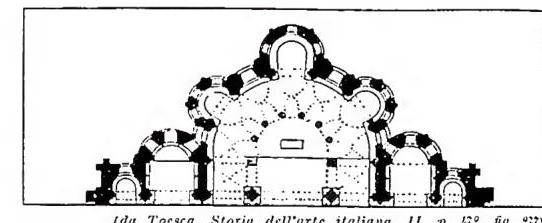
(from Tosca, Storia dell'arte italiana, II, p. 171, fig. 87)
DEAMBULATORIO – Apse of the church of S. Fede with d. (12th century).
Conques.
SS. Ambrogio e Carlo al Corso, perhaps due to a recollection of the cathedral of Milan.