
TUSCANY. -
I. GEOGRAPHY
It is the largest of the historical regions of peninsular Italy (23,000 km²).As such, it comprises lands of highly diverse nature and appearance: a coastal strip partly well-cultivated and flourishing (between the mouths of the Magra and the Arno) and partly, in the south, recently reclaimed (Maremma); a mountainous complex (the southern slope of the Apennines) in which fertile basins open (Lunigiana, Garfagnana, Mugello, Casentino) and which, in its higher elevations, is covered with woods and chestnut groves; and, between the two, other mountains and hills enclosing some of the most densely populated areas along the courses of the Serchio, the Arno, and their tributaries (Chianti Hills), while elsewhere lie less fertile and sparsely populated tracts, though endowed with notable mineral resources (Metalliferous Hills). On the whole, Tuscany, despite the modest extent of its plains, is a predominantly agricultural region, and its population lives mostly on farms, which tenants typically hold under sharecropping arrangements, except in the southern districts (Maremma), where large estates and major centers prevail. Among the crops, olive and wine production stand out, with Tuscany holding a leading position in Italian output, especially when quality is considered; but wheat, sugar beet, legumes, and fruit trees are also far from negligible. Less significant are forestry exploitation (though chestnut production is considerable) and livestock farming.
The anti-Apennine zones contribute extensively to the extractive industry, practiced since pre-Roman times: marble in the Apuan Alps, iron pyrites in the Grosseto area, mercury from Mount Amiata, boraciferous soffioni in the Volterra district (Larderello), and above all the iron ores of Elba, which supply the blast furnaces of Piombino. Nevertheless, processing industries have had and retain a rather modest development in Tuscany, as evidenced by the fact that local craftsmanship, strong in a long artistic tradition, has been able to preserve itself substantially. Despite this, Tuscany boasts, among other things, a significant number of metallurgical enterprises (Piombino, Livorno, Elba, San Giovanni Valdarno), an efficient woolen industry (Prato), renowned shipyards (Livorno, Viareggio), and numerous smaller establishments in various industrial sectors. Trade also occupies a notable place: as a transit zone between northern and southern Italy, Tuscany is crossed by the two main axes of peninsular railway traffic, the coastal line centered on Pisa and the inland line passing through Florence, while the sea plays a relatively minor role in its commerce, given the limited hinterland along a coastline already quite extensive.
The population (3.2 million inhabitants in 1951) has a density slightly below the Italian average, which is attributable to the sparse settlement of mountainous areas and the still incomplete transformation of the Maremma: the high densities of the provinces of Florence and Livorno contrast with the low densities of Siena and Grosseto. Conversely, the dispersed population has a higher proportion than in Italy as a whole; yet, despite this and in relation to its vigorous municipal history, Tuscany has a considerable number of large and medium-sized urban centers: 2 cities with over 100,000 inhabitants, 8 (including the provincial capitals and Prato) with over 50,000, and 13 with over 20,000 inhabitants.
| Province | Area (km²) | Population (1,000 inh.) | Density (inh./km²) | Capitals and population (1,000 inh.) |
|---|---|---|---|---|
| Arezzo | 3,232 | 329.3 | 102 | Arezzo (66) |
| Florence | 3,880 | 917.8 | 239 | Florence (376) |
| Grosseto | 4,496 | 211.5 | 49 | Grosseto (38) |
| Livorno | 1,220 | 281.0 | 230 | Livorno (141) |
| Lucca | 1,772 | 364.9 | 206 | Lucca (87) |
| Massa e Carrara | 1,156 | 203.4 | 176 | Massa (50) Carrara (62) |
| Pisa | 2,448 | 348.5 | 142 | Pisa (77) |
| Pistoia | 962 | 219.1 | 228 | Pistoia (77) |
| Siena | 3,821 | 277.0 | 72 | Siena (52) |
| Tuscany | 22,986 | 3,152.5 | 137 |
II. HISTORY
The unitary character that Etruria had possessed during the Etruscan period was lost in 90 B.C., when it was included in Roman citizenship. Under Augustus, Etruria became the VII region of the Empire. The Romans also called it Tuscia (hence Tuscania), a name that became official under Diocletian.Information regarding the evangelization of Tuscany is uncertain. It can be assumed that the first penetration of Christianity occurred as early as the 1st century, although there is no positive evidence to support the tradition that claims St. Linus, pope, was born in Volterra, and names St. Frontinus as bishop of Florence and St. Paulinus as bishop of Lucca. In the 4th century, St. Felix was probably the first bishop of Florence, and Gaudentius of Pisa. The oldest dioceses were those of Fiesole, Lucca, Pisa, Arezzo, Siena, Chiusi, Florence, and Pistoia. From the 5th century onward, barbarian devastations also made ecclesiastical conditions difficult.
A certain unity was restored to Tuscany by the Lombards, who established a duchy there with its center in Lucca, which became a county under the Franks, until Adalbert obtained the title of marquis in the 9th century. Around the mid-11th century, the marquisate passed to the Attoni, and under Matilda (1046-1115), it played an important role in the Investiture Controversy. During this period, Nicholas II, bishop of Florence, Alexander II, bishop of Lucca, and a century later, Alexander III of Siena ascended to the papal throne. At the beginning of the 11th century, St. Romuald extended the Camaldolese Order to the region, and St. John Gualbert founded the Vallombrosan Order.
After Matilda’s death, a centrifugal movement emerged in the marquisate, accompanying the rise of a new civilization: rural economy progressed and transformed, and in the cities, new industrial and mercantile classes overthrew the power of the feudal lords. The Communes, aided by the active collaboration of the bishops, fought for their freedom without any sense of regional solidarity, instead relying on distant sovereign authorities such as the Papacy and the Empire, thus accelerating the fragmentation of the region. For centuries, it was no longer possible to speak of a history of Tuscany, but only of the histories of the individual Communes that composed it merely geographically. De facto independent, the Communes aimed to expand, each aspiring to supremacy over its rivals. In the 11th and 12th centuries, Lucca and Pisa led, and eventually the latter prevailed; then, defeated by Genoa, it ceded primacy to Florence, which in turn subjugated neighboring Pistoia and Arezzo. The attempts of Uguccione della Faggiuola and Castruccio Castracani were directed toward territorial conquests without any intention of reconstituting a regional state.
In the first decades of the 13th century, the Servites of Mary (v.) was established in Florence, and at Lecceto, near Siena, the Hermits of St. Augustine (v.) had one of their most important centers. In the first half of the 14th century, some Sienese patricians gave rise to the Benedictine Congregation of Monte Oliveto. In 1367, the Sienese Order of the Jesuati was approved by Urban V. Among the Tuscan saints of this period are Catherine of Siena and Andrea Corsini, bishop of Fiesole.
Protestant penetration was of little significance, limited almost exclusively to Lucca, from which some families emigrated to Geneva, and to Siena, TONCHINO (v.) Socini (v.).
The central power, supported by Cosimo’s energy, who had completely disempowered the urban aristocracy of mercantile and banking origin, creating a class of officials appointed by the prince rather than chosen by birthright, weakened under his feeble son Francesco I (1574-87). It recovered under Ferdinando I (1587-1609), who protected men of letters and artists, expanded the University of Pisa, initiated the reclamation of marshy areas, and promoted the development of Livorno. He sought to free himself from Spanish protectorate by adopting a policy of alliance with France and succeeded in inserting Tuscany into European politics. A friend of Henry IV, he gave him his niece Maria in marriage; he vigorously stimulated the maritime activity of the Knights of St. Stephen, instituted by Cosimo I. In the 17th century, Tuscany also became, through the work of Galileo and his disciples, a center of scientific activity, until the Accademia del Cimento was founded in 1657. Cosimo II (1609-21) attempted to continue the policy of balance between France and Spain but soon had to yield to Spanish preponderance. With him, the Order of St. Stephen undertook its last enterprises in the struggle against the Turks. Decline became more pronounced in agriculture and commerce, leading to an acute demographic depression. However, during the government of Ferdinando II (1621-70), who, though vainly attempting to form a league of Italian states during the Thirty Years’ War and gaining no advantage from forced participation in the War of Monferrato and the War of Castro, the Tuscan economy experienced a spontaneous
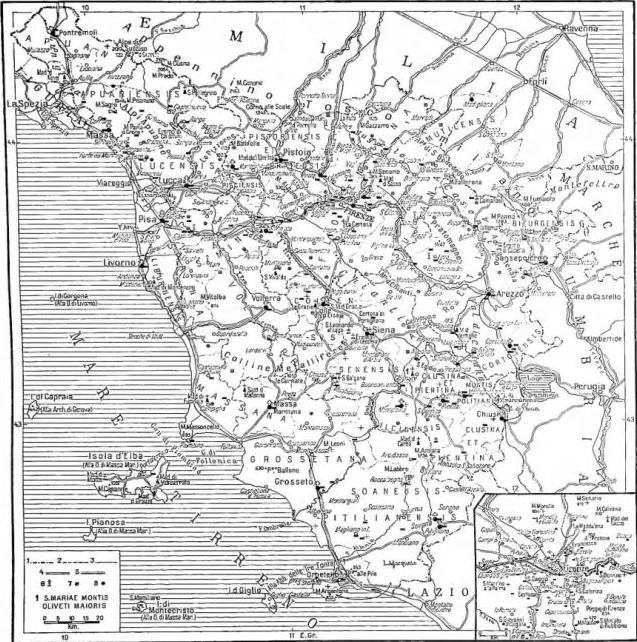
TOSCANA - 1) Regional boundaries; 2) provincial boundaries; 3) ecclesiastical district boundaries; 4) roads; 5) railways; 6) oratories; 7) abbeys; 8) pievi.
In the 17th century, the following were elected popes: Alessandro de' Medici, archbishop of Florence, as Leo XI; the Sienese Fabio Chigi, as Alexander VII; the Pistoian Giulio Rospigliosi, as Clement IX; and the Florentine Maffeo Barberini, as Urban VIII.
regency followed, established by Francis Stephen. When he ascended to the imperial throne in 1745, the autonomy of the grand duchy appeared to be nullified. However, in 1762, through the marriage agreement between his third-born son, Peter Leopold, and Maria Luisa of Bourbon, Francis pledged to separate Tuscany from the Empire and grant it to his son. Three years later, upon Francis's death, Peter Leopold was welcomed in Florence with enthusiasm. A quintessential enlightened sovereign, he had the prudence to surround himself with native figures who had proven their worth during the regency and began, with perhaps excessive fervor, his reforming efforts, first in the field of agriculture. To this end, in 1766, he established a Consulta, which included Francesco Gianni and Pompeo Neri, with the collaboration of bishops and parish priests. The result of his activity was the census. All real estate, including the sovereign's own, was subjected to public taxes, thereby alleviating
the tax burden on small landowners. To increase their number, the fragmentation of large estates was encouraged, and a middle class of free farmers and small landowners began to form. To the law proclaiming the marketability of all lands were added the reclamations of the Sienese Maremma, the Valdichiana, and the Valdinievole. In economics, Leopold developed the guidelines outlined by Bandini in his Discorso economico of 1737. Neri's Riflessioni on grain trade disseminated liberal doctrines. With the 1775 reform, absolute freedom was decreed for the importation of cereals and the bread trade. The customs reform abolished all internal tolls, establishing a single customs barrier at the state's border. Capital flowed into cultivation, and production rapidly increased. In the administrative field, the reform was based on decentralization criteria entirely opposed to those of enlightened despotism. Municipalities enjoyed almost complete autonomy, and their magistracies were filled by lot among landowners, heads of farming families, and artisans. The revival of ancient titles—priori and gonfaloniere—was not a restoration of the past but an anticipation of the civic representations of the modern municipality as a self-governing entity. In the judicial sphere, the new criminal legislation of 1786 abolished torture, suppressed the death penalty, and guaranteed the accused the right to defense and the impartiality of the trial. Leopold encountered strong resistance, however, in ecclesiastical matters, for, without considering the sentiments of his people, he relied exclusively on the Jansenist and anti-papal tendencies. He suppressed many religious orders and confraternities, transferring their assets to poor parishes, introduced the placet and exequatur, abolished the ecclesiastical tithe by subjecting all properties to the grand ducal tithe, suppressed the tribunals of the Inquisition and the Nunciature, and eliminated the privilege of the ecclesiastical forum. Interfering further in the internal organization of the Church, he modified the rules governing the dependence of convents on foreign superiors, established norms for admission, and subjected them to the jurisdiction of bishops. While seeking to improve the economic conditions and cultural level of the lower clergy, he also stipulated that parish priests could appeal to the sovereign even in disciplinary matters. Finally, he established that bishops must convene a diocesan synod every two years and subjected ecclesiastical councils and assemblies to state jurisdiction, where he demanded representation. In this activity, Leopold was certainly inspired by the example of his brother Joseph II but was also particularly influenced by the bishop of Pistoia and Prato, de' Ricci (v.). In 1790, having become emperor, Leopold ceded Tuscany to his son Ferdinand. Ferdinand's inexperience and weakness allowed opponents to organize a movement that, also under the pressure of popular demonstrations—more or less provoked or tolerated—induced the grand duke to revoke much of his father's legislation. The Catholicism of the Tuscans rebelled against Leopold's ecclesiastical reforms, just as it had risen against Josephinism in other states. However, it must be noted that many modern institutions were not foreign imports but the fruit of Tuscany's economic resurgence, promoted by the Lorraine legislation. During the Revolution, Ferdinand III maintained friendly relations with Paris, refusing, despite the pressures of the powers, to join the anti-French coalition. Only when England threatened to occupy Livorno was he forced to abandon neutrality and expel the French. Nevertheless, relations with Paris continued, and on February 9, 1795, a separate peace was concluded. In 1798, despite his scrupulous neutrality, Ferdinand was deposed and left for Vienna. Restored in 1799, he soon had to leave Tuscany again, which, after Marengo, became the Kingdom of Etruria under the Treaty of Lunéville and was assigned to Louis of Bourbon, son of the Duke of Parma. Bonaparte respected its independence until, with the Treaty of Fontainebleau (1807), the King of Etruria received Lusitania and ceded Tuscany to Napoleon. Annexed to France, Tuscany was governed directly from Paris, even when, in 1809, Napoleon granted Elisa Baciocchi the title of grand-
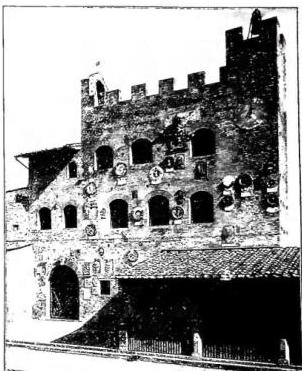
(Photo: Alinari)
TOSCANA - Façade of the Palazzo Pretorio or del Vicariato (13th century), with coats of arms of the vicars in glazed terracotta and stone from the 15th-16th centuries - Certaldo.
for a brief time in 1814 by Murat, the Convention of Parma returned it to Ferdinando. The Congress of Vienna enlarged it with the Presidii and the Principality of Piombino. Ferdinando relied on moderate ministers such as Corsini and Fossombroni: the return to the past was not a reaction, and many innovations of the French regime were preserved. The abolition of conscription and the reduction of taxes fostered the people's attachment to the restored dynasty. From the freedom of commerce and industry derived the resurgence of all productive activities. Agriculture flourished, and a moderately progressive middle class formed, averse to revolutionism and capable of understanding those who, through peaceful means, aimed at civil renewal. The movement of ideas enjoyed in Tuscany a favor that had no equal in other parts of Italy. Therefore, secret societies did not take root in Tuscany. Even after the uprisings of 1820-21, there were no political persecutions, and Tuscany offered asylum to exiles from all states, while a group of intellectuals gathered to study agricultural, economic, and educational problems: among them, Gino Capponi, Cosimo Ridolfi, Raffaello Lambruschini. The accession of Leopoldo II initially brought no changes; but from 1828 Austria induced the grand duke to change policy. The Antologia was suppressed, some exiles were expelled, but discontent did not provoke revolutionary attempts, nor were there repressions. After 1830, tolerance criteria were briefly restored, allowing liberals to resume their propaganda. In 1839, the first of those Congresses of Scientists convened in Pisa under the auspices of the grand duke, which in various cities of the peninsula greatly contributed to bringing together scholars from all regions and forming a national consciousness. But after the death of Fossombroni and Corsini, Leopoldo began to withdraw, and at the beginning of 1848, the latent conflict between prince and subjects became more defined. Under pressure from liberals, Leopoldo granted the Civic Guard, opening the way for demands for greater reforms. These movements took on a more revolutionary character in Livorno, where Guerrazzi fought reactionaries and moderates, demanding the Constitution. The long delays
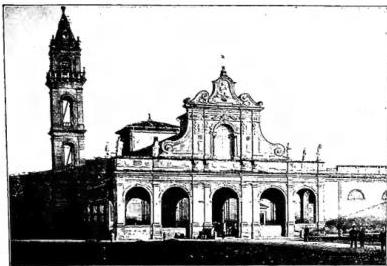
TOSCANA - Exterior of the church of S. Verdiana (18th century) - Castelfiorentino.
Delays in organizing the Civic Guard provoked riots that in Livorno ended with the arrest of Guerrazzi. Only on 17 February did the Grand Duke, following the example of Naples, grant the Constitution. When the insurrections of Milan and Venice and the fall of Metternich gave Italian princes the impression that Austria was no longer able to defend its hegemony, Leopoldo decided to participate in the war. In May, Tuscan battalions, composed largely of volunteer students, halting Radetzky's advance at Curtatone and Montanara, gave the Piedmontese army time to cross the Mincio and deploy for battle, which led to the victory of Goito. After the failure of the federal war of 1848, the ministry presided over by Gino Capponi had to navigate between two adversaries: the distrustful Grand Duke and the democrats who dominated in Livorno. Giuseppe Montanelli's proposal to convene an Italian Constituent Assembly in Rome introduced a seed of dissolution into the national movement. The Capponi ministry resigned and was succeeded by a democratic government with Guerrazzi and Montanelli. The Grand Duke initially signed a decree convening the Constituent Assembly to conclude a federal pact that would ensure Italy's unity and independence while respecting the existence and form of government of individual states; he then changed his mind and left Florence for Siena and Porto Santo Stefano. The Grand Duke's departure paralyzed the ministry's activity, which was replaced by the triumvirate of Guerrazzi, Montanelli, and Mazzoni, who dissolved the Chambers to replace them with a single assembly that would decide the form of government to be given to Tuscany. But after the Grand Duke fled to Gaeta on 21 February, the most radical elements prevailed, and dictatorial powers were granted to Guerrazzi. He attempted to reconcile with the moderates and rely on the National Guard, which opposed the republic. It seems he intended to prepare for the Grand Duke's return, hoping to save constitutional freedoms with a spontaneous act of recall. However, the Livornese volunteers who had accompanied him to Florence, and whom he now sought to distance, provoked riots that severely damaged his prestige. When he sought to proceed with a regular convocation of the assembly so that the people's legitimate representatives could proclaim the restoration of the constitutional monarchy, the National Guard did not support him, and the liberal municipality, under the illusion of currying favor with the Grand Duke, allowed the most reactionary elements free rein and had Guerrazzi arrested. Meanwhile, Leopoldo had already come to an agreement with Vienna, and Austrian troops, having crushed Livorno's resistance, entered Florence on 25 May, followed by the Grand Duke on 28 July: from that moment, Leopoldo was regarded by Tuscans as a foreign prince holding power with the aid of foreign arms.
In 1852, Leopoldo revoked the Constitution and agreed to conclude a Concordat with the Holy See. This was followed by Mazzinian infiltration and political attacks previously unknown. Trials and perpetual exile struck a good number of patriots, and Tuscan policy was directly regulated by Austria, which maintained military occupation until 1855. Before the outbreak of the 1859 war, Cavour offered the Grand Duke of Tuscany Piedmontese guarantees in exchange for an alliance. Leopoldo's refusal caused disappointment and discontent in the army and pushed liberals into action. On 27 April, the Grand Duke was forced to leave the state. A provisional government was formed, presided over by Ubaldino Peruzzi, which offered Vittorio Emanuele II the dictatorship for the duration of the conflict. Napoleon III's veto compelled the King to limit his consent to a temporary protectorate, BONCOMPAGNI, FAMIGLIA (v.) as his commissioner to Tuscany. However, the Tuscan government, led by Bettino Ricasoli, upheld the unitary principle, thwarting even a plan by Napoleon III to create a kingdom of Central Italy to be assigned to his cousin Girolamo; and when the Armistice of Villafranca forced Vittorio Emanuele to recall his commissioner, it convened a representative assembly that voted for union with the Kingdom of Sardinia, a union ratified by the plebiscite of 15 March. Thus, at the opening of the new session of the Subalpine Parliament, the representatives of Tuscany also participated on 2 April.
III. CONCILIAR REGION OF T
It is one of the regions into which Italy was divided by measures of the S. Congregazione Concistoriale on 15 February and 22 March 1919, and 29 September 1933 (AAS, 11 [1919], pp. 72-74, 176; 25 [1933], p. 466) for the purpose of celebrating regional councils in place of provincial councils (v. IV).It comprises the territories of the ecclesiastical provinces of Firenze, Pisa, and Siena, as well as the archdiocese of Lucca, the dioceses of Arezzo, Cortona, Montalcino, Montepulciano, Pienza, and the abbazia nullius of Monte Oliveto Maggiore.
In the regional capital (Firenze) is located the regional tribunal for marriage nullity cases; it also functions as an appellate tribunal for cases judged at first instance by the tribunals of the Umbrian (Perugia) and Marchigian (Fermo) regions. Appeals against the rulings of the Etruscan regional tribunal are to be brought before the tribunal of the Romagnol region (Bologna) or the S. Rota (cf. Pius XI, motu proprio Qua cura of 8 December 1938, in AAS, 30 [1938], pp. 410-13). Pio Ciprotti
IV. ART
The artistic importance of Tuscany has been preponderant in the peninsula since antiquity. Indeed, it is a singular privilege of this region to have had, at two distinct moments separated by many centuries, the capacity to rise to an uncontested cultural primacy, creating two original civilizations endowed with great expansive and penetrative force.
In the field of figurative arts, the concept of Tuscan culture does not consecrate, as in literature, the primacy of one city over others. If the few testimonies prior to the year 1000 (the cathedral of Chiusi, the Pieve of Arliano, the crypts of S. Antimo, S. Salvatore al Monte Amiata, S. Baronto, S. Salvatore in Agna) do not permit a secure judgment of a period that appears generally dominated by the activity of Comacine workshops, subsequently every province had flourishing schools distinctly characterized in terms of conceptions, forms, and results; nor can it be affirmed that Florence held precedence before the appearance of Giotto.
Florentine Romanesque architecture (v. FIRENZE), faithful to the spirit of paleochristian forms in its prototypes (Baptistery, S. Miniato al Monte, SS. Apostoli), had a rather limited expansion (no further than Empoli and its Pieve); whereas the styles of Pisan-Lucchese architecture (v. PISA; LUCCA), reconciling Lombard presuppositions with Oriental decorative suggestions, spread rapidly throughout Tuscany from Pistoia to S. Quirico d’Orcia and also influenced areas beyond the region’s borders, Sardinia (v.), and indirectly in other parts of Italy (the problem of a Pisan mediation for some interesting constructions in Capitanata, from Manfredonia to Troia, remains controversial).
Similarly, sculpture had its major centers in Lucca, Pisa, and Arezzo, cities in which, initially, Lombard-Emilian influence was very strong due to the presence of artists from those regions (Guglielmo and Bonamico in Pisa; Biduino in Lucca; Gruamonte and Guido da Como in Pistoia; Giroldo da Como in Massa Marittima; Marchionne in Arezzo); but a true plastic renaissance originated in the environment of Pisan workshops, NICCOLÒ (v.), who can rightly be considered Tuscan, whatever his place of origin, insofar as he found in the conditions of Tuscan culture the ideal terms to express his message.
The extent to which the Tuscan milieu had developed a self-aware sense of its own worth is amply demonstrated by the transformation undergone by Gothic architecture in Pisa, Lucca, and Siena, but above all in Florence. In Tuscany, the transalpine Gothic imported by the Cistercians remained confined to a few peripheral abbeys (San Galgano, San Salvatore a Settimo), while the inflections of its language gave rise to new characteristics in the structures of the region’s strong Romanesque tradition, establishing some of the fundamental aspects of Renaissance art.
A similar situation emerges in the other arts, even if the dramatic intensity of a Giovanni Pisano seems to engage more willingly with the lessons of transalpine Gothic. To the Pisan-Sienese school, whose greatest exponents include the sculptors who followed and studied under Nicola—from Tino da Camaino (v.) Nino Pisano (v.)—a Florentine school now opposed itself, with Arnolfo di Cambio and Andrea da Pontedera, striving to accentuate the break from Gothic linearism and foster forms of more substantial plasticism. The pictorial vision of Giotto, like that of Ambrogio Lorenzetti or Maestro Stefano, reflects a rediscovered human proportion, for which the term "naturalism" has already been proposed. But the followers (v. , e.g., under the entries GADDI
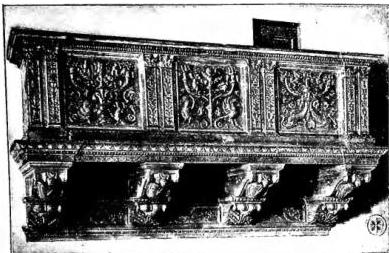
TOSCANA - Cantoria of the Collegiate Church of Impruneta (16th century), near Florence.
TADDEO; DADDI BERNARDO, etc.) strive to interpret it in increasingly discursive and graceful forms, weakening that essential and rugged vigour which had been Giotto’s greatest achievement. Thus, the second half of the 14th century seems to mark a triumph of Sienese grace invading the Giottesque iconography now widespread everywhere. This eclecticism, encompassing sculpture and painting (from the Orcagna to Andrea di Firenze, Agnolo Gaddi, Spinello Aretino, Francesco Traini, Giovanni da Milano, Antonio Veneziano), will exhaust itself in increasingly weary repetitions until the dazzling BRUNELLESCHI, FILIPPO (v.), Masaccio (v.), Donatello (v.), who, each in their own artistic domain, imposed the new Renaissance vision.
The 15th century thus emerges as the great century of Florence. The unitary coherence of the informing concepts of the new culture (v. FIRENZE; RINASCIMENTO; UMANESIMO, etc) achieved an extraordinarily effective affirmation, for it succeeded in expressing a numerous host of excellent masters and stimulated their most compelling and original outcomes, in a dizzying succession of commissions and works. For architecture, one may recall Michelozzo, Giuliano and Benedetto da Maiano, Andrea Cavalcanti, Simone Pollaiolo known as il Cronaca, Giuliano and Antonio da Sangallo the Elder, Ventura Vitoni, all operating within Brunelleschi’s orbit; then L. B. Alberti and Bernardo Rossellino; and, outside Florence, the Sienese Antonio Federighi and Francesco di Giorgio Martini, and the Lucchese Matteo Civitali. Among sculptors, Niccolò Lamberti and his son Piero, Bernardo Ciuffagni and Nanni di Bartolo, still uncertain between the old and the new; then Nanni di Banco, Brunelleschi, Lorenzo Ghiberti, Luca, Andrea and Giovanni della Robbia, disseminators of glazed terracotta, Bernardo and Antonio Rossellino, Desiderio da Settignano, Agostino di Duccio, Mino da Fiesole, Benedetto da Maiano, the goldsmiths and bronze artists Antonio Pollaiolo and Andrea Verrocchio, as well as the Sienese Jacopo della Quercia, Giovanni Turini, Antonio Federighi, Lorenzo di Pietro known as il Vecchietta, Francesco di Giorgio Martini, Neroccio di Bartolomeo, Giacomo Cozzarelli, and the Lucchese Matteo Civitali, around whom gather pupils and provincial artists (such as Pagno di Lapo, Urbano da Cortona, Simone Strini, Bertoldo, il Bellano, Pietro Torregiani, etc.), capable, in moments of inspiration, of producing works not unworthy of the masters. Outside Florence, during this transitional period, some painters (Pisanello, Masolino da Panicale, etc.) are important for the consequences their presence had in initiating the Renaissance of local schools, for example, in Lombardy and Verona. But in Florence, from Paolo Uccello to the Beato Angelico, to Domenico Veneziano, the artists of the early Renaissance fell under the spell of Masaccio’s vision of the stories of the Carmine. Even artists of the stature of Piero della Francesca drew from it, destined to disseminate the new language in Umbria, the Marches, Emilia, and Lazio; as well as delightful and brilliant illustrators like Benozzo Gozzoli and, in Siena, Domenico di Bartolo. Meanwhile, Filippo Lippi, Andrea del Castagno, and, in a minor key, Alessio Baldovinetti, steered Florentine painting toward those solutions of dynamic linearism that characterize the second half of the century, in the works of Antonio and Pietro Pollaiolo, Andrea del Verrocchio, and above all Sandro Botticelli. The detached composure of the early Renaissance was being replaced by a restless and dramatic anxiety, especially in the figurative cycles of Luca Signorelli, from Cortona, which prepared the ground for Michelangelo’s formidable investigations. Meanwhile, on the threshold of the century, the path toward the "grandeur" of 16th-century conceptions unfolded through contacts and exchanges that broadened the horizon of Florentine culture, as Flemish artefacts flowed into the city and artists from all parts—even the greatest (such as the Umbrian Perugino or the Marchigian Raphael)—arrived to learn the Florentine lesson and contribute their own original solutions.
Siena, meanwhile, lingered in refined and precious chromatic explorations, with Stefano di Giovanni, known as il Sassetta, Giovanni di Paolo, Sano di Pietro, engaged—as Brandi writes—in "a continuous struggle between an exuberant interiority and an antiquated culture." A misinterpretation of Florentine forms will be found in artists more receptive to the new, such as Matteo di Giovanni, Neroccio di Lando, and Francesco di Giorgio Martini, the latter more attuned than the others to the teachings of Lippi and Baldovinetti.
In the 16th century, Florence ceded its national primacy to Rome, which, for its rise, availed itself of the best Tuscan artists, inducing them to long and fruitful sojourns. But if the axis of attraction now shifts from the Arno to the Tiber, Tuscany remains active for a long time, expressing, in the first masters of Mannerism, another moment of felicitous productivity, to which contribute, in architecture, the prototypes of Michelangelo and Raphael, inspiring Mariotto Folfi, Bartolomeo Ammannati, Bernardo Buontalenti, Giovanni Battista Dosio, Giorgio Vasari, and Baccio d’Agnolo; in Siena, Baldassarre Peruzzi; in Lucca, Francesco Marti.
Sculpture finds its principal innovator in Andrea Sansovino, while Benedetto da Rovezzano, Andrea Ferrucci, Baccio di Montelupo, and Francesco Rustici are active; but Michelangelo’s influence soon becomes exclusive for Raffaello da Montelupo, Giovanni Angelo Montorsoli, and overwhelming for Vincenzo de’ Rossi. Other masters retain, despite their intellectual eclecticism, a certain fluency and independence of manner, such as Jacopo Sansovino, il Tribolo, Ammannati, Benvenuto Cellini, il Lorenzetto, Vincenzo Danti, Taddeo Landini, Francesco da Sangallo, and Giovanni della Opera. The century will close on a positive note with the production of Pietro Tacca and Giovanni Caccini, and the foreigners Pietro Francavilla and Giambologna. In Pisa, Stoldo Lorenzi asserts himself; in Versilia, the Stagi family operates; in Siena, Lorenzo Marrina; in Arezzo, Simone Mosca.
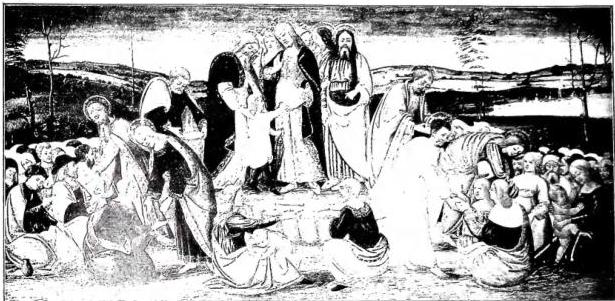
TOSCANA - The Manna. Painting by J. del Sellaio (2nd half of the 15th century) - Berlin, Private Collection.
Among painters, while Albertinelli remains faithful to the teachings of Fra Bartolomeo, and Francesco Granacci repeats the schemes of the Ghirlandaio school, Andrea del Sarto attempts an approach to the tonal modes of Venetian painting. Pontormo and Rosso Fiorentino excel, original and disconcerting personalities of a positive Mannerism; before the Raphaelesque and Michelangelesque imitation determines the labored academic Mannerism of Giorgio Vasari, Alessandro Allori, Francesco Bachiacca, and Francesco Brina; from which only Francesco Salviati and Bernardino Poccetti are saved as decorators, and Angelo Allori, known as Bronzino, as a portraitist. At the end of the century, Santi di Tito attempts a return to the sources, with little success.
Outside Tuscany, the best artist produced by the Michelangelesque school is undoubtedly Daniele da Volterra. In Siena, an opening is made rather toward the Umbrian school than toward Florence. Its interpreters are Bernardino Fungai, Gerolamo del Pacchia, and Andrea del Brescianino. Peruzzi brings the Raphaelesque influence, later triumphantly reaffirmed, in the Leonardesque conjunction, by the Piedmontese Giovanni Antonio Bazzi, known as Il Sodoma, who became a Sienese by choice. Domenico Beccafumi, the most original artist of 16th-century Siena, proceeds in isolation in a search for new expressive modes, recalling Pontormo and Rosso. The Mannerism of Ventura Salimbeni prepares the local school, now exhausted, for the irruption of the Baroque. With the end of the century, the productive cycle of Tuscan art seems irrevocably closed. The region, still a dispenser of creative energies in the 16th century, fails to maintain the same propulsive force, but, as if exhausted, inevitably becomes a tributary province in the following two centuries to the major centers of Baroque culture: Rome, Naples, and Bologna. Among architects, the 17th century lacks prominent personalities. From Matteo Nigetti, a pupil of Buontalenti, to Don Giovanni de' Medici, to Gherardo Silvani, to Lodovico Cardi known as Il Cigoli, to Zanobi del Rosso and Ferdinando Ruggieri, no one advances beyond the cultural positions of late Mannerism, or translates even the modes of Berninian Baroque into academic formulas.
Sculpture is in an even more disastrous situation. The few artists of merit seek elsewhere, especially in Rome, to adapt to the new demands of taste (e.g., Agostino Cornacchini, and, in the 18th century, Filippo della Valle). The most fortunate, Francesco Fancelli, becomes a court sculptor in London. Only at the end of the 17th and in the 18th centuries do artists like Battista Foggini and the Roman Innocenzo Spinazzi, a teacher at the Florentine Academy, attempt to revive the fortunes of sculpture, though without moving beyond a dignified eclecticism. Equally substantial is the exodus to Rome of the most capable Florentine painters, such as Il Cigoli, Domenico Cresti known as Il Passignano, Giovanni da San Giovanni, and later Luti, Conti, and Redi. Jacopo Chimenti known as L'Empoli, Matteo Rosselli, Baldassare Franceschini known as Il Volterrano, Carlo Dolci, Francesco Furini, and Lorenzo Lippi gain some renown in their homeland. But Florence prefers to call for major decorative works the Veronese Jacopo Ligozzi, Pietro da Cortona, Luca Giordano, and, at the beginning of the 18th century, the Venetian Sebastiano Ricci. The situation in Siena is identical, from which the best pupils of the eclectic Salimbeni, such as Alessandro Casolani, Pietro Sorri, Ventura Salimbeni, and Francesco Vanni, escape toward Rome, Genoa, Pavia, and Florence. More gifted than the others, in his Caravaggesque phase, appears Rutilio Manetti, also active in his homeland. From Lucca, where Pietro Paolini works, Giovanni Coli, Filippo Gherardi, and Pietro Testa known as Il Lucchesino arrive in Rome, following Pietro da Cortona. The latter is also the animator of a lively school in his native city. Pistoia supplies Rome with Giacomo Giminiani and Lazzaro Baldi; and Pisa with Orazio Gentileschi and Orazio Riminaldi.
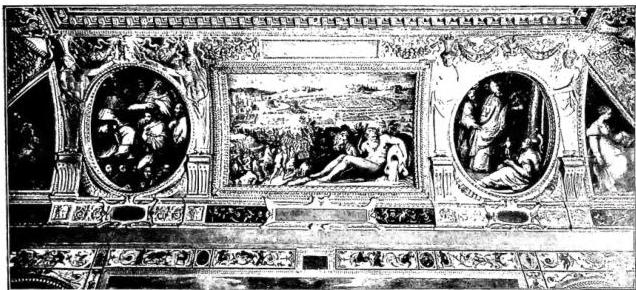
TOSCANA - Clement VII creates Ippolito de' Medici a cardinal and sends him as legate to Hungary. Frescoes by G. Vasari in the Hall of Clement VII (second half of the 16th century) - Florence, Palazzo Vecchio.
It is with this movement that Tuscany regains its national primacy. Masters such as the Livorno-born Giovanni Fattori, the Modigliana-born Silvestro Lega, and the Florentine Telemaco Signorini rank among the most compelling figures of the century, even beyond national borders. Around them, pursuing the same program of fidelity to the intimate aspiration for the conquest of artistic freedom—which is first and foremost an awareness of the visual values of painting, in a climate akin to that of French Impressionism—work artists drawn from all over Italy, though primarily Tuscan, such as the already mentioned Cecioni, who was the group’s theorist, the Livorno-born Serafino de' Tivoli, the Florentines Cristiano Banti and Raffaello Sernesi, and the Pisan Odoardo Borrani. These artists prefer secular subjects, and their contribution to sacred art is therefore limited. The legacy of the Macchiaioli remains alive and operative in the region even during the period of Divisionism and later Cubism and Futurism. Contemporary Italian painting features several Tuscan masters at the forefront, who have passed through various avant-garde experiences but remained substantially faithful to that commitment to reality and nature which is characteristic of the Tuscan tradition. We mention the Livorno-born Amedeo Modigliani, who lived in Paris, the Versilia-born Lorenzo Viani, the Florentines Ardengo Soffici and Ottone Rosai, and the Cortona-born Gino Severini. Sculpture has found in Libero Andreotti an artist sensitive to the stimuli of modernity, interpreted with a delicate and dynamic sensibility akin to that of the ancient Sienese masters.
Of modern urban renewal, Tuscany possesses some prototypes that engage directly with current debates, such as the Santa Maria Novella station in Florence, designed by a group of Florentine architects led by Giovanni Michelucci.
No profile of the minor arts is traced here, for which reference is made to the individual entries (ARAZZO; CERAMICA; FERRO BATTUTO; INCISIONE; MUSAICO; OREFICERIA; RICAMO; TARSIA, etc.); it will suffice to recall how Siena, Florence, Lucca, and Arezzo boast the distinction of having nurtured flourishing schools at every period, to whose development both great artists and world-renowned artisan workshops contributed.
V. FOLKLORE
Tuscany represents, with regard to popular literature, a highly vibrant zone of production and diffusion. Originating in Tuscany is one of the most important forms of monostrophic lyric song, the rispetto, which, though sharing the same number and length of verses as the Sicilian ottava, differs in rhyme and stylistic procedure: while in the canzuna (ab) the concept unfolds freely throughout the song, in the rispetto (ab ab cc dd) "it must be condensed in the quatrain with alternating rhymes, then reiterated in the refrains on the particular that matters most; or else hint at external circumstances in the first part, to manifest the true sentiment in the second." The rondinella is, musically, the finest Tuscan rispetto. The stornello also flourishes in Tuscany. Rispetti and stornelli are customarily sung interspersed with a refrain, also called rifiorito, consisting of a short stanza of two or four verses. Among the principal forms of Italian popular poetry that have converged in Tuscany, the epic-lyric song stands out as widely traditional, whether preserved in its original metrical form of French type (that is, "with verses ordinarily divided into two hemistichs, equal or not; bound, more by assonance than by rhyme, in stanzas often rendered, in appearance, more or less complex by the repetition of verses or hemistichs and by the refrain"), or profoundly transformed in meter, later diffused in this new form toward the Veneto on one side, and toward central Italy and Sardinia on the other. Beyond the better-known songs of this genre, such as La donna lombarda, Cecilia, etc., rarer ones are documented, such as La fanciulla del mare, La sposa di Susa, L'innamorato timido, and L'amante trascurata. From Piedmont, epic-lyric songs with religious subjects (e.g., Maria Maddalena, and for the opening S. Barbara) also descend into Tuscany, just as from central Italy come—and are poorly preserved—narrative religious songs in hendecasyllables: but more widely diffused among the people are stories in ottave. Numerous are the testimonies of enumerative or iterative songs: La mosca mora, Bella che vai al mercà?, Chi l'ha mangiata la testa, la testa dell'anitra mia? An extensive documentation of all this material is provided by the manuscript collection assembled, with rigorous and precise inquiry and selection criteria and continuous examination of critical and historical problems, by Michele Barbi, generally designated by the siglum RB: a multi-volume edition is being prepared, edited by V. Santoli, P. Toschi, and G. Vidossi.Of remarkable importance is Tuscan popular theater. Surviving within it, rising to true spectacles, are traditional dramatic forms that spring from popular festivals and ceremonies, such as the maggio, the bruscello, the befanata, the zingaresca, and the testamento. Composed almost entirely in quatrains of octosyllables are the maggi drammatici, which treat religious, historical, and romantic subjects, and have remained confined to the countrysides of Lucca, Pistoia, Pisa, and Volterra; very brief and sparse in action are the Aretine maggi, which in this resemble rather the bruscelli, though offering greater metrical variety. The bruscello, written in octaves or sestets, derives its name from a small tree or branch of laurel, holm oak, or pine, adorned with ribbons and flowers, which, always carried in hand by one of the group and later planted in the ground, constitutes the center of the popular performance: its subjects, beyond that of the hunt (the origin of this farce, according to some, dates back to certain masquerades that took place in the Sienese countryside about four centuries ago, in which a kind of nocturnal hunt was mimicked with a lantern hung on a limed branch, called precisely bruscello), may be the contrast between a young man and an old man for the hand of a girl (this form is found, under various names, outside Tuscany as well), or even legendary and historical episodes, such as La distruzione di Troia, Pia de' Tolomei, Gl'Italiani in Africa, etc. The befanate, religious or profane, in stanzas of four octosyllables, mostly with crossed rhymes, are sung in the Lucchese countryside by groups of young people, through the village streets in front of the houses of the wealthier inhabitants, in one or two choirs, accompanied by violin or accordion. "Written in stanzas of four verses—three heptasyllables and one pentasyllable—rhyming the second with the third, and the fourth with the first of the following stanza," the zingaresca and the testamento "resemble each other in plot and in the character of the participating figures; except that in the zingaresca the main role is always played by a gypsy woman, who employs magic to aid unhappy lovers, removing with her spells the obstacles that opposed their marriage;—while in the testamento the [comic element] is constituted by the ridiculous figure of the doctor (notary) and by the parody of wills or marriage contracts" (Giannini). All these performances are connected with the festivals of Carnival or spring and have the significance of expulsion and propitiatory rites. On Ascension Day fall two of the merriest festivals of the spring season: that of the grillo in Florence and that of the fiaschetta in the Monte Amiata, the latter so called because many young men carry around their necks a fiaschetta full of wine. Patronal and calendar festivals in general are celebrated with great splendor, in which ritual elements proper to cyclical ceremonies are almost always recognizable: noteworthy are the feast of S. Giovanni in Florence, with sumptuous processions and allegorical floats, in which representatives of the various city guilds participate; the also Florentine feast of the rificolone, dedicated to the Nativity of Mary (8 Sept.); that of S. Ranieri in Pisa for the imposing illumination (luminara) along the Arno; that of S. Croce in Lucca "in which an ancient simulacrum of Jesus crucified, which, according to legend, would have been made by Nicodemus," is exposed for the veneration of the faithful. Finally, famous are the festivals held in Siena on 3 July for the Visitation and on 15 August for the Assumption of Mary, on the occasion of which the traditional palio is run. Of this, based on an ethnographic comparison with ancient rites of the beginning of the annual and seasonal cycle, one of the principal elements of which was precisely the representation of a contest or struggle, race or armed duel, it is possible to identify the original ritual meaning and propitiatory character, which it has not entirely lost, though it has become historicized and adapted to the new environment: thus the Carroccio, the procession of the 17 contrade with their respective military captains, reveal the primitive sacred and warlike character.
of the festival, while the display of costumes, the waving of flags, and the decoration of the carroccio itself lend the event a remarkable spectacular quality. A similar ritualistic meaning and spectacular flair are evident in other famous festivals, such as the giostra del Saracino held in Arezzo on the feast day of S. Donato (7 August), the city’s patron saint, and the gioco del ponte in Pisa, which historically dates back to the Lombard era. Even in the scene of the scoppio del carro (explosion of the cart), which takes place on Holy Saturday morning in Florence, the fire can be recognized as the most ancient ritual element, later overlaid with the legendary motif linking its origin to the Holy Sepulchre: Florentine tradition holds that the first spark of sacred fire was once kindled from three small stones taken from Christ’s Sepulchre and brought to Florence by messer Pazzino de’ Pazzi. The rite becomes spectacle with the invention of the cart (common, after all, to all sacred festivals) and the ignition of the fire by means of the colombina—symbol of the Holy Spirit—which, at the very moment of the Resurrection, glides along a wire from the high altar. From the behavior of the colombina and the manner in which the cart explodes, Tuscan peasants, who flock to Florence’s Piazza del Duomo, draw omens for the harvests, as Easter also marks the beginning of the agricultural season.
Among the customs marking the human life cycle, some deserve special mention either for the singularity of certain elements or for comparison with those of other regions. In much of Tuscany, and still today in some villages, it was once customary to hold an abundant banquet a few days after baptism, attended by the new mother, called in Florence and Pisa the scappanata (because all the dishes were originally made from capon meat), in Arezzo the cicallo, in the Pian di Lucca area the impagliata, and in Rosignano Marittimo the riconoscimento (recognition), as guests, with gifts of eggs and poultry, officially acknowledged the mother’s new social status. The marriage proposal (chiesta) was generally made through a cozzone or marriage intermediary. Picturesque in the Pisan hills and the surroundings of Siena is the scene of transporting the bride’s trousseau on the eve of the wedding, on a cart drawn by oxen adorned with ribbons and bells; no less picturesque in the Barga area is the trousseau carried in open baskets on the heads of young girls advancing in procession. In some villages, the custom of the serraglio or parata survives—a practice once widespread throughout Tuscany—consisting of blocking the newlyweds’ path with ribbons, which were then removed in exchange for money or sugared almonds. In the Lucca area, the serraglio was performed only when the bride left her village, and in this case, the obstacle solemnized a rite of material passage. In Sienese comedies and various memoirs from the sixteenth century, in Tuscan synodal constitutions, and even in some almanacs from the last century, old customs of considerable ethnographic interest are documented, which remain alive and observed in the popular traditions of other countries and regions: the toccamano, a well-known ritual form in Italy (v. ROMAGNA) and widely diffused in France; the bride’s kiss in church, corresponding in Sardinia to the ceremony of the bride being embraced by the groom and his companions; the breaking of the bowl, a vestige of a magical ceremony (potus et biberagium) practiced to strengthen emotional bonds, which in other places is replaced by the breaking of the wedding cake or even a cinnamon stick to confirm the nuptial vow before the notary; the punch given to the groom during the wedding ceremony, specifically at the moment of blessing when he declares his consent—a gesture depicted in many paintings of the Marriage of the Virgin (v. Chapel). This last rite, traced back to Roman emancipatio and manumissio, has so far found parallels in Italy only in Romagna and some traces in Lombardy, but it is perhaps not far from the truth to connect it with the widespread custom of friendly greeting by striking a blow on the shoulder. In the countryside of Lucca and Pistoia, the custom of the scampanata (mock serenade) for widowers who remarry persists. Among funeral rites, a singular one—observed until a few years ago in the Lucchese mountains—was that of carrying children who died before the age of seven to the cemetery in a basket adorned with ribbons, borne on the head of a young girl.
Elements useful for characterizing Tuscany from a folkloric perspective are offered by the lives of peasants and shepherds: their clothing, household objects, and work tools—of which beautiful examples from Lunigiana are preserved in the Civic Museum of La Spezia—constitute documents of considerable ethnographic-comparative interest. The short trousers of the Biassa costume, for example, the woolen gaiters used in the Pontremolese mountains, and the double-colored woolen cap (black inside and red outside, folded over the ear) closely recall details of the Sardinian-Corsican male costume. The buccina, made from the tritonium nodiferum, which until recently was used in Montelungo instead of bells from Holy Thursday to Holy Saturday to call the faithful to church, and was once used by Apuan shepherds to frighten wolves with its sound, now serves for the scampanata (and in the upper Val di Magra, millers use it to notify farmers who have grain to grind). This instrument is also among the most common objects used by Corsican shepherds. Finally, the wine horn—a hollowed-out ox horn, sealed at the base and pierced at the tip, which the peasants of Veppo carry slung over their shoulders—is singular. In the distribution of the main forms of rural housing, the type with an external staircase, where the dwelling is placed above the rustic areas (cellar, storeroom, etc.), is dominant, especially south of the Arno and on the island of Elba, thus proving to be very ancient and to have had a very broad diffusion in the past. - Vedi tavv. XXXV-XXXVIII.