
FERRUCCI FAMILY. - Famiglia di scultori
(secc. XV e XVI) originaria di Fiesole.
Sono maggiormente degni di menzione:
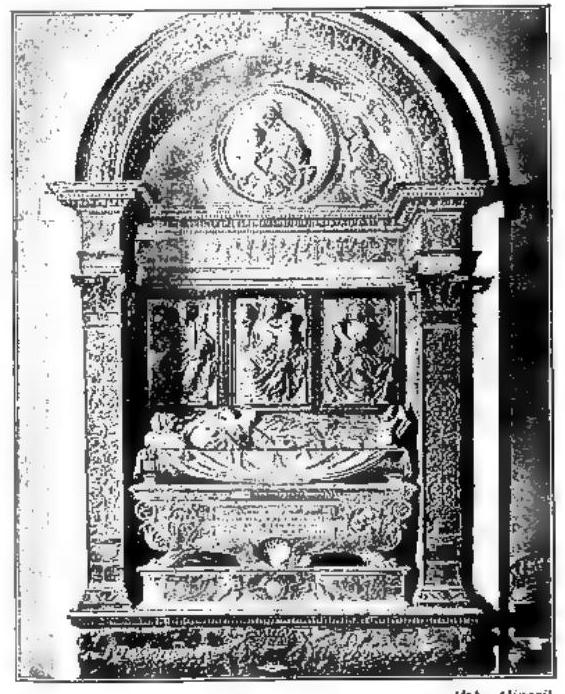
FRANCESCO (b. 1437, d. after 1492), son of that Simone di Nanni who was Ghiberti's assistant. Perhaps a collaborator of Desiderio da Settignano in the Tabernacolo of S. Lorenzo, he imitated his forms in the friezes of the Badia Fiesolana (1460-66) and in the Balducci monument (1471-72, S. Egidio). Under the influence of Verrocchio his sculpture tended to nestle and become entangled in the funerary monument of Barbara Manfredi (1467-80, S. Biagio at Forlì) and especially in the figures of that of Tartagni (S. Domenico in Bologna), whose stylistic elements have allowed criticism to reconstruct the artist's activity. The same delicate eclecticism is found in decorations executed in the Ducal Palace of Urbino (1474-80), in the Angels of the Tabernacle of S. Maria di Monteleone (1483, Perugia), in the Oliva tombs (1485-88, Montefiorentino).
ANDREA, called da FIESOLE, was perhaps his pupil (b. 1465, d. 1526), influenced by the style of Sansovino, of Mino da Fiesole and of Benedetto da Masavo in the altar reredos of the cathedral of Fiesole (1492-91), in the one that is in London in the Victoria and Albert Museum, in the baptismal font of the cathedral of Pistoia (1497-99), in the altar for the Balcica Chapel (1519, cathedral of Eastergom). Michelangelesque forms found in him a fervent imitator, albeit superficial because of his constant quattrocento intonation: proof of this eclecticism are the St. Andrew (1512-13, cathedral of Florence), the busts of Marsilio Ficino (1521-22) and of Virgilio Adriani (1522, S. Salvatore al Monte).
FRANCESCO di Giovanni del Taddeo called del TADDA, b. at Fiesole or at Florence in 1497 and d. there on 29 May 1585, belonged to another branch of the family. If he was a more than mediocre imitator of Michelangelesque forms (and proofs of this are the tomb of G. F. Vegio in the Camposanto of Pisa and the decorations of the S. Casa of Loreto), he has his importance and came to celebrity for having found the way to carve porphyry, in which he executed the cup fountain of the first courtyard of Palazzo Vecchio (Florence), a head of Christ (Museum of Prague). Assisted excellently by his son Romolo, he carved the Justice for the Roman column of S. Trinita (Florence), very many low-relief medallions among which one of Cosimo I (Victoria and Albert Museum of London), besides numerous decorations of tombs.
Bibliography3 works
Fabis Borroni