
COLONIA, ARCHDIOCESE of. — The archdiocese of C., together with its suffragans of Limburgo, Treviri, Aquisgrana, Münster, and Osnabrück, forms the ecclesiastical province of C., also called that of the Lower Rhine. The archdiocese has an area of 6,000 sq. km. and a population of 4,000,000 inhabitants, of whom 2,500,000 are Catholics. Before 1939, it had 1,484 churches with 697 parishes, served by 2,100 diocesan priests, 200 religious priests, and 269 seminarians; 50 male religious houses with 380 religious, and 506 female religious houses with 8,225 religious women; it also had 292 assistance and care institutions with 29,565 patients. For the seminarians there are two colleges in Bonn on the Rhine, namely the Albertine and Leonine Colleges; the seminarians spend their final two years in the seminary of Bensberg near C. Alongside the archbishop are two auxiliary bishops and the Metropolitan Chapter.
In 30 B.C., C. was one of the settlements of the Germanic Ubii and, in A.D. 50, became a Roman colony which, after the emperor Claudius and his consort, was called C. Claudia Augusta Agrippinensis. C. soon became the capital of a province and, temporarily, also an imperial residence.
The first historically attested bishop was Maternus, present at the Synod of Rome in 313 and at that of 314
of Arles. The presence of Christian communities as early as the second century can be demonstrated. Around 400, C. was conquered by the Franks, in 511 by the Merovingians, and became part of Austrasia; in 925 it definitively became German.
Following the granting of the duchy to Bruno I (953–56), the temporal power of the archbishops of C. was established. From 1028 until the sixteenth century, they had the right to crown the sovereign, and from 1131 they became chancellors for Italy; from the thirteenth century they also held electoral dignity. Around 1288 the city freed itself from the authority of the archbishops, who thereafter had their residence in Bonn, Brühl, Godesberg, and Poppelsdorf.
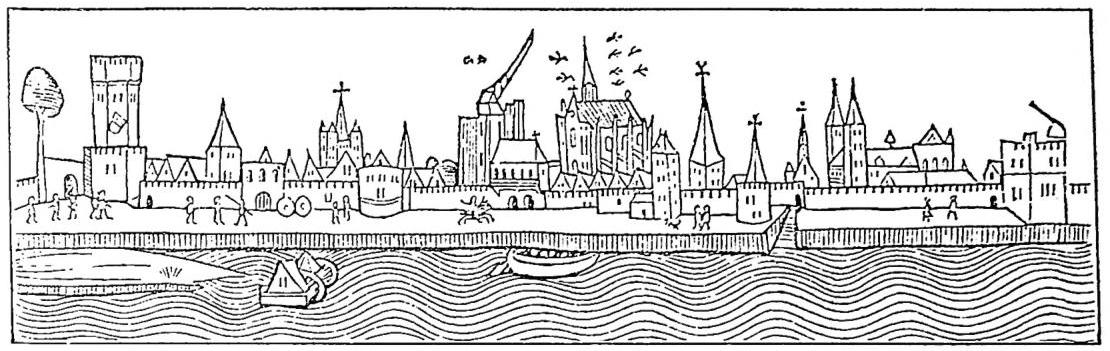
During the Middle Ages, C. was one of the largest and most respected cities on account of its artistic treasures, its scholarship (1388, University), and also its industry and economy (one of the most distinguished members of the Hanse).
The attempts of Ermanno da Wied (1515–46) to make the country Protestant were unsuccessful. The apostasy of Archbishop Gebhard II Truchsess (1577–83) provoked the war known as the «Kölnischer Krieg» (1583–88). The defeat of the prince-elector saved Catholicism in north-western Germany. After Ernesto di Baviera (1583–1612), various Bavarian princes obtained archiepiscopal dignity. The last prince-elector, Massimiliano Francesco d’Austria (1785–1801), fled in 1794 before the French into Westphalia. Between 1801 and 1803 the archdiocese was secularized and divided into the archdiocese of C. on the eastern Rhine and the diocese of Aquisgrana in the western Rhineland. In 1821, following the bull of Pius VII De salute animarum, the former situation was restored.
Archbishop Clemente Augusto, Baron Droste zu Vischering, occupied a prominent place in the so-called «Kölner Wirren», that is, in the struggle between the Protestant Prussian state and the Catholic Church (the dispute concerning mixed marriages). The struggle continued between Bismarck and Archbishop Paolo Melchers (Kulturkampf, 1866–85). In 1930, on the basis of the concordat with Prussia (13 August 1929), Pius XI restored the division between Aquisgrana and C. by the bull Pastoralis officii nostri. Particularly venerated in C. are St. Orsola and St. Gereone with his companions, victims of the Diocletian persecution.
One of the greatest archbishops was St. Bruno (925–65). Also from C. were St. Bruno the Great, founder of the Carthusians, and St. Alberto Magno (1193–1280). St. Tommaso d’Aquino was his disciple in C. from 1248 to 1252. In the church of the Friars Minor in C. lies the tomb of the Doctor Subtilis, Duns Scotus. In the same church is the tomb of Adolfo Kolping (born 18 December 1813 at Kerpen, near C., and died in the metropolis on 4 December 1865), founder of the association of journeymen (Gesellen-Verein) and one of the most eminent popular educators.
C. is the seat of the provincial houses of the Jesuits of the Lower Rhine, the Congregation of the Lazarists, the Missionaries of the Holy Spirit, the Alexians or Cellite Brothers, the Augustinians, the Sisters of St. Vincent, the Benedictines of Perpetual Adoration, the Carmelites, the Poor Clares, the Sisters of the Good Shepherd, and the Ursulines. The archdiocese has 21 men’s and 34 women’s Marian congregations.
The University of C. was founded in 1388, following the example of that of Paris, and is the first German university founded by a city. Dominicans, Franciscans, Hermits of St. Augustine, and Carmelites were incorporated into the theological faculty. Students who had left Heidelberg because of the plague and Paris because of the schism formed the University’s first influx. Students from the northern countries outnumbered the others, both among professors and among students. The most celebrated faculty was the theological faculty. The University flourished in the sixteenth century; in 1528 a decline began, which was halted by the Jesuits. The scholastic method of this University was always the «via antica», that is, the scholastic realism taught by St. Tommaso and St. Alberto.
The various monasteries and Congregations had founded seminaries attached to the theological faculty; in addition to these, from 1610 to 1670 there existed a Dutch seminary (Collegium Hollandicum). At the beginning of the Protestant Reformation, the University initially sympathized with it, but soon took the side of the papacy and distinguished itself by ecclesiastical rigor. It accepted only theses derived exclusively from the Summa Theologica of St. Tommaso. Indeed, the University had condemned Luther’s doctrine as early as 1250.
After its dissolution, ordered by the French in 1798, its restoration failed in 1818 because of resistance from the Prussian government, which decided to found the University of Bonn on the Rhine. Only in 1919 was a new University established, with five faculties.
C. is the seat of the «Caritas Verband» of the archdiocese and of the central office for Catholic statistics in Germany. In addition to two boarding colleges for theology students, there are four secondary-school boarding colleges at Münstereifel, Neuss, Opladen, and Rheinbach. In 1928 the Alberto Magno Institute was established at C. for the study of his doctrine. The state higher school of music contains a section for Catholic church music. C. also has an Institute of Religious Art, the archdiocesan library with 60,000 volumes, and the historical archive of the city and archdiocese. The Schnitzen Museum contains religious art from the whole of the Rhineland. Among the city’s 33 scholarly associations, the Catholic Görres Association (Görresgesellschaft), the Association of Catholic Academics (Kath. Akademiker-Verband), and the advisory Congregation (Zentralbildungsausschuss) for Germany’s Catholic associations are predominant.
Already in the Roman period, C. possessed various churches, preserved until the war of 1939–45. The oldest church was the ancient cathedral in the center of the city, where, later, the church of St. Cecilia was erected. Churches were soon built over the tombs of the martyrs: St. Gereone to the north-west of the city, also called ad Sanctus Aureos; and, to the north of the city, St. Orsola, called ad Sanctus Virgines. During the Merovingian period the church of St. Clement was built, later St. Cumiberto, and, on the Roman temple, St. Maria in Campidoglio; nearby stood the church of St. Andrea and that of the Holy Apostles. St. Bruno I founded the Benedictine abbey of St. Pantaleone.
Of the Gothic churches, the most distinguished is the Cathedral. The churches of the Friars Minor are also Gothic, as are the choir of St. Orsola and St. Andrea with the tomb of Alberto Magno.
The Cathedral is one of the greatest European cathedrals, a masterpiece of Gothic art. Its history extends across the centuries. After 300 years of work, construction was halted for three centuries. Only with the beginning of Romanticism, at the start of the nineteenth century, did the desire to complete this national monument revive. In its construction, the Cathedral shows influences from north-western France, where similar examples had already been created. The five-naved basilica is interrupted by the three-naved transept, which is completed in the choir. There the two principal seats were assigned to the pope and the emperor. The Cathedral was the parish church for the archdiocese’s high nobility.
ARCHAEOLOGY. — C. has open-air Christian cemeteries with sanctuaries dedicated to St. Ursula, St. Gereon, and St. Severinus. Burial was carried out in wooden coffins, stone sarcophagi, or simple graves covered with stone slabs. At S. Severino it has been established that the Christian cemetery was laid out above the earlier pagan one. Frankish graves were subsequently superimposed there as well. The Christian cemetery has yielded fourth-century gold-ground glassware. A fine inscription of a Concordia from the end of the fourth century bears the monogram mathfrak{M} with the two letters A and Ω and two palm branches; another inscription, now in the city museum, commemorates a Romula societate martyribus (CIL, XIII, 8486). Even more important than those at C. are the discoveries of a Christian cemetery at Bonn, beneath the collegiate church formerly dedicated to St. Martin but which also retains the name of S. Cassio, companion of Florenzio; these are the two martyrs of Bonn. Another crypt was found beneath the Romanesque basilica, belonging to an earlier sacred building. Beneath the floor of the crypt a large burial area with stone sarcophagi was discovered.
Especially precious is the fourth-century glass cup found at Müngersdorf, with biblical scenes on a gold ground.
The Cologne masters, almost all of foreign origin and for the most part remaining anonymous, lived in the Schildergasse and belonged to one of the 22 Gaffeln, which regulated their production.
Among the most interesting painters of the school, the following should be mentioned: WILHELM VON HERLE, author of a Madonna with Sweet Pea Flowers (Wallraf Museum), a St. Veronica (Munich Pinakothek), and an altarpiece for the Poor Clares (1380), in which the Sienese influence transmitted through Fraga and Avignon is visible: here, for the first time, one finds that type of blond Virgin, with a rounded forehead, downcast eyes, and a small mouth, which would subsequently recur in all the works of the Cologne masters. STEPHAN LOCHNER, originally from Meersburg on Lake Constance, emigrated to C., where he d. in 1451. He may be regarded as the school’s foremost and most significant representative. The works that can certainly be attributed to him are the Last Judgment, his earliest work (C. Museum), the Madonna of the Rose Bower (Wallraf Museum), the Madonna with the Violet (Archiepiscopal Museum), the Presentation in the Temple (Darmstadt Museum), which is the only dated work (1447, the artist’s mature period), and then the Cathedral triptych (c. 1440), a true masterpiece for its admirable balance, its acute characterization of the figures, and its masterly technique and expressive power. After him, the Cologne masters (first half of the 15th century) were influenced by the Flemish artists of Brouges and Lovanio, especially Jean van Eyck and Roger van der Weyden. The so-called MEISTER DES MARIENLEBENS is remembered, author of seven paintings depicting the life of Mary (Munich Pinakothek) and of the Vision of St. Bernard, in which, through the influence of Thierry Bouts, a profound feeling is expressed together with a gracious realism. A lesser painter is the MEISTER DER VERHEBRLICHUNG MARIÀ, with whom the school of C. increasingly distanced itself from mysticism. The MEISTER DER HEILIGEN SIPPE owes his name to a painting with this subject (C. Museum); he also produced a St. Sebastian rich in dramatic effect. The MEISTER VON ST. SEVERIN dominated the school at the end of the 15th century: in the Adoration of the Magi and the Cycle of St. Ursula, he reacted against the cloying idealism of the earlier masters by exaggerating—without lapsing into banality—the ugliness and vulgarity of the figures. With him, the influence of Roger van der Weyden came to an end, while that of Quentin Metsys began; he also deserves credit for having been the school’s first portraitist. The MEISTER DES BARTHOLOMÂUSALTARS belongs, if not stylistically, then chronologically, to the beginning of the 16th century and was trained in the school of Martin Schongauer: his works (several altarpieces and a Deposition, which is his masterpiece) redeem themselves from a certain knowing vulgarity through the magnificence of their vivid colors, filtered through an amber-toned background.
With the 16th century, the Cologne masters were influenced by the masters of Antwerp, such as Scorel, Heems-Kerk, and especially Ioos van Cleef. The latter had a great influence on BARTHEL BRUYN (b. in Wesel in 1493, of Dutch origin, d. in 1557), who won considerable fame as a portraitist; his religious paintings are cold imitations of the Italian Mannerists known through Jan van Scorel. — Vedi TAVV. CXXVII-XXVIII.
END OF THE THIRD VOLUME