
MEROVINGI. -
I. HISTORY
Dynasty that ruled the Franks from the 5th century to the 8th century. Belonging to the tribe of the Salian Franks, after long plundering the Roman provinces, at the beginning of the 5th century they had moved from the region of the Yssel to Belgic Gaul. Around 430, King Chlodio occupied the area of Tournai and Cambrai. The dynasty took its name from King Meroveus, who in 451, alongside the imperial forces under Aetius, fought with his Franks against Attila’s Huns.His successor Childeric, still within the imperial sphere, fought against the Saxons and Alamanni. After 482, at the head of the Salian Franks of Tournai, Clovis appears, the principal figure of the dynasty. With his limited and poorly unified military forces, he eliminated the exhausted imperial remnant at Soissons, gathered around Syagrius, and then absorbed various independent tribes of the Salian Franks and the Ripuarian Franks of the Rhine Valley. Around 496 he took part in the struggle between the Ripuarian Franks and the Alamanni: the latter were defeated and driven back eastward. Around 496–500, Clovis, who was still a pagan, either at the insistence of his wife, the Burgundian Clotilde, or perhaps because he needed to secure the sympathies of the Catholic populations of central Gaul, received Baptism at Reims from the archbishop Remigius. While the Visigoths and Burgundians, enclosed within their Arianism, were at odds with the sentiments of the Roman population, and the other barbarian tribal leaders still remained pagan, this exceptionally skilful leader transferred his sphere of action to the region of the Seine and, through his conversion, succeeded in removing every opposition between his people and the Roman population. Clovis’s act was immediately understood in its significance, and the bishop of Vienne, Avitus, wrote to the king to congratulate him on his conversion.
Clovis soon declared himself the protector of the Catholics against the Arian Visigoths and, under the pretext of Alaric II’s persecution of the Roman population, declared war on him, defeated him at Vouillé (Poitiers), and occupied, with Toulouse as its capital, all the Visigothic provinces of Gaul (507). Only Theodoric’s intervention from Italy saved Spain and Septimania for the Visigoths.
At his death (511), Clovis had united the entire region under his rule: the Franks, initially settled where the Roman population was sparse, left the Gallo-Romans of the occupied regions their old organization. There could be, and there was, no fusion of the two populations; but religious and political equality provided the basis for the emergence of a new people. After Clovis’s death, his four sons divided the territories conquered by their father as private property: Childebert at Paris, Clovis at Orléans, Chlotar at Soissons, and Theodoric (Thierry) at Reims. They continued their father’s work: they destroyed the kingdom of the Burgundians; overthrew the power of the Thuringians and occupied their country; raided Spain as far as Zaragoza and Italy, taking advantage of the struggles between the Empire and the Ostrogoths. They were cruel princes who aimed only at conquest, perhaps merely at plunder. In 588 Chlotar I, the survivor of the four brothers, once again united the entire Merovingian dominion; at his death in 561, a new partition took place among the four sons: Sigebert between the Meuse and the Rhine, Chilperic from Soissons to Cambrai, Guntram from Berry to Burgundy, and Charibert in the west, from Rouen to Bordeaux. In 567 Charibert died, and his dominions were divided among his brothers without any political criterion. In these divisions, regions were not discussed, but only cities or parts of cities, in order to balance the portions of the various contenders. In this new period of fragmentation, there was no longer any talk of expansion: Childeric’s expeditions in Italy aimed less at conquest than at extracting gold from the Byzantines and Lombards. Fighting took place in the east against the Avars, but with a primarily defensive purpose. For the princes, there was no concern for the State, but only the desire to enrich themselves at the expense of their subjects, turning tribute into ordinary robbery and converting justice into a brutal device for confiscating the property of those whom they wished to despoil. For thirty years, the lives of the sons of Chlotar I revolved around the bitter struggle between Sigebert and Chilperic. Sigebert married Brunhilda, daughter of the Visigothic king Athanagild; Chilperic married her sister, Galswintha, after repudiating Audovera, but then returned to his concubine Fredegund and had his first and second wives killed for her sake. Thus hatred arose between the two families. Sigebert defeated his brother, but died at the hands of an emissary of Fredegund; Brunhilda was captured and imprisoned. She emerged by marrying Chilperic’s son, then returned to the kingdom of her son Childebert, whom she protected against her enemy, just as she later protected her grandsons Theudebert and Theodoric. Struggles and intrigues continued until, after the deaths of Sigebert’s descendants and of Guntram, Chlotar II, the son of Chilperic and Fredegund, succeeded in reuniting all the dominions of the Merovingian family, consecrating his triumph by the quartering of his enemy Brunhilda (613).
Through this most disastrous civil war, the cause of profound decline, people came to speak of Austrasia and Neustria, as well as Burgundy. Everywhere groups of aristocrats with particular interests had formed; everywhere a central administration had arisen that exploited the country. In the three political units, real power lay in the hands of a Mayor of the Palace, a high official who originally had been nothing more than the superintendent of court services, but who had extended his authority over all those sent from the Palace to the various offices of the provinces to represent the king’s authority. Since separatist tendencies had by then become vigorous, Chlotar II had to send his son Dagobert to Austrasia as king, with Pippin as Mayor of the Palace. In 629 Dagobert became king of all the Frankish territories, but he had to arrange a partition of the realms between the sons of Sigebert and of Clovis II, as subsequently occurred upon his death in 639. The most sorrowful period of the Merovingian dynasty then began. The kings came to power as children or almost so and died young. Government lay in the hands of women and Mayors of the Palace; around the throne, the struggles of the Frankish aristocratic parties were unceasing. Of Dagobert’s sons, Sigebert III died in 656 and Clovis II in 657, leaving the kingdom to his eldest son, Chlotar III. His mother, the former slave Bathilda, governed on his behalf, supported by the energetic Mayor of the Palace, Ebroin. At Chlotar III’s death in 673, the succession was disputed between Theodoric III and Childeric II. The Great, led by Leodegar, bishop of Autun, rose against Ebroin: Ebroin was confined to the abbey of Luxeuil, where Leodegar was soon afterwards likewise imprisoned by his enemies. They were reconciled and released, but the parties brought them to fight once again as before; Leodegar was killed in 678, and Ebroin in 681. In Austrasia, Pippin of Heristal rose to power; in Neustria, Berthar.
In the new civil struggle Pi-
The internal struggles had caused matters of foreign policy to be neglected. Dagobert had fought unsuccessfully in Thuringia against a Slavic invasion and had had to content himself with organizing the defense. Pipin of Heristal had fought against the Alamanni, Bavarians, and Frisians. Charles Martel, before resuming the war in Germany, had to concern himself with Aquitaine, where the princes, faced with the Frankish threat, had sought the aid of the Arabs of Spain.
(from Ch. Lauer – Samaran, Les diplômes originaux des Mérovingiens, Paris 1903, plate 15)
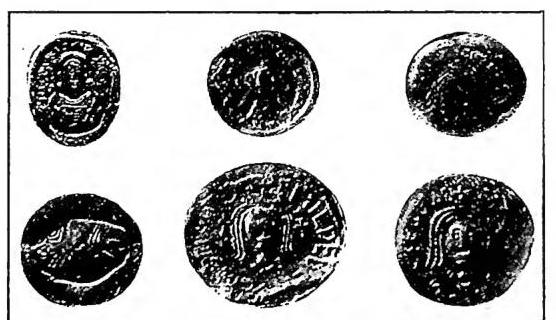
MEROVINGI — From left to right: Seals of Childeric I, Dagobert, Theuderic III, Clovis III, Childebert III, Chilperic II.
Thus the Merovingian dynasty, after three centuries, came to an end more through exhaustion than through the violence of others. Einhard, Charlemagne’s biographer, reproached the M. for having lacked sufficient vigor; and certainly, after completing the unification of all Gaul, they had done nothing to create the State. Yet, through their incapacity, they had made possible the peaceful coexistence of the various ethnic elements, preparing the formation of medieval France.
II. ART
Merovingian art is still the subject of controversy among critics. Some scholars (J. Hubert, op. cit. in bibl.) proclaim its absolute originality; others, on the contrary, deny it any autonomy of expression and, insisting on its analogies with the art of the Near East, regard it as entirely dependent upon that art (L. Bréhier, op. cit. in bibl.), or as a parallel manifestation of thatof the other Western countries in the same period (P. Lavedan, op. cit. in bibl.).
Of the architectural works of the Merovingian period, almost nothing has survived; the numerous cathedrals erected at that time were destroyed or altered by the many subsequent renovations, so that only a few elements remain incorporated into later buildings. The principal remains are the lower part of S. Pietro in Vienne and of several Provençal baptisteries, generally of an octagonal plan inscribed within a square and presumably covered by a dome (Marseilles, Aix, Venasque, Riez, Fréjus, Mélas, Valence, all dated to the fifth century). Some oratories and crypts are better preserved (St Victor of Marseilles, fifth century; the crypts of S. Lorenzo in Grenoble and of Jouarre, dated to the seventh century). Several important architectural works have been almost entirely rebuilt: the cathedral of Clermont-Ferrand and that of Lyon (ca. 450); those of St Germain d’Auxerre, the SS. Apostoli of Paris, St-Germain-des-Prés (sixth century), and the great abbeys of St-Denis, Jumièges, and St-Vandrille (seventh century). Merovingian churches generally had a plan of the Constantinian type, with some variations (the abolition of the atrium, beginning as early as examples from the sixth century, is important); they were built of stone and roofed with wood. A characteristic element, which formed the basis for the theory of the originality of Merovingian art, is the bell tower (in which a clear independence from the tower of Syrian churches has been discerned): sometimes placed at the crossing with the transept (the lantern towers of S. Martino di Tours and of the churches of Nantes and Clermont-Ferrand), or separated from the body of the church (the rear bell tower of S. Martino di Tours). S. Martino di Tours (ca. 472) was the largest of the Merovingian churches; according to the information given by Gregorio di Tours, it was 160 feet long and 60 feet wide, had 120 columns, and its façade had eight portals.
Nothing has survived of the civil or military architecture. With regard to the latter, the sources document the fact that the Roman building traditions remained alive; very important fortifications were the castle of Merliacum, described by Gregorio di Tours, and the castle on the Moselle described by Venanzio Fortunato (I. III, 12).
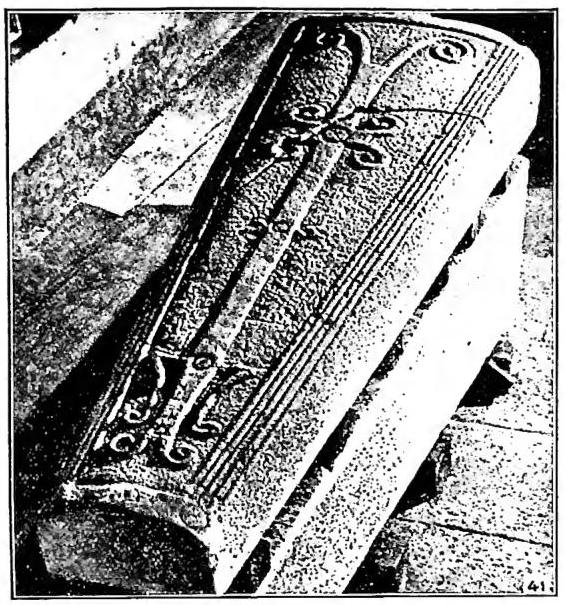
Of the frescoes and mosaics with which the M. covered the walls of their churches, only the information provided by the sources has survived (S. Martino di Tours was decorated with frescoes depicting the stories of the Saint; the church of the SS. Apostoli in Paris was adorned with mosaics, including on the exterior). Something has survived of the sculpture, which is characterized by the abandonment of plastic effect and reduced to a flat relief or even to a drawing engraved on stone. The human and animal figure is gradually deformed until it becomes arabesque; a taste for ornamentation predominates, geometrized and stylized (e.g., Aquitanian sarcophagi, capitals of the churches of Grenoble and Jouarre). The relationship with Oriental art has likewise been assessed in various ways with regard to sculpture, and also with regard to miniature painting and goldsmith’s work, of which a great abundance of material has been found in the tombs (e.g., the Treasure of Childerico [481] at the Cabinet des Médailles; the Treasure of Pouan [451] at the Museum of Troyes; the Treasure of Gourdon [ca. 527]). Goldsmith’s work is the most important chapter in the history of Merovingian art, also because of the presence of several identifiable personalities, including S. Eloi (588–665), the most celebrated goldsmith of the time of Dagoberto, and Dadillo and Ello (a reliquary bearing a signature in the Treasure of S. Maurizio d’Agauno).