
LYON, ARCHDIOCESE of. - Arch-
diocese and capital city of the Rhône department at the confluence of the Rhône and Saône rivers. It extends across the Rhône (except for the canton of Villeurbanne, united with Grenoble) and Loire departments; it covers an area of 7,564 km² with a population of approximately 1,700,000 inhabitants. There are over 1,500 diocesan priests, 2 major seminaries, and 6 minor seminaries. The primate is assisted by two auxiliary bishops, one of whom resides in Saint-Étienne.
By apostolic letters of 29 November 1801, the archbishop of Lyon was authorized to unite Vienne (v.); from 1801 to 1822, he also held the title of archbishop of Embrun. Suffragan dioceses of Lyon are Autun, Dijon, Grenoble, Langres, and Saint-Claude. The patrons of the archdiocese are the holy bishops Irenaeus and Pothinus; the patron of the primatial church is St. John the Baptist.
I. HISTORY
From the time of Augustus, L. was the capital of all Celtic Gaul; the Emperor Claudius, who was born there, showered it with favours, and from then on it was called "Colonia Copia Claudia Augusta Lugdunense." It was partially burned by the army of Septimius Severus, who fought against Albinus in its vicinity. During the Roman period, it was the most populous city in the Gauls and the richest in monuments; it was the seat of a mint and had commercial relations with the East, Italy, and Germany. It was therefore called the Rome of Gaul and "Caput Galliarum." As many as four provinces took their name from "Lugdunum." L. fell into the hands of the Burgundians in 470; in 534, it passed to Childeric; it then became part of the Kingdom of Burgundy until 843; thereafter, it passed under Lothair, then under Charles, King of Provence (853-63), Lothair II (863-69), Charles the Bald, and Louis (869-79). In the year 890, it passed under the Kingdom of Provence. Gregory VII, on 20 April 1079, established L. as the primatial see over the provinces of Rouen, Tours, and Sens, a privilege confirmed by Callistus II. In the 12th century, L. was
In L., the coronations of Popes Clement V (1306) and John XXII (1310) were celebrated; there, too, the antipope Felix V made his renunciation in 1449. L. suffered greatly from the Huguenots in 1560 and during the French Revolution. Pope Pius VII visited L. in 1804 and 1805. At the initiative of the Servant of God P. Jaricot, the Society for the Propagation of the Faith (v. PROPAGAZIONE DELLA FEDE) was established in L. in 1822.
For the bishops of L., there is an episcopal catalogue from the mid-9th century in an evangeliary now in the Seminary of Autun; another list in the Chronicle of Hugh of Flavigny (MGH, Scriptores, VIII, p. 321), continued until Hugh Parvus (1082-1116) and then until Humbert of Bugey (1148-52); a third catalogue, in a 17th-century copy in ms. 1385 of the Library of L., extends to Archbishop Louis of Villars (1302-1308).
The first bishop, Potinus, died in prison in 177; the date of 2 June indicated in the Martyrologium Hieronymianum is not that of his death. He was succeeded by Irenaeus (v.), Zacharias, Aelius, whose tomb was visited by Gregory of Tours (In gloria confessorum, 61); Faustinus, mentioned in Ep. 68 of St. Cyprian; Vocius, present in 314 at the First Council of Arles; Verissimus, who attended the Council of Sardica in 343; Justus at that of Aquileia in 381; Alpinus, noted on 13 September in the Martyrologium Hieronymianum; while his successor Antiochus is recorded on 13 August; Eucherius, to whom Polemius Silvius dedicated his "Laterculus" in 449; Patient, often cited by Sidonius Apollinaris (Ep., II, 10; IV, 25; VI, 12); Rusticus, buried at St. Nicetius, where his sepulchral poem was found (CIL, XIII, 2395); Viventius presided over the Council of L. between 518 and 523; his epitaph is acrostic (CIL, XIII, 2396); Lupus presided over the Third Council of Orléans in 538. Then Sacerdos, who presided over the Fifth Council of Orléans in 549, was present at that of Paris in 552, where he died in the same year after securing the succession for his nephew Nicetius. Fragments of his sepulchral poem were found at St. Nicetius in 1883 (A. Steyert, Nouvelle histoire de Lyon, II, Lyon 1897, p. 30, fig. 25; CIL, XIII, 2398). They were followed by Nicetius, who died in 573; Etherius, who corresponded with Gregory I (Jaffé-Wattenbach, 1436, 1747, 1830, 1872). Aregius presided over the Council of Paris in 614, Tetricus over that of Clichy in 627, Candericus over that of Chalon-sur-Saône; Leidradus (798-817), a friend of Alcuin and a great restorer, resigned and retired to the monastery of St. Medardus in Soissons. In more recent times, the cardinals Peter of Tarentaise, later Innocent V (v.), John of Lorraine (1537-39); Ippolito d'Este, who was administrator of L. in 1539 and 1562; Francis of Tournon in 1551; Alphonse Louis du Plessis de Richelieu, brother of the statesman; Le Tencin (1740-58) are remembered. The popes Innocent IV, Gregory X, Boniface VIII, and Clement V were canons of the Cathedral.
Until 1796, the Cathedral of St. John the Baptist formed a group with the adjacent churches of St. Stephen and St. Cross. St. Stephen, attributed to Bishop Alpinus, was restored around 480 by Bishop Patient and later, in the time of Charlemagne, by Bishop Leidradus. The bishop's palace was attached to II. Preceded by a pronaos, it was in the shape of a Greek cross, and its side arms communicated on one side with the church of St. Cross, on the other with St. John. It later became a baptistery. St. Cross was erected by Bishop Aregius and restored by Leidradus at the beginning of the 9th century, by the clergy and the people in 1444. Both St. Stephen and St. Cross were sold in 1792 and demolished in 1796. The original form of the church of St. John is not known. Agobardus, successor of Leidradus, wrote in a poem that the latter had transferred the relics of the martyrs Cyprian, Speratus, and Pantaleon from Arles. The deacon Florus illustrated the decoration of the sanctuary in verse. It was rebuilt in the 13th century (J. B. Martin [V. op. cit. in bibl.], p. 3 ff.).
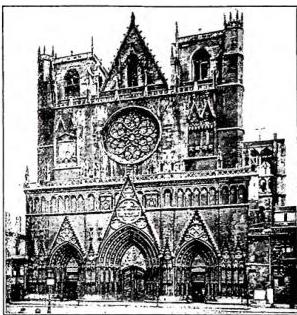
(from L. Schurenberg, Die kirchliche Baukunst in Frankreich, Berlin (B), loc. 79)
LIONE, ARCHDIOCESE of. - Façade of the Cathedral (13th century).
BIBL.:
For the history: A. Steyert, Nouvelle histoire de Lyon, 4 voll., Lyon 1895-99; J. B. Martin, Histoire des églises et chapelles de Lyon, 2 voll., Lyon 1908-09; A. Kleinclausz, Histoire de Lyon, 3 voll., Lyon 1939-52; for the bishops: L. Duchesne, Fastes épiscopaux de l'ancienne Gaule, I, Paris 1907, pp. 142-66; for the primacy: P. F. Kehr, Papsturkunden in Frankreich, IV, Berlin 1911, pp. 1-10; for the Waldensians: A. Dondaine, Les hérésies du XIIe siècle en France, in Revue d'histoire ecclésiastique, 40 (1944-45), pp. 247-97; for the cathedral: J. B. Martin, op. cit., I, pp. 1-100; F. Deshoulières, art. cit.; for the basilica of Patient: E. Griffe, La Gaule chrétienne à l'époque romaine, I, Paris 1947, pp. 220-21.
A. M. Zimmermann
The archbishop Guiscard (1165-80) began the new primatial church of St. John the Baptist, continued by his successor Giovanni di B. Ilesme and later by the prelates Rinaldo de Forez and Roberto d'Alvernia. Pope Innocent IV consecrated it in 1244. The lower part of the façade dates to the time of Archbishop Pietro di Savoia (1308-32) and was continued under Cardinal di Talaru (1375-1389) and Archbishop Filippo di Tourey (1389-1415). The great rose window is the work of G. De Beaujeu, and the stained glass by H. de Nivelle (G. De Jerphanion, Le vitrail de la Rédemption à la cathédrale de Lyon, in Orientalia christiana, 28 [1932], pp. 298-310). The chapter house and Treasury rooms date to 1459; the upper part of the façade and the two towers were completed in 1480. Inside, the columns and pillars supporting the arches are decorated with foliage capitals. The apse is covered with stucco incrustations featuring figures, animals, and decorative motifs. The central nave has eight bays with ogival vaults supported by large cruciform pillars composed of four columns. Among the chapels, the artistic Bourbon Chapel is notable, erected by Cardinal Carlo di Borbone (d. 1488) and completed by his brother Duke Pietro in 1508. The statues that adorned it were destroyed in 1562 and during the French Revolution (A. Macé, Une merveille de l'art gothique. La chapelle des Bourbons à la cathédrale St-Jean de Lyon, Lyon 1941). The central portal features sculptures of the zodiac signs, labors of the months, the history of St. John the Baptist, and episodes from the Old and New Testaments. The side portals depict the story of Samson, the life of St. Peter, scenes from the Apocalypse, the legend of Theophilus, and isolated saints. The Treasury was looted by Huguenots in 1562 and again in 1792 during the Revolution. Cardinals Fieschi and De Bonnald reconstituted it: Limoges enamel caskets, chalices, pyxes, and miters from the 13th-15th centuries, processional crosses from the 12th and 13th centuries, a portable altar from the 15th century; a monstrance donated by Empress Josephine in 1805. A Life of Jesus Christ painted in 1506 for Blessed F. de Gueldres, Duchess of Lorraine. The Missal of Thomas James, Bishop of Dol, illuminated by Attavante of Florence in 1485; the Missal of Boniface VIII (1294-1303), that of the Chapel of the Magdalene from the late 14th century (G. De Jerphanion, Le Missel de la Sainte-Chapelle à la Bibliothèque de la Ville de Lyon, Lyon 1944). Following the separation laws, the Treasury was transferred to the Library of Lyon.
In the extension of the façade stood the medieval singing school, which operated in the morning, hence the name "manécanterie" given to the 11th-century building, rebuilt between 1458 and 1460.
Outside the city, along the road connecting Lyon with Arles, St. Irenaeus was buried; in the time of Gregory of Tours (Historia Francorum, I, 29; In gloria Martyrum, 49), he was venerated in the crypt of St. John among the martyrs Epipodius and Alexander (BHL 2574-75), the latter of whom, along with 34 companions, is recorded in the Martyrologium Hieronymianum on April 24. The sepulchral monument of Irenaeus, Alexander, and Epipodius had been rebuilt by Bishop Patiens and consisted of a semi-subterranean vaulted hall, later surmounted by a basilica damaged during the Wars of Religion and reconstructed in 1584; transformed into a barn in 1792, it was restored to worship in 1801 and enlarged around 1830.
In 1946, in a heating system, a reused stone block was discovered containing a Latin metrical inscription placed by a Lucilia Stratonica for her child buried in a sarcophagus in the basilica erected for herself and her descendants (W. Seston and C. Perrat, Une basilique funéraire palenne à Lyon, in Revue des études anciennes, 45 [1947], pp. 139-59). In the area known as "de Choulans," near the church of St. Lawrence, a Merovingian-era cemetery was discovered (P. Wuillemier and A. Audin, L'église et la nécropole Saint-Laurent dans le quartier lyonnais de Choulans, in Institut des études Rhodaniennes de l'Université de Lyon. Mémoires et Documents, 4, Lyon 1949).
The church of St. Justus, Bishop in Thebaid, near that of St. Irenaeus, has disappeared, but a description remains in a letter by Sidonius Apollinaris. The body of Bishop St. Justus, who died in Thebaid in 390 and was later transferred to Lyon, was placed in a crypt beneath the basilica previously dedicated to the Maccabees. Sidonius Apollinaris describes the solemn feasts held annually on September 2 (Epist. lib. V, 17). The Basilica built at Ainay, declared by Gregory of Tours to be of "mirae magnitudinis" (In gloria Martyrum, 48), was succeeded by the Benedictine abbey of St. Martin, whose church was consecrated on January 27, 1107, by Paschal II, who dedicated the altar to the Immaculate Conception; the church was devastated in 1562, incorporated into Cluny in 1604, secularized in 1685 by Innocent XI, and transformed into a collegiate church; it was suppressed during the French Revolution (1790). It is now a parish church. Pope Pius X elevated it to a minor basilica on June 25, 1905 (T. Malley, Une sécularisation au dix-septième siècle. L'abbaye de St-Martin d'Ainay, in Etudes, 1913, pp. 354-76; A. Chagny, La basilique St-Martin d'Ainay et ses annexes, Lyon 1935; Cottineau, I, coll. 36-38).
St. Paul. Its construction is attributed to the time of Archbishop Sacerdos (549-52); restored by Leidradus in the 9th century, it became a Benedictine abbey secularized in the 11th century; rebuilt in the 13th century; later transformed into a collegiate church. The bell tower from 1440 was modified in 1875; characteristic is the central octagon at the crossing of the nave, transept, and apse (L. Duplain and J. Giraud, L'église St-Paul de Lyon, Lyon 1923).
St. Nizier. An abbey founded in the 9th century; in the 13th century, a parish of the city; elevated to a collegiate church by Archbishop L. de Villars in 1305; restored several times thereafter. It served as a cathedral at the beginning of the 19th century during the restoration of St. John. The interior has three naves with a transept and apse. The façade was rebuilt in the 18th and 19th centuries. The central portal dates to the 16th century. In the church of St. Nizier, some Lyonese prelates of the 6th century were buried; in 1308, excavations were conducted in which their sepulchral inscriptions were transcribed (G. Guigue, Procès verbal de 1308 énumérant les épitaphes des archevêques de Lyon inhumés dans la cathédrale au VIe et au VIIe siècle, in Bull. de la Soc. des antiquaires de France, 1876, pp. 145-58).
The church of St. Romain, located at the foot of Gourguillon, was erected by Fredaldus and his wife; rebuilt in the 16th century and demolished in 1752. The church of St-Pierre-le-Vieux, near the former, was demolished in 1792. The church of St. Bonaventure or of the Cordeliers was first dedicated to St. Francis, then in 1484 to St. Bonaventure because he had preached there; the 15th-century façade was rebuilt in 1858. The church of St. Bruno stands on the site of the Carthusian monastery of Lys St-Esprit, founded in 1584. The first stone was laid in 1590, but interrupted work resumed only in 1724 under architect F. S. Delamonce and was completed in 1750. Among the modern churches of Lyon, notable is the basilica of Fourvière, once a collegiate church dedicated to St. Thomas of Canterbury, with a chapel dedicated to the Blessed Virgin, erected by Olivier de Chavannes between 1173 and 1192. In the 15th century, devotion to the Blessed Virgin developed there; in the 17th century, pilgrimages began; in the 18th century, a new chapel was built. By vow of the Archbishop of Lyon, Monsignor Ginouilhac, made in 1870, architect P. Bossan began construction of the present Basilica in 1872; it was consecrated in 1896.
The Library of Lyon is precious for its wealth of manuscripts. The scriptorium of Lyon flourished especially in the 9th century during the time of the deacon Florus (v. G. de Jerphanion, Traces d'influences orientales dans les manuscrits illustrés de la Bibliothèque de Lyon, in Comptes-rendus de l'Académie des Inscriptions et Belles-lettres, 1943, pp. 177-93).
BIBL.:
G. de Jerphanion, Le Missel de la Sainte-Chapelle à la Bibliothèque de la Ville de Lyon, Lyon 1944; A. Macé, Une merveille de l'art gothique. La chapelle des Bourbons à la cathédrale St-Jean de Lyon, Lyon 1941; T. Malley, Une sécularisation au dix-septième siècle. L'abbaye de St-Martin d'Ainay, in Etudes, 1913, pp. 354-76; A. Chagny, La basilique St-Martin d'Ainay et ses annexes, Lyon 1935; L. Duplain and J. Giraud, L'église St-Paul de Lyon, Lyon 1923; G. Guigue, Procès verbal de 1308 énumérant les épitaphes des archevêques de Lyon inhumés dans la cathédrale au VIe et au VIIe siècle, in Bull. de la Soc. des antiquaires de France, 1876, pp. 145-58; W. Seston and C. Perrat, Une basilique funéraire palenne à Lyon, in Revue des études anciennes, 45 (1947), pp. 139-59; P. Wuillemier and A. Audin, L'église et la nécropole Saint-Laurent dans le quartier lyonnais de Choulans, in Institut des études Rhodaniennes de l'Université de Lyon. Mémoires et Documents, 4, Lyon 1949; G. de Jerphanion, Le vitrail de la Rédemption à la cathédrale de Lyon, in Orientalia christiana, 28 (1932), pp. 298-310; G. de Jerphanion, Traces d'influences orientales dans les manuscrits illustrés de la Bibliothèque de Lyon, in Comptes-rendus de l'Académie des Inscriptions et Belles-lettres, 1943, pp. 177-93; Cottineau, Répertoire topo-bibliographique des abbayes et prieurés, I, coll. 36-38.
Sotto gli auspici della Società «Amis de la Bibliothèque de Lyon» fu fondata nel 1923 una collezione illustrante documenti e manoscritti di detta Biblioteca. Ivi E. A. Lowe ha pubblicato 13 manoscritti tra il V e l'VIII sec. in onciale e semionciale; V. JALABERT, LOUIS, Le peautier de Pally (Lione 1923); P. Lauer, L'Évangéliaire carolingien de Lyon (Parigi 1928). Tra i manoscritti della Biblioteca si notano due portolani italiani, l'uno composto dal genovese Pietro Visconte ca. il 1319 per Marino Sanudo, l'altro col blasone dei Cornaro della fine del sec. XIV. Notevole è il Museo della città situato nel Palazzo S. Pietro. Di grande importanza è la raccolta delle iscrizioni cristiane, pubblicate più volte da E. Le Blant, A. De Boissieu (CIL, XIII, 2351-2445) e da A. Allmer e P. Dissard (Musée de Lyon, Inscriptions antiques, 5 voll., Lione 1889-92); il IV vol. dalla p. 1 a 183 è dedicato alle iscrizioni cristiane. Di esse la più antica datata è dell'anno 334. Da ricordare è l'epitafio di una «Procula di (arissima) femina famula Dei a terra ad Martyres» (CIL, XIII, 2423), riprodotta da A. de Boissieu (Inscriptions antiques de Lyon, Lione 1846-54, p. 547, n. 6). Tra i sarcofagi si ricordano due frammenti di ignota provenienza sui quali era rappresentato G. Cristo tra i dodici Apostoli (E. Le Blant, Sarcophages chrétiens de la Gaule, Parigi 1886, p. 4, n. 6 e tav. II, nn. 2-3). Assai ricco è il materiale medievale (R. Jullian, Catalogue du Musée de Lyon, III. La sculpture du moyen âge et de la Renaissance, Lione 1945). Un capitello medievale scolpito proviene da una chiesa di Modena (G. De Jerphanion, Un curieux chapiteau du Baptiste au Musée de Lyon, in Miscellanea G. Mercati, V [Studi e testi, 125], Città del Vaticano 1946, pp. 61-68).
Pregevole è una collezione di stoffe attraverso l'età, che si inizia con frammenti copti, disposta nel Museo delle Arti.
II. LETTER FROM THE CHURCHES OF L. AND VIENNA. — In the year 177, a persecution broke out against the Christian community of L. News of these events is found in a letter sent from L. to the Churches of Phrygia.
This is a kind of catholic letter. As a literary form, similar to the so-called martyrdom of Polycarp, it was chosen—before the adaptation of trial records for literary purposes—to speak of the charism of martyrdom (v. E. Peterson, in Pro regno, pro sanctuario [Miscellanea van der Leena], Nijkerk 1950, p. 351 ff) to Christians in Asia Minor, threatened by the danger of Montanism. The letter is important for the theology of martyrdom. Not only is the Spirit present to assist Christians in professing their faith, but Christ himself suffers in the martyr. The letter clearly distinguishes the confessor from the martyr. Martyrdom is a struggle against Satan, etc. The letter is written in a relatively simple form, though not without rhetoric. Its authenticity has been contested, but it cannot be seriously doubted. Six excerpts from this document are found in Eusebius (Hist. eccl., V. 1-4).
The complete list of names, categorized by the type of martyrdom, was at the end of the document but is now lost. Eusebius provides the following list: Vettius Epagathus, Sanctus, Maturus, Attalus, Blandina, Pothinus, Alexander, Ponticus, Alcibiades.
The Martyrologium Hieronymianum on June 2 instead lists 48 names and adds in a first group: Zacharias the presbyter, Macarius, Silvius, Primus, Ulpinus, Vitalis, Comminus, October, Philomenus, Genuinus, Julia, Albina, Brata, Emilia, Potamia, Pompea, Rodana, Biblis, Quarzia, Maternus, Elpis.
It then distinguishes those condemned to the beasts: Sanctus the deacon, Maturus, Attalus, Alexander, Ponticus, Blandina; and those who died in prison: Artisteus, Cornelius, Zosimus, Titus, Julius, Zoticus, Apollonius, Geminianus, Julia, Ausonia, Emilia, Giannica, Pompeia, Donna, Justa, Trofima, Antonia.
From the document, we learn that in the summer of 177, a group of arrested Christians were interrogated in the forum of L. by a military tribunal. During the trial before the provincial governor, the young Christian Vettius Epagathus stepped forward to defend his coreligionists. A tumult arose, and Vettius was arrested; during the interrogation and tortures, ten recanted. But they were replaced by other arrested faithful. Special cruelty was inflicted upon the deacon Sanctus, the neophyte Maturus, Attalus, and Blandina, who, though young and delicate, endured the tortures with remarkable fortitude for an entire day. Sanctus answered every question with "I am a Christian," even as he was torn with red-hot copper plates; his steadfastness brought the apostate Biblis to her senses, who reaffirmed her faith and later attained martyrdom. The terrible torments caused the death of several. After a few days, the others were interrogated again, among them the venerable bishop Pothinus, already a disciple of Polycarp of Smyrna, who, after being tortured, was returned to prison and died there two days later. Maturus, Sanctus, Blandina, and Attalus were exposed to the beasts in the amphitheater; the first two, torn apart by them, were placed on red-hot iron chairs and then killed. Attalus, being a Roman citizen, was sent back to prison to await imperial instructions. Meanwhile, even the recanters returned to the faith. Marcus Aurelius decreed that those who persisted in remaining Christians should be executed, while the others were to be freed. On August 1, the anniversary of the dedication of the altar erected in L. in honor of Augustus, the survivors were brought before the tribunal, and all confessed their faith; Roman citizens were condemned to decapitation, the others to the beasts. During the interrogation, a certain Phrygian physician named Alexander, who encouraged the confessors, was also condemned to the beasts. Attalus ended up on a red-hot chair, while Ponticus and Blandina were reserved for the last day of the gladiatorial games. Ponticus, aged 14, died under torture; Blandina, after scourging and the fire of the gridiron, was wrapped in a net and exposed to the fury of a bull, which tossed her into the air several times before she finally died, pierced. The bodies of the martyrs who died in prison were thrown to the dogs; after six days, the miserable remains surviving the beasts and the fire were burned, and the ashes scattered in the Rhône.
1) First Council. — This was the XIII Ecumenical Council, held in 1245 under Pope Innocent IV. It must be situated within the context of the violent conflicts between the papacy and Frederick II. When Cardinal Fieschi, who was the Emperor’s candidate and took the name Innocent IV (June 1243), ascended to the pontificate, hopes arose for a détente and a period of peace. However, Frederick II soon returned to the offensive. After all attempts at agreement with the Swabian failed, the Pope, fearing imprisonment, left Rome and went to Lyons, a free city situated at the borders of France and the Empire. His first thought was to convene a council.
This council opened on 28 June in the cathedral of St. John in the presence of 140 bishops, who had come from various provinces of Christendom. Also present were the Latin Emperor of Constantinople, Baldwin II, the three patriarchs of Constantinople, Antioch, and Aquileia, and the ambassadors of many princes.
The Emperor, though invited, did not appear; instead, his legates appeared with the chancellor Thaddeus of Suessa, archbishop of Palermo. From the first session, the latter made new peace proposals on behalf of his lord. The Pope refused to accept them, and it was decided that Frederick II, though absent, would be judged by the Council. Thaddeus protested in vain, arguing that the Emperor could not be judged without being heard; in vain, he sought a postponement, assuring that Frederick had set out, was on his way, and would soon arrive. The Emperor, however, remained in Upper Italy. Thaddeus also attempted in vain to respond to the serious accusations raised against Frederick; unable to do more, he appealed to a future Pope and a truly ecumenical council. But his appeal did not prevent Innocent from pronouncing the sentence of excommunication and deposition against Frederick, accused of perjury, persecution of the Church, invasion of the Papal States, suspicion of heresy, and protection of the Saracens. The Fathers affixed their seals to the act of deposition, then cast down their extinguished candles. No one present contradicted.
Beyond the condemnation of the Emperor, the Council also addressed other matters. Among other things, it issued prescriptions concerning the Holy Land and the Crusade against the Tartars, established rules for the procedure to be observed in ecclesiastical judgments, forbade under pain of excommunication the supply of arms to Muslims and the plundering of pilgrims traveling to the Holy Land, and prescribed a tax on ecclesiastical goods for the benefit of the Latin Empire of Constantinople. The Council promulgated no dogmatic decree and concluded on 17 July 1245.
2) Second Council. — This was the XIV Ecumenical Council, held from 7 May to 17 July 1274. On 1 September 1271, after a laborious conclave lasting nearly three years, Gregory X was elected Pope while he was in St. John of Acre. At that time, the last strongholds of Christian conquests in Palestine and Syria were falling. Ten years earlier (1261), the Latin Empire of Constantinople had collapsed to the full advantage of Michael Palaeologus. One of the new Pontiff’s first thoughts was to prepare a Crusade to retake the Holy Land. As for the Latin Empire of Constantinople, the Pope was willing to leave it in the hands of the Greeks, provided they abandoned schism and joined the Crusade. At the same time, aware of the rather serious disorders observed everywhere, especially among the clergy, Gregory was determined to attempt a general reform. Precisely to achieve this threefold aim—union of the Greek Church with the Latin Church, a Crusade in the Holy Land, and reform of the clergy—Pope Gregory, immediately after his coronation (27 March 1272), convened a general council for 1 May 1274, without, however, specifying the city in which it was to be held. The choice of Lyons was announced only in April 1273. It was to be attended not only by archbishops and bishops, mitred abbots, and other prelates or procurators, but also by Christian princes, including the Byzantine Emperor, Michael Palaeologus. Delegates from the Khan of the Tartars were also to be present for the Crusade.
Although scheduled for 1 May 1274, the Council actually convened on the 7th, after three days of fasting. It may be considered one of the most numerous conciliar assemblies in history. While kings were notably absent (with the exception of the elderly king of Aragon, who, moreover, left before the Council ended), the ecclesiastical world participated almost in its entirety: 500 bishops, 60 abbots, and over 1,000 other prelates or procurators, as nearly all chroniclers report. Not only was the number extraordinary, but so was the quality of those present: rarely had an assembly included such celebrated figures as St. Bonaventure, St. Albert the Great, Peter of Tarentaise (the future Innocent V), three others who would later become popes—Adrian V, John XXI, and Nicholas IV—St. Philip Benizi, John of Vercelli, Humbert of Romans, Durand of Mende, and the Greek Franciscan John Parastron, who played a leading role in the union of the Greeks. It is well known that St. Thomas Aquinas was to have taken part, but he died during the journey on 7 March.
The Council held six sessions. More work was done between sessions than during them. In the first, on 7 May, the Pope, commenting on the words: Desideravi hoc pascha manducare vobiscum, spoke of the Council’s threefold purpose. In the second and third sessions (18 May and 7 June), disciplinary constitutions were promulgated. On 24 June, the Greek ambassadors finally arrived, after a terrible shipwreck in which most of them had perished. All the conciliar fathers went out to meet them. The Greek legates presented letters in which Emperor Michael, his son Andronicus, and the entire high clergy (50 metropolitans and over 500 bishops) submitted to the Church of Rome and accepted the profession of faith sent to Michael in 1267 by Pope Clement IV. On 29 June, the feast of SS. Peter and Paul, Gregory X celebrated Mass, during which the Epistle, Gospel, and Credo were chanted in Latin and Greek. The Greeks repeated three times in their own language the Qui ex Patre Filioque procedit. St. Bonaventure delivered a discourse. Nothing remained but to officially sanction the union by reading the documents presented by the Greeks: this took place in the fourth session on 6 July. The logothete George Acropolites, on behalf of Michael Palaeologus who had appointed him plenipotentiary, recited aloud the profession of faith of Clement IV. Germanus, former patriarch of Constantinople, and Theophanes, metropolitan of Nicaea, did likewise on behalf of the Greek clergy. The Te Deum was then sung, and the Credo was again chanted in Latin and Greek. The Greeks repeated twice in their language the Filioque. On 15 July, St. Bonaventure, who had played a primary role in the Council, died. The Pope and all the Fathers of the Council attended his funeral. The following day,
On July 16, the fifth session took place, during which fourteen Constitutions were promulgated, including the one concerning the Conclave, which the cardinals accepted reluctantly. The sixth and final session was held on July 17. In it, two Constitutions were published, one of which was dogmatic (Fideli ac devota professione: Denz-U, 460), by which the Council defined that the Holy Spirit proceeds eternally from the Father and the Son, not as from two principles but as from one principle, not by means of two spirations but by means of one spiraction: oeternoliter ex Patre et Filio non tamquam ex duobus principis sed tamquam ex uno principio, non duobus spiratimius sed unica spiratione procedit. This definition is of particular importance as it radicitus destroys the principal objection that the Greeks raised against the Catholic doctrine expressed by the Filioque, according to which the Latins would have taught that the Father and the Son are two distinct principles of the Holy Spirit. This dogmatic decree, which in the official collection of the Council's Constitutions is inserted under the rubric: can. 1, has hitherto been erroneously attributed, by most historians, to the second session, that is, at a time when the Greek legates had not yet arrived: which seemed entirely implausible (cf. S. Kuttner, op. cit. in bibl., pp. 44-47).
In addition to this can. 1, Gregory X issued, on November 1, 1274, under the name of the Council of L., thirty other canons or disciplinary Constitutions concerning the Conclave, elections, benefices, ecclesiastical trials, usury, the foundation of new religious Orders, etc. It should be noted that all these constitutions were not compiled during the Council but were added afterward, as part of the program for the reform of morals. The order in which they follow does not correspond to the historical order.
Together with the dogmatic definition on the procession of the Holy Spirit, the most important act of the Council of L. was the official consecration of the profession of faith of Clement IV, known as that of Michael Palaeologus, as an expression of the Catholic faith (Denz-U, 461-66). The first part of this document reproduces, approximately, the profession of faith of St. Leo IX (1053), which is that issued by bishops at their consecration. The rest, beginning with the words Sed propter diversos errores, defines the state of souls after death (Purgatory and immediate retribution), the septenary number of the Sacraments, the primacy of jurisdiction of the Church of Rome and of its head as successor of St. Peter.
The triple purpose that Gregory X had set for himself in convening the Council was only imperfectly achieved. The union with the Greeks, determined by political motives, was ephemeral. The Crusade, after a promising start, had no follow-up. As for the reform of morals, it was quite superficial. It must be said, however, that the Pope, who had convened the Council, was not at all responsible for such an unfortunate outcome. The blame lies rather with unfavorable circumstances and unforeseen events that followed. The union with the Greeks was particularly compromised by certain excessive demands of Gregory's successors, who passed like meteors across the papal throne: indeed, from 1276 to 1284, there were five pontiffs.
IV. LITURGY OF L
The liturgy of the Church of L. from the 5th to the 8th century was nothing other than the ancient Gallican rite. In none of the many councils of Gaul during these centuries, which the bishops of L. also attended, often as presidents, is there mention of a special rite or liturgical privilege of the Church of L. The change occurred with Charlemagne’s reform. Archbishop Leidrad (797-814) introduced, along with Gregorian-Roman chant, the other Gregorian books of the Roman liturgy. After Charlemagne’s death, the Gallican liturgy revived insofar as many of its elements were fused with the Roman rite. Alcuin composed the supplement to the Gregorian-Hadrianic Sacramentary, which included not a few Gallican rites. The Church of L. did not escape this influence: it accepted the new Sacramentary and, under Burcard II (c. 1000), the new pontifical; but compared to the other Churches of Gaul, it remained more faithful to the Roman liturgy adopted under Leidrad, albeit with all the particularities introduced from the 10th to the 18th century.Proof of this can be seen by comparing the oldest sacramentaries (e.g., cod. 537 of the Library of L.) with the missals of the 15th century. As in the sacramentaries, the proprium de tempore and de sanctis are not separated but intercalated; for the saints special to L., a separate fascicle is placed after the ecclesiastical year (Missal of Jean de Talaru, 14th century); the Missal of a certain Colinet de Marles (14th-15th century) first unites in a single series the saints of L. with the saints of the Gregorian rite. The Missal known as that of Chasselay (15th century) is the first to separate the proprium de tempore and de sanctis and adds new Offices (Introitus and Gradualia), but retains the lessons for Wednesdays and Fridays of the week. Printed missals adhered to this Chasselay model (from 1487 in 8 editions) until 1556; in the Missal of Tournon, the most typical Roman-Lyonnais Missal according to the Tridentine reform, the prefaces increase (from 8 to 11) and especially the proses. The last purely Roman-Lyonnais Missal, known as that of Marquemont (1620) and in use until 1737, contains some additions to the Gregorian text of the ancient sacramentaries but no transformation. The Missal of Rochebonne (1737) breaks with tradition: orations, proses, epistles, and Gospels are all modified, the number of officiants and processions decreases. The rupture with tradition is completed in the spirit of a return to antiquity and neo-Gallicanism with the Missal of Montazet (1768), introduced and accepted by the Chapter of L. only under threats from the Parliament; it was no longer the ancient Lyonnais Missal but the Parisian Missal in the spirit of the new Gallican or Jansenist ideas. Breviaries and rituals conformed to this Missal. The Missal of Montazet was retained even after the Empire (1823 and 1825), but under Bonald (1841-44) there was a return to the Missal of Marquemont of 1620. In 1866, the Roman Missal and Breviary were introduced with the addition of a Lyonnais Proprium, and in 1902 a new edition was made with further additions of particular feasts and rites. The ancient stations and Lyonnais Paschal Vespers were abolished in 1914.
The rite of the Mass dates back at least to the 10th century. The Missal of 1737 changed the imposition of the amice (over the alb); until the 18th century, the maniple was assumed after the chasuble, but after this time the Roman rubrics were followed. The Confiteor, until the Missal of Rochebonne (1737), had a shorter formula like that of the Carthusian or Dominican rite. In ascending the altar, the apologia "Deus qui non mortem" was said first, then "Conscientias". At the kiss of the Gospel, the priest recites "Credo et confiteor" in sung Masses. At the Offertory, a prayer is said with hands outstretched over the Host: "Dixit Jesus... Ego sum" (Jn 6:51-52; 16th century). Then the priest takes the chalice, saying "Quid retribuam" (Ps 115:3, 4), pours wine and water into it with the prayer "De latere", offers the chalice together with the Host on the paten with "Hanc oblationem" and "In spiritu humilitatis". For Christmas, there are three prefaces; for Epiphany, Easter Day, Ascension, and Pentecost, one each; likewise for the Blessed Virgin, the Apostles, Lent, and the commune. At "Unde et memores", the priest extends his arms in the form of a cross. The elevation of the chalice and Host occurs at the words "Fiat voluntas tua sicut in caelo"; at "et in terra", they are placed on the altar. The "Libera" is said aloud, and in sung Masses it is chanted. There are no special prayers for the anointing of the Body and chalice other than "Domine sancte Pater... nisi tu" and "Domine Christe... separari".
In the sung Mass, the large number of officiants of every order (priests, deacons, subdeacons), at least three, is striking. At the beginning, the Gospel, which is on the altar or carried in procession by the subdeacon (Ord. Rom., I, 8), is kissed. The incensation of the altar is not attested before the 12th century. The celebrant sits while reading the Epistle, the Gradual, and the Gospel. Before the Offertory, the hands are washed. Several verses followed the Offertory antiphon. A large corporal is used. After the incensation, the hands are washed again. At the Elevation, the canons bow, not kneel. After the first "Agnus Dei", the antiphon "Venite populi" is sung, perhaps an ancient chant for the fraction of the bread before the introduction of the "Agnus Dei". Throughout the time from the "Sanctus" to Communion, two thurifers incense the altar, then the dignitaries and the choir. After the "Placeat" without blessing, the priest with the ministers leaves the altar and returns to the sacristy, reciting the Gospel of St. John; if there is a special final Gospel, it is recited in the sacristy. The celebrant and ministers wear the mitre, not as a sign of distinction but as part of the liturgical vestments. The subdeacon holds the paten during the Canon, not with a veil but with the maniple. On ferial days of Lent, two capitulars bring the bread and wine to the celebrant. In the pontifical Mass, the entrance is very solemn: seven acolytes with candles precede, followed by seven subdeacons (one mitred with the cross), seven deacons (the archdeacon mitred with the bishop’s crozier), and six priests (the seventh is the celebrant himself); the bishop, with his assistants in copes, wears a long grembiale. The assistants recite everything together with the celebrant, except the words of consecration, which are recited on Holy Thursday (the only concelebration). The chalice is prepared, between the Epistle and the Gospel, at an altar different from the high altar (that of administration). At the Offertory, the assisting priests offer small hosts, and all the assistants receive Communion. After the "Libera", the solemn tripartite pontifical blessing follows. After the Communion of the assistants, the remaining sacred species are carried by the dean to the chapel of the Sacrament. There is no final pontifical blessing because it has already been given at the "Libera".
In the Office, until the 18th century, the absence of hymns is notable, as in the ancient Roman Office, except for Compline. Another peculiarity is that the canons recited the entire Office from memory. The organ has been used only since 1841. The administration of Baptism was performed by immersion, even in the 16th century. In Extreme Unction, twelve anointings are used.
V. CULTURAL INSTITUTIONS
During its period of splendor (2nd century), schools also flourished in L. In the Middle Ages, they were restored by the great bishops Leidradus (cf. J. Pourrat, L'antique Ecole de Leidrade, Lyon 1899), who also benefited from the work of Amalarius and Agobardus. L. was the first French center for renowned printing presses specializing in editions of biblical, patristic, theological, and juridical works. For the preciousness of its libraries, cf. H. Leclercq, Lyon, in DACL, X, 1, coll. 350-89. A vast complex of cultural institutions still enhances the city's prestige today.1. The Ancient Studium
The existence of a Studium or University in L. during the Middle Ages has given rise to difficulties and discussions. It is certain that schools existed there, particularly of law; however, several points need clarification.
This school of the Curia did not remain long in L., as the Pope left the city in 1251. Later, toward the end of the 13th century, another School of Law was found in L., which must have been a local (municipal) Studium. Few and obscure data confirm its existence; among these is the controversy (1291-92) between the arch-
bishop and the Chapter regarding the licentia docendi or authorization to be granted to doctors who were to teach. The agreement, by which the archbishop granted the "license," while the doctores regentes were chosen by mutual accord between the two parties, was ratified by Nicholas IV with the bull of 23 March 1292. Subsequent disputes were regulated by the letters of Philip IV on 6 May 1328, given the annexation of the city to the Kingdom of France. From that time, no further mention of the School is found.
2. The Catholic University
Thanks to the law of 12 July 1875, which recognized the freedom of higher education in France, a free Faculty of Law was established in L., inaugurated on 22 November 1875. This marked the beginning of the Catholic University, which to this day retains the name Facultés catholiques de Lyon. It comprises six Faculties, established over time: three in civil studies—Law (1875), Letters (1877), and Science (1877)—and three in ecclesiastical studies—Theology (1878 [canonical erection, 16 April 1886]), Canon Law (1935), and Philosophy (1935); in addition, various specialized institutes: Commercial Law (1919), Industrial Chemistry (1919), Social Studies (1944), Linguistics (1945), and Pedagogy (1947). In 1949, the Institutum S. Gregorii Magni, a higher school of sacred music, was affiliated with the Catholic University; in 1950, it had 6,000 students. The Faculty of Medicine, not yet erected, is currently represented by the Hôpital Saint-Joseph, opened by the University on 15 November 1894 (cf. the epistle Quo magis of Leo XIII, 30 October 1894: Leonis XIII Acta, XIV, Rome 1895, pp. 345-346). The new grand headquarters of the University, constructed during the war, was inaugurated in 1945.The "university region" of L. (southeastern France) includes the five metropolitan sees of L., Avignon, Aix, Chambéry, and Algiers; additionally, the dioceses of Marseille, Belley, Moulins, and Carthage: a total of 28 dioceses, with a population of approximately 10 million inhabitants. The body of bishops constitutes the General Episcopal Council, which convenes once a year. To guarantee and manage the property of the Catholic University, the Société civile was established on 30 April 1877.
The statutes of the Faculties of Ecclesiastical Studies, conforming to the apostolic constitution Deus scientiarum Dominus, were approved by decree of the Sacred Congregation of Seminaries and Universities of Studies on 22 February 1935. The Grand Chancellor of the University is always the cardinal archbishop of L.; its heavenly patrons are St. Thomas Aquinas and St. Irenaeus.
3. The Faculty of Theology
Also to be noted in Lyon is the Faculté de théologie of Fourvière, reserved for students of the Society of Jesus: a flourishing institution, universally renowned for its renewed studies in dogmatic and positive theology. - Vedi tav. XCIV.LIPARI, DIOCESI di - Panorama of Valistrieri.
(Int. Edit)