
INNOCENT V, POPE, Blessed. — A Dominican friar, known by the name of Fr. PETRUS DE TARANTASIA, was born in Tarantasia proper (the upper Isère Valley and not in the Aosta Valley or in the small and little-known Lyonnais Tarantasia) about 1224, and died in Rome on 22 June 1276.
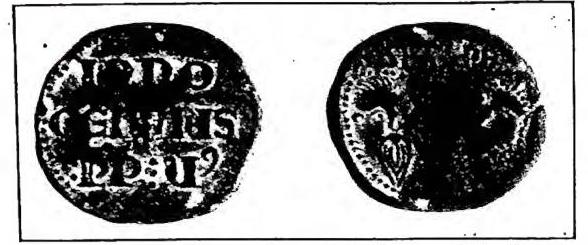
(courtesy of H.E. Msgr. A. P. Frutaz)
INNOCENT V, POPE, Blessed — Lead seal of I. V, found in the Thora Valley above Sarre (Aosta), 1 August 1897 — Aosta, Museum of the Academy of St. Anselm.
Penitentiary Major, he accompanied Gregory X to Beaucaire (21 April 1275) and to Lausanne (6 October).
At the death of the Pope, which occurred at Arezzo on 10 January 1276, Cardinal Peter, present at the Conclave, was chosen as his successor (21 January) and assumed the name of Innocent V; then on 22 February in Rome he was enthroned and crowned. The few months of his pontificate were intensely occupied with the preparation of the Crusade, which political difficulties rendered unrealizable, with the pacification of Genoa with Charles of Anjou, and with the cessation of hostilities between Ghibelline Pisa and the Tuscan Guelph League. The months of March and April were particularly devoted to the Eastern problems of the Crusade and the Union, sanctioned by the Council of 1274, which treated with the envoys of Michael VIII Palaeologus, George Metochita, archdeacon of Constantinople, and the Grand Intendant Theodore. Unfortunately, in the course of these delicate negotiations Innocent came under the excessive influence of Charles of Anjou and Philip of Courtenay, Latin Emperor of Constantinople, as is evident from the tone of the instructions given to the General of the Friars Minor, Jerome d’Ascoli, head of the mission that was to conclude the negotiations with Palaeologus. The mission was then interrupted by the death of the Pope. The too evident sympathies of Innocent for Charles of Anjou placed the Pope in serious difficulties with the elected Roman Emperor, Rudolph of Habsburg. Innocent also concerned himself with the process of canonization of Margaret of Hungary. As for his alleged hostility towards the Servite Order, it has been established that this is a groundless legend. His cult was confirmed by Leo XIII on 14 March 1898. Feast, 22 June.
OPERE. — Peter of Tarentaise occupies a distinguished place among the scholastics of the 13th century, and his writings enjoyed considerable diffusion not only within the university milieu but also in the principal cultural centers of Europe, as is evident from the approximately 280 manuscripts (13th–16th centuries; the list is susceptible to further enrichment) found in the libraries of the continent and from the monumental 17th-century edition of his commentary on the Sentences. He belongs to the transitional period of the Dominican school, which moved from Augustinianism tinged with Neoplatonism to Christian Aristotelianism alongside the two great masters, his contemporaries and friends, St. Albert the Great and St. Thomas Aquinas. Peter’s works represent the fruit of his university teaching, but unfortunately their analysis is laborious for most readers because the greater part of them remains in manuscript form. Peter was not only a refined compiler, as is evident especially in his commentary on the Sentences, but also a true thinker capable of defending his solutions with originality and firmness. His scholarly output includes, as was the case with the great scholastics of the 13th century, commentaries on Scripture and on the Sentences, as well as particular theological questions in which the originality of his thought is discernible.
To his first teaching period belong: 1) Commentary on the Four Books of the Sentences, composed between 1257 and 1259 but published between 1259 and 1264 (cf. ed. by T. Turco and Giovanni Battista de Marinis, 4 vols. in-fol., Toulouse 1649–52). The author made use of the parallel commentaries of Sts. Bonaventure and Thomas Aquinas; the latter had to analyze the work at the request of John of Vercelli, to whom he later addressed the Explanatio dubiorum already mentioned. 2) The A version of the gloss Dedi te in lucem gentium on the Epistles of St. Paul, dating from before 1264. Of this gloss there exists a B version by an anonymous author, long attributed in the past to the Dominican Nicholas of Gorran and printed repeatedly under his name (Cologne 1478, etc.). Of particular theological interest are the “distinctions” and the “doubts” that interrupt the literal commentary.
To his second teaching period are to be attributed: 1) the Quodlibet containing 37 questions (cf. ed. by P. Glorieux, in Recherches de théologie ancienne et médiévale, 9 [1937], pp. 237–80). Question 36 on salvation in the state of innocence was refuted by St. Thomas in Quodlibet V, q. 5, a. 8. 2) The questions De lege et praeceptis (more than 50), definitively claimed for Peter. The first question on the existence of the Eternal Law has been published in full (cf. ed. by O. Lottin, in Ephemerides theologicae Lovanienses, 14 [1937], pp. 295–97). The solutions offered to the dogmatic and moral questions treated here and in the Quodlibet allow one to grasp the most original aspects of the thought of our author. Thirteen sermons certainly authentic are also preserved by Peter. His glosses on the Pentateuch and on St. Luke have not yet been rediscovered.