
PIETRO LOMBARDO. – Theologian and bishop, known as the Master of the Sentences, born in Novara at the end of the 11th century, died in Paris on 21 (or 22) July 1160.
I. LIFE
His life is little known. Of humble origins, he was recommended by St. Bernard (Ep., 410: PL 182,619; vir venerabilis) to the canons of St. Victor in Paris, where he arrived around 1135–36, after a brief stay in Reims. A few years later (ca. 1142–43), he is mentioned by Gerhoh of Reichersberg among the best-known commentators on St. Paul (Libellus de ordine donorum Spiritus Sancti, in MGH, Libelli di lite, III, Hannover 1897, p. 275); it is therefore to be assumed that P. L. already held a Parisian chair, probably at Nôtre Dame. His prestige must have grown rapidly, since in 1148 he was counted among the magistri scolares who, together with Pope Eugene III, judged the theological doctrine of Gilberto Porretano at the Council of Reims (Giovanni di Salisbury, Historia pontificalis, chap. 8; ed. Poole, Oxford 1927, p. 17). In a Bamberg manuscript, a gloss attributed to Pietro di Pottiers (v.) alludes to a journey by P. L. to Rome, which certainly took place in 1151–52, since on 19 January 1152 Eugene III, in a letter to Enrico, bishop of Beauvais, recommends the lator praesentium, that is, « magister Petrus » (PL 180, 1488–89). Elected bishop of Paris toward the end of June 1159, he died the following year. An unknown annotator of Roberto di Torigny’s chronicle offered the new bishop this praise: « Magister Petrus Lombardus, vir magnae scientiae et super Parisiensium doctores admirabilis » (MGH, Scriptores, VI, p. 509).II. MINOR WORKS
In Psalmos davidicos commentarii (PL 191, 55-1296), also called Glossae continuae or Glossae Psalterii, probably written before 1140: an explanation of the individual verses, gathered from the Latin Fathers, with a strong tendency toward allegorism; Collectanea in omnes Divi Pauli epistolas (a work printed under this title by J. Bade [Paris 1535] and reproduced by Migne [PL 191, 1297-1696; 192, 9-520]), but commonly called Maiores glossae epistolarum or Magna Glossatura; compiled before 1142-43 (according to van den Eynde, between 1138 and ’40), it enjoyed wide diffusion, although it is no more original than the preceding work; the author, however, introduced a new method: the insertion of quaestiones theologicae alongside verses that provided an occasion for them. This work is therefore to be regarded as the immediate preparation for the book of the Sentences (cf. C. Spicq, Esquisse d'une histoire de l'exégèse latine, Paris 1944, pp. 125-27); Sermones: according to the research of B. Hauréau (Notice sur les sermons attribués à Hildebert de Lavardin, in Notice et extraits des manuscrits de la Bibliothèque nationale, 32 b [1888], pp. 107-166), there were about thirty festal discourses, scattered among those of Hildebert of Lavardin and Peter Comestor (PL 171, 339-964); they belong to the genre of scholastic oratory, with artificial divisions (always in three parts) and exaggerated allegorism; otherwise, they reveal the author’s piety and learning. For other doubtful or spurious works cf. De Ghellinck, in DThC, XII, cols. 1974-78.III. THE « BOOK OF THE SENTENCES »
The true title is Libri IV Sententiarum. The work was probably begun around 1148 and completed in 1151-52 (cf. F. Pelster, Wan hat Petrus Lombardus die « Libri IV Sententiarum » vollendet?, in Gregorianum, 2 [1921], pp. 387-92), and was somewhat revised in the following years: it has been held, perhaps mistakenly, that the author prepared a second edition of II. The Sentences was the work that had more manuscripts and editions than any work after the Bible: there are 20 incunabula; first printed at Strasbourg (ca. 1471), after 1500 it received numerous further editions (e.g., PL 191, 521-962), culminating in the critical edition prepared by the Friars Minor (2 vols., Quaracchi 1916), with valuable historical prolegomena.The division into books and capitula is original; the distinciones, however, were introduced later and according to criteria that were not always consistent, so that significant differences are found in the individual commentators (cf., e.g., P. Philippe, Plan des Sentences de Pierre Lombard d'après st Thomas, Juvisy s. d.). The four-part division of the work is based on a passage from St. Augustine (De doctrina christiana, I, chs. 2 and 4: PL 34, 19-20) dealing with res and signa. Liber I: res quibus fruendum: the Trinity and the unity of God, 48 distinciones; Liber II: res quibus utendum: Creation and Grace, 44 distinciones; Liber III: res quae fruuntur et utuntur: the Incarnation, Redemption, the theological virtues, the commandments (the division can be applied only to this last part, since it is men and Angels who fruuntur et utuntur), the last things, 40 distinciones; Liber IV: signa, quae adhibentur in significando: the Sacraments of the Old and New Law, 50 distinciones. The Augustinian inspiration that emerges here and there, not exploited in such a way as to constitute the profound unity of the entire theological system, imposes on the immense material a purely external framework; thus, in the fictitious scheme, there is no place either for De vera religione (whose elements had been extensively developed in anti-Jewish polemic) or for De Ecclesia (which had been treated especially by the canonists), and the questions, often without being connected through any real articulation, follow one another artificially. Nevertheless, P. L. is superior to the four schools that preceded him (Anselmian, Abelardian, Victorine, Porretan) in the logical ordering of the questions and in the comprehensiveness of the program (especially with regard to the Sacraments and the Novissimi).
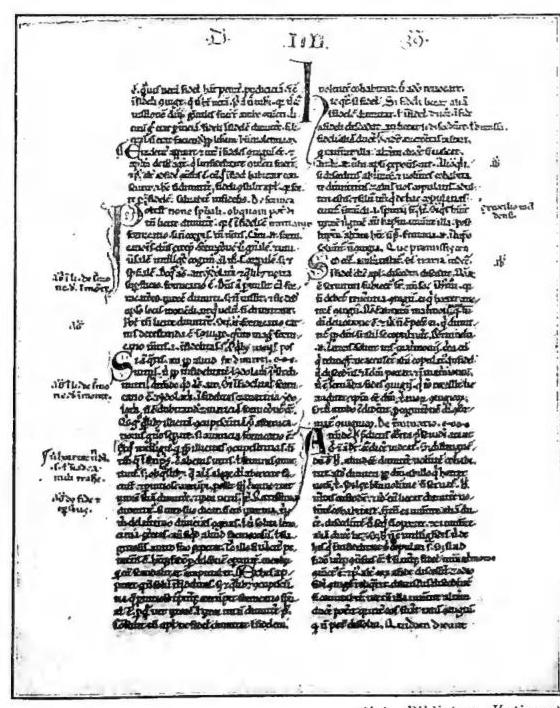
Thus P. L., perhaps inferior in talent to his contemporaries, knew how to surpass them in patient systematic work, comprehensiveness of treatment, balance of outlook, and orthodoxy of doctrine. Indeed, the book of the Sentences, after violent and prolonged attacks (at three points: 1163-77: John of Cornwall and Gerhoh of Reichersberg; 1179: Walter of St. Victor; 1215: the disciples of Gilbert Porretanus and Joachim of Fiore) and after partial condemnations (1179), received a verdict of orthodoxy from Innocent III at the Fourth Lateran Council; with that verdict it entered all the theological schools, was commented on by the greatest masters (St. Albert the Great, St. Bonaventure, St. Thomas: cf. J. Stegmüller, Repertorium commentariorum in Sententias Petri Lombardi, Würzburg 1949), and presided over the scientific elaboration of Catholic theology.
BIBLI: J. Schupp, Die Gnadenlehre des Petrus Lombardus, Freiburg in Br. 1932; J. De Ghellinck, s. V. in DThC, XII, cols. 1941-2019 (masterly); id., L'essor de la littérature latine au XIIe siècle. L. Bruxelles-Paris 1946, passim (v. index); id., Le mouvement théologique du XIIe siècle, 2e ed., Bruges-Paris 1948. E. De Clerck, Droit du dénué et nécessité de la Rédemption. Les écoles d'Abéliard et de Pierre Lombard, in Rech. de théol. une. et médiév., 14 (1947), pp. 31-64; D. van den Bynde, Précisions chronologiques sur quelques ouvrages théologiques du XIIe siècle, in Antonianum, 26 (1951), pp. 330-33. Antonio Piolanti