
PIETRO della PALUDE (Petrus a Palude). — Dominican theologian, born at Varambon (Ain) around 1277, died in Paris on 31 January 1342. A religious in Lyon, he studied in Paris and became master of theology on 13 June 1314. He was a member of the commission charged with examining Durandus of Saint-Pourçain’s commentary on the Sentences, and together with Giovanni of Naples he drew up a list of 93 errors and a catalogue of 235 articles contrary to Thomism.
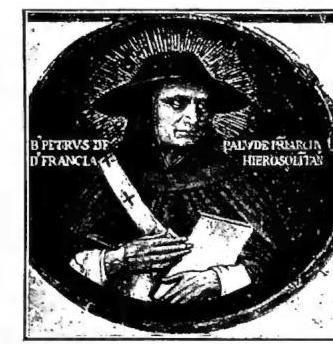
(Alinari photograph)
PIETRO DELLA PALUDE — Portrait. Detail from the Crucifixion. Fresco by Beato Angelico (first half of the 15th century). Florence, Convent of S. Marco. Of the commentary on the Sentences, begun in 1310, whose first two books remained unpublished (Paris, Bibl. naz., Mazar. 988, 809), the last two were instead fairly widely circulated (I. III, Paris 1517; I. IV, Venice 1493, Paris 1518); the author responds with learning and fervor to the objections raised by Durando against s. Tommaso and is therefore regarded as one of the finest interpreters and defenders of Thomism; his teaching on the Sacraments is especially esteemed.
Numerous biblical commentaries, still unpublished, are attributed to him. Two of his Quodlibetales questions are known (Toulouse, n. 744; Munich, lat. 26, 309). The De paupertate Christi et Apostolorum attributed to him, against Michele da Cesena, is by Erveo di Nedellec (Hervaeus Natalis). The well-known treatise De causa immediata ecclesiasticae potestatis (Paris 1506), published under his name, is probably by the Dominican cardinal Pietro de Godin (v. GODIN), his contemporary. The four short works written against Giovanni de Pouilly are authentic.