
PALESTINE. - A region in the Near East on the Mediterranean coast between Phoenicia and Egypt, which was conquered as the "Promised Land" by Israel in the time of Joshua and was the stage of biblical history. The name (Gr. Παλασινίη, Lat. Palaestina) reproduces Pēlēseth "Philistia" (Egyptian Pω-r'-δ-θ, Assyrian Palastu), which before the Hellenistic period designated the south-western coastal plain of P. (Šēphēlāh).
Numerous discoveries in recent decades of stone implements and human fossil remains in various caves of P. have shown that it was inhabited by man from the most remote prehistoric ages, whose form, habits, diet and tools have been reconstructed. After the discovery of the "human skull" in the ez-Zattijhēh cave in Wādī el-'Amūd, made in 1925 by F. Turville-Petre, the finds of human remains in the caves of Suqbah (1928) near Ramleh, of Carmel (1928-34) and of Gebel Qafzeh (1934) with stone implements of Abbevillian, Levalloisian and Mousterian characteristics confirmed the presence in P. of Palaeolithic man (Palaeanthropus Palaestinus) akin to the Neanderthal type.
The Mesolithic, represented by the Natufian (from Wādī Naṭūf, near Lidda), presents the farming, pastoral and even artistic man. Its particular feature is microlithism and the working of bone into needles, hooks, fish-hooks and combs. Great care was taken in the burial of the dead; in the cemetery in front of the el-Wad cave in Wādī Maġārah, skulls and heads were adorned with shells and bones. The presence of Neolithic culture in P. is still debated; some think there was a direct transition from Mesolithic to Chalcolithic. The distinctive features of the pre-ceramic village of Jericho, with clay houses, a sanctuary and figurines of animals and deities, seem to belong to the Neolithic. To this period (6000-4500 B.C.) are also attributed the megalithic monuments (dolmens, menhirs, cromlechs), of which Transjordan is particularly rich.
The appearance of metal and the new development in ceramic technique characterize the Chalcolithic (end of the 5th and beginning of the 4th millennium B.C.), also called "Ghassulian" from the excavations carried out in 1929 at Telejāt Gassūl (q.v.), in the valley east of the Jordan, and later at Megiddo, Beisan, 'Affūleh and Tell el-Fara'. The population, of unknown origin, displays an advanced culture.
I. CIVIL HISTORY. — With the “Canaanite” age (3000–1200 B.C.) Palestine enters the light of history. This is the Bronze Age, so called “Canaanite” to designate, in the broad sense, the whole of the peoples who inhabited Palestine before the coming of the Israelites and who left
copious remains of their civilization, brought to light by excavations and chronologically determined as follows: Early Bronze (3000–2000); Middle Bronze (2000–1600); Late Bronze (1600–1200).
About 3000 B.C. a first Semitic immigration, strictly speaking “Canaanite,” brought a true revolution in Palestinian civilization. Cities were built on hilltops or spurs near springs and fortified with massive walls and supplied with water. The political and social organization remains unclear; but it probably consisted of city-states around which the bulk of the population, still nomadic or semi-nomadic, moved. Over a large part of the region Egyptian influence extended, remaining dominant, through various vicissitudes, throughout the Bronze Age. Toward the end of the 2000s B.C. the Canaanites were overwhelmed by new Semitic invaders, Amorites (v.), whose settlement in Palestine is reflected in the Egyptian “execration texts,” published by Sethe in 1926 and by Posener in 1940. These texts, written on ostraca or statuettes, were intended to curse effectively princes and cities rebellious to the Pharaoh and reveal Egyptian expansionist policy, which, weakened by the new invaders, sought to consolidate along the trade routes. But with the overwhelming military occupation of the Hyksos (c. 1730–1580 B.C.), Egypt was eliminated from Palestine. Using horse-drawn chariots and new weapons, the Hyksos, having overrun Palestine, even managed to occupy Egypt. Dreaming of founding a vast empire under their rule, from Africa to Asia, they fostered exchanges between the two countries and left traces of a composite culture.
After the expulsion of the Hyksos (c. 1580 B.C.) Palestine became an Egyptian province. After Thutmose III subdued in 1479 B.C. the revolt of Syrian and Palestinian princes in the plain of Megiddo, the country, under a firm and wise regime, enjoyed material prosperity, as excavations show. Serious disturbances to the peace were caused in the 14th century by the bands of Habiru and by the rivalries and double-dealing of local princes, as the letters of el-’Amārnah inform us.
Despite the military expeditions of Ramses II (1292–1226) and Meneptah (1225–1205) to keep open the lines of communication, Egyptian influence steadily weakened and was submerged by the new wave of invaders, “the peoples of the sea,” who, though repulsed from the borders of Egypt, left a powerful group, Philistines (v.), along the southern coasts of Palestine. In these chaotic conditions, favorable to every new invader, the Hebrews entered the land.
The “Hebrew” period extends from the end of the 13th or beginning of the 12th century to the Babylonian exile (587 B.C.). After the death of Moses on the threshold of the Promised Land, Joshua undertook the conquest of Canaan. Having opened a breach in the Jordan valley and captured Jericho, the Hebrews advanced directly to the central highlands, from where, through gradual expeditions to the south and north, they conquered the whole land, except the city of Jerusalem, the plain of Esdraelon, strongly held by the Canaanites, and the coastal cities, occupied by the Philistines. The twelve tribes, among which the conquered territory was divided, found themselves separated by these Canaanite enclaves into three groups: the tribe of Judah and Simeon in the south, the house of Joseph (Ephraim and Manasseh) in the center, and the tribes of the north in Galilee.
Without a central power, political functions were exercised by the tribal chiefs; but the continual threats to Israelite expansion and hegemony by the Canaanites, the raiders from the east, and especially the Philistines, brought a change in social structure. Deliverers arose (v. GIUDICI), who, in difficult moments, placed at the head of one or more tribes with limited power and only for the time of crisis, saved the land from the oppressor: Deborah from the Canaanites, Othniel (Ehud) from the Moabites, Gideon from the Midianites, Samson from the Philistines. But the Philistines remained a grave danger. Thanks to their civil and military organization and the use of new iron weapons, they advanced from the coast into the hill country, destroying Shiloh (1050 B.C.) Ark (v.) of the Covenant. Then the need for national unity was felt, and Samuel, the last of the Judges, anointed Saul king of Israel; he began his reign with victorious campaigns but ended it with the defeat at Gilboa.
True political unity of David (v.). Through fortunate wars he subdued the last resistance of the Canaanites and Philistines, expanded the borders of the state, and finally drove the Jebusites from their stronghold on Zion, establishing Jerusalem as his capital, bringing back the Ark, and making it the political and religious center of Israel. Under his son Solomon the kingdom gained increasing prestige abroad, while at home it became urbanized with Oriental splendor in the construction of the Temple, the palace, and administrative and military offices. Dividing the kingdom into twelve districts, each governed by a responsible official, Solomon created a powerful army and opened new trade routes to Phoenicia, Arabia, and Ophir, developing the trade in chariots and horses and the mining industry. But at his death the kingdom, burdened by fiscalism and traditional tribal antagonisms, split into two parts: the smaller portion of the people, namely the tribes of Judah, Simeon, and Benjamin, remained under the Davidic dynasty with Jerusalem as capital and territory extending from Idumea to the mouth of the Jordan in the Dead Sea; the other tribes, under the preeminence of Ephraim, retained the rest of Palestine with the capital first at Shechem, then at Tirzah, and finally at Samaria. In internal politics, the northern kingdom, called “Israel,” was continually involved in palace revolts, while the dynasty of Judah was more stable. The history of the two kingdoms is one of wars between them; Israel, militarily stronger, usually prevailed. They fought other wars together to defend the borders left by King David or to preserve their independence from the Assyrian colossus. But the kingdom of Israel was unable to resist the formidable Assyrian onslaught, and in 722 B.C. Samaria, the capital, was taken by Sargon II and the population deported to Assyria. From the few elements remaining and new imports arose the hybrid race of the Samaritans.
In 538 B.C. Cyrus the Great, having conquered the Babylonian Empire, permitted the Jews to return
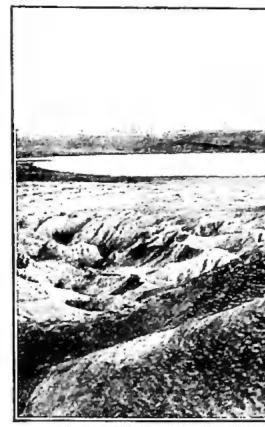
PALESTINE — The Dead Sea seen from Nebi Mûsâ. In the foreground the desert of Judah, in the background the mountains of Moab.
and the rebuilding of the Temple. The returnees confined themselves within the narrow limits of Judah and around Jerusalem; but the reconstruction was long and painful, due to the opposition of the Samaritans and to internal strife. The great figures of this period are Zerubbabel, Ezra, and Nehemiah. Only in 515 B.C. was the reconstruction of the Temple completed, and in 445 B.C. that of the walls.
At Herod’s death his kingdom was divided among his sons, who continued the transformation begun by their father in Palestine: Archelaus, ethnarch of Judea, Samaria, and Idumea, rebuilt the palace of Jericho; Philip, tetrarch of Gaulanitis and Trachonitis, built
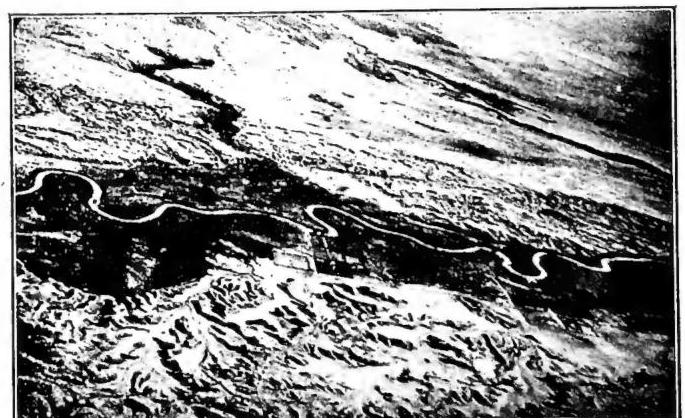
PALESTINE - Aerial view of an area in the Jordan valley.
(photo by Associated Press)
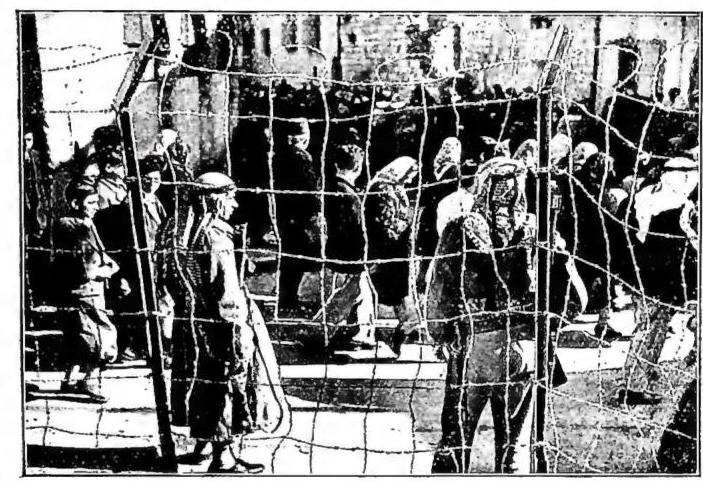
PALESTINE – Easter pilgrimage in the Holy Land. The pilgrims, seen through barbed wire, pray at the third station of the Way of the Cross, guarded by armed Arabs belonging to the National Guard. The barbed wire is for the defence of the Old City of Jerusalem, in the Arab quarter.
Caesarea Philippi and Bethsaida Julias; Herod Antipas, tetrarch of Galilee and Perea, founded the cities of Tiberias and Livia in Transjordan. At their death the territory was directly annexed to the province of Syria, except for the brief period of Agrippa I (37–44) and Agrippa II (50–100), and governed by procurators (v.) resident in Caesarea. Among these was Pontius Pilate (26–36), who tried and condemned Jesus to death. The violent “Jewish War” (66–70) ended with the occupation of Jerusalem in 70 by Titus and the destruction of the Temple, the massacre and the deportation of the Jews of Palestine.
As the Roman troops approached, the Christians had taken refuge in Pella, beyond the Jordan; once the storm had passed, they returned to Jerusalem and settled around their mother church on Mount Sion. Social life was gradually resuming its rhythm when the Jews made a final attempt to reconstitute themselves as a nation, led by the daring Bar Kokhba (v.). The revolt was long and tenacious, especially around the fortress of Bethar, where, for three years (132–35), the rebels held out against the Roman legions; but in the end it was crushed, and Hadrian, to prevent any revival of Jewish aspirations, rebuilt Jerusalem on an entirely different plan, making it the Roman colony known as Aelia Capitolina. On the site of the Jewish Temple pagan statues were placed, and on Golgotha, where Jesus had been crucified, a temple to the Capitoline triad was erected. The Christians, having at their head a bishop of Gentile stock, were not disturbed; but the Jews were forbidden even to enter the new city. The ancient name of Judaea was changed to Syria Palaestina.
In the 4th century, with Constantine’s conversion to Christianity, Palestine entered a period of prosperity. Constantine’s mother, St Helena, in 326 visited Palestine to venerate the Holy Places and to promote the construction of the sumptuous basilicas of the Holy Sepulchre in Jerusalem, of the Nativity in Bethlehem, and of the Eleona on the Mount of Olives. Pilgrimages then intensified, and important written accounts of them have been handed down (v. ITINERARI). Many colonies of monks settled everywhere in Palestine. The population grew not only in Palestine and Transjordan, as is shown by the numerous Byzantine churches, monasteries and hospices that keep coming to light, but even in regions now almost deserted, such as the Negeb.
In 451 Jerusalem was made head of an independent patriarchate (v. GERUSALEMME, patriarchato di).
But in 614 the Persians, led by Chosroes II in his war against the Byzantine Empire, swept over Palestine, welcomed by the Jews and the Samaritans, and devastated the country, destroying and gravely damaging the basilicas and monasteries and persecuting the Christians to death or taking them into slavery. This was followed by a bold and patient work of reconstruction, promoted by the monk Modestus, and with the return of Heraclius (628–629) Palestine was just beginning to recover when the Arab conquest intervened.
The Caliph ‘Umar, having defeated the Byzantine army at the Yarmuk, in 637 made his entry into Jerusalem, which had surrendered under terms negotiated by the Patriarch Sophronius.
During the Arab domination, first under the elective caliphs of Medina, then under the Umayyads and the ‘Abbasids, the policy of tolerance promoted by ‘Umar was maintained. Pilgrimages were resumed and the reconstruction of the ancient sanctuaries permitted. The country, embellished, especially under the Umayyads, with monuments and winter palaces (such as those discovered at Mefer near Jericho and at Khirbet el-Minjeh on the Sea of Galilee), became predominantly Arab-Muslim.
After the ‘Abbasids came the Fatimids of Egypt, and under the Caliph al-Hakim persecution of the Christians broke out. By his order, in 1009, the church of the Holy Sepulchre was destroyed, its treasures and relics plundered, monks and pilgrims killed or driven out. A brief interval of tolerance followed his death. After the Fatimids, the Seljuk Turks resumed the persecutions in an even more violent manner.
The sad situation moved Europe to action and provoked Crusades (v.). Palestine was organised into a Kingdom by the Latins or “Franks.” But on 15 July 1187 Saladin, who had proclaimed a “holy war,” recaptured Jerusalem, and despite various attempts by the Christians, on 1291, with the fall of St Jean d’Acre, the last defence of the Latin Kingdom collapsed. Palestine was then incorporated, with Syria, under the rule of the Mamluks of Egypt.
Periods of persecution alternated with periods of tolerance. In 1335, through the intercession of King Robert and Queen Sancia of Naples, the Franciscans, as representatives of the Latins or Catholics, officially settled in the convent on Mount Sion on the site of the Upper Room and entered into the service of the Holy Sepulchre, obtaining a place within the basilica, together with the dissident communities.
To the rule of the Mamluks of Egypt succeeded that of the Ottomans, which lasted four centuries (1517–1917). The beginning was marked by great activity in administrative reorganisation and reconstruction (it was to Suleiman the Magnificent, 1542, that the present city walls are due); but their rule was disastrous for the country, which was harried by pashas and beys who regarded it as a land to exploit. Corrupt administration and fiscal oppression reduced the region to economic misery. At the end of the 18th century Napoleon, having conquered Egypt, advanced into Palestine; but unable to take Acre (‘Akkah), powerfully defended by Jazzar Pasha and the English, he abandoned the enterprise on 20 March 1799. Later Sultan Mahmud II tried to restore order in Palestine; but the turbulence of the Pasha of Acre, ‘Abdallah, son of the aforesaid Jazzar, who sought to make himself independent of the Sultan, provoked the intervention of Muhammad ‘Ali, Viceroy of Egypt, who with 30,000 men under the command of his son Ibrahim Pasha captured Acre.
The Egyptian occupation, which lasted nine years (1831–40), was not without beneficial effects. Administration was reorganised, European initiative and relations with Europe were encouraged, with the establishment of consulates in the principal cities. Greater freedom was given to the exercise of Christian worship, ancient sanctuaries were rebuilt, institutes of charity, schools and hospitals were opened, and religious communities grew: the Catholic ones under the protection of France, the “Orthodox” under the influence of Russia, the Protestant ones on the initiative of the Germans and the English. There was also a strong current of Jewish immigration. But this promising restoration was abruptly interrupted by the World War: Turkey, allied to the Central Powers, made of Palestine a base of operations against Egypt occupied by the English. On 11 Dec. 1917 Jerusalem surrendered to General Allenby.
The “Balfour declaration” of 2 Nov. 1917, providing for the establishment in Palestine of a National Home for the Jews, subject to the civil and religious rights of the non-Israelite communities already existing there, was incorporated in the peace treaty with Turkey signed at Sèvres on 20 Aug. 1920 and in the text of the British mandate approved by the League of Nations on 24 July 1922. From the difficulty of reconciling the establishment of the National Home with respect for the rights of the existing communities arose the Palestinian problem or Arab-Jewish conflict, which became so acute that in 1947 Britain surrendered its “mandate” to the U.N. On 15 May 1948 British troops left Palestine and the Arab-Jewish war broke out. Since 1948 Palestine has been divided into two zones under the sovereignty of the two antagonists: the State of Israel (q.v.), with its capital at Tel Aviv, comprises most of the territory from Galilee to the Negeb; Jordan controls, besides Gaza, the eastern part of Palestine along the Jordan (Samaria) as far as the Old City of Jerusalem and Bethlehem. This division corresponds to the status quo of the armistice concluded in 1948. V. TRANSCIORDANIA.
Donato Baldi
II. ECCLESIASTICAL HISTORY
For the history prior to the First World War, see GERUSALEMME, PATRIARCATO di. After the war of 1914–18 Palestine came under British mandate; according to official British government figures toward the end of 1945 it had 1,795,179 inhabitants, of whom 1,101,565 were Muslims, 554,329 Jews, and 139,285 Christians.(courtesy of Dr. N. Di Girolamo)
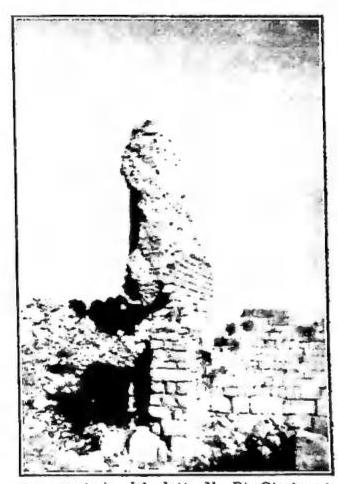
PALESTINA – Remains of the Crusader castle at Tallḥit.
The number of Jews had increased by about 58,000 by 15 May 1948.
With these figures the situation of the Christians is already indicated; they form a very small minority between the two hostile blocs of Muslims and Jews. In the struggle between these blocs the Christians clearly sided with their Muslim fellow-citizens, feeling themselves also to be Arabs.
Among the Christians only 39%, i.e. 51,320, are Catholics. The last detailed statistics for the individual confessions date from 1931. It is assumed that the proportions have remained more or less the same, although the absolute number of faithful has greatly increased, since at that time only 91,398 Christians were counted in all.
The other Catholic communities, apart from the Maronites who constitute 9.6% of the Catholics, are few in number. There is a small number of Armenians, Syrians and Chaldeans. The diversity of rites in Palestine is not as great as elsewhere, since at the time of the christological disputes Monophysitism could not take root in the Patriarchate of Jerusalem.
Among the non-Catholics the Greek rite predominates. 71.2% of the dissidents are “Orthodox.” The dissident Greek Patriarchate of Jerusalem is still dominated by the Greeks, who occupy all the important posts, while the people and the lower clergy are Arabs. The antagonism between the Greek leaders and the Arab people is the principal fact in the situation of this Patriarchate, which is undoubtedly in a
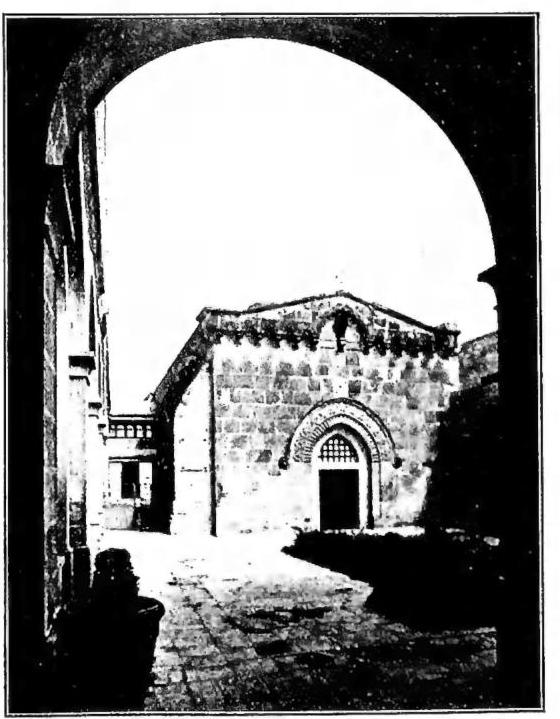
PALESTINA - Façade of the Church of the Flagellation (14th century), restored by engineer G. Barluazi — Jerusalem.
(courtesy of Dr. N. Di Girolamo)
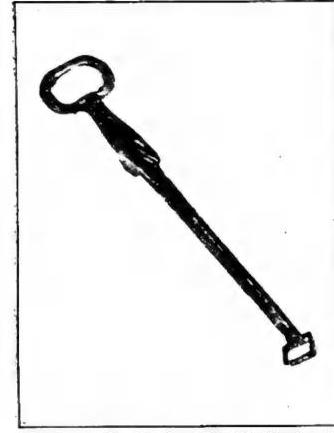
PALESTINE – A key to the Holy Sepulchre is kept by a Muslim family.
The Russian colony passed, toward the end of 1948, under the jurisdiction of the Patriarch of Moscow, whereas previously it had been subject to the anti-Soviet Episcopal Synod of the Russian emigration.
The religious situation has been completely upset by recent events. After the outbreak of war between Israel and the Arab League (15 May 1948), more than half a million Arabs fled; among them 60–70,000 Christians, of whom 20–30,000 were Catholics. Only a small part has been able to return so far (1951). Catholic works and institutions suffered greatly from the war. In the State of Israel, which, according to official figures at the end of 1950, had 1,150,000 inhabitants, of whom 87% were Jews, only a very small minority, about 50,000, are Christian. The future of these Christians is very precarious. The Greek-Catholic diocese of St John of Acre survived the war and has been able to reopen some schools. Yet about 43% of its faithful still live in exile. V. ISRAEL; TRANSJORDAN.
III. CHRISTIAN ARCHAEOLOGY
The study of Christian archaeology in Palestine may be said to have begun in this century, and there is still lacking a comprehensive general work that brings together its findings.1. From the 1st to the 4th century — Of the episcopal complex on Mount Zion, seat of the successors of St James, only a rather ruined wall remains (the eastern one of the present Cenacle). The fact that the church was enlarged in the 4th century suggests that it was originally quite small. According to Fr Vincent, who excavated the site, the church at ‘Amwās (Emmaus [q.v.]) was truly large and had three apses, built in the 2nd–3rd century, but his opinion is not shared by many scholars; in fact, some prefer to lower this dating (Lassus, C. Cecchelli), while others (A. Prandi) believe that the original building had a different purpose. An apsed cave near Bejt Gibrīn, with broken crosses scratched into it, seems to indicate a sacred place that was profaned. Some ossuaries with crosses, found on the Mount of Olives and along the road to Bethlehem, are probably of Christian origin, dating from the time when the Church of Jerusalem was composed mainly of converted Jews. Terracotta lamps with crosses and swastikas, found in cisterns at Bejt Nattīf along with other objects from the 2nd–3rd centuries, suggest the existence of crypto-Christian artefacts.
2. From the 4th to the 7th century — The building activity begun by St Helena, under the impetus of Bishop Macarius, continued throughout the Byzantine period, transforming Jerusalem into a “new city” and erecting sacred buildings in every village of Palestine. In Galilee, the activity of Count Joseph of Tiberias stands out; he seems to have erected rather modest buildings, as can be judged from structures attributed to him, such as the lower church of the Multiplication of the Loaves at et-Tābighah. In Judea, distinguished builders included Melania the Younger and Eudocia in the 5th century and Justinian in the 6th. The Holy Places (q.v.), witnesses to the deeds of the Saviour, were adorned with shrines. After the tomb of the Saviour (326), tombs of martyrs followed, often as a result of visions in dreams: St James the Less (351) on the Kidron, St John the Baptist (tomb profaned in 561–62) at Sebaste, Moses on Mount Nebo (Siyāghah), St Stephen at Kafr Gamala (415) and probably also the two martyrs of ‘Ayn Kārim, to whom the mosaic inscription alludes: “Hail, O martyrs of God.”
In the construction of these shrines, the element of memory strongly influenced the architectural arrangement. It consists of a “cave,” as at the Holy Sepulchre, Eleona, Bethlehem, etc.; of “sand” left deliberately visible, as at the Ascension; of “water,” as in the pools of Siloam and the Probatica, at the River Jordan and at the Well of the Samaritan Woman. Sometimes this memory simply communicated with the liturgical basilica, as at the Holy Sepulchre, where the tomb of the Redeemer communicates with the Martyrium through the triportico; at Bethany the tomb of Lazarus (= Lazarion) is located west of the atrium (4th century), exactly as at St Menas in Egypt. More often, however, the building surmounts the memory: the Well of the Samaritan Woman; Bethlehem, the cave of the Nativity; Eleona, the cave of the Teaching, etc. When it is a “cave,” it sometimes remains at the level of the new building, as the Holy Sepulchre of the Redeemer within the Anastasis, and the tomb of the Virgin (5th century) through the cutting of the rock, but more often it becomes the crypt of the building, as at Bethlehem, at the Mount of Beatitudes (4th century), Eleona, etc., giving rise to a motif that would later be developed in Europe.
The religious buildings of Palestine exhibit a construction
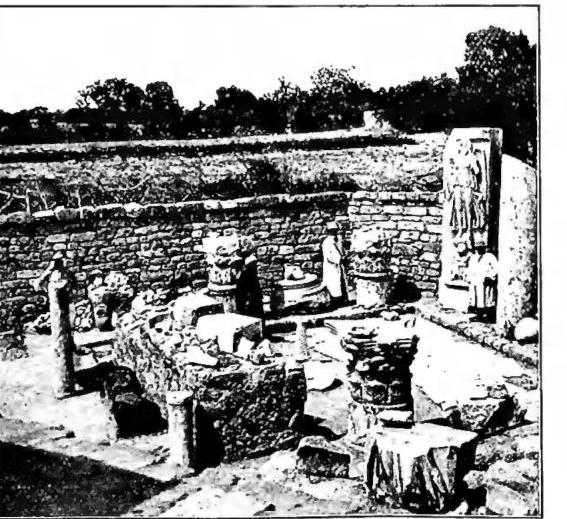
PALESTINE — Archaeological material discovered in the excavations of Ascalon.
The construction of religious buildings in Palestine exhibits great variety: five-aisled basilicas (Bethlehem and the Martyrium), three-aisled basilicas with a single apse (the ordinary type) or with three apses (a rare case and the first secure example at Gethsemane, 4th century), most often with two sacristies flanking the apse; buildings with a trefoil plan (Deir Dōsi and St. John in Jerusalem, both 5th century, and Bethlehem, connected with the Basilica in Justinian’s reconstruction); in the shape of a cross (the Well of the Samaritan Woman and the pinnacle of the Temple, both known only from literary sources; 4th–5th centuries); with two apses (east and west: the Tomb of the Virgin); with an octagonal plan (Bethlehem connected with the Basilica in the Constantinian period, Capernaum with an apse, and Garizim with four side chapels); and round (Anastasis, the cathedral of Bejsān with an apse). Rock-cut chapels, ordinarily used by monks, are sometimes caves left in a semi-natural state, except for painted decoration (Deir Mukellik, Mar Sābā, el-Merd), while others are well adapted by leveling the rock or adding masonry (the Grotto of the Nativity, partially at Gethsemane), which instead occurs when the spaces were previously used as tombs (e.g., the columns on the Wādī el-ʿAmad in Jerusalem, later fitted with an apse) or cisterns (e.g., at Bethany, near the Sisters of Charity and the site of the Beatitudes). The walls of the buildings, generally 75 to 95 cm thick, are mostly of squared stones (courses 29 to 49 cm) of rectangular shape in the 4th–5th centuries, tending to become square in the 5th. They are coated with painted plaster (4th century: Bethlehem, Bethany; 5th century: Hān el-Aḥmar or the Monastery of St. Euthymius, etc.) or with mosaics (Sijāgāh, Bethlehem 6th century, etc.). Around the apse there are sometimes seats for the clergy (Sijāgāh) with the bishop’s throne. Seats are occasionally found on the sides of the presbytery, which extends in front of the apse into the space of the central nave (Mhajjet), and ordinarily set against the perimeter walls. Pulpits were often hexagonal (Sijāgāh, St. Stephen in Jerusalem) and placed in the south nave or in front of the presbytery.
The altars found are mensa-type, often with semicircular recesses, supported by four small columns. As appears in some cases (e.g., Mhajjet, St. George, where there is a mosaic with a lamb at the tree), the orientation of the altar is toward the east, so that the priest celebrated with his back to the congregation. Eusebius’s description of the twelve columns of the Martyrium suggests a ciborium, and it seems that the circular platform with octagonal steps of the Constantinian octagon at Bethlehem (q.v.) is precisely the remnant of the ciborium, although it is ordinarily regarded as an oculus. Columns of moderate size suggest the presence of a ciborium in other churches, such as St. Stephen in Jerusalem (5th century). Under the altars (ʿAjn Hannijeh, Mhajjet) or nearby, reliquaries have been found, ordinarily in the form of small sarcophagi with pitched roofs, sometimes with holes for aromatic oils (Sijāgāh). The interior space was sometimes subdivided (St. Stephen, ʿAjn Hannijeh) to separate the relics of various martyrs.
The decoration of sacred buildings in the 4th century and largely also in the 5th consisted of decorative or symbolic motifs, perhaps with lavish gilding, but without the use of the human figure. This is evident from the account of Egeria (q.v.) and from the remains discovered. Wall paintings or mosaics of that time are not preserved; instead, many floor mosaics survive (Bethlehem, Eleona, Bethany, Gethsemane, the Mount of Beatitudes) from the 4th century, always without figures and only with geometric motifs and a few rare birds (Bethlehem). This is understandable when one reflects that prominent figures such as Eusebius of Caesarea (q.v.) and St. Epiphanius (q.v.) adhered to the anti-image movement. It is therefore not a question of iconographic types created in Palestine, in the sanctuaries, and then spread throughout the world. The evidence adduced in this regard with the ampullae (q.v.) from Monza and Bobbio dates only to the 6th century, when even in Palestine a current of art with extensive use of human figures had already formed. By this time we have the descriptions of Choricius regarding the churches of Gaza and the few mosaic remains described by authors (Adoration of the Magi at Bethlehem in the building rebuilt by Justinian) or paintings seen until recent times (Baptism of Jesus at Sbejtah) and perhaps the Majesty at Gethsemane, and above all a large repertoire of
floor mosaics. This is uniform in Palestine and neighboring regions and presents fairly well-defined characteristics in both iconographic and technical respects. Iconographically, there is extensive use of scenes from daily life: hunting, fishing, agriculture, etc., and of symbolic motifs often explained with biblical phrases: stags at the fountain, animals at the tree, the ox and lion together, bulls near the altar, the four rivers of Paradise; or allegorical ones such as the four seasons, the Earth with fruits in her lap, etc. Only once is there a scene of the deeds of Jonah (Bejt Gibrin). Technically, one notes: the use of extremely small tesserae for heads and hands compared to the rest of the body, a double bedding layer, agitated backgrounds, stocky figures with fixed gazes and outlined in dark lines, with orbiculi and tabulae in the garments, and chiaroscuro sometimes quite conventional. The places where this style is attested include Sbejtah, Bejt Gibrin, Jerusalem (Orpheus), Bejsān (Hammām and monastery), the region of Madaba and Gerasa, and many other sites where the repertoire is limited to animals, especially birds (e.g., with Armenian inscription on the Mount of Olives). The dating to the 6th century or shortly thereafter is given by the mosaic inscriptions affixed to the mosaics themselves: 518 at Bejt Alfah (synagogue), 529–33 at St. John in Gerasa, 567–69 at Bejsān (monastery); 575 at Qabr Hirām (Lebanon), 395–96 at St. Elijah in Madaba, 597–608 in the chapel of the Theotokos at Sijāgāh, 604 at St. Sophia in Ḥalīd al-Kifāṣī, whereas nothing of this kind is found before this time; and by the evidence of excavation. Preceding this 6th-century movement is the mosaic pavement of et-Tibāṣāh (Church of the Loaves and Fishes), executed on a Nilotic repertoire that exerted some influence on the later movement, e.g., in the repetition of birds on the papyrus corolla (Madaba, ʿAmwās, Bejt Gibrin, Mhajjet).
Sculpture was of little importance in Palestine: apart from a rough Good Shepherd from el-Mīneh near Gaza, perhaps imported from Egypt, only a limited repertoire of geometric and floral motifs is found. The capitals are ordinarily of Corinthian style with a rough draft and two or three rows of acanthus leaves, very prominent in the 4th century (Gethsemane, Bethany), much more attenuated and conventional afterward. Other capitals are basket-shaped (Eleona, Holy Sepulchre) and many are of simplified floral style and not inelegant (Sijāgāh, Gīrā near Qubejbeh), where the cross sometimes dominates and a rare animal figure appears (Sbejtah). The chancel screens also feature floral motifs and a few rare animals, such as sheep at el-Merd and gazelles drinking from a vessel, in a fragment in the Museum of the White Fathers in Jerusalem. The latter two motifs appear to be derived from mosaics.
The baptisteries known so far are always small and attached to a religious complex ('Amwās, Eleona, Sbejtah, Sijāgāh, etc.), usually a small chapel with an apse. Such seems to have been that of the Holy Sepulchre and that of Bethlehem, which was apparently located in the north-west corner of the Basilica or, more precisely, in the atrium. Many baptismal fonts are preserved, of various shapes: cross-shaped both inside and outside (Sbejtah), four-leaf clover-shaped inside and outside (Sbejtah, Bejt 'Awwā and Melakatha near Bejt Nattif, which bears the inscription: «For the health of Matthew and George»), octagonal outside and four-leaf clover-shaped inside (Thecua and Bethlehem, which has the inscription: «For the memory, peace and remission of sins of those whose name God knows»), square outside and quadrilobate inside ('Amwās, Beersheba, Hirbet Zakarijjah with the mutilated inscription: «For the health of Sophronia and Baricha»), round on both sides (el-Merd and Hirbet Maqāṭir near Bejtīn). The font of Hirbet el-Ma'mūdijjeh, near Hebron, was fed by the spring itself.
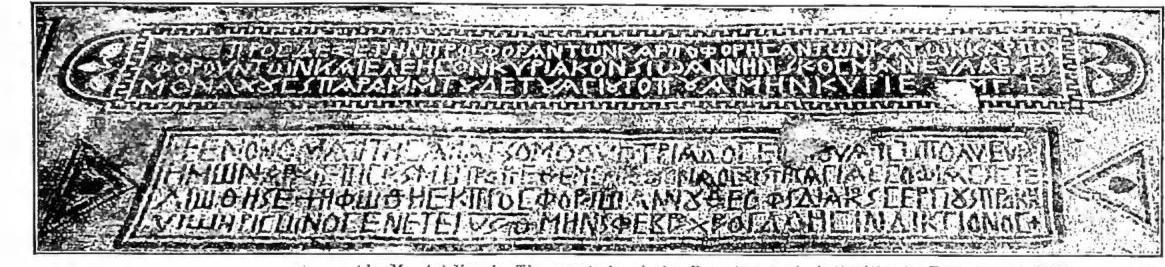
PALESTINE – An inscription recording the contribution of Deacon John to the building of the church of Hagia Sophia (Feb. 604) – Khalīd al-Kifājī.
Monasteries were built in Palestine in places where there was a sufficient supply of water and where it was easy to construct a monastery with cells and cloisters. Among the best preserved of the Byzantine period are Sijāghah (completely excavated), Sijār al-Jānim near Bethlehem (with fine water installations), and Hān al-Aḥmar (5th cent.), which have a walled complex with several cells. Of the double installation on the Jordan, dedicated to St Gerasimus, almost nothing remains, since the cells were made of very flimsy materials. At first a cave served as a church, but in the 5th cent. many churches were built (Mār Ṣābā, Kossiba, Wādī Fārah, etc.), usually single-naved with pillars, though rock-cut chapels were still in use.
Christian cemeteries in Palestine often consist of rock-cut chamber tombs, mainly of the arcosolium type. The chambers are rarely painted and the repertoire is limited: crosses, birds, palmettes (Gethsemane, Beit Jibrīn, ‘Ayn Kārim), and perhaps a figure of an angel (Qolōnijjah). The cross is always placed above the entrance, and is added if the tomb is reused (‘Ayn Ḥanniyeh, Jerusalem, etc.). This type of tomb is sometimes built of masonry, e.g. the complex near the Gate of St Stephen in Jerusalem. The catacomb or gallery system, though known from few examples, is also found, e.g. the so-called “Tombs of the Prophets” on the Mount of Olives, which has a semicircular plan. Scattered everywhere are many sepulchral stelae, showing that open-air cemeteries were also widely used. They bear the cross, the name of the deceased, and a short inscription. To find purely Christian formulae one usually has to go down to the 6th cent. The date is reckoned by local hours: of Eleutheropolis (Beit Jibrīn), Gaza, Scythopolis (Beit Shean), Bostra, Pompeiopolis, etc. In churches and monasteries there are polyandria, i.e. deep common graves, with a ring at the mouth where three stones were placed, one of them pierced (pelluikon) so that it could be easily removed. Sometimes the tombs are covered with mosaic (Sijāghah, at Jericho the church of Antimus, ‘Amwās, Beit Shean, etc.).
Pottery continues without notable differences from the Roman period, with jars, cups, plates, etc., and good firing. The vessels are coated with black slip and decorated with white lines, or only with cinnabar stripes in geometric floral patterns, rarely with any figure. Rouletting and many mouldings on the rims are used as relief decoration. “Terra sigillata,” less precise than in earlier times, bears the cross in various forms (‘Ayn Beit Sūriq, 6th cent.), Sijār al-Jānim (plain of Jericho), indeterminate human figures (Sijāghah), perhaps an imperial personage (Beit Alfāh, synagogue), and may represent Jesus Christ (Jericho). Among the plates, one for a polycandelon found at Gallicantu is notable; it bears the inscription: “S. Theodosi: Joseph the humble monk.” Another found at ‘Ayn Kārim (Visitation) has the letters IC XC YC OY on either side of the cross and the names of John and Paul. The clay lamps generally have an elongated ovoid body, good firing but very limited decoration: the cross in many forms, palmettes, and a few inscriptions, including the two very common ones: ΛΥΧΝΑΡΙΑ ΚΑΛΑ and ΦΩC ΧΥ ΦΕΝΗ ΠΑCΙΝ. There is also a “heart-shaped” type, with poorer firing and fine decoration including scenes and animals, but it seems to have developed after the 6th cent. Stamps for bread, bricks, etc. often bear the cross with the Alpha and Omega, sometimes only flanked by dots (Sijāghah) or planted on Calvary depicted as an arch or three pyramids (‘Tulūl er-Rūsum near Gaza). Some small clay flasks, evidently used for holy oils, have two small handles at the mouth and walls decorated with simple representations dominated by the cross and the three crosses on Calvary (Zion, Ophel) or doves, vases, and palms (‘Aynabūs near Nābulus). As eulogiae, some sun-dried clay discs are known which bear impressions of scenes of the Nativity, Annunciation, the cross, and the legendary hiding of St John in the mountain (a disc preserved at Bobbio and coming from ‘Ayn Kārim).
There are many metal objects, such as ampullae (q.v.) preserved at Bobbio and Monza, which came from Palestine through the consul Leontius (end of the 6th cent.) and were sent to St Gregory the Great. They are believed to reproduce some compositions existing in Palestine at that time and some representations of the Holy Sepulchre with elements perhaps copied from life. Many are the chains from church excavations, with rings interspersed with crosses for polycandela and censers. These present a rounded caldarium with segments (Jericho) or without (Mubmās), or paired (Beit Shean), or hexagonal (Nestorian hermitage near Jericho). Few candlesticks are known, round and unadorned (‘Ayn Beit Sūriq, 6th cent.). Metal lamps often have the cross as a handle. Medals found in tombs sometimes depict Our Lord and the Virgin (lead at Beit Shean, monastery) or figures of saints including St George and another on the cross blessing, perhaps a stylite. It is curious to note that the latter were found together (at al-Jīsh, ancient Giscala) with others bearing the “mystic eye” to ward off the evil eye and the very common inscription: ΕΙΣ ΘΕΟΣ Ο ΝΙΚΩΝ ΤΑ ΚΑΚΑ. Rings are often simple; noteworthy is one with symbols: serpent, eagle, and lion (Ashkelon) and others with the word ΥΓΙΑ followed by a name, and one with figures of the Saviour and the Virgin (Gezer) very crudely executed. Metal weights also usually bear the cross, with ornaments around or beneath a loggia, sometimes (lead) on Calvary.
Glass continues the repertoire of the Roman period: many weights and chalices are of glass, including one found at Gerasa which bears sheep at the symbolic tree and doves. Glass lamps have a simple bowl and a tapering foot for insertion into a polycandelon, ending in a small roundel. Window glass is yellowish and thick, or folded and curved with a large radius. It is set in plaster, which is supported by fragments of brick laid one upon another like a small column.
3. From the 7th to the 12th century
From inscriptions found it is deduced that Christians continued to build or at least repair churches until the 8th century. Notable are those of Sbejtāh (711 and 725–35) and ‘Awjā al-Ḥāfir (767–68) in Palestine and of Quwejameh (717–18) and Mā’īn (719–20) in Transjordan. Under Yazīd II (722–23) the iconoclastic movement began, which spared neither sacred images nor human figures in mosaic pavements. It is hard to say whether churches with undamaged mosaics were abandoned before this date. As buildings, the reconstruction of the Holy Sepulchre in the 11th century after the fierce destruction by al-Ḥākim (1009) is notable, as is perhaps the erection of the church of the Holy Cross near Jerusalem, which still exists, while nothing remains of the church of the Amalfitans, once famous. Graffiti found in the Arab palace at Mejer, near Jericho (8th cent.) and elsewhere, attest that Christians participated in the construction of Arab works of art.4. From the 12th to the 13th century
In these centuries there was an almost incredible building movement: churches and castles sprang up everywhere, mostly of rather large proportions, constructed with hewn stones or rough stones in the parts not visible. The walls are 2 m thick so as to support the weight of the massive vaults. The plans are mostly of basilican style, except when there was an adaptation of ancient structures, as at the Holy Sepulchre and the Ascension. The workers cut the stones diagonally, so that today the diagonal tool marks left on them serve as a characteristic of this period. The walls were literally covered with paintings and mosaics, which unfortunately have come down to us in a very reduced state. Among the paintings, fragments from Abû Gôsh (Saints, Abraham’s Bosom) stand out, as well as the stele from Bethphage, the work of a very skilled and somewhat independent artist (Raising of Lazarus, Disciples Taking the Asses, Palm Sunday Procession), from Bethlehem (in a chapel and on the columns of the Basilica), very rough and primitive (Deesis and saints), from Sebaste (Discovery of the Head of St. John, defaced by workers when it was found in 1931), and from Dejr Mukellâ (Christ with Saints and Crucifixion). Among the mosaics, a fragment of the Ascension on Calvary and parts of three scenes from the life of Christ (Entry into Jerusalem, Transfiguration and Ascension, Nativity in the Grotta) stand out, as well as saints, angels, and representations of councils in the Basilica of Bethlehem. Among the sculptures that escaped vandalism, there is an “embrace” or “kiss” from the hospital of St. John (now in the Museum of the Flagellation), the artistic capitals of Nazareth with scenes from the life of Christ and the Apostles, which were buried before being placed on the façade of the Basilica, the fine capitals with figures of monstrous animals from the Ascension and the cloister of Bethlehem, the beautiful frames of the Holy Sepulchre, and above all the sumptuous portal of the same Holy Sepulchre, which bears scenes from the last week of Our Lord’s life (Last Supper, Raising of Lazarus, Palm Sunday Procession). The altars are built of masonry (St. Helena at the Holy Sepulchre) and also feature painted shelves (St. Stephen). There is a series of bells, one with the inscription Vox Domini, others with a single letter, and one with winged dolphin handles. They were accompanied by about a hundred organ pipes.Pottery has no special characteristics and continued to be made by the Arabs, from whom it takes its name, both by hand (rough and minium-painted vessels) and on the wheel. Beautiful inverted vessels were found, but mostly with geometric designs (Emmaus el-Qubejbeh) and rarely with floral designs, coats of arms, and small human figures (ʿAflî). The lamps are always elongated in shape, but often bear Arabic inscriptions without the characteristic Muslim formulae. —See plates XLIII–XLV.