Also known as:
Khosrow Parviz, Chosroes II, Khosrau II, Khusro II;
Latin: Chosroes II
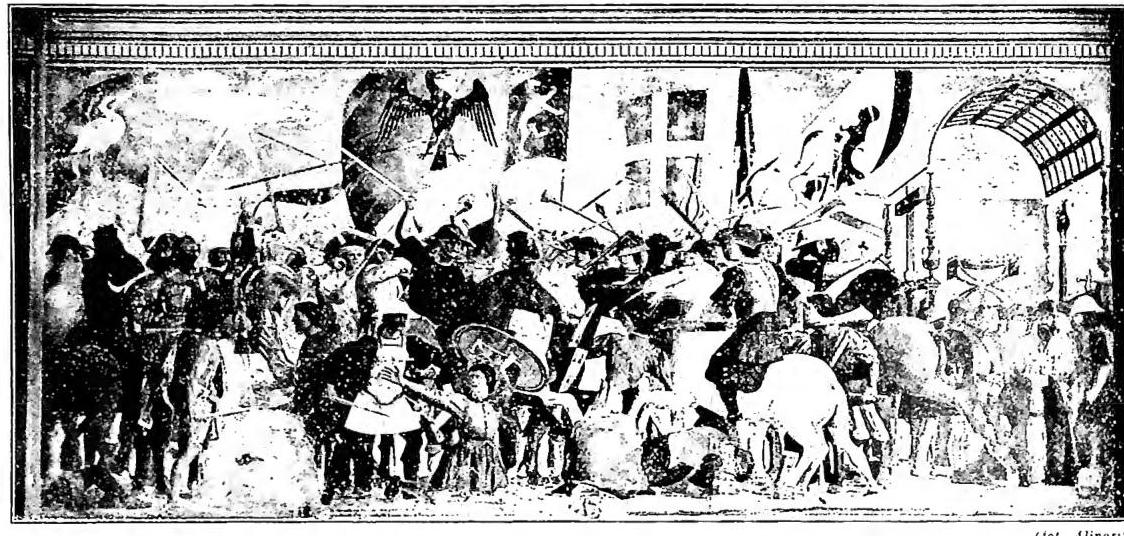
KHOSROW II, Persian emperor - Defeat of K. and his death. Fresco by Piero della Francesca (ca. 1450). Arezzo, church of St. Francis.
KHOSROW (Husrav) II, Persian Emperor. - Called the Victorious. He reigned from 590 to 628. At the beginning of his reign, both because of his friendship toward the emperor Maurice and because of the influence of his Christian wives, he was rather benevolent toward Christians. In 596 he had Sabrišō' elected katholikós, who always enjoyed imperial favor and even accompanied C. on the first campaigns against the Byzantines. After Sabrišō' died, C. gave orders to elect as his successor a certain Gregory (605), who seemed suitable for putting an end to the discords between Nestorians and Monophysites, the latter being led by Hēnānā. By the will of C., the see of Seleucia-Ctesiphon remained vacant from the death of Gregory (609) until his own. Each faction then organized its own hierarchy.
In 604 C. declared war on the usurper Phocas on the pretext of avenging Maurice. Having occupied Dara, C. easily conquered Mesopotamia, Syria and Palestine. Despite the death of Phocas and the accession of Heraclius to the throne, C. continued the struggle. In 611 he occupied Caesarea of Cappadocia and during the summer of 614 he penetrated into Jerusalem, which was barbarously devastated. Particularly grievous was the burning of the basilica of the Holy Sepulchre and the seizure of the True Cross, which was subsequently carried off to Persia together with an immense booty of sacred furnishings. The imperial goldsmith, the Christian Jazdān, saved the Cross from destruction. Up to this point C. did not persecute Christians. When, however, in 627 and 628 the victorious Heraclius (v.) penetrated into Persia, C. harassed both the Monophysites and the Nestorians. Jazdān was tortured and killed by order of C. This was the signal for the revolt led by C.'s son Šērōe. C., deposed, was in turn killed by one of Jazdān's sons.
Bibliography2 worksJ. Labourt, Le christianisme dans l'empire perse sous la dynastie sassanide, Paris 1904, passim; Cronaca di Seert: PO 13, 474-504. Ignazio O
BIBL.: J. Labourt, Le christianisme dans l'empire perse sous la dynastie sassanide, Paris 1904, passim; Cronaca di Seert: PO 13, 474-504.
Ortiz, de Urbina Ignazio. “Cosroe (Husrav) II, imperatore persiano.” In Enciclopedia Cattolica, vol. IV, coll. 707–708. Città del Vaticano: Ente per l’Enciclopedia Cattolica e per il Libro Cattolico, 1950. https://azioneromana.com/article/cosroe-husrav-ii-imperatore-persiano.
MLA
Ortiz, de Urbina Ignazio. “Cosroe (Husrav) II, imperatore persiano.” Enciclopedia Cattolica, vol. IV, Ente per l’Enciclopedia Cattolica e per il Libro Cattolico, 1950, coll. 707–708. Azione Romana, https://azioneromana.com/article/cosroe-husrav-ii-imperatore-persiano.
BibTeX
@incollection{ec4_cosroe_husrav_ii_imperatore_pe,
  author    = {Ortiz, de Urbina Ignazio},
  title     = {Cosroe (Husrav) II, imperatore persiano},
  booktitle = {Enciclopedia Cattolica},
  volume    = {IV},
  pages     = {707--708},
  note      = {Cited by column},
  publisher = {Ente per l’Enciclopedia Cattolica e per il Libro Cattolico},
  address   = {Città del Vaticano},
  year      = {1950},
  url       = {https://azioneromana.com/article/cosroe-husrav-ii-imperatore-persiano}
}
One of some 20,000 entries brought back from the twelve printed volumes (1948–54). Spotted something? Help us improve it.
Click or scroll to zoom · drag to pan · Esc to close