
CROCE. - Instrument of execution upon which Jesus Christ died (Io. 19, 17-31; Mt. 27, 32-42).
SUMMARY:
I. Instrument of execution
II. Criminals subjected to the punishment of the Cross
III. Method of inflicting the punishment of the Cross
IV. The crucifixion of Jesus
V. The sign of the Cross
VI. The veneration of the Cross
VII. The Cross in liturgy
VIII. The Cross in archaeology
IX. The Cross in art
X. The tree of the Cross
XI. The Crucifixion in art
XII. The Crucifix in art
XIII. The Crucifix in folklore.Since the Gospels provide very few details in narrating the Passion of Calvary, assuming that the horrors of crucifixion were well known to their readers, it is necessary to turn to Roman archaeology to accurately understand the characteristics of this punishment. Although the procedure varied considerably at the discretion of judges and executioners, many rules regarding the wood of the cross and the methods of fixing it, the procedure, and the persons subjected to the penalty of the cross were invariably followed, and were certainly applied in the Passion of the Lord.
I. INSTRUMENT OF TORTURE
Every crucifixion is characterized by the use of the "wood"; it is the killing of a man through immediate and stable union with the wood. Therefore, in the New Testament, the cross is simply called "wood" (Acts 5:30; 1 Pt. 2:24; etc.). However, not a single piece of wood was generally used, but two; already the Septuagint uses the expression ξύλον διδάμων (Josh. 8:21) for the term 'šs. The larger, upright wood, fixed in the ground, gave its name to the torture: σταυρός is the stake driven into the earth. The crux sublimis and the crux humilis are distinguished; the latter was used mainly when crucifixion was combined with the sentence ad bestias.The smaller, transverse wood could take two forms: the furca, which was originally an agricultural tool designed to support the two-wheeled wagon by raising its pole. The guilty slave had this fork placed around his neck and was led through the neighborhood while confessing his crime (Plutarch, M. Coriolan., 24, 9; Vitne, 225 d). This punishment was aggravated by subjecting the offender to flagellation, which could be prolonged until death (Suetonius, Nero, 49, 2: «Nudi hominis cervicem inseri furcae, corpus virgis ad necem caedi»). However, not every household possessed such a fork; therefore, in its place, the patibulum was used, that is, the bar with which the house door was locked at night: by placing it around the neck of the offender, he was immobilized. Generally, a third piece of wood was added, the cornu, a pointed stake fixed into the upright wood, on which the condemned was placed so that he would not faint and die quickly while hanging freely. This "horn" is mentioned almost exclusively in Christian sources (cf. P. Franchi de' Cavalieri, Della forca e della sua sostituzione alla c. nel diritto penale romano, in Nuovo bull. d'arch. crist., 13 [1907], p. 603 ff.).
II. PERSONS SUBJECTED TO THE PUNISHMENT OF THE CROSS
Ancient peoples used to punish the gravest crimes with death on the cross. However, the cross was not employed everywhere, as it was not in use among the Assyrians, the Egyptians, or the Greeks in their homeland. The cross was introduced among the Jews only by Alexander Jannaeus (d. 76 B.C.), a semi-pagan prince, and by the Romans. The cross was employed by the Persians, from whom Alexander the Great and the Diadochi learned of II. The Carthaginians, in particular, frequently punished both their own citizens and foreigners with the cross; it seems the Romans adopted this practice from them, applying it in times of war against rebels, brigands, and pirates. In Rome, this punishment was called tervile, yet even a Roman citizen could suffer it, despite Cicero’s opposition.III. METHOD OF INFLICTING THE PUNISHMENT OF THE CROSS
Every crucifixion was preceded by two torments: the condemned was scourged (as occurred in every other form of execution), then carried his cross. While Latin texts speak instead of the furca being carried, only Greek texts mention the transport of the cross: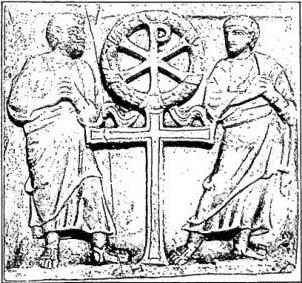
φέρει τὸν αὐτοῦ σταυρόν (Plutarch, *De sera numinis vin-
dicta, 9; Moralia*, 554 a); likewise Artemidorus (2, 56), Cha-
riton (De Charea et Callirhoe, 4, 2, 3), and the rabbinic text
Gen. Rabba, in H. L. Strack-P. Billerbeck, *Kommentar
zum Neuen Testament, I, Munich 1922, p. 587: Isaac carried the wood "like the condemned man his cross." Latin texts prior to the translations of the New Testament do not contain this phrase, but describe how the condemned carried the patibulum, sometimes adding that the guilty were then nailed to the cross. Thus Plautus: « Ita te forabunt patibulatum per vias Stimulis », « tibi esse pereundum extra portam Dispessis (= dispansis) manibus, pati- bulum quom habebis », « Patibulum ferat per urbem dein- de adfigatur cruci » (Mostellaria, I, 1, 56 ff.; Miles glo- riosus, II, 4, 6 ff., 358 ff.; Carbonaria, frg. 2). The phrase « deligata ad patibulos (!) » is explained: « Deligantur et circumferuntur, cruci defiguntur » (Clodius, 3: Roman. historicorum fragm.*, 2, 78). Dionysius of Halicarnassus (VII, 78) thus describes the preparation for execution: the master hands over the guilty slave to his companions to be dragged through the forum; they, stretching out the condemned man’s two hands and binding them with his shoulders and chest to the wood that reaches to the roots of his hands, led him naked, continuously striking him with whips and mocking him.
The upright of the cross was either permanently erected at the place of execution or fixed into the ground before the execution. Cicero boasts of having removed the cross from the Campus Martius during his consulship and reproaches Labienus, who orders « crucem ad civium supplicium defigi et constitui » (Pro C. Rubivio perd. reo, 3, 10; 4, 11). In Sicily, the Mamertines « more et instituto suo crucem defiserant » (In Verrem, II, 5, 66, 169). At the end of the Jewish War, the legate ordered a cross to be erected to immediately hang a captured youth upon it (Flavius Josephus, Bell. Iud., VII, 6, 4). No evidence suggests that the entire cross was carried; this is excluded first of all for the cross of Jesus, which, being at least 4 meters high, would have been of such weight that not only a man already weakened by flagellation would have been incapable of carrying it, but even a healthy and robust man. Moreover, such an apparatus would have required much labor and time without any utility. The condemned man, in fact, carried only the patibulum on his shoulders. It must therefore be concluded: in the phrase "to carry the cross," there is a synecdoche, for the entire cross was not carried, but only its smaller part, the furca or patibulum, to the place of execution (cf. C. G. Cobet, Annotationes in Charitonem, in Mnemosyne, 8 [1859], pp. 229-303, especially 275-79). This carrying of the cross was accompanied by harsh mockery of the condemned (Philo, In Flaccum, 9, 72).
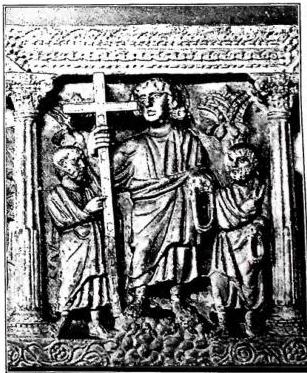
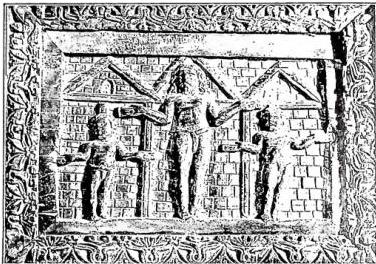
(from Wilpert, Sarcofagi, pl. 23, 1)
CROSS - Sarcophagus with the Crux invicta between two apostles
(4th century) - Salona.
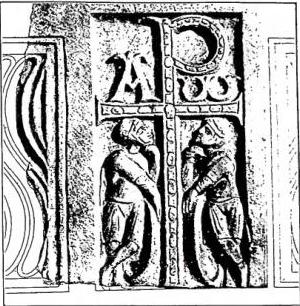
(from Wilpert, Sarcofagi, tav. 23, 1)
CROCE - Sarcophagus with the Crux invicta and soldiers at the sepulchre
(4th century) - Rome, Lateran Museum.
The fastening to the cross was not done in the manner almost always depicted in Christian art, that is, either on the entire cross lying on the ground or already erected, but rather through an intermediate system: the condemned was fastened to the patibulum lying on the ground, and then hoisted onto the upright post. This follows from what has been explained: if the condemned carried the patibulum to the place of execution, he could simply be raised by the soldiers onto the cross and its upright. But if a bloody crucifixion was carried out, the criminal, first thrown to the ground, was nailed to the patibulum, so that « patibulo suffixus in crucem tollitur » (Firmicus Maternus, Mathematica, VI, 31, 38 and elsewhere). If the cross was very tall, ladders or ropes were used. Finally, the feet of the condemned had to be fastened (with ropes or nails, perhaps to the Achilles tendon). This is confirmed by many texts that speak of « aliquem in crucem tollere, elevare » or, in the passive sense, « in crucem tolli » or « crucem ascendere » or « in crucem excurrere »: such expressions attest that the cross was the endpoint of an upward-directed action. This does not align with the conception of ecclesiastical art: if the condemned had been nailed to the cross lying on the ground, he would not have been "elevated in crucem," but merely lifted by means of the cross itself.
The reconstruction that was in vogue among scholars in the last century must also be excluded: the entire cross previously erected, upon which the condemned climbed with a ladder (as in Fra Angelico’s well-known painting). The series of actions that Jesus predicted for Peter, including the suffering to be endured on the cross, was entirely different: « You will stretch out your hands, and another will gird you and lead you where you do not wish » (Io. 21, 18). The stretching out of the hands was therefore not the final action of the condemned, but the first in the execution; already in the forum, after the judge’s sentence, he was stripped and his hands were stretched out on the patibulum; then he was "dragged" with a rope that wrapped around his body to the place of execution, where he was hoisted with the same rope.
The crucified often lived a long time on the cross: « they live with extreme agony sometimes the entire night and then still the entire day » (Origen, In Mt. comm. ser., 140: PG 18, 1793; ed. E. Klostermann, XI, Leipzig 1935, p. 290). A slave crucified with nails in Damascus in 1247 died only on the third day (P. Schegg, Pilgerreise, I, Munich 1867, p. 140). According to modern physicians, the immediate cause of death was the blood, which could no longer reach the brain through the violently stretched limbs (H. Mödder); retained in the lungs, it impeded the movements of the heart and, after much torment, finally caused the death of the wretched. The crucified were "guarded" (Mt. 27, 36) by soldiers while alive and after death. The corpses hung unburied to be torn apart by wild beasts and birds. It is not certain that the cross was considered the most horrendous death (which in I Cor. 13, 3 is death by fire).
Sometimes an unusual system was used. In the Jewish War, « the soldiers, in mockery, nailed the Jewish prisoners to the cross in various positions » (Flavius Josephus, Bell. Iud., V, 11, 1); sometimes the executioners pleased themselves by suspending them « capite conversos in terram » (Seneca, Ad Marciam de consol., 20, 3). Some were taken down still alive (Flavius Josephus, Vita, 75). For others, death was hastened by fire, smoke, breaking of the legs, or a lance thrust. Finally, to the relatives of the dead who requested them, « corpora ad sepulturam dabantur » (Digesta, 48, tit. 24, 1).
IV. LA CROCIFISSIONE DI GESÙ
Il Salvatore scelse la morte di c. liberamente, perché ignominiosissima, « per attestarci il suo amore », affinché nessuno avesse paura (Lattanzio, Instit., IV, 26: CSEL, XIX, p. 382, 2-6). Altre ragioni sono state addotte dai teologi: l'abbraccio delle mani estese, la riparazione del peccato commesso con il « legno », la scelta libera del momento della stessa morte.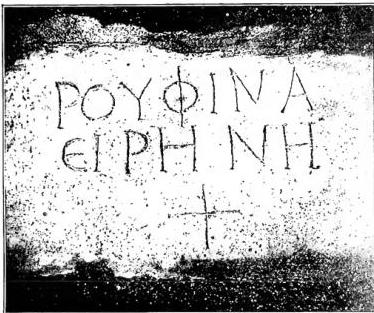
Incoronazione di Gesù. Esisteva un mimo del « re dei Giudei », che i soldati romani solevano rappresentare spesso nei loro accampamenti. Quando Pilato consegnò loro un uomo che si era dichiarato « re dei Giudei » e la cui reità era già stata sancita mediante la flagellazione, i soldati ripeterono crudelmente quel mimo facendo uso d'una corona di spine, di schiaffi, di sputi. La loro colpa appare diminuita da tale circostanza, ma non tolta.
Gesù portò la C. vestito (Mt. 27, 31; Mc. 15, 20: « lo vestirono con i suoi indumenti e lo condussero alla crocifissione »). Dopo la crocifissione furono divise le sue vesti. I Romani in ciò si adattarono al senso di pudore dei Giudei. È da concludersi da ciò che anche sulla C. Gesù portava un leggero rivestimento. Ma i Padri, attenendosi alla consuetudine romana, ritenevano che Gesù fosse nudo sulla C.
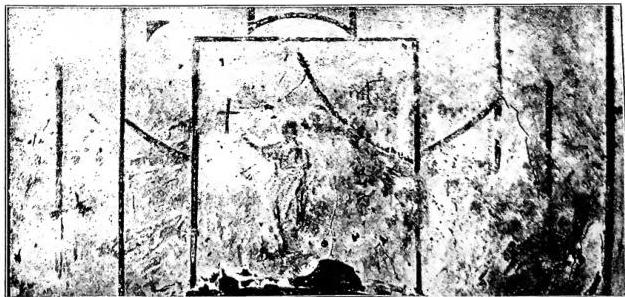
Gesù non rimase appeso per 6 ore alla C., come potrebbe far supporre Mc. 15, 25 con alcuni codici di Io. 19, 14 (nonché il cosiddetto « autografo »; PG 92, 77), ma solo per 3. Non morì per lesione cardiaca, ma per l'eccessivo numero di lesioni traumatiche inflitte al suo corpo.
lexikon, 3ª ed., VII, coll. 118-26; O. Marucchi, Croix, in DB, II, coll. 1127-34; V. Schultze, Kreuz und Kreuzigung, in Realene, für prot. u. Kirche, 3ª ed., XI, pp. 90-92; E. Saglio, Croix, in Ch. Daremberg-E. Saglio, Dictium. des Antiquités, I, II, pp. 1573-75; Hirtzig, Kreuz, in Pauly-Wissowa, IV, coll. 1728-31; H. Hollard, Croix, in Dict. enc. de la Bible, I, pp. 257 sq., 259; U. Holzmeister, Crux Domini eiusque crucifixio ex archaeologia Romana illustrantur, in Verbum Domini, 14 (1934), pp. 149-55, 216-20, 244-49, 257-63; H. Mödder, Die Todesursache bei der Kreuzigung, in Stimmen der Zeit, 144 (1949), pp. 50-59. — Tra i cattolici sostennero, con alcuni altri, che Gesù portò solo il patibulum, e che con esso fu innalzato in C.: F. X. Krauss, in Theol. Literaturblatt., 2 (1867), p. 670; P. Strasser, Das Kreuz, Lina 1884, p. 20 sq.; M.-J. Lagrange, Evangile selon. Marc, Parigi 1928, p. 423; H. Lusscau-M. Collomb, Manuel d'études bibliques, IV, ivi 1932, p. 845 sq.; F.-M. Braun, in L. Pirot, La Ste-Bible, X, ivi 1935, p. 467; J.-M. Vosté, De passione, Roma-Parigi 1937, pp. 247, 290; A. Wikenhauser, Kreuzigung, in LThK, VI, col. 259; J. Schmid, Marcus, Regensburg 1938, p. 184; I. Gomà y Tomás, El Evangelio explicado, IV, Barcellona 1940, p. 378; G. Ricciotti, Vita di Gesù Cristo, 3ª ed., Milano-Roma 1941, p. 730. Urbano Holzmeister
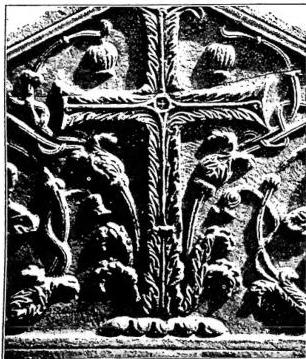
Martyrs made the sign of the cross before facing martyrdom. The early Christian did not neglect this act of faith at the start of the day, upon entering and leaving the house, when dressing, bathing, at table, or when lighting the lamp (Lactantius, Inst. Div., IV, 27; Tertullian, De cor. mil., 3, 11: « frontem signaculo crucis terimus »; St. Jerome, Ep. 18 ad Eustochium: « ad omnem actum manus pingat Domini Crucem »). The sign of the cross was also made over everyday objects. In the 4th century, St. Cyril of Jerusalem (Catech., 22, 36) states that Christians not only mark their foreheads but everything—the bread they eat, the cups from which they drink. With the sign of the cross.
(fot. Pont. comm. di arch. sorra)
CROCE — Marble inscription of Rufina Irene, with an equilateral C. (3rd century). Rome, Catacomb of Callixtus.
everything in the Church is blessed, consecrated, and sanctified: (« Crux tua omnium fons benedictionum, omnium est causa gratiarum: per quam credentibus datur virtus de infirmitate, gloria de opprobrio, vita de morte » (St. Leo the Great, Sermo 8 De passione Dom.). The ancients expressed the efficacy of the triumphant sign of redemption with this anagram:
Φ
Z Ω H
C
that is: the Cross is Light and Life (φῶς-ζωή). In the Middle Ages, no public document, inscription, or law was begun without first tracing the C. This replaced the signature of the illiterate and often preceded that of ecclesiastics. In many rural areas, even pasta and bread were marked before baking. The sign of the C. is observed on city gates, as well as on ancient cisterns and wells, on oven mouths, and on household furnishings. Antiquity has likewise transmitted to us encolpia and reliquary cases shaped like a c., on which exorcism formulas were sometimes engraved, as in the gold C. recovered by Pius IX from a tomb in the Cemetery of Cyriaca. The most famous of these Cs. with exorcism inscriptions is the one known as the « medal of St. Benedict », still used today against demonic infestations. From the 3rd century onward, ecclesiastical documents attest to the use of the sign of the C. in both Western and Eastern liturgies (Tertullian, De resurrect., 8; De cor. mil., 3, 11). As for the form of the sign of the C., the aforementioned documents speak of a sign made on the person or on objects, but there is no mention of the large sign of the C. made on the body. According to Tertullian (De cor. mil., 3), a small sign of the C. was made with a single finger, probably the thumb, in the shape of a T or an X: with the thumb alone, objects distant from the person were also blessed in the 4th–5th centuries. The first mention of the sign of the C. made on the chest is found in Prudentius (Cathemer., 6): it refers to a sign traced with brief strokes, similar to that made on the forehead. Gaudentius of Brescia (De lect. evang.) then speaks of a triple sign on the heart, lips, and forehead—a practice that has remained unchanged to this day for the proclamation of the Gospel during Mass. The sick were marked on their aching limbs (St. Gregory the Great, Dialog., 2, 20; Cassian, Collat., 8, 18). It seems that the struggle against Monophysites and Monothelites gave rise to the use of two or three fingers, while the Monophysites made the sign with a single finger to indicate the single nature in Christ. From the 7th century onward, the Greeks, to profess their faith in the two natures of Christ, made the sign of the C. with two fingers, that is, with the thumb and index finger, or with the index and middle fingers. From the 8th century, Greek priests gave blessings by joining the thumb with the ring finger, imitating the monogram of Christ: IXC. The Latins, on the other hand, gave blessings by extending the first three fingers and bending the ring and little fingers. While in the 8th century in the East a practice not unlike the large sign still in use today had spread, in the West as late as the 13th century Lucas of Tuy spoke of a sign of the C. made on the face (faciem suam munieus) in this way: « raise the three extended fingers to the level of the forehead saying in nomine Patris, lower them to the chin saying et Filii, then bring them to the left saying et Spiritus Sancti, and finally to the right saying Amen » (De alt. vita, 2, 15). A 12th-century English document, however, mentions a sign reaching to the chest, made with three fingers. In the 16th century, there was still no uniformity on whether the hand should be moved from left to right or vice versa. The current form in the Latin Church—blessing persons and things with all fingers extended and making the sign in the same manner—was strongly contested in the 13th century (Sicardus, Mitrale, 3, 4: PL 213, 109; Innocent III, De altaris mysterio, 2, 45; Durandus, Rationale, V, 2, 13). In the Roman liturgy, the large sign of the C. is frequently used in the Mass, in the administration of the Sacraments, in blessings, and in the Divine Office. The small sign, made with the thumb alone on the forehead, mouth, and chest, is used at the Gospel during Mass; it is also made on the Book of the Gospels, on the mouth at Aperi Domine and Domine labia mea aperies, on the forehead and head of the baptized, on the forehead of the confirmed, in Extreme Unction, etc. The Christian people make the large sign of the C. ordinarily at the beginning or end of prayer, in danger, etc. In Portugal and Spain, as in the Dominican Order, the large sign of the C. is almost always preceded by the triple sign with the thumb. Numerous Spanish catechisms teach how to make the sign of the C. with only two fingers of the right hand, bringing them to the abdomen rather than the chest—practices dating back to the 14th century.
The oldest formula was « Signum Crucis »; later came a profession of faith in Christ (« In nomine Iesu ») or in the Most Holy Trinity (« In nomine Patris et Filii et Spiritus Sancti »); then also an invocation of divine aid (« Adiutorium nostrum in nomine Domini » or « Deus in adiutorium meum intende ») and others.
All this makes it clear how the cult of the Cross was a logical and natural thing for the Christian, who regarded his as the religion of the Cross, and it was practiced from the very beginning. This is demonstrated by the reproaches that pagans, at the end of the 2nd century and the beginning of the 3rd, directed toward Christians, calling them Crucis religiosi and thus also idolaters; they observed a widespread reality, though distorting its meaning and value. The apologists, in response, did not deny the fact but merely took pains to explain the nature of that cult and veneration (cf. Minucius Felix, Octavius, chaps. 9, 12, 29; Tertullian, Apologet., 16). In the same way, St. Cyril of Alexandria later responded to Julian the Apostate, who accused Christians of a crime in adoring the wood of the Cross, tracing its sign on their foreheads, and adorning the doors of their houses with it: « Nos, Crucem intuentes, recolimus eum qui in ea mortuus est, ut omnes vitam haberemus » (Contra Iul., 6: PG 76, 793). One may also mention the frequent use of the sign of the Cross by martyrs in moments of greatest unbearable torture; their aspiration to die on the Cross themselves; and the Christians’ practice of representing the Cross in various more or less hidden or secret ways, to more easily evade the searches or profanations of pagans.
The appearance of the Cross to Constantine, the subsequent victory over Maxentius, and even more the discovery of the sacred wood gave new and stronger impetus to the cult of the Cross; all the more so since the emperor erected a basilica in Jerusalem, which attracted many pilgrims and where solemn ceremonies began to be performed, especially on Good Friday. It can be said that from that point onward, the cult of the Cross became a subject of preaching for the Holy Fathers; to liturgy and preaching were added art (v. below) and poetry (cf. Prudentius, Apotheosis, 446 ff.; Contra Symmachum, I, 494 ff.; St. Paulinus of Nola, Poem., 30, 97 ff.; Sedulius, Carmen paschale, V, 188 ff.). St. John Chrysostom declares that in his day the Cross was used by the faithful as ornament, remedy, and protection: « Hoc utique celebratum videre est in domibus, in foro, in desertis... in vestimentis, in thalamis... in vasis argenteis et aureis... in tectis, in libris, in urbibus, in vicis » (Homilia Quod Christus sit Deus, 9: PG 48, 826; cf. also: Homilia 2ᵃ, De Cruce et Introne, 1: PG 49, 47).
It thus became necessary to intervene to curb excesses and abuses. A law of Theodosius and Valentinian III (Cod. Iustin., I, tit. 7) prohibited, under severe penalties, the painting, sculpting, or tracing of the Cross on floors, so that this sacred sign might not risk being trampled. The Council in Trullo of 692 (can. 73, Hefele-Leclercq, III, p. 572) adopted this measure and added the penalty of excommunication. It should also be noted that during the Iconoclastic controversy, the image of the Cross was respected; and even the iconoclastic emperors Leo the Isaurian, Constantine Copronymus, Leo IV, Nicephorus, Michael II, and Theophilus had it impressed upon their coins.
Naturally, the Fathers and the Church were vigilant to ensure that the cult rendered to the Cross did not degenerate into error. The Second Council of Nicaea in 787 (Hefele-Leclercq, III, p. 768) and the Eighth Council of Constantinople in 869 (ibid., IV, pp. 521-22) define that the Cross is indeed to receive greeting (ἀσπασμός) and veneration (προσκύνησις), but not adoration (ἀληθινή λατρεία); a distinction that the monk Theodore the Studite (d. 826) carefully elaborated (Antirhetici III adv. Iconomachos: PG, 91, 345 and 419), observing that the adoration directed to God is ἀληθινή προσκύνησις, while that directed to the Cross is relative (προσκύνησις σχετική). These and other later definitions, up to the Council of Trent, placed the seal of their authority upon the perennial devotion that had been in force among the Christian people from the earliest times.
VII. THE CROSS IN LITURGY
1. The Feasts of the Holy Cross. — Current liturgical books include two: In Inventione S. Crucis (3 May) and In Exaltatione S. Crucis (14 September).(by courtesy of Mons. A. P. Frutse)
CROSS — Monogrammatic C. on the pediment of one of the side porticoes of the Tempietto del Clitunno (late 4th–early 5th century), near Pissignano.
[Non-Text]
(photo: R. Fabbrica di S. Pietro)
CROSS - Latin C. on a sarcophagus lid with the scene of the Adoration of the Magi (4th century) - Vatican, Grotte.
The feasts followed the development of devotion to the relic of the Holy Cross, which originated with its discovery. The year of this event remains uncertain. The Alexandrian Chronicle assigns it to 320, the Liber Pontificalis to 310 (I, p. 167), while the Doctrina Addai traces it back to the time of Tiberius (14-37). The Peregrinatio Aetheriae (ca. 394) assumes it occurred before 335, but Eusebius in the Vita Constantini, written in 337, does not mention it at all. The first reliable document is the testimony of St. Cyril of Jerusalem in Catechesis, XIII, 4: PG 33, 775; written in 347. Even less is known about the day of the Inventio. It should be noted, however, that the Chronicle and the Peregrinatio give the date as 14 September, which has caused no small confusion in identifying the two feasts in the documents.
Historically, the liturgical feast of the Exaltatio precedes that of the Inventio. Its origin is Palestinian, specifically local to Jerusalem, and must be sought in the annual celebration of the dedication (which took place on 13 and 14 September 335) of the two Constantinian basilicas of the Anastasis and the Martyrion. The feast achieved great renown. By the end of the 4th century, the Peregrinatio speaks of multitudes of monks, bishops (up to 40 or 50), clerics, laypeople, both men and women, who for eight continuous days flocked from all parts of the East to take part in II. It was in no way inferior to the feasts of Easter and Epiphany (Peregrinatio ad loca sacra, ch. 48, in Itinera, ed. Geyer, p. 100). Over time, a solemn exposition of the relics of the True Cross began to be made, so that gradually this rite became the principal object of the solemnity, almost entirely overshadowing the dedication. Alexander of Cyprus (6th century) designates it precisely with the name that later remained: Exaltatio praeclarae Crucis (PG 86, 2176).
From Jerusalem, the solemnity spread to many Eastern churches, especially where a relic of the True Cross was possessed, such as in Constantinople, Apamea, and Alexandria.
For the West, the first testimony of a liturgical feast of the Holy Cross is found in the biography of Sergius I (687-701), which reads: Qui etiam ex die illo pro salute humani generis ab omni populo christiano die Exaltationis Sanctae Crucis in basilicam Salvatoris, quae appellatur Constantiniana, osculatur et adoratur (Liber Pontificalis, I, p. 374).
The text suggests that the feast was already celebrated before Sergius; probably first in the oratory of the Holy Cross at the Lateran, then in the Sessorian basilica Sanctae Crucis in Hierusalem. However, one should not go too far back, as the uncertainty of the documents in recording it shows: for example, it is found in the Gelasian Sacramentary (mid-8th century; cf. ed. Wilson, p. 198), but is missing in the Epternach manuscript of the Martyrologium Hieronymianum, executed by a bishop consecrated by Sergius I (cf. Liber Pontificalis, I, p. 387, note 29). Sergius must have added the solemn exposition and adoration of the Cross preserved in the Sancta Sanctorum of the Lateran, as mentioned in the cited text, a ceremony still attested in the Ordo of Cencio Camerario at the beginning of the 13th century.
While in Rome the feast of the Exaltatio, fixed on 14 September, was being established, in Gaul a feast of the Inventio Sanctae Crucis had been introduced and was successful, set on 3 May. It seems that it entered the Gallican churches in the first half of the 8th century: it is not found in the Leonine (6th century) and Gregorian (7th century) Sacramentaries, Gregory of Tours (593-94), so abundant in such matters, does not mention it, and it is absent from the Lectionary of Luxeuil (late 7th century). It is, however, recorded in the manuscripts of the Martyrologium Hieronymianum of Wolfenbüttel (772) and Bern (slightly later), the Mozarabic calendars, and the Gelasian Sacramentaries of the 8th century (cf. P. de Puniet, Le Sacramentaire romain de Gellone, Rome [1938], pp. 92-93; Sacramentarium Pragense, ed. A. Dold, Beuron 1949, p. 71).
The date of 3 May was suggested, it seems, by the legend of Judas Cyriacus, bishop of Jerusalem (BHL, 7022). The Missale Gothicum (7th-8th centuries) and that of Bobbio (8th century) place the feast between the Easter octave and the Rogations, without further indication. Reg. 316 and the
The Pragense already had the date of May 3. In essence, the two calendars, the Roman and the Gallican, each had their own feast of the Holy Cross on different dates, and both remained in the liturgical books when these, having migrated to Gaul, returned to Rome with added notes and transformations.
The liturgical formulary of the two feasts also reflects their vicissitudes. The office of the Exaltatio is of evident Roman manufacture: this is shown, among other things, by the antiphon O magnum pietatis opus, taken from the metrical epigraph of Pope Symmachus (498-514) for the oratory of the Holy Cross in St. Peter’s, and the other Salva nos, Christe, which recalls the emblem of the same basilica (cf. U. Mannucci, Per la storia dell'ufficio della S. C., in Rass. Gregor., 1910, col. 249). The lessons narrate the recovery of the Holy Cross from the hands of the Persians, which took place in 665 under Heraclius.
The office of the Inventio, on the other hand, is Gallican. The antiphons of the 12th century alluded to the legend of Judas Cyriacus and were suppressed by Clement VIII (1592-1605) "quia historiam continebant dubiam" and replaced with the current ones (v. Tommasi, Opera, t. IV, p. 250). The remaining lessons recount the discovery of the Cross made by St. Helena. The Mass is of classic Gallican type (cf. G. Manz, Ist die Messe de Inventione S. Crucis im Sacram. Gelas. gallischen Ursprungs?, in Ephém. lit., 47 [1958], pp. 192-96).
In 1741, the Commission appointed by Benedict XIV for the reform of the Breviary decided to suppress the feast of May 3, but the entire project, as is known, failed, and the two feasts of the Holy Cross have remained in place until now.
---
CROCE, Esaltazione della S. (festa della). - È la festa che celebra il trionfo della S. C. recuperata dall'imperatore Eraclio nel 628 dai Persiani che l'avevano asportata da Gerusalemme nel 614. La festa, che ha radici orientali, fu introdotta a Roma nel sec. VII, probabilmente sotto papa Sergio I (687-701), e fissata al 14 settembre. La sua origine è legata alla dedicazione delle basiliche costantiniane del S. Sepolcro e del Calvario, avvenuta il 13 settembre 335, e alla successiva esposizione della reliquia della C. il giorno seguente. In Oriente la festa era detta Exaltatio S. Crucis e aveva un carattere prevalentemente liturgico, mentre in Occidente assunse anche un significato storico, legato al recupero della reliquia.
Il formolario liturgico romano, come si è visto (v. S), è di origine orientale e riflette la tradizione gerosolimitana. L'ufficiatura è caratterizzata da antifone e responsori che esaltano il mistero della redenzione operata dalla C. e la vittoria di Cristo sul demonio. La Messa, invece, è di tipo romano, con l'introito Nos autem gloriari e il Vangelo della crocifissione secondo Giovanni (19, 6-11.13-20.25-28.30-35).
Nel Medioevo la festa assunse una particolare importanza in relazione alle crociate e alla devozione alla C. come simbolo di vittoria cristiana. In questo periodo si diffusero anche le rappresentazioni iconografiche dell'Exaltatio, con Eraclio che riporta la C. a Gerusalemme, spesso raffigurato mentre entra in città a piedi scalzi in segno di umiltà.
The Ceremonial of Bishops, ordering that the "Cross of the Lord" be on the altar, establishes its base as high as the nearest of the candlesticks, which vary in height so that, with their ascent, they may better adorn the Crucifix. Its presence on the altar, like the repeated bows and glances directed toward it by the celebrating priest during the Holy Mass, aims to inculcate that this is the real representation of the sacrifice of the Cross. Therefore, it is always necessary, except during the exposition of the Most Blessed Sacrament, because the image yields to reality.
3. The Pectoral Cross. - It is a small cross of gold or other gilded metal, often adorned with precious stones, which bishops wear suspended from the neck as their own distinctive sign, containing within it a relic that is often of the Holy Cross. It is also used by regular abbots, canons of many cathedral and collegiate chapters, some ecclesiastical dignitaries by special apostolic indult, and some abbesses as a sign of their rank. Pius X granted it to cardinal deacons. There are two types of pectoral cross: one is suspended from a gold chain or other gilded metal, used with ordinary vestments, the other hangs from a cord of red silk for cardinals and green for bishops,
(Ist. Almorì) CROSS - Crucifixion. Panel from the door of S. Sabina (5th century) - Rome.
and is worn during sacred functions and over the mozzetta. The Ceremonial of Bishops mentions only the latter, considering it a pontifical ornament, while it makes no reference to the former.
The origin of the pectoral cross is very likely connected to the encolpia and those sacred objects that Christians wore on their chest. Ancient writers do not mention it: this means that originally it was merely a personal devotion. Later, the popes made it a sacred ornament, subsequently imitated by bishops and abbots. The first examples date back to approximately the 9th century. Innocent III, in De sacro altaris sacrificio, I, cap. 2, refers to the pectoral cross as a liturgical ornament of the pope. A 12th-century Pontifical lists among the liturgical vestments of the bishop the "Crux pectoralis, si quis ea uti velit" (E. Martène, De ant. Eccl. rit., I, Antwerp 1736, cap. 4, art. 12, ordo 23).
Silvario Mattei
VIII. THE CROSS IN ARCHAEOLOGY
Under the name of cross (C.), various signs of this shape, very ancient, are designated, such as the swastika or hooked cross (♩) and (♫); the hieroglyph ♠, proper to Egypt, called crux ansata and found in about twenty Christian inscriptions (G. Lefèvre, Inscriptions gr. chrét. d'Egypte, II Cairo 1907); the sign +, which, to be distinguished from that known as the Latin cross (+), is called the Greek and equilateral cross; the monogram in the shape of a cross +, which appears to derive from the Constantinian monogram (♓) or chrismon, commonly called the monogrammatic cross. It should be noted, however, that the so-called crux decussata or St. Andrew’s cross (X) is a pure invention of medieval art.1. Gammadion or hooked cross. - The swastika (from the Sanskrit Svasti "health," "well-being," "happiness"), called the gammadion cross because it consists of four equal arms ending in a segment at a right angle, resembling the Greek capital gamma, appears to be considered the oldest sign of fortune and religious significance in primitive solar cults. It is found, painted or engraved, from the Neolithic age onward, on vases, amulets, spindle whorls, funerary monuments, fabrics, and figures. The oldest examples known so far are those found on vases at Mussian Tepe near Susa, in Elam, dating from 4000-3000 B.C. Around 3000 B.C., it appears in the pottery of the Danubian region, then at Troy, in Greece; in southern Italy, in Etruria, among the Germans around 1000 B.C., and in India by 500 B.C. Beginning in the 3rd century A.D., alone or with other signs, it appears on many funerary inscriptions in Lycaonia and Isauria; on the monument of Clodius Hermes at San Sebastiano in Rome and in the Catacombs of Domitilla, Pamphilus, Generosa, and the Vigna Massimo (M. A. Boldetti, Osservazioni sopra i cemeteri, 2 vols., Rome 1720, p. 60; E. Josi, Il cimitero di Panfilo, in Riv. d'arch. crist., 1 [1924], p. 67, fig. 18; Wilpert, Pitture, pls. 112, 3; 180; 212; G. Cotzoni, Le questioni cronologiche della C. e dei monogrammi X e †, Athens 1939), where, without necessarily being considered a way to conceal the Christian cross, at least in inscriptions where it is not merely an ornamental sign, it may allude either to Christ, the sun of salvation, or to the happiness of the deceased. In the face of the Cross, the swastika disappears even in northern Europe by the 6th-7th century A.D. It remains a sacred symbol for Buddhists, who, in Tibet, have adopted it in the form of hooks turned to the right. A variant of the rectilinear hooked cross was the curvilinear one, formed by two intersecting S-shapes, also having symbolic meaning.
2. Monogrammatic cross. - In the Letter of Barnabas (9, 8), from the beginning of the 2nd century, the abbreviation of the name Ἰησοῦς is assumed to be known as the siglum IH; but, as evidenced by monuments, the name of Jesus first, and later as the signum Christi, the Chi Iota (X), the Chi Rho (☧), and the monogram in the shape of a cross (†) were above all known, all three, moreover, used almost exclusively as compendium scripturae in writings and monuments long before Christianity: the first on coins of Chios (Κίος); the second for abbreviating common names beginning with XP and as a sign on Athenian coins, tole-
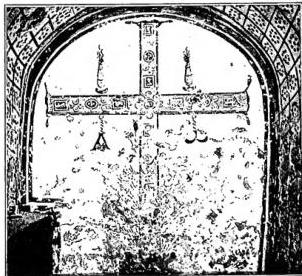
(from Wilpert, Pitture, pl. 159)
CROSS - Cross with the apocalyptic letters. Fresco in the cemetery of Ponziano (6th century) - Rome.
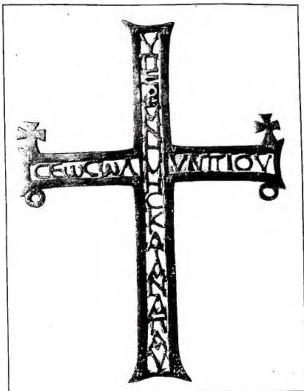
(photo: Vatican Library)
CROSS - Bronze C. offered in suffrage for a certain Olimpio (5th-7th century) - Vatican Library, Sacred Museum.
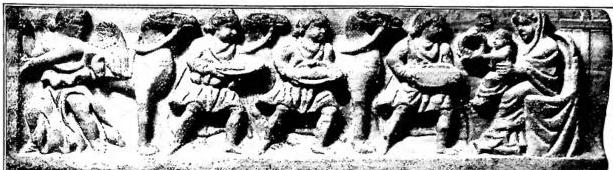
The rather rare X, which, as the superimposition of the initials I('Ἰησοῦς') X(ριστός) dating from the 3rd century, is called pre-Constantinian. The X, which also arose in the West a little later and owes its rapid diffusion—particularly in Rome—to Constantine and its repeated appearance on his coins, has been termed Constantinian. It is only from the 4th century that this, from a compendium scripturae of the name of Christ, becomes a true monogram signum Christi and figure of the Cross (St. Augustine, Tract., 118, 5: PL 34, 1950). The oldest example of it is given by a Roman inscription, attributed to the year 323 (G. B. De Rossi, in Bull. d'arch. crist., 1 [1863], p. 23). In another inscription, also from Rome, of 340 (G. Cotzoni, op. cit., p. 88), to reinforce its relation with Christ, the apocalyptic letters A and Ω are associated with it, which from then on are found very frequently. Likewise from Rome, it spreads in all its variants, with or without a circle or enclosed in a crown, as excellently represented on Christian sarcophagi in the scene of the resurrection, which has been called anastasis or, more precisely, Crux invicta, because the resurrection of the God-Man is the victory of the Cross (cf. Wilpert, Sarcofagi, tavv. 11, 4; 18, 1-5; 44, 1-3; 142, 1 e 3; 145, 1 e 7; 146, 1 e 3; 192, 6; 238, 1, 4, 7; 239, 2; 241, 1-4; 243, 1; 285, 1). In the East, the first certain case known so far is from 354 (G. Cotzoni, op. cit., p. 69).
Since the allusion to the Cross was too concealed there, this monogram was also represented crossed by a horizontal line (X). From this, as found in Constantinian coins already around 335 and in funerary inscriptions of 355, the transition was made to the monogrammatic Cross (†), which also appears in the forms † X and X X X. In 365 (G. Cotzoni, op. cit., p. 91), the monogrammatic Cross with the A and the Ω appears, in the
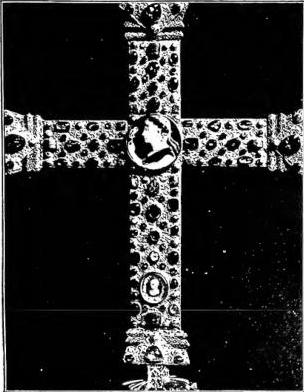
CROSS - C. of Lothair, in gold and gems with a cameo depicting Augustus at the center (9th century, perhaps 10th) - Aachen, Cathedral Treasury.
In the arrangements A † Ω and ‡ or in other variants; and often, especially in Syria, surrounded by a circle or a crown, or with the fish, doves, or the peacock. This monogram, almost contemporaneously with its emergence and before the Constantinian one, passed from the West to the East on coins and then on monuments (For the monogram in the paintings of the catacombs, V. Wilpert, Pitture, pp. 117-18; tavv. 154, 1; 162, 2; 207; 241; 251).
At the beginning of the 5th century, the X disappears from Roman funerary inscriptions, and the † becomes rarer. Outside Rome, however, both are still maintained for a long time on monuments and objects, and it is known that from the time of Justinian, especially in Syria, there was the custom of depicting the monogram on the exteriors of houses (C. M. Kaufman, Handbuch der christlichen Archäologie, Paderborn 1922, fig. 215, p. 270). Cases of the monogrammatic C. still appear in the 8th century. However, from the beginning of the 5th century, these two monograms, together with the C. that later prevailed, appear in the splendor of mosaics. Typical are the beautiful †, crowned by the manus divina, on the vault of the baptistery of Naples and the triple X of the baptistery of Albenga, surrounded by twelve doves (Wilpert, Mosaiken, tavv. 29, 88; as well as 32, 51, 91, 109). In the late Middle Ages, the Constantinian monogram was replaced by the sigil IHS, which according to a popular etymology was interpreted as in hoc signo or, as today, Jesus hominum salvator. More recently, a small c. was added above the H (IHS).
3. Gemmed C
The open cross (+ †), commonly called capitata or immissa, is used as an ornament both before and after Christ; as a Christian sign and in the equilateral or so-called Greek form, it appears in Syria and in the West.The cross † is found Herculaneum (v.); the four small crosses (+) traced in charcoal on one of the ossuaries discovered in 1945 near Jerusalem had an ephemeral success (v. L'osservatore romano, 1945, nn. 229-31, 255, 279).
As far as is currently known, the oldest monument with a Christian C. seems to be the inscription of Palmyra, from the year 136 (cf. H. Leclercq, in DACL, III, col. 3048; here erroneously assigned to 134), which features two crosses in the form of X: the sign that, also in the form of +, was used in the ancient Hebrew alphabet to express the tāw. This is followed by the inscriptions, with a Greek cross, of Dura Europa and Madula in Syria, respectively from the years 163 and 197-98. Of later date, besides the debated cross on the coin of King Abgar IX (179-234), there are the crosses of three other inscriptions from Dura Europa, from 234, two of which present the well-known cryptogram or magical Sator Arepo, similar to two from Pompeii. For the period from 313 to 350, only three examples of the cross have come down to us.
In the West, the Latin cross, Herculaneum (v.), is also veiled under the form of the tāw (T) and, perhaps, sometimes also of the anchor; then of the monograms X and †. In the cemeteries, it is rather rare, and of the few examples that remain from the pre-Constantinian period, none is dated. However, with the Greek cross of the inscription of Rufina in S. Callisto and the blasphemous graffito of the Palatine (v. ACCUSE CONTRO I CRISTIANI), it seems possible to reach, at most, the end of the 2nd century. It is then found in the hypogeum of the Aurelii (v.) on Viale Manzoni. From 314, though among pagan symbols (since its appearance and importance of place follow the progressive predominance of Christianity in the Empire), the cross is found on the coins of the imperial mints of Tarragona, Lyon, Trier, and Aquileia. From around the middle of the 4th century, that is, after the discovery of the Cross in Jerusalem (326-36), they begin to appear—
(fot. Alinari)
CROSS - Crucifixion. Detail from the miniature of the Syriac Evangeliary of Rabbula (A.D. 586) - Florence, Biblioteca Laurenziana, cod. Pl. 56.
to appear on sarcophagi, almost simultaneously, the Crux invicta (Wilpert, Sarcofagi, pls. 142, 3 and 146, 3) and its explicit representation, as incontestably evidenced by the sarcophagus lid discovered in 1942 in the Vatican Grottoes, also dated around 340, which presents the first true image of the Cross (v. Bruyne, Importante coperchio di sarcofago, in Riv. d'arch. crist., 20 [1945], pp. 249-80), and moreover in the capitata or Latin form, which is believed to have been the Cross of Christ.
CROSS - C. in the form of a knotted trunk in the sculpted Crucifix by Giovanni Pisano (14th century) - Siena, Museo dell'Opera del Duomo.
It appears to date from the 5th century, as well as staffs and handheld crosses, so frequently depicted in the Middle Ages (Wilpert, Mosaiken, pp. 47-50).
Thus, the Cross, from a sign of ignominy, transforms into a sign of glory and becomes the most common and honored Christian symbol.
IX. THE CROSS IN ART
1. Barbarian Crosses. — This name is given to crosses found in barbarian tombs, primarily in Italy, but also in France and Germany. They may have served for personal devotion, like pectoral crosses, but instead of being worn around the neck, they were applied to garments. They are made of very thin gold leaf, with small holes for sewing. They feature braided decorations and sometimes extremely crude figures; they have equal arms and generally measure 7 or 8 cm. Exceptions include some notable specimens, such as the one in the Innsbruck museum, originating from Livezzano, approximately 16 cm long, and the one found in the tomb known as Gisulfo’s in Cividale, adorned with garnets and lapis lazuli. They were in use during the 7th century.2. Votive Crosses. — Precious royal gifts, generally suspended from crowns (v. corona), which were hung above altars. Among those found in the treasure of Fuente de Guarrazar near Toledo in the last century, the most notable is that of King Recesvinto (8th century, now in the Cluny Museum). Also well-known are those of the Monza Cathedral, one of which is a gift from Agilulfo (591-615), and the other perhaps from Berengario I (888-924). In all of them, the gold surface is entirely covered with gems and pearls.
(fot. Anderson) CROSS - Painted C. erected on the "pergula." Detail from a fresco by Giotto - Assisi, upper church of S. Francesco.
After the 13th century, the Cross intended to be placed on the altar is supported by a base, which sometimes becomes elaborate with symbolic ornaments or architectural motifs in the Gothic period, and pictorial ones in the Baroque era, and occasionally also supports statuettes, generally of the Virgin and St. John. But in form and decorative technique, the altar Cross follows the same evolution as the processional Cross.
In the 13th century, goldsmiths began to avoid rigid lines: the extremities of the Crosses are lobed, and a second traverse (likely derived from Eastern types) is placed above the horizontal arm, creating an effect of greater lightness; to the filigree technique is added that of niello, and precious stones are arranged with a more spaced rhythm (Cross of Amiens Cathedral and of the church of Blanchefosse in the Ardennes). Simultaneously, Rhenish and Limoges workshops produced Crosses covered with champlevé enamels, more modest in material but rich in color (Poldi Pezzoli Museum in Milan, Copenhagen Museum, Gerona Cathedral). In the following century, the most precious translucent enamels were used (processional Cross of the Schlossmuseum in Berlin, altar Cross of the National Museum of Florence), and large knots or floral motifs made the contours more dynamic. But it is in the processional Crosses of the 15th century that Gothic fantasy expresses itself with the greatest exuberance. From the first half of the century are the splendid Crosses of the major "schools" of Venice, in rock crystal and silver, all embellished with flowers and small angelic figures. More severe, with a prevalence of plastic elements, are the Abruzzese Crosses, among which those by Nicola da Guardiagrele are notable (S. Maria Maggiore in Lanciano, 1422; Aquila Cathedral, 1434). In the Sicilian ones, the sumptuousness of the ornamentation shows Arab-Spanish influences (Cross of Mazara, similar to the Spanish one of Cervera), or Catalan (S. Martino delle Scale). Gothic nostalgia persists in the first half of the 16th century, but as the century progresses, a return is made to an austere simplicity of contours, and new chromatic preciousness is achieved with new materials, such as engraved crystal (Cross by Valerio Belli in the Victoria and Albert Museum in London) or hard stone; and in the course of the 17th century, also coral.
4. Cruciform reliquaries. - Already in the first half of the 4th century, the distribution of fragments of the sacred wood had begun, and the relics were preserved by the faithful in settings of rings and pectoral Crosses. Those of churches were kept in precious staurothecae, mostly in the form of a Cross, sometimes processional, which do not differ from other Crosses in form and ornament, but which have - usually at the center - a cavity to contain the relic. This is concealed by a cover formed by a large precious stone in the gemmed Cross of the Sancta Sanctorum (6th century?); and it was also hidden in the enameled Cross with scenes of the infancy of the Redeemer, in the Vatican Museum (from the time of Paschal I). But subsequently, it is almost always visible through a crystal.
One of the most precious reliquary Crosses of the 10th century is that of Limbourg; for the 12th, one may recall that of Cosenza Cathedral and the one known as St. Leontius’s in Naples Cathedral, both with Byzantine enamel plaques; for the 13th, the Cross of Genoa known as the Zaccaria Cross, from the booty of Phocaea, and those of Atri Cathedral and S. Niccolò in Pisa, in rock crystal, perhaps of Venetian workmanship, with miniatures on a gold ground shining like enamels. Of the same type is a 14th-century Cross in S. Francesco in Assisi; translucent enamels are found in a Cross from Padua and another for various relics in the National Museum of Florence.
These reliquaries generally had a case, often also cruciform (embossed silver casket in the Vatican Christian Museum, 9th century); but sometimes in the form of a quadrangular tablet into which the staurotheca was set (reliquary of Cardinal Bessarion in Venice).
(courtesy of Dr. B. Depenhart)
CROSS - Crucifixion. Canvas by Conrad Witz (15th century).
Berlin, museum.
and fell into disuse in the 15th century iconostasis (v.). They were, in fact, placed above the iconostasis, inclined toward the nave, as seen in two frescoes from Giotto’s cycle in Assisi (The Nativity at Greccio and The Miracle of the Stigmata); in the same cycle, the fresco depicting the prayer in San Damiano indicates that smaller crosses stood above the altars.
The oldest dated cross is that of Sarzana Cathedral, painted by a certain Guglielmo in 1138; however, throughout the 12th and 13th centuries, only nine crosses can be securely dated. The shaping varies and does not follow a logical process of transformation, whereas the iconographic development is clear, at least for the principal figure: until the mid-13th century, the Christus triumphans and the Christus patiens appear simultaneously, while the latter type predominates thereafter. As for the accessory scenes, the topmost panel always depicts the Ascension; the lateral panels initially feature evangelical symbols, figures of prophets, and mourning figures, which later simplify into the half-figures of the Virgin and St. John. In the central panel, which until the mid-13th century is also figurative, Umbrian crosses depict the Virgin and St. John, alone or with other mourning figures, while Pisan crosses contain framed scenes of the Passion. Among the most famous 13th-century painted crosses are those by the Lucchese artists Berlinghiero and Bonaventura Berlinghieri, those by Giunta Pisano (Assisi, Santa Maria degli Angeli; Pisa, San Ranierino, etc.), who nobly simplifies the iconography by reducing it to the main characters of the drama, and those by Cimabue (Florence, Santa Croce; Arezzo, San Domenico). Among the 14th-century crosses, those by Giotto (Florence, Santa Maria Novella; Padua, Arena Chapel) stand out, whose human grandeur is sometimes echoed by his followers (the cross of San Giorgio a Ruballa by Taddeo Gaddi and by an anonymous Rimini painter in the Malatesta Temple in Rimini). At the beginning of the 15th century, the workshop of Lorenzo Monaco produced crosses cut to follow the contour of the Crucifix; this innovation was not followed in the rare crosses of the mid-century, which feature polylobed terminal panels, as had already been customary in the 14th century (the cross by Giovanni di Francesco in San Andres a Brozzi).
6. Boundary Crosses
Made of stone, generally placed on a high pedestal; they stood at the entrance of a town or at the boundary of a property or district. The oldest known examples are those of Newcastle (7th century) and Hexham (8th century), adorned with low-relief sculptures that represent the earliest documents of English sculpture. After the 12th century, they are frequent in France, where many were destroyed during the Revolution; in Spain (Ávila, Puerta de San Vicente; Durango); and in Italy, where the most notable are those from the streets of Bologna, now in San Petronio.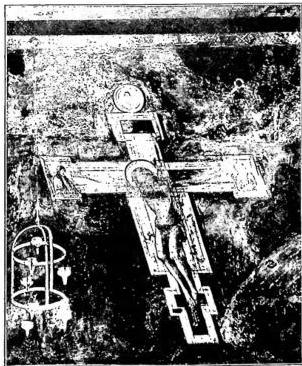
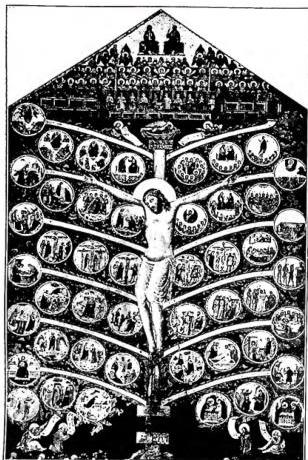
X. THE TREE OF THE CROSS - This is a symbolic representation of the Cross of Christ, imagined as a living tree, that is, endowed with branches and leaves, flowers and fruit, as in the author of the hymn Vexilla Regis: Crux fidelis.
XI. THE CRUCIFIXION IN ART
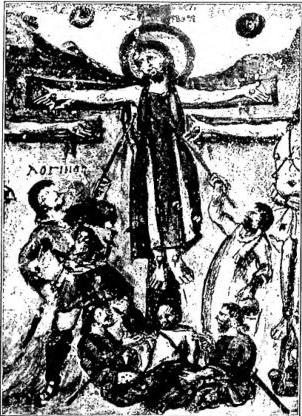
The earliest realistic representations of the Crucifixion scene date back to the 5th century. Among these, one may include the famous panel on the door of S. Sabina in Rome, although there Christ and the thieves have their hands and feet pierced by nails but the crosses are not depicted. Also from the 5th century is an ivory in the British Museum in London, where Christ, still alive, appears nailed to the cross, and Longinus is in the act of striking him with the lance, while nearby are the Madonna and St. John; a little further away, Judas hangs from the tree. From the 6th century is a miniature in the Evangelary of the monk Rabbula, transcribed in Mesopotamia in 586 (Florence, Biblioteca Laurenziana, Cod. sir. 56), where the scene is rendered by a miniaturist who follows certain aspects of Hellenistic painting with equally realistic accents and even greater liveliness and number of details. Here, the Redeemer between the thieves, still alive, is clearly fastened to the cross with four nails, wears the colobium (v. COLOBIUM), a long sleeveless tunic, and below are, besides the Virgin and St. John, three pious women expressing their intense grief; then the soldiers with the lance and the sponge, and at the foot of the cross, the others whothey gamble for Christ’s garments with dice. In the sky above, the sun and moon are darkened. The scene is completed below with that of the Resurrection.
Approximately two centuries later, in the chapel of S. Zaccaria in S. Maria Antiqua in Rome, a fresco repeats the scene, though simplified. The large image of the crucified Redeemer, still alive and wearing the colobium, balances the composition; at his sides, the thieves are no longer present, but to the left are the Virgin and Longinus, and to the right, St. John and the soldier with the sponge. The greater schematization of the scene and the evident tendency toward hieratic imagery depend on clear influences of Byzantine taste.
Meanwhile, while in the East, after the iconoclastic controversy, a new depiction of the Redeemer gradually takes shape—now appearing dead on the Cross—in Italy, and also in the rest of Europe until the 13th century, the concept of Christ alive and triumphant prevails. This remains true even when, as in S. Urbano alla Caffarella near Rome, at the beginning of the 11th century, a popularizing painter insists on the realistic elements of the scene. Nevertheless, the scene assumes a new character not only in 13th-century depictions, whose sense of heartfelt melancholy is to be linked with the Franciscan spirit, but also when
Cimabue, in the transept of the Upper Basilica of Assisi, paints the two great crowded Crucifixions, where the pathetic accents of Byzantine art acquire an irrepressible dramatic force, and the drama erupts with hitherto unknown power. Today, little more than a shadow remains of those paintings, yet enough to convey their immense value, not only pictorial but also religious and human.
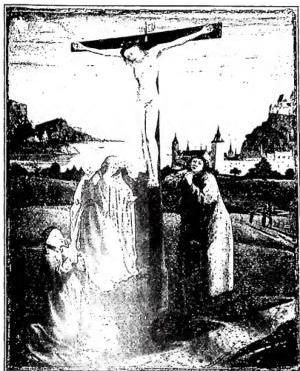
The master’s followers will repeat his scheme or complicate it, as in the Crucifixion on the right transept of the Lower Church of S. Francesco in Assisi, but they will not even graze the simple and severe sense of his narration. Nor will Pietro Lorenzetti, despite the highly dramatic accents and the large crowd thronging at the foot of the Cross in his Crucifixion, also in the transept of the Lower Church of S. Francesco in Assisi, nor Barna in his Crucifixion in S. Gimignano, equally crowded and dramatic with the group of pious women near the fainting Virgin, the knights, the soldiers, and the executioners, nor Andrea da Firenze in the fresco of the Spanish Chapel near S. Maria Novella in Florence.
Similarly, in relation to the master’s prototype, sculptors had acted who derived the scheme of their reliefs with the Crucifixion from that carved in relief by Nicola Pisano in the pulpit of the Baptistery of Pisa, which Giovanni Pisano had taken up again with livelier accents and an exacerbation of forms in the pulpits of Pistoia and the Cathedral of Pisa.
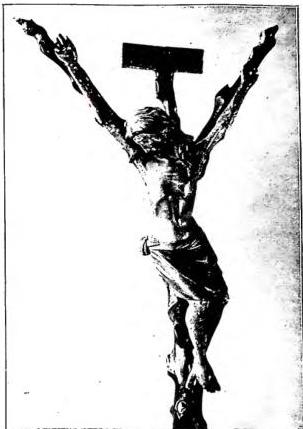
Even Masaccio, at the dawn of the Renaissance, was to leave the profound mark of his formidable personality in two Crucifixions. He collaborated, in fact, on the one painted by Masolino around 1423 in S. Clemente in Rome, still in line with 14th-century compositions, and on the other that was part of the polyptych of the Pisan church of S. Caterina, now in the Museo Nazionale in Naples. Here, beyond the image of the dead Christ on the Cross and to the left and right of the Virgin and St. John, is that of the blonde Magdalene dressed in red, who has flung herself kneeling to embrace the wood of martyrdom. And that most human impulse, that desperate grief, contrasts—highlighting its majestic solemnity—with the image of the Redeemer erect on the Cross, his head as if sunken between his shoulders, and with the mute anguish of the Madonna and St. John.
In those same years, the Blessed Angelico, in S. Marco, enunciated the drama of the Crucifixion with very different intentions. Against the backdrop of a flat, brownish, and livid horizon rise the three Crosses, at whose feet the principal figures of the drama align with saints and friars of the Order, who, ecstatic and sorrowful, contemplate the dead Redeemer on the Cross. It is a solemn celebration rather than the evocation of the drama.
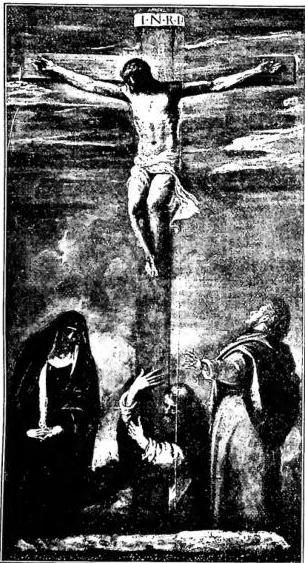
in another group, that character of calm solemnity mentioned above in relation to Angelico’s Crucifixion is maintained (Perugino, triptych in Leningrad, fresco in the chapter house of S. Maria Maddalena de’ Pazzi in Florence, Giambellino in his numerous Crucifixions), while the scene gradually becomes depopulated, and the two thieves, the soldiers, or the executioners no longer appear.
With the early 16th century, the resolution of the theme of the Crucifixion seems to orient itself, among non-archaizing artists, more toward the second solution than the first, and even Michelangelo leaves some of his drawings, mere ideas later used by his followers (Marcello Venusti, Jacopo del Duca), where the image of the crucified Redeemer dominates, flanked only by the Virgin and St. John. But in the second half of the century, the new sentiments linked to the Catholic Reformation (v.) demand that the theme be taken up again and expressed in all its dramatic power (Tintoretto, the great Crucifixion of the Scuola di S. Rocco in Venice in 1565), paving the way for those 17th-century forms characterized by the complacent naturalistic representation of events (Lanfranco, Barberini Collection in Rome). Along this path, naturally with the different accents determined by the different era and new pictorial and plastic achievements, some memorable 18th-century representations of the drama of Golgotha are also to be placed (G. B. Tiepolo in the church of Burano; G. D. Tiepolo in the Crucifixion of the Via Crucis in the church of the Frari in Venice; G. B. Goya in the Crucifixion of the Prado Museum in Madrid).
Nineteenth-century depictions, in the vast majority of cases, do not exceed the illustrative value of the drama, while the most modern ones aspire, even through formal stylizations, to convey the sense of the absolute spiritual dominion of the dead Redeemer on the Cross.
In medieval and 15th-century representations of the Crucifixion, sometimes at the foot of the Cross a skull is depicted; it is meant to recall that, according to a widespread medieval belief, Christ’s Cross was planted on the tomb of Adam.
XII. THE CRUCIFIX IN ART
It is necessary to reach the Romanesque period to find a true diffusion in sculpture of the iconographic type of the isolated figure of Jesus on the Cross, that is, detached from the more complex scene of the Crucifixion, regarding which see above (XI).Among the oldest and most famous is the Crucifix known as the «Volto Santo» (v.) of Lucca from the 12th century, which gathers around itself a vast series of sculptures in France, Spain, and Germany (for this subject, see the extensive work by Bréhier, cited in the bibliography). In Italy, the Crucifixes of S. Gimignano and that of S. Paragorio in Noli adhere to the type of the Volto Santo, while other works repeat a different iconography, also modeled on Byzantine examples, representing Christ already deceased on the Cross, no longer clothed in the colobium but naked, with only the perizoma (Crucifix of Archbishop Aribert in Milan Cathedral). Another iconographic type of the Crucifix had established itself in the West, prevailing in the Nordic countries: it depicted Jesus still alive and with royal attributes that magnified the divine sacrifice, as had already been seen in the Volto Santo and related works. This type is found in the bronzes and goldsmith works of Limoges and in the Rhenish and Burgundian Crucifixes, of which a splendid example in Italy is that in the church of S. Anna in Pisa, derived from contemporary sculptures of Autun, Vézelay, and Moissac. It differed profoundly from Byzantine forms in the stylization and modeling of the body, spread throughout Romanesque art, and also reached Italy, though slightly modified due to the coexistence of influences derived from the East. Thus, in the Crucifixes of Casale Cathedral and Vercelli Cathedral, and in that of S. Antimo, which, however, of mediocre workmanship, approaches
(from V. JALABERT, LOUIS, Les Bréviaires mss. des bibl. publ., Paris 1921, pl. 112)
St. Andrew hymning the Cross. Miniature from the late 15th century.
Among the wooden crucifixes of the 12th century, mention is also made of that in S. Lorenzo Nuovo near Bolsena (1160-68), featuring Christ alive, as in the Crucifix in S. Pietro in Bologna and another belonging to Ferdinand III in Innsbruck. Particularly fine are the Crucifixes in the Pinacoteca of Turin, the Courajod Crucifix in the Louvre, and another in the church of St. George in Cologne, in which Christ hangs from the Cross already dead.
With the 13th century, a new iconography spreads ever more widely, affirming a more human and pathetic conception of the sacrifice of Golgotha: the Crucified is often nailed with three nails instead of four to enhance realism, the torso twists, the legs bend, and the head is completely inclined toward the right shoulder.
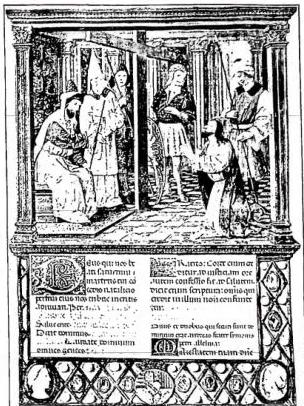
Giovanni Pisano, in the Crucifix of the Museo dell’Opera del Duomo in Siena, and Lorenzo Maitani, in those of the church of S. Francesco and the sacristy of the Duomo in Orvieto, open at the beginning of the 14th century the series of remarkable Crucifixes of which Italian art, in every era and in every material—from wood to bronze, marble, ivory, and silver—was the most distinguished producer. Of particular beauty is also the large wooden Crucifix of the basilica of S. Paolo in Rome, considered by some scholars, following Vasari, to be the work of Pietro Cavallini. From it derives a notable series of Crucifixes found in the churches of Rome.
At the beginning of the 15th century, Brunelleschi, still in his—
CROSS - Invention of the Cross. Miniature from the late 15th century in the Roman Breviary of René II of Lorraine - Paris, Petit Palais Library, ms. 42, f. 173v.
Still influenced by fourteenth-century iconography, Brunelleschi models his wooden Crucifix for Santa Maria Novella with the head inclined and the body inert, yet he imparts to it a new human realism, restrained and measured, which already belongs to the stylistics of the Renaissance. Similar results are achieved by Donatello in the wooden Crucifix sculpted in rivalry with Brunelleschi and in another cast in bronze in 1447 for the high altar of the Basilica del Santo in Padua. A more serene sentiment of sorrow asserts itself as the Renaissance progresses, evident already in works from the first half of the century (the Crucifix by Michelozzo in San Giorgio Maggiore in Venice, by Benedetto da Majano in Santa Maria Novella in Florence), beyond which the theme somewhat recedes from sculpture and finds greater place in painting, even for isolated representations.
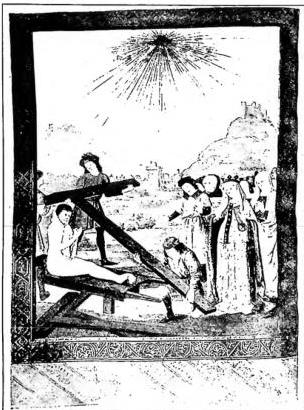
Subsequently, more than the works of individual artists, the artisanal productions for ecclesiastical furnishings and a few significant works by modest craftsmen should be cited, in which the expression of religious sentiment outweighs mere artistic interest.
XIII. THE CRUCIFIX IN FOLKLORE
In popular tradition, the Crucifix has given rise to particular(from R. Schilling, L'Alseco, Paris 1918)
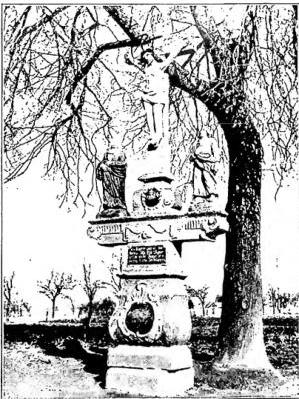
CROSS - Calvary near Erstein (18th century).
Forms of veneration for certain images and numerous legends inspired by the images themselves have arisen in popular tradition. Most of these are accounts of miracles performed by this or that Crucifix, with a prevalence of the motif of the sacred image being struck, which sheds blood, or even water and blood, or moves, or pales, or cries out, while the impious offender is incinerated by lightning or swallowed by an abyss, or the limb with which he committed the sacrilege remains immobilized.
A curious legend also surrounds the Crucifix of the church of S. Marcello in Rome: to explain its dark color, the common people tell that the artist who sculpted it killed a sleeping charcoal burner to be able to depict with the greatest vividness the spasms of a dying man. - Vedi tavv. LXI-LXV.