
SACRED VESTMENTS. — These are the garments worn by the sacred ministers during liturgical functions.
In order to render worship more august and out of greater reverence toward God, the Church wished special V. sacred functions. They were derived neither from those used in the worship of the Old Testament nor from those of the pagan cults of the classical age, but were chosen from among those used in civil life (excluding those of a military nature) in the Roman world by the more serious and qualified persons. The tunic (v.) reaching to the feet, over which the major clerics wore the sleeveless casula or planeta (v.), covering the entire person; in the 6dalmatic (v.) was already in use, and was soon to become the proper outer garment of deacons. The other sacred vestments or ornaments were gradually introduced into liturgical use. This usage remained constant even in the face of the use of more or less abbreviated garments introduced by the barbarian invasions; the Church remained faithful to the ancient usage of the upper classes. Leaving aside the rochet (v.), which is not regarded as a V. s, there is the surplice, whose name superpelliceum indicates its purpose: it was the ample white linen outer garment that covered the everyday clothing of the minor clerics (cardinal bishops wear it over the rochet when they don the cope).
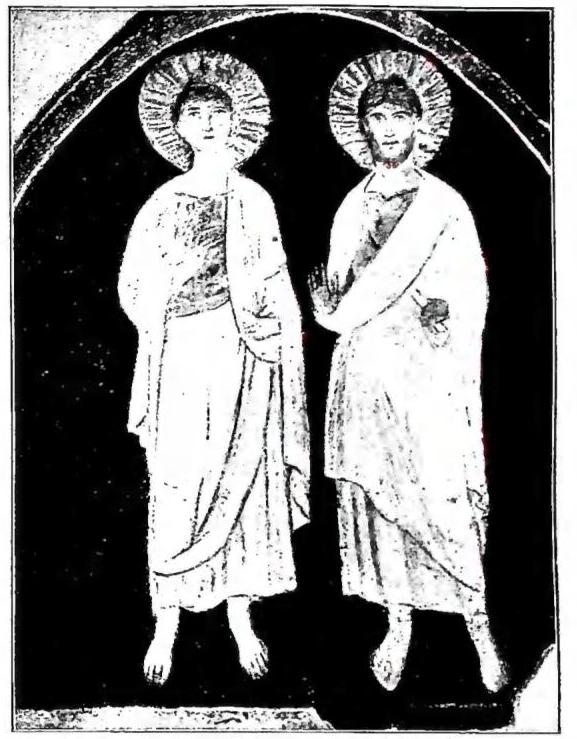
(from Gershich Tiber, Magyarország Románkori Emléki, Budapest 1838, inv. CCXLV)
VESZPRIMIA – Duc Apostoli. Thirteenth-century fresco in a chapel of the Cathedral – Veszprimia.
Germany, France, and Poland. The pontifical insignia are the mitre, the crozier, the ring, and the pectoral cross. Other episcopal accessories are gloves, sandals, and shoes. The Pope wears the falda, a full underskirt that covers the body from the waist down to beyond the feet; the fanon, worn over the chasuble and consisting of white and gold stripes; and the succintory, fastened to the right side of the cincture (v. le rispettive voci).