
DALMATICA. – Liturgical vestment proper to the deacon. It was a white, ankle-length garment reserved for the higher classes (emperors, Roman nobles), made of linen or wool, and often also of silk, ornamented with two strips of purple (clavi) of greater or lesser length according to the dignity of the person who wore II. This costume passed into Roman usage, and the d. of the 2nd century was a loose tunic reaching just below the knee, furnished with wide sleeves extending to the wrist. This vestment was worn by 3rd-century bishops also in civilian life, as is known from St. Cyprian, who removed his d. before his martyrdom. After various vicissitudes, it ultimately remained exclusive to the clergy.
The ancient writers speak to us of its use, but it is not possible to determine precisely to whom it properly belonged.
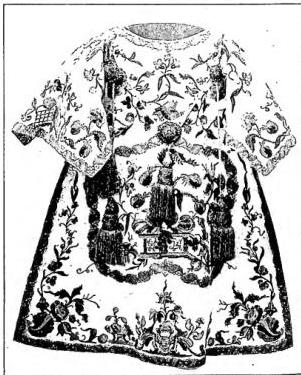
In the 12th century the d. was made the same color as the vestments, and the clavi, its characteristic distinguishing feature, disappeared; they no longer had any meaning once the exclusive use of white had been abandoned in favor of broader stripes. Outside Italy, as early as the 9th century, the full-length garment began to be shortened to the knees, and the sleeves likewise. Later, to facilitate movement, the d. was opened at the sides and widened in its lower part, while the two sections remained joined almost to the hips. In the 16th century, to make it easier to put on, it was opened somewhat above the shoulders; and, to close the two openings, cords with tassels (flounces) were introduced, often doubled or tripled, hanging down the back. This custom is reproduced in the illustrations of the first editions of the Pontificale and the Cerimoniale dei vescovi.
According to current prescriptions, deacons wear the d. at the solemn Mass, in processions, at blessings, and at the solemn blessing with the Blessed Sacrament, but they may not also wear it at Vespers (S. Rit. Congr., decrees 3526, 3719, 4179). Given its festive character, from ancient times the d. has not been used on days of penance or fasting, but is replaced by folded chasubles (Messale, Rubr. gen., XIX).
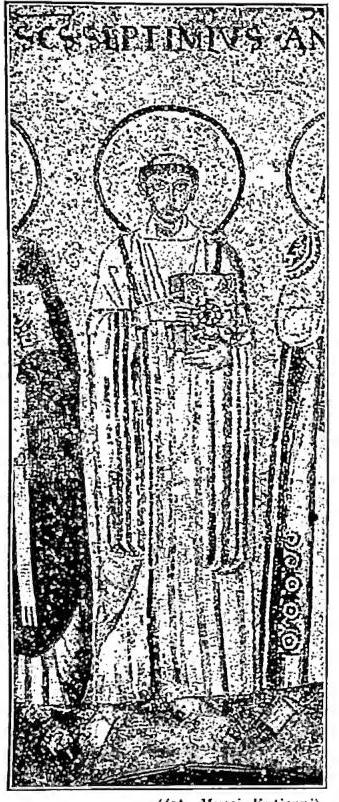
The most common opinion is that it was the proper vestment of the supreme pontiffs, who granted it to the deacons of Rome, not for every day but for solemn occasions. According to the Lib. Pont., Pope s. Silvestro (314–35) permitted «ut diaconi dalmaticis in ecclesia uterentur». Already toward the end of the 4th century, the Roman author of the Quaestiones ex Vetere Testamento, 46 (ca. 370–75), assumes that other bishops and deacons also wore it: «hodie diaconi induuntur dalmaticis sicut episcopi». As appears from the mosaics of the period, in the 5th century it was worn at Milan, and in the 6th at Ravenna; Rome expressly granted it to others as well (for example, Simmaco [498–514] gave it to the deacons of s. Cesario of Arles [*Vita 1. Cesarii Arel., I, 4], s. Gregorio Magno [590–604] to the deacons of the church of Gap, and Stefano II [752–57] to the abbot of S. Dionigi of Paris). In the 9th century the custom became established that many priests should wear it beneath the chasuble (Walafridus Strabo, De rerum ecclesiasticarum exordio et incremento*, 24), an abuse which the Apostolic See nevertheless resisted, although it finally (even before the 12th century) granted it to cardinal priests, abbots, and certain others.
According to the formula of the Holy Ordination and the prayer said when it is put on, the d. signifies «a garment of salvation, a vestment of joy and of justice», a symbolism that readily derives from its ancient use.
(photo Jules Messiaen)
DALMATICA — D. bearing the coat of arms of Empress M. Teresa
(18th century) — Soignies, church of S. Vincenzo.
Coronati in Rome. But toward the end of the 13th century, the sleeves were also often shortened in Italy, as in that of Bonifacio VIII preserved in the Treasury of Anagni. A beautiful Byzantine work of the 14th century is the embroidered-fabric d. known as that of Carlomagno, in the Treasury of S. Pietro in Rome. From the Renaissance onward, the d., by then confused with the tonacella, assumed the character it still retains today, and its particular value depends on the fabric from which it was made or on the embroideries that adorn II. — Vedi tavv. LXXVI-LXXVII.