
VALAFRIDO (UUALAFRID, WALAFRID), STRABONE. — Reichenau (v.), Lat. Angia, nicknamed, on account of his natural short-sightedness, Strabo (“the squinting one”), which he himself changed to Strabus, born in Alamannia of a humble family (cf. his poem Nostalgia, composed at Fulda in 829) in 868–869, died on 18 August 849 while crossing a ford of the Loire. He is one of the most appealing figures of the Carolingian age.
Presented to the monastery of Reichenau at a very tender age, he became a monk there under Abbot Haito (806–23). His teacher was the monk Vettino, and he enjoyed the friendship of the librarian Regimberto, Godescalco of Orbis, and Grimaldo. Under Abbot Erlebaldo (823–38), although hindered in his literary inclinations, he already revealed himself as a poet with the Tituli Angiensis, composed to celebrate the dedication of the church of Reichenau: verse letters sent in Tatto’s name to important figures of the period. His finest poem of that time is the Visio Wettini, which K. Vossler defines as a modest prelude to Dante’s Divine Comedy: it is a song in praise of Reichenau and its abbots, whom it describes with great acuity. V. had witnessed the death of the exemplary religious Vettino, who had dictated an account of a journey undertaken in a vision through hell, purgatory, and heaven, guided by an angel; Haito had composed a prose version of it, with allusions to living persons; V. turned it into a Latin poem, masterly and wholly original, although one can sense that its author was an admirer of Virgil; by showing, for example, the clergy’s judgment of Charlemagne, who is punished in purgatory, it even possesses some historical value. Another poem by V. is more interesting from the standpoint of the history of culture: the Hortulus, a poetic and practical description of the little garden of medicinal plants, which was obligatory in Benedictine monasteries; the whole is sincerely felt and imbued with the most delicate observations of a lover of nature. At that time he also composed a supplication in verse to an abbot, perhaps his own, asking him to show him mercy. From 826–27 to 829 he went to Fulda, then the foremost center of study in Germany, to become a disciple of Rabano Mauro (v.). There he devoted himself to theology, and Rabano directed him to study exegesis according to the commentaries of the Fathers. V. was among those who, under Rabano’s guidance, translated Taziano’Diatessaron (v.) into Old German; he composed a gloss, also in Old German, based on Anglo-Saxon texts, which was discovered among the Reichenau codices.
In 829 Ildino (v.), chief chaplain of Ludovico il Pio, had him summoned to the court at Aachen to serve as chaplain to the empress Giuditta, who was likewise born in Alamannia, being the daughter of Count Welf, and also as praecetior to the prince Carlo (later “the Bald”). In the first days of his new office, which brought him into contact with the most important men of the period (numerous poetic letters to them survive), he composed the poem De imagine Tetrici, on the statue of Theodoric the Ostrogoth erected by Charlemagne in the royal palace; for him Theodoric is an Arian tyrant and serves as a pretext for celebrating the devout and orthodox Emperor Ludovico il Pio and his second consort, against whom the sons of the first marriage were directing slanders and revolts. Throughout that period V. Giuditta, which was also loyalty to the idea of the Empire.
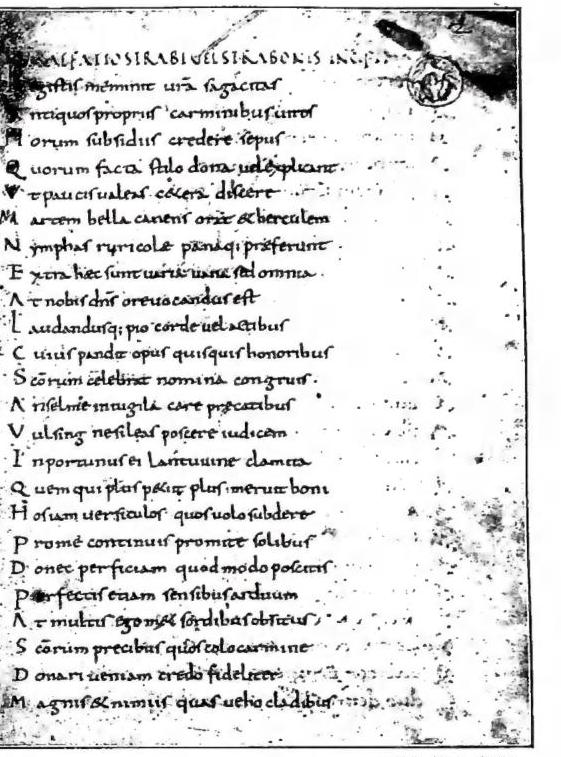
VALAFRIDO STRABONE — Preface to the Passio metrica of S. Mammete. Ninth-century codex containing the Carminum Walafridi Strabonis parva xylloge — Vatican Library, cod. Reg. lat. 469, f. 25.
as duke of Alamannia; but everything changed with Ludovico’s defeat at the hands of his sons in 833. The Emperor had to send Giuditta into exile at Ortona; her son was sent to the abbey of Prüm, in the Eifel, where V. followed him. After the Empress had been freed by a nobleman and, following an adventurous flight, returned to her husband, matters changed: V. returned to Aachen with Carlo il Calvo, who shortly thereafter was declared of age. In recognition of the great services that V.’s pen had rendered him, in 838 Ludovico wished to make him abbot of Reichenau; but he was not welcomed by all the monks, some of whom had supported Ludovico il Germanico, who in 833 had occupied Alamannia for the first time. For this reason Erlebaldo resigned, and an election was held which, it seems, gave the majority to Ruadhelm. In January 839, however, Saxony and Alamannia defected from Ludovico il Germanico; the Emperor regained Alamannia without striking a blow and, while preparing for war against his rebellious son, went with Giuditta to visit that province. The monks then had to come to terms, and V. became abbot. Matters changed immediately after the death of Ludovico il Pio (840): this was followed by Alamannia’s lightning submission to Ludovico il Germanico. V. went into exile at Speyer, where he wrote a song in honor of the Emperor Lotario, as well as his most celebrated theological work, the Liber de exordis et incrementis quorandam in observationibus ecclesiasticis rerum, a liturgical and archaeological handbook in which he explains the origin of divine worship and of altars, of sacred images (upholding the well-known moderate Carolingian theory), of the baptismal rite, and of the use of vernacular languages; he recommends the daily celebration of Holy Mass and compares earthly and sacred dignities. In the entire treatise he does not speak of transubstantiation, defended by Pascasio Radberto, and even uses an unsuitable expression; but this does not mean that he denied it, as some Protestant encyclopedias have claimed after E. Reuss. V. in fact does not engage in dogmatic discussions and must be interpreted according to the doctrine of Rabano Mauro who, although, Ratramno (v.) and others, an adversary of Pascasio Radberto, also teaches transubstantiation with the utmost clarity.
In 841 the battle of Fontenay decided matters against the unity of the Empire and against Lotario. Grimaldo then succeeded in reconciling Ludovico il Germanico and V. (842); Ruadhelm, who had intruded once again, had to withdraw, and from 842 to 849 V. carried out an extremely fruitful activity as father to his monks, raising Reichenau into a center of study and a hub of attraction and international relations. He enjoyed Ludovico il Germanico’s confidence to such an extent that, in order to prevent the continuous wars between Carlo il Calvo and Lotario, in 849 the latter assigned him to Carlo il Calvo’s court; but V. died by drowning. He was commemorated in an epitaph by Rabano.
A book by V. containing formularies of letters brings the work of the learned abbot fully to light. He knew the life of high society like a perfect courtier; besides its value for cultural history, the book is important for the rare historical and biographical information it contains. Another collectanea of V.’s writings was very recently described by B. Bischoff. He can no longer be regarded as a great exegete, since the Glossa Ordinaria contains very little material by V. Perhaps V. is more important for his commentaries in Old German than for those in Latin, but neither have yet been adequately studied. V. shines chiefly as one of the finest Latin poets of the “Carolingian Renaissance.”