
VIRGILIO. – P. Virgilius Maro (ancient form: Vergilius, cf. F. Ritschl, Opuscula philologica, II, p. 779 ff.) is the greatest poet of the Augustan age, born at Andes (Mantova), today Pietole Virgilio (A. Dal Zotto, Vicus Andicus, Mantova 1930), on 15 October 70 B.C., and died at Brindisi on 21 September 19 B.C. The tradition, continued through the centuries by legends and recollections of poets and humanists (Stazio, Silv., IV, V. 54; Silio Italico in Plinio, Ep., III, 7; Petrarca in the Itinerarium Syriacum; Boccaccio in the Genealogiae, etc.), although subject to doubt, places his tomb at Naples on the via Puteolana intra lapidem secundum (Donato, Vita Verg., 36). His life, according to the information common to the ancient biographers (E. Diehl, Die vitae vergilianae und ihre antihen Quellen, Bonn 1911), unfolded in harmony with the poet’s tranquil character. Naturally excepting those portents that, in an ideal sense, anticipated his birth—an indication of the early popular wonder that arose as a reflection of his work (his father a farm laborer and skilled beekeeper, his mother “Magia,” who gave birth to him painlessly and after a strange dream, etc.).
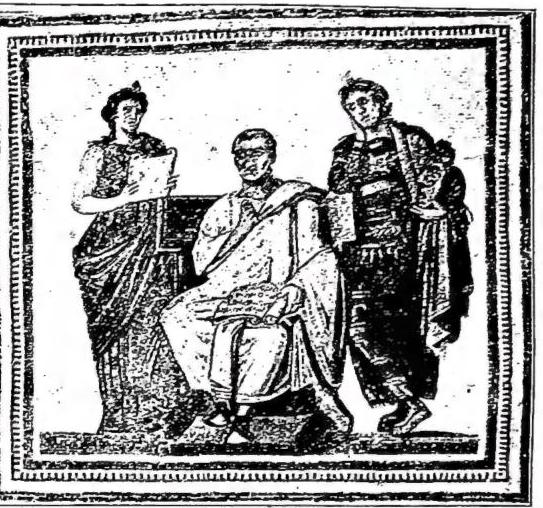
(from Les écrivains célèbres, edited by R. Queneau, I, Paris 1851, plate opposite p. 18)
VIRGILIO - V. holding the scroll of the Aeneid between the Muses Clio and Melpomene. Mosaic from Sousse (Hadrumetum). Tunis, Bardo Museum.
Ciris and the Culex. While the former poem is an epyllion of Alexandrian technique and workmanship, the Culex transcends the lightness of its subject and of the analogous epitaphs for other animals (a gnat accidentally killed by a shepherd appears to him in spirit and recounts its journey in the world beyond). It is significant that this composition anticipates that series of visions of the world beyond, a need so deeply felt and urgently pursued by our poet.
The Eclogues are the first revelation of Virgilian individuality. Reading the Idylls of Theocritus helps to make Virgil’s first poetic initiation more distinct and more immediate. The Eclogues contain motifs of varied inspiration, and two elements predominate in them: the realistic tone, such as may be found in I and III (especially in the first part), and the mythical and symbolic element, which idealizes reality and echoes Eastern beliefs and aspirations. The nature described in the Bucolics, even though here and there it shows some preciosity derived from Arcadian taste (P. Grimal, Les jardins romains, Paris 1943, p. 404 ff.), is something real and deeply felt, as in Ecl. I, where V. alludes to the misfortune that befell him when his land was confiscated for the veterans in 41 B.C. (J. Liegle, Die Tyrtirusekloge, in Hermes, 78 [1943], p. 209 ff.). The melancholy of the sunsets lends this countryside an almost religious solemnity. Whoever disturbs this peace is a barbarus and an impius. The symbolic motif, on the other hand, finds its concrete expression in the much-discussed Ecl. IV, with its mysterious allusions to the virgo and the puer. The Christian commentators of the fourth century A.D., struck by the messianic inspiration that dominates the entire eclogue (v. below), credited it with the character of a Christian prophecy, despite the vigorous opposition of s. Girolamo, who regarded this interpretation as puerilia (Ep., LIII, 7).
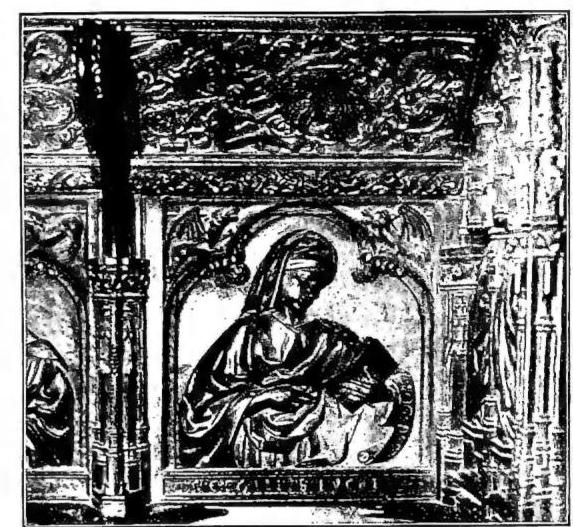
(from Virgilio nel Medioevo, Turin 1928 — Studi medioevoli, n. s., 5 [1928], plate after p. 34)
VIRGILIO – V. Christ. Relief from the beginning of the 16th century. Detail of the wooden choir of the Cathedral of Zamora.
3rd ed., Bari 1950, pp. 37–54). That the subject was suggested by Maecenas is demonstrated by the frequent allusions (I, 2; II, 41; III, 41; IV, 2), but here the poet knew how to ennoble and transform the haud mollia iussa of his powerful friend by taking up again, in Book IV, those otherworldly problems (v. 315 ff) which, departing from the Culex, reappear more fully developed in the Aeneid.
The saga of Aeneas and his coming to Italy had been transmitted by the colonists of southern Italy to the indigenous populations. Greek historians and poets, beginning with Stesichorus in his Iliopersis, lent authority to this tradition, to which were also added names of things and places supposedly touched by Aeneas on his journey: Caieta Prochyte, the island Aenaria, the cult of Aphrodite alvelae at Eryx (C. Robert, Die Griechische Heidensage, III, II, Berlin 1926, p. 1516 ff.). Confirmation that the legend of Aeneas was rooted in Etruria is provided by an Etruscan statuette at Veii, dating from the first half of the 5th century B.C., which depicts the hero supporting his father Anchises (A. Fuhrmann, in Archäologischer Anzeiger, 1941, pp. 422–28). V. undertook his task, which lasted eleven years, conscious of the difficulties and responsibilities arising from II.
The Vitae document his poetic torment until, sick and at the point of death, he vainly requested that his poem be committed to the flames. The work was discussed and eagerly awaited in the cultural world of the Augustan age. This is attested by Propertius’s celebrated verse: nescio quid maius nascitur Iliade (II, 34, 65 ff.); and when the Aeneid appeared, published by Varius and Tucca, it soon overcame the malicious criticisms of its obtrectatores. The poet had given Roman literature its highest epic composition and the Latin people the noblest celebration of their origins. In its plot and episodes, the Aeneid happily reconciled poetry and legend, history and reality, distinguishing itself through its particular conception from the other analogous poems that arose in the archaic period (Bellum poenium of Naevius, Annales of Ennius, etc.). The protagonist, Aeneas, lives the drama of the stateless, without possessing the splendid qualities that might characterize an ancient knight. He leaves behind a painful and tragic experience, acts silently, conscious of the task entrusted to him by the gods, but almost as though he were merely serving this duty. The other characters come before us suffused with a profoundly human light. There is the intense torment of love suffered by Queen Dido (B. Croce, op. cit., pp. 55–64), the noble pride of Turnus, and Mezentius’s grief for his son Lausus. War is viewed sadly, as a deplorable event that engulfs the best—mostly flourishing young people who go to meet it enthusiastically, unaware of the terror it contains. Thus Camilla, Pallas, Euryalus, and Nisus die. Another aspect of the poem is that aura of religiosity which envelops or arises from every place and situation. Aeneas himself never undertakes any enterprise without first consulting the omens. The religious legends, cults, and origins of the ancient Italic peoples come alive in the evocative descriptions of the places and peoples of ancient Latium: Ardea, Lavinium, Laurentum, Albunea, etc. This is evidence of V.’s acute historical and patriotic sense (Servius, ad Aen., I, 44; B. Tilly, V.s Latium, Oxford 1947).
The underworld reappears in Book VI—a motif, as has been said, carefully meditated upon. Following the concept of Orphic-Pythagorean eschatology, souls, according to their sins in life, are subjected in the hereafter to punishments that they expiate in Tartarus (vv. 548–627), while the souls of the just dwell peacefully in Elysium. Others—and here a Platonic motif becomes evident—drink the waters of Lethe and, after being purified, are destined to be reincarnated in life (vv. 703–51). From this vision the poet takes his inspiration to exalt those spirits who will give life to the highest and best-known figures in Roman history (Aeneis, Buch IV, erklare von E. Norden, 2nd ed., Leipzig 1916).
Finally, by recalling the stage preceding the foundation of Rome, the Aeneid seeks to offer its fullest glorification, reflecting its imperial splendor in rapid allusions (I, VIII, 342 ff.).
Lanfranco Fiore
THE TRADITION OF
V. THROUGH THE CHRISTIAN CENTURIES
The name of V. remained held in high esteem throughout the centuries, enjoying an uninterrupted success unmatched in the tradition of the classics. The influence he exerted upon writers of Latin literature continued also in the Christian Middle Ages, and the quotations drawn from his works, especially the Aeneid, reach a very high number.It is true that poetic imprint can be spoken of only in the case of the major writers, from Prudentius to Dante; but his fame is demonstrated by the many echoes of his expressions, the centos composed from his verses (first and foremost that of Proba Faltonia, composed in the 4th century, after the noblewoman’s conversion to Christianity), and above all the fantastic myths that were gradually elaborated concerning his personality, originating in learned circles and then becoming progressively distorted through contact with popular imagination. Only an author whose fame was as extensive as that of V. (a fame consolidated by the interest of biographers and by the exegetical and lexical teaching of grammarians) could become the protagonist of a legend so multifaceted, absurd, and picturesque as to make it possible to find in it all the salient characteristics of the Middle Ages.
The first impetus had already come from the classical world, from Roman proconsular Africa: in the 2nd century A.D., Apuleius, on the basis of certain passages from Eclogue VIII (v. 64 ff), offers the first testimony (De magia, chap. 30) to the image of V. as a magician. This image gained wide credence in the later Empire, encouraged by the atmosphere of exaltation surrounding occult practices that was being created by the syncretism between Roman paganism and the mystery religions of the East; it became consolidated in the naïve credulity of the Middle Ages, finding renewed vigor with the emergence of a second myth—that of V. Christ. At the beginning of the 4th century, Lactantius, in the Divinae institutiones, attests for the first time to the Christological interpretation of Eclogue IV, but in a millenarian sense, that is, as referring to a second coming of Christ upon earth. A few years later, however, Constantine himself, in the Easter Oration delivered (if not written) by the Emperor after the Council of Nicaea, sanctioned with the authority of his high office the decidedly messianic meaning of the famous bucolic poem. It is interesting in this regard to note how the spread of this interpretation was contributed to, unintentionally, by St. Augustine himself, who, admitting the possibility of divine inspiration in the Cumaean Sibyl, implicitly acknowledged it also in V. when he derived from her the prophetic vision of the bucolic poem (cf. De civit. Dei, X, 27; Epist. 258, 5). From that time onward, the figures of V. the magician and V. the prophet were almost constantly confused, even though the imaginative episodes attributed to his intervention by a vigorous proliferation of biographical anecdotes emphasized now one aspect, now the other. Even in the 4th and 5th centuries, Africa remained the most fertile ground for the consolidation of these beliefs, with the legendary Passiones of the Alexandrian milieu and with the appearance of the first allegorical interpretation of the Aeneid in the De continentia Virgiliana of Fulgentius (probably a namesake and fellow countryman of the famous Fulgentius of Ruspe [v.]), in which the poem is explained in moralizing terms as a metaphor for human life. But already in the Early Middle Ages, and then down to the Renaissance, the entire Western world offered fresh material for the legend of V., favored not only by the mentality characteristic of the age but also by the subject matter of certain passages of his, destined to make a profound impression upon the people of that period: first and foremost, the palingenesis of Eclogue IV and the underworld of Book VI of the Aeneid. The glosses in manuscripts provide frequent examples of this and sometimes make it possible to localize certain traditions (from Naples to Gaul and Ireland); the Mysteries, especially French ones (Limoges, Laon), but also Italian ones (cf. the Lectio in Nativitatis nocte of Salerno), show the Roman poet in the procession of the Prophets and together with the Sibyl, probably drawing their original inspiration from a pseudo-Augustinian sermon (PL. 42, 1117 ff.); very many medieval treatises on alchemy are attributed outright to V.; chronicles, short poems, encyclopedias, and romances add new pieces to this fantastic musician, reaching a climax in the 12th century with the episodes recounted in the Policeratus of Giovanni di Salisbury, with the moral allegory of the Commentum super sex libros Eneidos Virgilii of Bernardo Silvestre, and with the chivalric transposition of the Aeneid in the Roman d’Eneas.
With Dante, the interpretation of V.’s figure shifts to another level: while not rejecting the medieval legend, Alighieri elevates the Virgilian allegory into poetic transfiguration (cf. Purgatorio, XXI, vv. 94-99), even when he alludes to the prophetic gifts of his “guide” (cf. ibid., XXVIII, vv. 139-44). But in the highly distinctive imprint that Dante’s genius gives to the representation of V., it is also possible to recognize a motif destined to be continued in Petrarch’s Africa and Canzone a Cola di Rienzo: that of the singer of Aeneas as a symbol of resurgent nationalism. The end of the Middle Ages tempers enthusiasm for V. the prophet: the Christological interpretation of Eclogue IV is rejected not only by Petrarch and Boccaccio but also by Benvenuto da Imola, who in the Chiuse virgiliane interprets the Bucolica as a historical allegory in which the life of their author is adumbrated with moral significance. The Renaissance rediscovers V. the poet, makes him the subject of learned lectiones (from A. Decembrio to Pontano, Scaliger, and Castelvetro), recreates his bucolic motifs in Boccaccio’s Ameto and Sannazzaro’s Arcadia, and studies his language and verse; but it does not completely free itself from the legend. The crystallization produced by medieval exegesis and imagination around the figure of V. would not be definitively shattered until the philological criticism of the last century—and perhaps with excessive animosity, since although it is true that a representation of the poet of Rome as a messianic prophet is absurd, it should nevertheless not be ruled out that the fantastic images of that vision, whose immediate occasion lies in the birth of Pollio’s son, sink their roots, through the Orphism of the mysteries of Sabazius, into Jewish prophetism.