
CAMPANIA. –
I. GEOGRAPHY
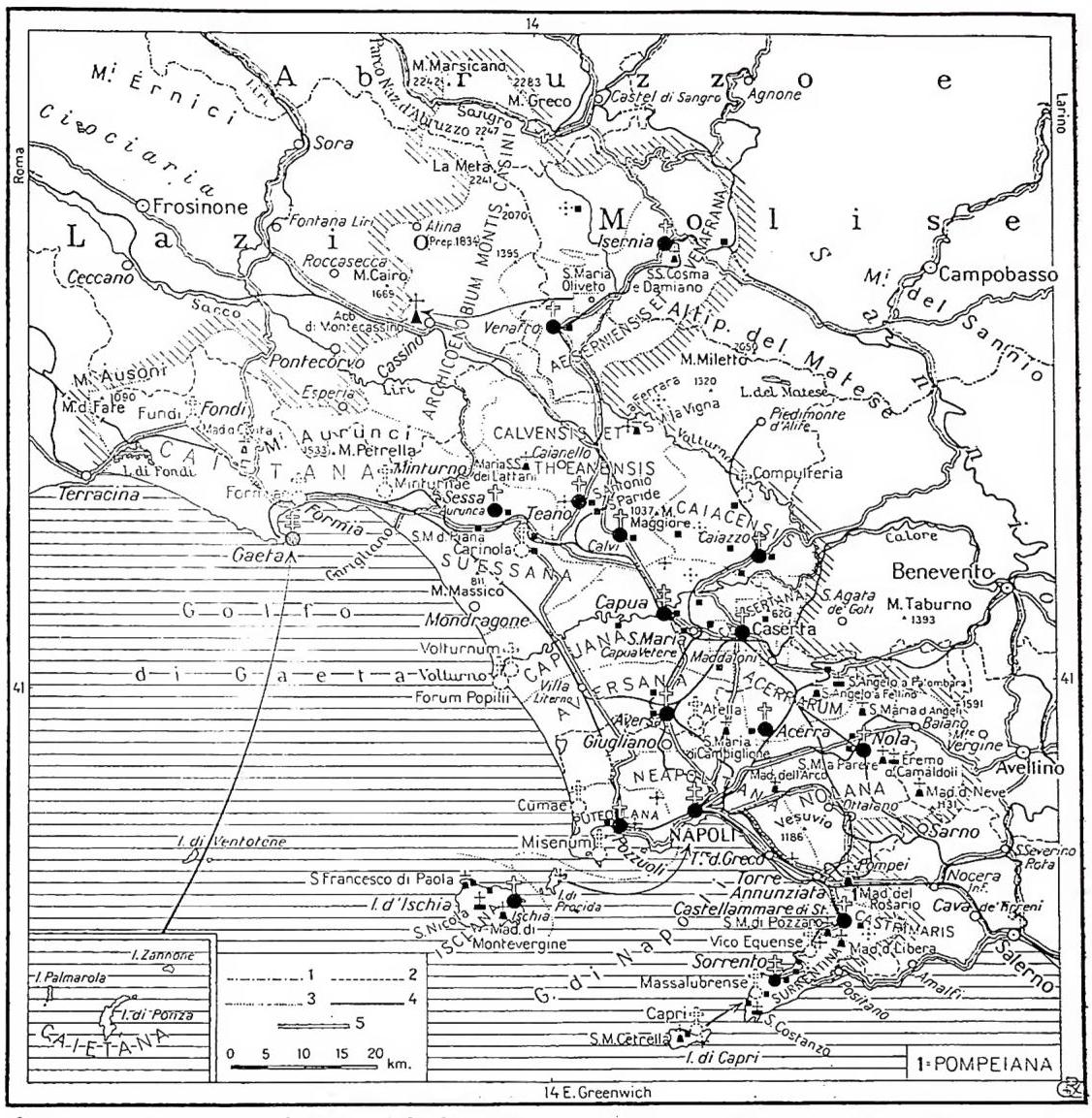
Historical region of southern Italy, comprising the Tyrrhenian side of the Apennines, from the Gulf of Gaeta (lower Garigliano) to that of Policastro (Sapri). In addition to the properly Apennine zone (from the Matese, which rises to 2,050 m, to the Cilento, where Mt Cervati reaches 1,899 m), essentially limestone in composition, and the anti-Apennine zone, which includes, together with the Neapolitan volcanic district (formed by active volcanic systems, such as Vesuvius, 1,186 m, and dormant ones, such as the Phlegraean Fields and Mount Epomeo on the island of Ischia), the imposing limestone mass of the Lattari (1,443 m), which constitutes the frame-
The great diversity of the landscape corresponds to marked contrasts in forms of economic activity and settlement. Agriculture (48% of the active population) benefits in the plains from the considerable fertility of the soil, the abundance of water, and the favorable climate; here, besides cereals, hemp and vegetables are cultivated, while olive trees, vines, and citrus fruits flourish on the slopes of the hills (the Salerno and Amalfi coasts). Among the regions of southern Italy, C. is the one with the greatest development of industry, from the ancient and traditional (pasta, tomato and fruit preserves, coral working), to the newer (footwear, glove manufacturing) and the most recent (mechanical, shipbuilding, textile), which are by now flourishing there; it is also, in southern Italy, the region where means of communication are densest and most convenient (especially railways). Maritime activity constitutes another important resource (the fishermen of the Gulf of Naples travel as far as the Greek islands and the coasts of Algeria).
With 4.2 million inhabitants (1 January 1948) over 13,505 sq km, C. now records, in Italy, the highest absolute level of regional population density (273 inhabitants per sq km) and provincial population density (Naples: 1,505 inhabitants per sq km). The coast of the Gulf of Naples, from Pozzuoli to Sorrento, exceeds 1,000 inhabitants per sq km;
nearly half of the Campanian municipalities record densities exceeding 200 inhabitants per sq km. It is characteristic, however, that only one urban center exceeds 100,000 inhabitants, in fact now reaching one million; and this alone suffices to clarify the particular position of Naples in relation to C.
| Provinces (and inhabitants of the provincial capital) | Area in sq km | Population according to the 1936 census | Density per sq km | Population 1-1-48 (in thousands) |
|---|---|---|---|---|
| Avellino 36,398 [1946] | 2802 | 446,412 | 159 | 494 |
| Benevento 46,921 [1946] | 2061 | 303,235 | 148 | 333 |
| Caserta 42,084 [1947] | 2639 | 506,860 | 192 | 573 |
| Naples 998,299 [1948] | 1171 | 1,734,848 | 1505 | 2028 |
| Salerno 89,979 [1948] | 4922 | 705,277 | 143 | 812 |
| TOTAL | 13,595 | 3,696,632 | 273 | 4240 |
Giuseppe Caraci
II. HISTORY
C. takes its name from the original nucleus of Capua and the ager campanus, the level territory that surrounds it like a broad field; the name subsequently came to designate neighboring localities as well, as a consequence of historical events or, more often, of administrative requirements. In the Augustan period C., forming part of the Regio prima together with Latium, already had a greater extent than the original region; later it came to include the land of the Hirpini and a large part of Samnium.In 1927, after the suppression of the province of Terra di Lavoro, whose capital was Caserta, some municipalities of that province were incorporated into the region of Latium, in the new provinces of Frosinone and Latina, and C. came to constitute a political unit, without any true homogeneity of traditions or even of geographical configuration. On 11 June 1945 the province was reconstituted, so that the ecclesiastical region once again coincided with the civil one. Historical reasons and traditional requirements contributed to its formation, giving it, in comparison with the civil region, a smaller extent but greater homogeneity, although this too is not perfect. It is now formed by three metropolitan sees: Capua, with its suffragans: Cajazzo, Calvi and Teano, Caserta, Isernia and Venafro, Sessa Aurunca; Naples, with its suffragans: Acerra, Ischia, Nola, Pozzuoli; Sorrento, with the suffragan see of Castellammare di Stabia. In addition, within the territory of C., but immediately subject to the Holy See, are the archbishopric of Gaeta, the bishopric of Aversa, the nullus abbey of Montecassino with the attached provostship of Atina; more recently the prelature of Pompei was also added.
Christianity was introduced into C. very early. Suffice it to recall that at Pozzuoli, the ordinary landing place of Easterners traveling to Rome, the apostle s. Paul, on disembarking there, already found some “brothers.” That s. Peter also disembarked there, however, is a very uncertain report, since it is transmitted by the apocryphal Actus Petri cum Simone. Herma (Pastor, Visio II, chaps. 1–4) mentions Cumae but without referring to its Church. Yet it is natural to think that the sees of those numerous bishoprics known to have existed in Italy in the middle of the third century should be sought, besides Latium, in C.; Capua, Naples, and Cumae appear the most probable, and perhaps the first of these may be traced back as early as the end of the first century. In any case, it will not be too bold to conclude that already toward the end of the second century Christian communities, organized with their own hierarchy, existed in several places in C. In the fourth century, while Capua and Naples were among the few cities in Italy to possess a basilica erected by Constantine, the region had several dioceses that must have dated from the time of the persecutions. Correspondingly rich was the flowering of martyrs and saints. Rufo, with the group of the Capuan martyrs, Gennaro, with that of the Neapolitans, and Erasmo of Formia are among the best known. At Nola, which had become, especially through the merits of its bishop Paolino, a small holy city of the West, s. Felice attracted numerous pilgrims. At the Council of Nicaea (325), Pope Silvestro is represented by Vincenzo of Capua. In that same century Capua would be distinguished by the teaching of Vittore.
The bishops of C. are recalled as a numerous group by s. Atanasio, by the Council of Sardica in 343, by Pope Liberio, by s. Ilario of Poitiers, and by Pope Innocenzo I during the fourth century, and subsequently by s. Leone in two letters from the middle of the fifth century (Lanzoni, p. 175).
Despite the splendid vitality that Christianity displayed throughout the region, pagan worship still persisted here and there, preferably in the mountains near the ancient sanctuaries. Thus s. Benedetto found extensive evangelical work in the Cassinate territory even in the sixth century, while on the summit of the mountain, in place of the ancient temples, he was establishing his monastery, which would exercise a beneficial and decisive influence in the formation of Christian Europe. The Gothic wars during the sixth century, as in other parts of Italy, brought ruin upon C., as s. Gregorio Magno testifies; but these were certainly surpassed, a few decades later, by the Lombard invasion, by which C. too was entirely divided and fragmented, and religious and civil life was disrupted or annihilated. Roman dominion, now represented by Byzantium, became confined to the coastal strip, where the duchies of Naples, Gaeta, and Amalfi acquired an increasingly autonomous character and life. The central part gathered around the Lombard duchy of Benevento, from which Capua and Salerno later separated. Among the minor lordships, that of Montecassino, almost independent, at the gates of the region on the road leading to Rome, is especially characteristic. Ecclesiastical life reflects these events. And with religious life, cultural and artistic expressions regain vigor, nourished by the various centers and especially by the Benedictine ones at Montecassino and S. Vincenzo al Volturno.
The Saracen invasion at the end of the ninth century once again repeated, though on a smaller scale, the damage caused by the Lombard conquest. The Campanian forces intervened victoriously at Ostia (816); and in C., with the battle of the Garigliano, Saracen power in southern Italy was definitively broken (915).
In the eleventh century a new vitality animated those regions, which, despite their fragmentation, had regained prosperity and wealth. And while Benevento, at the end of the century, passed to the Church, the Norman monarchy was taking root in the region, as throughout southern Italy. In 1059 it received its first investiture from Niccolò II, which was subsequently renewed consistently in the following periods, when, once the kingdom of Naples had been established, it was held by the Norman, Swabian, Angevin, and later dynasties as a fief of the Apostolic See, despite struggles and conflicts. Every Greek element was eliminated from the region, while Naples acquired an increasingly predominant position until it became the capital of the kingdom. The organization of the region may by now be considered definitive within the kingdom, which, while acknowledging its subjection to Rome, would especially in the eighteenth century engage in struggles to free itself and become entirely independent.
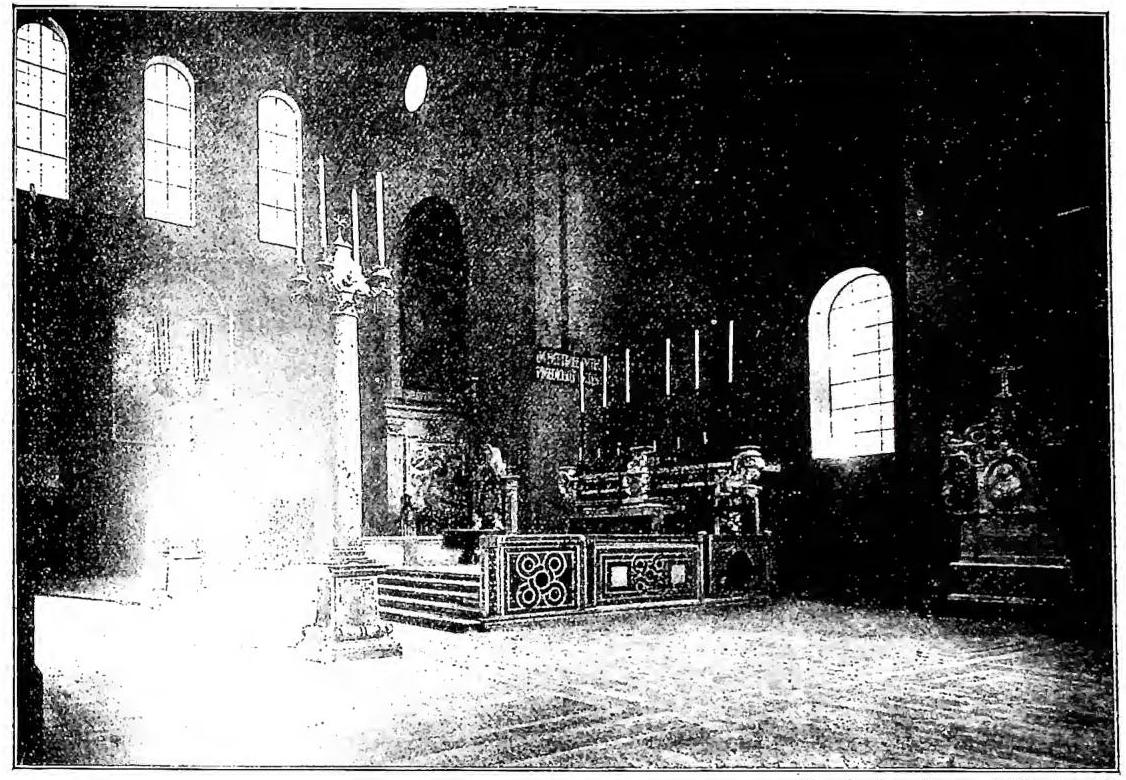
(Institute of the Superintendency of Antiquities, Naples)
CAMPANIA — Interior of the cathedral of Salerno (11th–12th centuries), with modern restorations.
charitable institutions, confraternities, institutions, and churches, the latter of which in Naples, for example, were until not many years ago more numerous than in Rome; the sanctuaries, from those of Pompeii, the Madonna dell'Arco, S. Alfonso at Pagani, and S. Gennaro at Naples and Pozzuoli, to the many others, especially Marian ones, that adorn even the most remote and humble villages; the frequent, exuberant religious celebrations and festivals, in which all the exuberance of the southern character appears—an exuberance that serves to explain, if not entirely to justify, those excesses and mixtures of the sacred and the profane that not infrequently make an appearance at these festivals, which, moreover, were, and in many places still are, the only diversion available to a people of limited needs. Among the most characteristic festivals, that of the lilies at Nola in honour of s. Paolino, and that of the four altars at Torre del Greco should be mentioned.
III. ART
The surviving evidence of early Christian art outside Naples (v.) is very scant. At Cimitile near Nola, s. Paolino, at the beginning of the 5th century, wished to build a new basilica beside the one where the tomb of s. Felice was located; at Nocera Superiore, almost at the same period, the basilica of S. Maria Maggiore was built. The stages in the development of sacred architecture, from the 6th century to the year 1000, are not yet clear, owing to the destruction and alterations of the scant remains. Few traces remain of the work of the Lombard architects and stonecutters who operated at Capua, Salerno and Benevento, or of the Byzantine buildings erected during the rule of the Eastern Empire. In the 8th century two Byzantine-type churches were built: the destroyed church of S. Maria delle Cinque Torri at Cassino and that of S. Sofia at Benevento, where, however, an original interpretation of Eastern models may be observed. Elements of Byzantine character are visible in the churches of S. Giovanni a Mare at Gaeta and S. Costanzo at Capri, as well as in a few other sacred buildings of the region.More than in architecture, the influence of Byzantine and Oriental art in general manifested itself in decorative sculpture, mural paintings and illuminated codices. With the rise of Amalfi’s maritime power and the advent first of the Normans and then of the Hohenstaufen, the arts flourished anew and entered their golden age. Thanks already to Desiderio, abbot of Montecassino (1058–87), building activity in C. had received considerable impetus; Desiderio brought architects and masters of mosaic and inlay work from the East, and Montecassino then became an artistic centre of great importance, from which architectural and decorative forms spread throughout the region. Ecclesiastical architecture nevertheless remained faithful in its structure to the basilican type with a Latin cross, while its decoration was enriched with particular motifs inspired by Siculo-Muslim models, but possessing a distinct local character, especially at Salerno and Amalfi.
Portals decorated with sculptures of Lombard character, with fragmentary Roman-period marbles or Byzantine-type marbles; bronze doors imported from Byzantium (as in the cathedrals of Salerno and Amalfi) or clearly derived from Byzantine models (as in the semi-destroyed doors of Benevento and those of the cathedral of Ravello); ambons, episcopal thrones, paschal candelabra and iconostasis screens increased the splendour of the celebrated temples. The use of mosaic decoration with geometric motifs, produced by Campanian masters who derived their taste from Siculo-Muslim art, was also frequent at this time.
In the field of painting, Byzantine culture predominates. At S. Vincenzo al Volturno a school of painting flourished (9th century), of which important evidence survives (the oratory of Abbot Epifanio); but the fundamental document of medieval Campanian painting is the cycle of frescoes that Abbot Desiderio had painted on the walls of the basilica of S. Angelo in Formis. Their influence is reflected in the frescoes of other medieval basilicas in Campania (S. Maria a Foro Claudio at Ventaroli, S. Maria del Piano at Ausonia).
When the Franciscans and Dominicans, favoured by the Angevins, succeeded the Benedictines in spiritual power, Campanian artistic activity underwent further development. Once they had consolidated their rule, the Angevins brought French architects to Naples, where they joined forces with native builders and spread the principles of the new Gothic architecture from the capital throughout C. After the Angevins, the Aragonese succeeded them, and Spanish Gothic became established and flourished until the Renaissance, which in C. did not possess vital artistic seeds. During the 15th and 16th centuries, architects, painters and sculptors reworked artistic forms inspired preferably by Tuscan and Roman examples. Artists then flocked from northern and central Italy, Sicily and Spain, seeking work and fortune: from Luciano and Francesco Laurana to Guglielmo Sagrera and Domenico Gagini.
During Spanish rule, the viceroys and, above all, the Jesuits, the Theatines and the Fathers of the Oratory, in renewing or founding churches and convents, gave vigorous impetus to building activity, which reached its culmination in the 17th century under the direct influence of architects such as Cosimo Fanzago, Giov. Antonio Dosio, Gian Battista Cavagni, Domenico and Giulio Fontana, Francesco Picchiatti, and of sculptors who immigrated from northern Italy, such as Giuliano Finelli, Andrea Bolgi and others. In 17th-century painting, on the other hand, Naples and C. established themselves through eminent personalities; Gian Battista Caracciolo, Massimo Stanzione, Bernardo Cavallino, Salvator Rosa, Mattia Preti, Luca Giordano and Francesco Solimena created a local school of painting that directed Campanian art towards new goals, leading it, with the transition from one century to the next, into nineteenth-century painting. In the second half of the 18th century, while architects such as Domenico Antonio Vaccaro and Ferdinando Sanfelice were building splendid churches and palaces and covering them with rich stucco decoration—the final flashes of declining Baroque—L. Vanvitelli, at Resina (Villa Campolieto), at S. Giorgio a Gremano (Villa Vargas), and especially at Caserta (the royal palace and park), developed architectural forms destined to prepare the gradual advent of nineteenth-century Neoclassicism. Characteristic manifestations of the artistic spirit and taste of the 18th century in C. were maiolica, used especially to cover the extradoses of church domes, and other products of the minor arts: furniture, porcelain, tapestries, marble works, nativity sculptures and silk fabrics, among which those of S. Leucio were famous. Between the end of the 18th century and the beginning of the 19th, French predominance imposed Neoclassical fashion, and art languished amid academic formulas and canons. After a period of stagnation, it resumed its course through the work of G. Gigante, D. Morelli, F. Palizzi, G. Toma, M. Cammarano and V. Gemito.
nel sec. XV, Castellon 1930; G. Chierici, L'elemento romano nell'architettura paleocristiana della C., in Atti del III Congresso naz. di Studi romani, Bologna 1934, pp. 207–14; id., Contributo allo studio dell'architettura paleocristiana nella C., in Atti del III Congresso intern. di archeologia cristiana, Rome 1934, pp. 203–16; G. Ceci, Bibliografia per la storia delle arti figurative nell'Italia meridionale, Naples 1937; W. F. Volbach, Sculture medievali della C., in Rendicanti della Pontificia Accademia romana di archeologia, 12 (1936), pp. 81–104
Felice de Filippis
IV. FOLKLORE
The popular traditions of C. may be distinguished according to several principal centers or areas: the city of Naples, the coastal region, Irpinia (Avellino), and the Beneventan Samnium. In the picturesque variety of its customs and usages, Naples has always possessed one of its principal attractions. A broad view of Neapolitan popular life from the sixteenth century onward may be obtained through the works of its dialect writers: Velardiniello, the « Gran Cortese », G. B. Basile, and others. From the eighteenth century onward, art too, especially through engravings and lithographs depicting folkloric scenes, has provided precise and appealing documentation. It is above all the artisans and street vendors who, with their cries and stalls, create the « local color »: the marinariello, the ovaiola, the verdummaro, the maruzzaro (snail seller), the castagnaro, the mellonaro, the franfelicaro (seller of solid honey sweets and candies), and likewise the zoccolaro, the knife sharpener, and the tinker. A characteristic figure was also Rinaldo, a popular storyteller. Given the psychology of the inhabitants and the sunny beauty of the surroundings, all the festivals acquire an exceptionally noisy and cheerful character. Suffice it to recall Piedigrotta, « the most Neapolitan festival in existence », held on 8 September with pilgrimages to the sanctuary of the Virgin of Pozzuoli, and which for more than a century has also become the festival of song. The pilgrimage to the distant sanctuary of the Madonna di Montevergine in Irpinia is likewise extremely crowded and full of movement and color. Characteristic forms of popular worship and particular devotion are also found in the pilgrimages to the Madonna di Pompei, the Madonna dell'Arco, etc. In the coastal area, especially around Amalfi and Capri, the rustic architecture with small domes, terraces, arches, and passageways beneath buildings, and with walls of luminous white, is highly characteristic, recalling that of the opposite Mediterranean shore. Among the fantastic beings in whom the common people of C. believe, we may recall « o munaciello », a benevolent household spirit, though sometimes mischievous, which is accustomed to appear in ecclesiastical dress with a skullcap; fortunate is the person who succeeds in removing it from his head. Famous is the walnut tree of Benevento, already known since
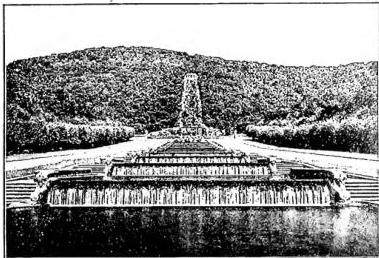
(photo: Ministry of P. I.)
CAMPANIA - CASERTA nel parco della reggia di CASERTA.
Notissimo è il «majo» di Baiano, grande albero intorno al quale il 26 dic. viene acceso un immenso falò, mentre i fedeli gridano: «O glorioso! Viva s. Stefano nostro!». Ancora ben vive le rappresentazioni di carattere sacro per la Settimana Santa, sia nella forma dei sermoni semi-drammatici, sia in quella di «misteri», grandi statue lignee costituenti dei gruppi con scene della Passione, posti lungo le vie, ai luoghi di sosta della processione: importanti quelli di Mirabella Eclano, Montoro, Lapio. Frequente è anche la rappresentazione della lotta fra s. Michele Arcangelo e il diavolo.
Molto diffuse le leggende mariane, quasi tutte collegate con luoghi di culto della Madonna, specie nella penisola sorrentina.
V. CAMPANIAN ECCLESIASTICAL REGION
It is one of the regions into which Italy was divided by measures of the S. Congregation of the Council of Trent of 15 February, 22 March 1919, and 29 September 1933 (AAS, 11 [1919], pp. 72–74, 176; 25 [1933], p. 466), for the purpose of celebrating regional councils in place of provincial councils.It comprises the territories of the ecclesiastical provinces of Capua, Naples, and Sorrento, as well as the archdiocese of Gaeta, the diocese of Aversa, the nullius abbey of Montecassino with the prepositure of Atina, and the nullius prelature of the Blessed Virgin Mary of the Most Holy Rosary (Pompeii).
The regional tribunal for matrimonial nullity cases is located in the regional capital (Naples); it also functions as an appellate tribunal for cases adjudicated in the first instance by the tribunals of the Beneventan (Benevento), Lucanian-Salernitan (Salerno), or Calabrian (Reggio Calabria) regions. Appeals against the judgments of the Campanian regional tribunal must be brought before the tribunal of the Latian region (Vicariate of Rome) or before the S. Rota (cf. Pius XI, motu proprio Qua cura, 8 December 1938, in AAS, 30 [1938], pp. 410–13). – Vedi Tav. XXXIII.