
Ecclesiastical Tribunals are the organs to which the exercise of jurisdictional power in the strict sense, that is, the judicial function belonging to the Church, is normally entrusted.
Although in the Church, by virtue of its divine organic institution, all public power, including judicial power, resides in the Pontiff and the bishops, and thus any original separation of functions is excluded, the need to entrust the exercise of judicial attributions to persons or organs particularly qualified for this purpose became increasingly pressing—due to the expansion of the Church and the development of its institutions and law. Hence, the various ecclesiastical tribunals, distinguished analogously to the ecclesiastical hierarchy, so that there are tribunals of the Holy See, directly attached to it, and metropolitan and episcopal tribunals, which constitute, so to speak, the common decentralized organs of ecclesiastical justice, that is, those attached to the ordinary hierarchical organization of the Church, according to the territorial distribution of individual circumscriptions.
I. TRIBUNALS OF THE HOLY SEE.
I. APOSTOLIC PENITENTIARY.
It is the supreme tribunal of the Church for the internal forum.
1. HISTORY
As in the rest of Christendom, in Rome too it was necessary to provide for the administration of the Sacrament of Penance in the basilicas and titular churches, with special regard also for the pilgrims who, out of spontaneous devotion or as penance for grave sins, flocked to the tombs of the Apostles. However, the establishment and organization of a true tribunal for cases of conscience in relation to the needs of the universal Church was achieved only gradually, that is, as ecclesiastical discipline was perfected and jurisdictional powers were centralized in the Curia. In 1193, a Giovanni di S. Paolo, cardinal of S. Prisca, is mentioned as "qui confessiones pro papa tunc recipiebat"; it is not stated, however, that he was the first to hold such an office, and he certainly must have had coadjutors or minor penitentiaries. Under Honorius III (1216-27), the names of some of these penitentiaries are known, among whom were several fratres, probably Cistercians. Under his successor Gregory IX, Dominicans (such as St. Raymond of Peñafort) and Franciscans also appeared in this office, as they did under every pontiff of the 13th century. Due to the nature of their duties, they had to follow the pontifical court when it moved outside Rome and were assimilated to the "cappellani" and familiares and to the apostolic notaries, thanks to the position of trust they held and the delicate matters often entrusted to them. Under Boniface VIII, it can be established with certainty that there were 8, 10, or 11 pontifical penitentiaries, now predominantly friars, with the task of promptly and without charge resolving the cases of those who turned to them. Even when the penitentiaries had to follow the Curia to Avignon, some of them remained in Rome; in 1339, it is known that there were four. As the functioning of this tribunal became more precise, it was observed that at its head was a cardinal with the title of poenitentiarius maximus, or summus, or generalis. The General Council of Vienne (1311-12), under Clement V, established that his faculties did not cease even during the vacancy of the Apostolic See, given the practical importance for the faithful and the long vacancies that unfortunately afflicted the Church at that time. The same Clement V entrusted the then major penitentiary, Cardinal Fredol, bishop of Tusculum, with reorganizing his office, limiting the writers to the number of twelve (const. Dignum est, 2 Sept. 1311); from this, it is evident that the issuance of absolutions, dispensations, and other rescripts had assumed considerable proportions, though precise information is lacking.Benedict XII (bull In agro dominico universali Ecclesiae, 8 Apr. 1338) issued new and precise norms for the organization and functioning of the Apostolic Penitentiary, which had by then become a curial organ with its own structure. To the cardinal penitentiary was added a specialist in canon law, as an expert and advisor in all pending questions; a certain number of minor penitentiaries were assigned, with delegated faculties for reserved absolutions and dispensations; writers and correctors for the drafting of rescripts; distributors and dispatchers; procurators or advocates. Its specific field was the internal forum; but due to the nature of the questions proposed, which sometimes exceeded the strict limits of the internal forum, partly reflecting on the external forum, and partly due to the tendency of every office to expand its competence, especially in doubtful cases, the Penitentiary, during the 15th century, appeared with powers and faculties much broader than the original ones. The popes themselves, in this period, increased its sphere of action with new faculties, and Sixtus IV (bull Quoniam nonnulli, 9 May 1484) recognized this state of affairs, confirming certain faculties concerning the external forum.
However, in the 16th century, the Penitentiary also became the object of a radical reform, and Paul III, in 1534, established a special commission to prepare it, encountering tenacious opposition from the cardinal penitentiary. The relative bull was published only by his successor, Julius III, in 1550 (bull Rationi congruit, 22 Feb.). Later, Pius IV, perfecting the work, published a new bull in 1562 (4 May, In sublimi b. Petri solio), with which the jurisdiction of the Penitentiary was severely reduced, assigning the resolution of certain questions of the external forum to the Apostolic Dataria, limiting the faculties of the cardinal penitentiary to the internal forum, and prohibiting, with very severe penalties, any further extension of the powers of this tribunal.
St. Pius V, to provide for a new organization of the Penitentiary, issued three bulls on 18 May 1569: the first, In omnibus rebus, suppressed the then-existing Penitentiary outright to reconstitute it almost ex novo, essentially based on the fundamental bull of Benedict XII. New personnel was appointed, with strict determinations and attributions: a regent as the immediate assistant to the cardinal penitentiary, a datary, a theologian, and a canonist as experts in difficult questions, writers and procurators (only two), and the bollator. The precise duties of each were established. The bull then attributed to the new Penitentiary the express faculty of resolving ex officio doubts and questions of conscience with interpretations having the character of authentic decisions. The second bull, Ut bonus, limited the various faculties of the members of the Penitentiary, and the third, In earum rerum, reaffirmed the principle that the tribunal of the Penitentiary pertained solely to the internal forum, sacramental and extrasacramental. Consequently, the attributions of the minor penitentiaries were also reorganized, for whom true colleges were constituted: one for the Lateran Basilica, composed of reformed Franciscans; a second for the Vatican Basilica, constituted by Jesuits; and a third for the Liberian Basilica, constituted by Dominican friars. After the suppression of the Society of Jesus (1773), the Jesuits at St. Peter’s were replaced by the Conventual Minors.
However, the cardinal penitentiaries managed to obtain, often evoa vocis oraculo, further faculties, with the old tendency to expand their competence even in the external forum. Urban VIII (17 September 1634) attempted to impose some restrictions, and Innocent XII, with the bull Romanus Pontifex (5 September 1692), issued an exhaustive catalogue of the tribunal's attributions. Half a century later, Benedict XIV, with four documents, once again sought to establish the staffing of the Penitentiary. With two bulls dated 13 April 1744 (Pastor bonus and In Apostolicae), new and precise norms were issued for the handling of various penitential causes: absolutions of reserved cases, matrimonial dispensations and those concerning irregularities, dispensations and rescripts in other matters of conscience, and the authentic resolution of proposed doubts; he circumscribed the faculties belonging to the officials. Then, in 1747 (bull Quanvis, 13 December) and in 1748 (bull Pastorali, 15 August), he made some adjustments and clarifications to his previous norms. The Penitentiary had occasion to expand its field of action once more, especially during the difficult period of the revolutionary occupation and Napoleonic domination, regaining faculties in the external forum, albeit with certain limitations, until, with the great reorganization by Pius X in 1908, it assumed its current structure, as outlined in the CIC.
II. PRESENT ORGANIZATION
Canon 258 § 1 of the CIC establishes that the Tribunal of the Sacred Penitentiary «for the internal forum alone grants graces, absolutions, dispensations, commutations, sanations, and condonations; it also examines questions of conscience and resolves them». It is said to be for the internal forum alone because the other dicasteries of the Holy See provide for the external forum. Only exceptionally do the provisions of this sacred tribunal have value also for the external forum (cf. cann. 1047 and 2251 and the apostolic constitution Quae divinitus of 25 March 1935: AAS, 27 [1935], pp. 97-113). Since the time of Benedict XV (25 April 1917), the Office of Indulgences has been annexed to the Tribunal of the Sacred Penitentiary, so that «it is also its responsibility to judge all that pertains to the use and concession of Indulgences, saving the right of the Holy Office regarding the doctrinal aspect of Indulgences and the discipline of new devotions» (can. 258 § 2).The Sacred Penitentiary today consists of two sections:
Tribunal and Indulgences. It is headed by the cardinal major penitentiary (SS. DD. Noutri Papae et S. Sedis Apostolicae Maior Poenitentiarius). He is first the penitentiary of the Pope and therefore it is his duty to assist the Pope ex officio at the point of death; then, as major penitentiary of the Apostolic See, he possesses very broad powers over all the faithful in matters of conscience and the concession of indulgences. From him alone, in matters of Confession, depend the four patriarchal basilicas of Rome (S. Giovanni in Laterano, S. Pietro in Vaticano, S. Maria Maggiore, S. Paolo fuori le mura) and the basilicas of Italy immediately subject to the Pope (such as those of S. Francesco in Assisi and S. Antonio in Padua), where he appoints the minor penitentiaries precisely for the ministry of confessions. He also grants these minor penitentiaries certain special faculties to absolve from censures and to dispense from vows, irregularities, or impediments: similar faculties he may grant to other confessors throughout the world. In the event of a sede vacante, the major penitentiary retains all his faculties and, in cases of grave and urgent necessity, may do what is usually reserved personally to the Pope (const. Quae divinitus, n. 12; cf. the const. Vacantis Apostolicae Sedis of 8 December 1945, n. 17: AAS, 38 [1946], p. 72). During the conclave, the major penitentiary is permitted to communicate with the office of the Sacred Penitentiary; and letters sent and received, bearing the seal of that office, are not subject to the examination prescribed for all other correspondence (const. Quae divinitus, cit. n. 12; cf. the const. Vacantis Apostolicae Sedis, cit., n. 17). If the major penitentiary should die during the vacancy of the Holy See, the cardinals must appoint the cardinal who will serve as major penitentiary during the vacancy (const. Vacantis Apostolicae Sedis cit., n. 14).
The cardinal penitentiary is assisted by a superior prelate, called the regent. The office of the secretariat includes, besides the regent, a secretary, two substitutes—one for the Tribunal and the other for Indulgences—and other officials (const. Quae divinitus, nn. 1 and 2). The Sacred Penitentiary also includes a body of prelates who periodically convene, under the presidency of the major penitentiary of whom they form the council, in the so-called «Signatura Sacrae Poenitentiariae Apostolicae». In this assembly, the most complicated and grave cases are treated (const. cit., nn. 5 and 6 b).
All other cases are handled in the Congresses for the Tribunal and for Indulgences, by the regent and the secretary with the substitute of the respective section. The three officials who participate in the Congress are jointly responsible for the resolutions agreed upon before the cardinal major penitentiary, who may reserve for himself, if he deems it opportune, the definitive approval of all resolutions taken in Congress (const. cit., n. 6 a). The most important cases, both of the Signatura and of the Congress, are then reported and submitted to the Holy Father by the cardinal major penitentiary in periodic audiences (const. cit., n. 6 c).
Recourse to the Sacred Penitentiary for matters concerning the Tribunal may be made directly by the interested person or, by his express mandate, by the confessor (cf. cann. 2252, 2254, and 2290); in practice, recourse through the confessor is preferable. The case should be presented without names or with fictitious names, briefly but with all circumstances deemed necessary or useful for a more exact judgment of the case itself. The presentation may be made in the vernacular; preferably, when clarity and precision are not compromised, in Latin. The place and date should not be omitted, with the complete indication of the address for the response.
Recourse to the Sacred Penitentiary—for matters of Indulgences—should generally be made through one’s own Ordinary.
II. APOSTOLIC SIGNATURA.
This is the supreme ecclesiastical tribunal, superior to diocesan and regional tribunals and even to the Sacred Roman Rota; it presents a certain analogy with the Court of Cassation in relation to Italian tribunals. Although it is not an appellate tribunal like the Sacred Rota, since it is concerned primarily with procedural questions pro vigili legum tutela (cf. AAS, 8 [1916], p. 209), it sometimes also deals with questions of merit; it extends its competence both in the strictly judicial field and in the administrative one, always, however, in matters of justice.
2. HISTORICAL NOTES
A referendary was, in the last period of the Roman Empire, one who was concerned with and reported to the emperors regarding the petitions addressed to them by citizens. This office later passed into some episcopal curias and into that of Rome.In the 6th century, there is already mention of iudices palatini, as advisors to the Pope in the handling of cases. The cardinals were the Pope’s natural advisors, but some cases were also referred to other palace officials (10, X, 11, 22). Petitions to the Pope were initially made orally, but after Innocent III all acts were written, and the Pope began to respond to the petitions addressed to him by affixing a sign in his own hand, which was gradually determined with precise norms and then remained unchanged, such as fiat, fiat ut petitur, fiat et dispensamus, fiat de omnibus, fiat motu proprio, fiat sub data petita, etc.; and beside it he placed the initial of his baptismal name, at least from Boniface IX onward (before this, the rule used in affixing the name is not known). Thus arose the Signatura. However, not all petitions (v. SUPPLICA) were annotated by the Pope: some were annotated by others ex mandato speciali or even by general mandate in certain matters. Sinibaldo Fieschi, later Innocent IV (1243-54), explicitly mentions the title of referendary in his Commentaria, whereas previously the same function was performed by the notaries of the Apostolic Chancery; the oldest figure historically identified with the title of referendary is the Spaniard Pietro Roderico, under Boniface VIII, in 1294.
From the pontificate of Eugene IV (1431-47), a new way of signing petitions appears through the referendario intimo, with the formula: Concessum in praesentia domini Papae.
The office of the Signatura originated from the fact that an ecclesiastical dignitary was granted the faculty to sign, in the name of the Pope, the rescripts that the Pope did not reserve for himself. This dignitary later became the head of a group of referendaries, and under Sixtus IV (1471-84) there existed a Signatura communis, distinct from the papal Signatura. It is not easy to determine when the distinction between Signatura iustitiae and Signatura gratiae occurred (cf. W. V. Hofmann, Forschungen zur Geschichte der Kurialen Behörden vom Schisma bis zur Reformation, Rome 1914, I, pp. 67-79; II, pp. 131-34).
It is uncertain how much truth there is in the report that already under Sixtus IV the distinction between the referendaries of the Signatura Gratiae, who were to number ten, and those of Justice, numbering six, had begun to take shape. Certainly, the complete separation from the Apostolic Chancery (v.) was then realized. Alexander VI, on 4 May 1493, separated the two signaturae (the distinction therefore existed earlier). Under Julius II (1503-13), a prefect presided over each Signatura, and thus the division of both Signaturae was perfected. The abuses that had crept in provoked reform attempts by the Renaissance popes; however, these were never fully applied, not even with the Council of Trent, which limited itself to making some observations without special regulations.
The first true reform, however, is due to Pius IV (cf. the bull Cum super nos of 1 July 1562); Sixtus V then, with his famous bull Immensa aeterni Dei of 22 January 1588, reformed, along with the entire Curia, the two Signaturae as well. That of Justice retained the characteristics and prerogatives of a tribunal, while that of Grace was transformed into one of the fifteen congregations, with a clearly distinct competence. A cardinal was placed at the head of each of the two Signaturae. Sixtus V also reduced the number of referendaries to one hundred, of whom no more than seventy could be assigned to the Signatura gratiae. From Clement VII (1523-34) onward, they were called referendarii utriusque Signaturae and served indifferently in one or the other. The Signatura Iustitiae was established as a true tribunal; some referendaries became actual judges and were called praelati votantes, having a decisive vote in sentences, while the others were deprived of II. Alexander VII, on 13 June 1659, established a college of referendarii utriusque Signaturae, which he wanted to be formed of twelve votantes of the Signatura Iustitiae. These referendarii votantes were at the same time referendaries of the Signatura Gratiae and of Justice. The prefects of the Signatura Gratiae, from the pontificate of Clement IX onward, are no longer encountered. The task of the Signatura Gratiae was the dispatch of matters concerning grace, which had to be resolved by the Roman Pontiff himself, both contentious and non-contentious matters, such as extraordinary remedies against a sentence, the granting of the clause appellatione remota or its removal, the commutation of last wills, etc. The referendaries examined the cases entrusted to them and reported on them in meetings, presided over by the Pope with the participation of the cardinals he summoned and the prelates having jurisdiction in urbe (cf. I. De Luca, Relatio Curiae Romanae, Cologne 1683, disc. 30, pp. 163-64).
From Clement IX (1667-69) onward, almost all the functions of the Signatura Gratiae were transferred to the Apostolic Dataria, and the Signatura Gratiae, instead of meeting weekly as before, began to convene once or twice a year, as it had under Benedict XIV. Under him, it was not the Prefect of the Signatura Gratiae but the Pope’s datary, Giovanni Giuseppe Millo, who signed the supplications with the clause concessum in praesentia. Even after Millo was made a cardinal, he continued as before, assisted by the officials of the Dataria: thus his successors continued. The two Signaturae lasted in this way until the French Revolution. Meanwhile, the referendaries, distinguished into votantes and non-votantes, participants and non-participants, continually obtained new and greater privileges from the Roman Pontiffs.
After the Papal States were reconstituted, Pius VII, on 6 July 1816, with the motu proprio Quando per admirabile, laid the foundations of the new legislation, and the Signatura di Giustizia became a civil tribunal and remained such, with some modifications under Leo XII and Gregory XVI (Legislative and Judicial Regulation of 1834: Acta Greg. XVI, IV, Rome 1904, p. 299 ff.), until the fall of the temporal power. The Signatura di Grazia was revived by Leo XII in 1826, but it did not last long, because after the death of Cardinal Cacciapiatti in 1839, no one spoke of this Signatura again, and in 1899 Leo XIII suppressed even the register of supplications. Thus, we arrive at the reform of the blessed Pius X, on 29 June 1908, which united in a single body the competences of the two ancient Signaturae.
Its procedure is regulated by the Lex propria Sacrae Romanae Rotae et Signaturae Apostolicae, annexed to the constitution. On 6 March 1912, with the approval of the same Pope, complementary norms were promulgated: Regulae servandae in iudiciis apud Supremum Signaturae Apostolicae Tribunal (AAS, 4 [1912], pp. 187-206). Benedict XV extended the competence of the Apostolic Signatura with the chirographum Attentis expositis of 28 June 1915 (AAS, 7 [1915], pp. 320-325); and in the same year, on 3 November, he approved other norms presented to him by Cardinal Lega, prefect of the Apostolic Signatura, to regulate activity in the administrative and gracious fields: thus we have the Appendix ad regulas servandas in iudiciis, apud Supremum Signaturae Apostolicae Tribunal (P. Gasparri, CIC Fontes, VIII, Rome 1938, pp. 608-18).
BIBL.:
W. V. Hofmann, Forschungen zur Geschichte der Kurialen Behörden vom Schisma bis zur Reformation, Roma 1914; I. De Luca, Relatio Curiae Romanae, Colonia 1683; P. Gasparri, CIC Fontes, VIII, Roma 1938; inoltre V. CURIA ROMANA; SEGNATURA APOSTOLICA; REFERENDARIO.
A. M.
II. CONSTITUTION OF THE TRIBUNAL OF THE APOSTOLIC SIGNATURA
At present, the Apostolic Signatura is composed of an indeterminate number of cardinals, who are the true judges of the Supreme Tribunal, with deliberative vote; among these, one serves as Prefect. Immediately following is the Most Excellent Secretary, who holds the title Auditor Sanctissimi (cf. the chirograph of Benedict XV Attentis expositis: AAS, 7 [1915], p. 324). He personally directs the activity of the Tribunal and often, together with the Cardinal Prefect, directly decides many questions. Next are the prelate voters and the referendaries, who perform duties similar to those of the consultors of the Sacred Congregations, the former with deliberative vote, the latter with consultative vote. There are seven voters, plus two supernumerary; the number of referendaries, however, is not defined. Among the prelate voters, one serves as promoter of justice, the other as defender of the bond. Permanent officials of the Tribunal include the summarists, the notary, and the archivist-protocolist.III. COMPETENCE
The competence of the Apostolic Signatura is summarized by the CIC in cann. 1602-1605. It is of a judicial and administrative nature and extends also to the civil forum for Vatican City. In the ecclesiastical forum, it is limited territorially by the S. Congregation for the Eastern Church (cf. the motu proprio Sancta Dei Ecclesia of 23 March 1938, in AAS, 30 [1938], p. 154); and by subject matter, it is limited by the Congregations of the S. Office and of the SS. Rites (can. 259) and by the Pontifical Commission for the Authentic Interpretation of the CIC.Firstly, its competence includes matters concerning the activity of the members of the S. Roman Rota and it judges violations of secrecy by the prelates auditors and damages caused by a null or unjust act (can. 1603 § 1, n. 1); it also rules on exceptions of suspicion raised against any prelate auditor and, if necessary, decrees their substitution (can. 1603 § 1, n. 1); the complaint of nullity against Rotal sentences, when not joined with an appeal, is always presented to the Apostolic Signatura (can. 1603 § 1, n. 3). The same tribunal is reserved the restitutio in integrum against Rotal sentences that have passed into res judicata but are found manifestly unjust due to factual errors or legal reasons, such as the falsity of a document, the fraud of one of the parties, or the production of new documents undermining the thesis that appeared proven (can. 1603 § 1, n. 4). Finally, it grants, if the case arises, the benefit of a new examination against Rotal sentences in matrimonial causes and in all those concerning personal status that do not pass into res judicata, when the S. Rota refuses to grant a new instance (can. 1603 § 1, n. 5). In these cases, generally, after the decision of the Apostolic Signatura, the matter is again heard by the S. Rota, unless the Signatura itself, by papal commission, must enter into the merits of the case.
In cases of conflict of competence between different tribunals, there is the faculty, or obligation depending on the circumstances, to have the question resolved by the Signatura unless such conflicts must be settled by another tribunal or by the legate of the Holy See, according to the places (can. 1612). As a consequence of the Concordat between the Holy See and Italy (art. 34), Austria (art. VII, 64), and Portugal (art. 25), the Signatura is responsible for the formal review of sentences in matrimonial causes before they are transmitted to the authorities of the respective States for civil effects. The Signatura sometimes judges directly on the merits of cases, in first, further, or last instance, but this is not by ordinary competence, rather by papal commission. Furthermore, the Signatura exercises jurisdiction in an administrative capacity when it examines petitions addressed to the Roman Pontiff to obtain that a cause be heard in first instance by the S. Rota (can. 1603 § 2), or that it be evoked from one tribunal to another. Many other cases may arise, not contemplated by the CIC, which offer opportunities to those who may have an interest to address the Apostolic Signatura with petitions in which aliquid petitur quod potissimum respiciat administrationem iustitiae (cf. the Chirograph of Benedict XV, loc. cit., p. 323). Finally, after the establishment of the State of Vatican City, the Apostolic Signatura
has become the Supreme Civil Tribunal of the same State. It thus acts as a Court of Cassation, within the limits, of course, of the pontifical territory (cf. Lex fundamentalis, in AAS, Supplemento, 21 [1929], p. 3).
IV. PROCEDURE
It is first necessary to distinguish between the Congress and the Full Plenary Signatura. The former consists of the Cardinal Prefect, the Secretary, and the voting prelates; it handles matters of lesser importance and convenes in the offices of the Signatura at the Palazzo della Cancelleria. The Full Signatura is composed of all the cardinals belonging to the Tribunal, who assemble in the Vatican on Saturdays. In addition to the Secretary, those voting prelates who have studied the matters of the day are invited. The Full Signatura is reserved for the most important questions, but it is quite difficult to define in absolute terms the limits of its jurisdiction, also because the Congress may have powers delegated by the Supreme Pontiff.Depending on the different types of matters, the procedure of the Signatura also varies.
Here, however, is a generic outline regarding judicial matters. The interested party presents a petition to the Secretary through the notary-protocolist, stating the reasons for the appeal and depositing a cautionary sum.
The Secretary entrusts the case to a referendary prelate and to one or more voting prelates, as the case may be, so that they may study it, and one of the voting prelates then reports to the Congress. If the matter is not of grave importance, it is immediately resolved; otherwise, the decision is referred to the Full Signatura. Here, the proceedings follow the ordinary process and are quite simple: the Secretary establishes the joinder of issue and closes the investigation. The Defender of the Bond or the Promoter of Justice, or both, intervene as the case may be; the party’s advocate naturally intervenes as well; the voting and referendary prelates assigned to individual cases may, upon invitation, make their own observations. One of the cardinals acts as rapporteur on the day of the Full Signatura, and all cast their vote, written or oral. Thus, the sentence is issued, which may also be reasoned.
In the case of an appeal for some grace or commission, the final report is submitted to the Roman Pontiff by the Cardinal Prefect or the Secretary, and the grace obtained is then communicated to the interested parties by a decree of the Signatura bearing the clause Ex audientia SS.mi. There is no possibility of appeal from the Congress to the Full Signatura. However, in the event of a negative response from the former, one may insist before the same Congress.
For the Signatura S. Poenitentiariae, V. above, I. Penitenzieria Apostolica.
Pietro Santini
### III. SACRA ROMANA ROTA.
Ordinary tribunal for the universal Church, established by the Holy See to receive, on appeal, from any other ecclesiastical tribunal, diocesan or regional, sentences in second and further instances.
3. HISTORICAL NOTES
The origins of the Tribunal can be traced back to the 12th century, with the so-called Capellani Papae,entrusted with hearing, in the name of the pope, cases that he did not wish to handle personally or through the cardinals; and it was precisely during that period that Lucius III (1181-85) began to revive Roman law as an auxiliary to canon law. Already under Innocent III (1198-1216), there is news of about ten magistri with the title of auditores causarum or Capellani Papae: and it was no coincidence that they bore such titles, for in reality those Capellani were entrusted with instructing cases and judging in the name of the Pope, who then confirmed their
sentence (cf. E. Cerchiari, Capellani Papae et Apostolicae Sedis Auditores Causarum Sacri Palatii Apostolici seu Sacra Romana Rota ab origine ad diem 20 sept. 1870, III, Rome 1920, pp. 6-11). Under the pontiffs who immediately followed Innocent III, the presence of the Capellani became stable and their number increased: in addition to the title of Capellani Papae, that of Sedis Apostolicae Capellani and Sacri Palatii Auditores is found. Under Boniface VIII (1294-1303), the common title was: Capellanus Papae ac Auditorum causarum Palatii Papae. Information on the manner of operation of the Capellani in the 13th century can be read in the work Speculum iuris written by Guglielmo Durando (d. 1296), who was one of the most illustrious cappellani of the early period (v. DURAND, GUILLAUME). Their office was to handle cases as true judges, but with delegated authority by virtue of a commission entrusted to them each time; with the increase in the number of cases, the Capellani proceeded under a single general commission, and were therefore also called Generales Auditores palatii domini Papae. Jurisdiction was never considered ordinary in an absolute sense, nor perpetual: upon the death of each pontiff, the activity of the auditors ceased entirely.
The name Rota became widespread during the Avignon period from the beginning of the 14th century. Among the furnishings of the papal palace was also a rotating support, Rota, on which the rolls of cases were placed: it seems that the tribunal and the Capellani took their specific designation from that support or from the fact that the auditors sat in a circle. According to others, however, the name Rota derives from the fact that cases were judged in turn. For the first time in documents, the word Rota appears in the collection of decisions of the auditor Tommaso Fastoli, published in 1337.
During the Avignon period, the number of cappellani was never fixed, and the group of its members,
though forming a college, still did not enjoy particular rights. Callisto III (1455-1458) and Pio II (1458-1464) intended to complete this evolution, but in fact never carried out their plan. As for the number, only Sisto IV (1471-1484), on 1 July 1472, with the bull Romani Pontificis, fixed it at twelve. He himself made exceptions, as did later Innocenzo VIII (1484-1492) and Alessandro VI (1492-1503); to be admitted to the college, it was then generally required that they had taught
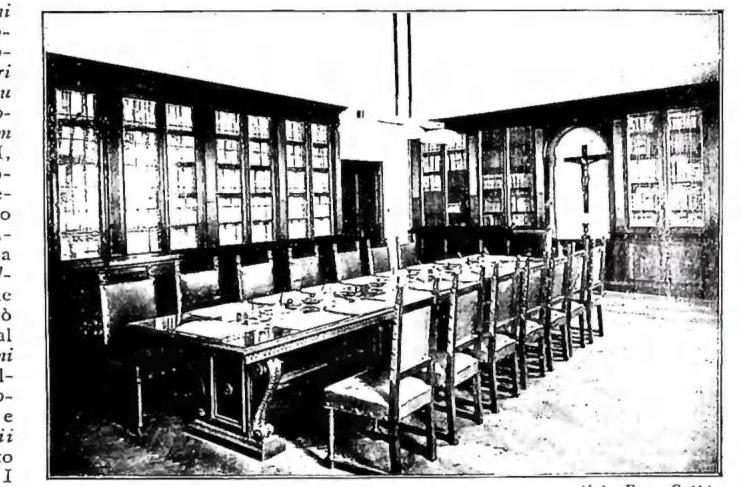
ECCLESIASTICAL TRIBUNALS - The assembly hall of the Tribunal of the Sacred Rota. Rome, Palazzo della Cancelleria.
The competence of the Rota could extend to the most diverse causes in terms of subject and importance: ecclesiastical, civil, and even those of public law. Among the matters submitted to its judgment, one may recall the matrimonial trial of Henry VIII with Catherine of Aragon, the question of the investiture of the Duchy of Ferrara, the disputed precedence between the two basilicas, Lateran and Vatican, and the difference between cardinal priests and deacons regarding the right of option. Only on 2 October 1746, with the constitution Iustitiae et pacis, Benedict XIV definitively established the competence of the Rota; if in the past it had not generally acted as an appellate tribunal, it now assumed almost that nature. The Pontiff first determined which causes were to be called minus graves and which graviores; he then fixed the competence of the various tribunals of Rome, that of the Capitoline Curia, that of the cardinal vicar, and that of the auditor of the Apostolic Camera; finally, he assigned to the Rota all major causes originating from both the tribunal of the cardinal vicar and that of the auditor of the Camera, as well as all those originating from any part of the Roman Curia. Moreover, as a consummate jurist, he distinguished the various cases in which the chaplains could act individually as simple prelates, without engaging the college of the Rota, and when they had to act as auditors of the tribunal of the Rota. From the 15th century onward, both the individual members and the entire Rota College saw their privileges and honors continually increased by the Roman Pontiffs. To the importance of their service, it may be added that five Roman Pontiffs emerged from the college of the Rota: Clement VIII, Gregory XV, Innocent X, Alexander VIII, and Clement XIII.
The importance and influence of jurisprudence were always highly significant. The Rotal decisions, always reasoned and often published, were frequently cited by jurists and judges of every tribunal and exerted no small influence on the application of legal science and the formation of the highest legal principles. These, like those of the Signatura, form part of the stylus et praxis Curiae Romanae and are one of the criteria to which one must resort in case of a gap in the law (CIC, can. 20; V. INTERPRETAZIONE). With the occupation of Rome by French troops in 1798, the Rota also almost entirely ceased its activity. Upon the reorganization of the Papal States, the Rota resumed its activity after 1815; in 1816, Pius VII granted the province of Ravenna the privilege of having an auditor, in place of Venice. With the Edict of 1821, the Rota was assigned, on appeal, the commercial causes of the Papal States. Once ecclesiastical and civil tribunals were completely transformed, the Rota became an ordinary appellate tribunal for the civil and ecclesiastical causes of the Papal States, and the Signatura was transformed into a sort of civil Cassation. The Regulation of Gregory XVI in 1834 coordinated the activity of the two judicial bodies in such a way that their existence had to cease automatically with the end of the Papal States in 1870. With Pope Pius X in 1908, the Rota (CIC, 1598-1691) and the Apostolic Signatura were reestablished, for which the Lex propria S. Romanae Rotae et Signaturae Apostolicae was published. In 1910, the Regulae servandae in iudiciis apud S. Romanae Rotae tribunal were added. These documents were later completed and unified in 1934 by the Normae S. Romanae Rotae tribunalis, which currently govern the activity of the sacred tribunal.
V. anche ROTA ROMANA; SEGNATURA APOSTOLICA
A. M. Stickler.Immediately following the auditors are the promoter of justice and the defender of the bond: in case of necessity, their office may be entrusted to multiple persons of equal or subordinate rank. Only priests graduated in utroque iure, of good repute and mature age, may be elected to these two offices. They are appointed by the Roman Pontiff upon proposal of the College. In addition to the stable substitutes of the Defender of the Bond or the Promoter of Justice, other priests, appointed on a case-by-case basis, fulfill the delicate task of defending marriage or iurium. Finally, there are notaries, scribes, the archivist, the distributor, the accountant, and the cursors. Advocates do not form part of the tribunal but are independent professionals; their intervention, however, is most necessary, as there is no case without at least one representative, chosen by one or both parties or assigned ex officio in cases of free legal aid or at least reduced expenses. By right, the ten consistorial advocates belong to the Rota; next are the ten procurators of the SS. Apostolic Palaces, and finally, there is the series of all Rotal advocates, who do not form a college and are not limited in number (v. AVVOCATO). To become a Rotal advocate, in addition to obtaining a degree in canon law, it is necessary to have attended the three-year course at the Rota’s studio and to pass an examination, which grants the diploma. Advocates are required to reside in Rome if they intend to practice before the S. Rota; they must account for the fees charged to their clients; accept cases of free legal aid assigned to them by the Dean; and finally, answer before the S. Rota itself and the Cardinal Commission of Vigilance at the Apostolic Signatura for any failure or infraction of their duties.
III. COMPETENCE AND ACTIVITY OF THE S. ROTA. – At present, the Rota primarily examines and resolves cases of an ecclesiastical nature, particularly matrimonial ones. Occasionally, it also handles criminal cases and those concerning Holy Orders. The Rota adjudicates cases of legal separation and, furthermore, matrimonial dispensations when this matter is connected with that of nullity. Regarding sentences issued by lower tribunals, the Rota may rule on the querela nullitatis, restitutio in integrum, and appeals for a new examination after a double conforming sentence in cases concerning personal status.
By its nature, the S. Rota is an appellate tribunal (can. 1598); thus, in second instance, it first and necessarily receives all cases originating from the tribunal of the Vicariate of Rome. It also receives, still in second instance, cases from other diocesan or regional tribunals of any province of the Holy Church (can. 1599 § 1). This faculty is shared concurrently with all local appellate tribunals. Finally, the Rota receives, in third and further instances, cases already adjudicated by an appellate tribunal that have not yet become res iudicata.
However, the Rota is also a tribunal of first instance for cases reserved to the Holy See (cf. can. 1557 § 2) and when the Roman Pontiff, either on his own initiative or at the request of the parties, assigns cases to be decided by the S. Rota from the first instance. Any subsequent instances will naturally always take place before the same sacred tribunal, without prejudice to the competence of the Apostolic Signatura. Nevertheless, the so-called causae maiores (can. 1600) are absolutely excluded from its competence, as they are personally reserved to the Roman Pontiff (can. 1557 § 1).
Following the establishment of the State of Vatican City, the S. Rota serves as a Court of Appeal. This jurisdiction is understood to be limited by the boundaries of Vatican City (cf. Lex fundamentalis, in AAS, Suppl., 1929). An example of the Rota’s extensive current activity can be drawn from the commentary (AAS 44 [1932], pp. 297-334) reporting the 1951 account. The tribunal handled 244 cases; 189 of these reached a sentence, comprising 186 cases of nullity or dispensation, 2 iurium cases, and 1 separation case. Fifty-five cases remained suspended and were thus archived, including 49 nullity cases, 3 separation cases, 1 tituli nobiliaris, 1 damnorum, and 1 alimony case.
IV. PROCEDURE OF THE SACRA ROMANA ROTA
The Rota is a collegial tribunal (can. 1598). Each judging panel is generally composed of three auditors: the most senior of these serves as president, almost always as ponens, and, if necessary, as instructor of the case. If a case has been judged in a lower tribunal by a number of judges greater than three, the Rota is not obliged to increase the number of its auditors (can. 1596). In certain cases, the judging panel may be composed of five, seven, or more auditors; it is not excluded that all its members may participate (in which case it is said videntibus omnibus): this occurs when a case is remitted to the Rota by the Apostolic Signatura, having been granted restitutio in integrum, and in cases where the Pontiff has so disposed. In such instances, no exception is made for auditors who have previously dealt with the same question, nor is the parity or disparity of the number of auditors considered. Each panel constitutes a tribunal in itself and may be regarded as a section, equal in rank and entirely identical to every other panel. When a case reaches the Chancery of the Rota, the Dean may assign it to any panel; in any subsequent instances, the case automatically passes to the panel composed of the more senior auditors. When the Dean, by special decree, assigns a case to a specific panel, he designates the president and the ponens; on occasion, however, one or two of the panel’s auditors may be replaced by others in sequence if illness or another just cause intervenes. If the ponens, once designated, subsequently has just cause to resign, the ponency may, after hearing the other two auditors, be entrusted to another. A case pending before the S. Rota is designated not so much by its protocol number as by the name of the diocese, the subject matter, the names of the parties, and the name of the ponens: coram, with the addition of the date of the sentence.The rotal fees vary according to the scope and gravity of the case; they are made known in a special table that indicates the minimum and maximum rights that may be claimed by advocates from their clients; not infrequently, gratuito patrocinio is granted or at least a reduction of judicial expenses. The acts of the process are generally printed, at the expense of the interested parties, by the Vatican Typography, though they remain always secret. Advocates and the parties to the case may, whenever they wish, inspect the procedural acts once the instruction, which is generally secret, has been completed. Nevertheless, the S. Rota publishes annually in the AAS, albeit in a generic manner, the list of all cases treated in the previous year, together with the dispositivum, omitting the names of the parties and sometimes even the indication of the diocese, so that the dissemination of information that might harm the interested parties is not easily facilitated.
The secrecy and seriousness of rotal practice may also be inferred from the fact that, at the appointed time for the definitive sentence of a case, each auditor, after having personally and separately studied the procedural acts, is required to produce a written vote. An oral discussion among the judges also takes place, and sometimes, in the diversity of opinions, one may, if deemed opportune, adhere to the opinion of another: the vote of each member of the panel is equal to that of the others and to that of the president and ponens. It may even happen that the ponens must subsequently draft a sentence with a conclusion contrary to his own viewpoint, if the other two colleagues have held a different opinion. Their votes are finally enclosed in an envelope and sealed: even the Dean is prohibited from inspecting them; only the Roman Pontiff could order their consultation. Every year, all sealed envelopes containing the votes of cases older than ten years are destroyed by fire.
As the S. Rota is a pontifical tribunal, it serves as a guide for all other tribunals, both diocesan and regional; its sentences and decisions are regularly published in special volumes, with the omission, as mentioned above, of the names of the parties. This typographical publication normally occurs ten years after the notification of the sentence to the interested parties.
DUTIES AND PRIVILEGES OF THE PRELATE AUDITORS
Leaving aside what has now fallen into disuse, we limit ourselves to noting some points of the constitution Ad incrementum of 15 August 1934, published by Pius XI, with the aim of coordinating, according to the various grades, the prelature of the Roman Curia (v. PRELATI).
The auditors are domestic and familiar prelates of the Roman Pontiff; exempt from the jurisdiction of Ordinaries. As apostolic subdeacons, they serve as ministers, with various duties, in the solemn functions of the Roman Pontiff. They assist at the blessing and imposition of the Pallia; and at the blessing of the Agnus Dei; the dean in person is entrusted with the lambs from whose wool the Pallia are to be made. Two prelate auditors, for the second time, promulgate in Latin and Italian the bull of indiction of the Holy Year; three auditors, among the most senior, are enrolled, by right, in the S. Congregation of Rites, as Prelate Officials. During the Conclave, the auditors guard the Rota reserved for the cardinals. In forensic ceremonies, they wear the toga over the plain cassock and the doctoral biretta with red piping and tassel. They enjoy the right of pontificals like the apostolic protonotaries de numero.
II. METROPOLITAN AND DIOCESAN TRIBUNALS
I. HISTORY
From the earliest times of the Church, first-instance jurisdiction was ordinarily exercised by the bishop within Christian communities, and as early as the 2nd and 3rd centuries, there is evidence of frequent appeals from bishops to the Pope. With the end of persecutions, episcopal jurisdiction was recognized—with inappellable character—by imperial constitutions for civil cases, where the parties consented. After the Lombard invasion, which had diminished the civil prerogatives of episcopal tribunals, under the Carolingian Empire and subsequently, these regained authority in relations with the State, but at the same time saw the rise and increasing affirmation of the contentious jurisdiction of urban deans and archdeacons, with their own tribunals, from which appeals were made to the episcopal tribunal. With the Council of Trent, all inferior tribunals were abolished, and the first-instance cognizance of all cases "ad forum ecclesiasticum quomodolibet pertinentes, etiam si beneficiales sint" was brought before the local Ordinaries (sess. XXIV, cap. XX de reform.).
The competence of these tribunals thus became increasingly defined and unified, while at the same time their functioning and organization assumed an increasingly distinct character from the administrative activity of the bishops themselves, with the separation of judicial functions—entrusted, under the presidency of the tribunal, to the officialis—from administrative functions devolved to the vicar general (v. PRESIDENTE DEL TRIBUNALE).
The CIC reaffirmed, in principle, this separation of offices (can. 1573 § 1) as the basis for the constitution of episcopal tribunals. For this reason, while reiterating the principle that the bishop is the natural judge in his diocese for all disputes not reserved to the Holy See (except where he is a party, as in matters concerning the temporal goods of the mensa or the curia: can. 1572 § 2), the bishop is advised to exercise judicial functions, especially in criminal or contentious cases of grave importance, through the ordinary tribunal, presided over by the officialis or vice-officialis (can. 1578; V. also, for inquisitions in criminal trials, can. 1940).
Regarding subsequent levels of the judicial hierarchy, since the Council of Trent established the rule that first-instance cases always pertained to the episcopal tribunal, appeals against its sentences were brought before the metropolitan, the patriarch, the primate, and the Apostolic See.
Later, as patriarchal and primatial dignities were reduced to a purely honorary title without any special jurisdiction (can. 271), the levels of jurisdiction remained fixed in three instances, respectively before the bishop, the metropolitan, and the Holy See.
Thus, in the system of the CIC (l. IV, part 1), there are the ordinary tribunals of first instance at the bishop’s level; the ordinary tribunals of second instance at the metropolitan’s level; and the pontifical tribunals (Sacra Romana Rota, Apostolic Signatura). To safeguard the right of the parties to a triple degree of jurisdiction, for cases tried in first instance before the metropolitan (which occurs, obviously, for subjects, entities, or persons belonging to his episcopal see), it is established that second-instance judgment is rendered by the tribunal of a local Ordinary, designated once and for all. Similar provisions are made for archbishops without suffragans or for bishops immediately subject to the Holy See (can. 1594).
II. ORGANIZATION AND FUNCTIONING
The constitution of ordinary ecclesiastical tribunals, which is identical for the first and second instance, as are the rules for the conduct of cases before them (can. 1595), may be either of a single judge or collegial, depending on the matters or cases.The single judge — in the person of the bishop and, on his behalf, in cases which he does not reserve to himself, of the officialis or vice-officialis (v. PRESIDENTE DEL TRIBUNALE) — must, however, always be assisted in any judgment by two consulting assessors, chosen from among the synodal judges. These are priests of exemplary life and experts in canon law, appointed in the synod and by the bishop in the interval between one synod and another, with delegated authority.
The collegial tribunal is constituted by the officialis or vice-officialis, as president, and two or four other judges, designated by the Ordinary in rotation from among the synodal judges. The college must consist of three members in contentious cases concerning the bond of Holy Orders, marriage, or the temporal rights and goods of the cathedral church; likewise in criminal cases which may entail the deprivation of an inamovable benefice, or the imposition or declaration of excommunication. Cases concerning crimes which entail the penalty of deposition, perpetual deprivation of the ecclesiastical habit, or degradation are, instead, reserved to a tribunal of five judges. Furthermore, the Ordinary may entrust the adjudication of other cases to a college of three or five judges, and it is recommended that he do so especially if the matters, "attentis temporis, loci et personarum adiunctis et materia iudicii," appear to be of greater difficulty or importance (can. 1577 § 2).
The sentences of the collegial tribunal are rendered by majority vote; the direction of the process pertains to the president.
The same rules apply to both degrees of jurisdiction, but if a case has been heard collegially in the first instance, it must also be so in the appellate instance, and with no fewer judges.
In addition to the judges, the staff of the ecclesiastical tribunal includes other officials whose presence is necessary for all acts of the tribunal or is required only for certain judgments and in given circumstances. Of notary (v.) or actuary, who must intervene in every process, and by whom all acts must be drawn up or at least subscribed, under penalty of nullity. He corresponds to the clerks of the lay forum; he is designated by the judge before the adjudication of the case begins. Other auxiliary officers are the cursores, for notifications, and the apparitores, for executions, whose functions may be performed by the same person. Their acts constitute public evidence. Cursores and apparitores are as a rule laymen; the notary is normally a priest, and must always be so in criminal cases involving clerics.
Judicial officials who do not necessarily intervene in all cases, but only in certain ones, promoter of justice (v.) and the defender of the bond (v.), who represent the public interest in the ecclesiastical tribunal and oversee the regular administration of justice.
The promoter of justice intervenes in criminal cases, in which, indeed, the exercise of the criminal action or accusation pertains exclusively to him; he also intervenes in contentious cases in which, in the judgment of the Ordinary, the public good is at stake, and finally, he may take the initiative, in concurrence with the interested parties or in their stead if they lack the capacity to act, to promote cases of matrimonial nullity (cann. 1586, 1934, 1971). The defender of the bond intervenes obligatorily in cases concerning marriage and Holy Orders, with the task of defending the relative bond. Both are appointed by the Ordinary, are removable by the bishop for just cause, and must be confirmed upon the change of bishop.
The parties in a case may be represented in judgment by a procurator and defended by an advocate, whose functions may, however, be exercised by the same person, provided he possesses the required qualifications and is duly authorized by the competent ecclesiastical authority. Their appointment, however, is not obligatory, except by legal prescription or order of the judge.
The legal aid (v.), total or partial (can. 1914), with the designation, by the judge, of an ex officio defender.
III. ECCLESIASTICAL TRIBUNALS FOR MATRIMONIAL JUDGMENTS IN ITALY
The organization of ecclesiastical tribunals outlined thus far applies to the Church in general. For Italy, however, in light of the serious practical problems arising from the application of the Concordat of February 11, 1929, which recognized civil effects for canonical marriage and the related nullity rulings issued by ecclesiastical tribunals, it was deemed appropriate to distribute differently the organization of first- and second-instance tribunals designated to hear such disputes. Therefore, with the motu proprio Qua cura of December 8, 1938, Pius XI decreed that each conciliar region of Italy should have a single tribunal entrusted with judging matrimonial nullity cases for all the dioceses of the region. The competence for the appellate judgment of the rulings of each regional tribunal was assigned to another among them, specifically designated according to the following table:| Piedmont | Turin | Milan |
|---|---|---|
| Lombardy | Milan | Genoa |
| Liguria | Genoa | Turin |
| Emilia | Modena | Bologna |
| Veneto | Venice | Milan |
| Romagna | Bologna | Venice |
| Tuscany | Florence | Bologna |
| Umbria | Perugia | Florence |
| Marche | Fermo | Florence |
| Lazio | Rome (Vicariate) | Sacred Rota |
| Abruzzo | Chieti | Benevento |
| Benevento | Benevento | Naples |
| Lucania and Salerno | Salerno | Naples |
| Campania | Naples | Rome (Vicariate) |
| Apulia | Bari | Benevento |
| Calabria | Reggio Calabria | Naples |
| Sicily | Palermo | Naples |
| Sardinia | Cagliari | Rome (Vicariate) |
IV. TRIBUNALS FOR RELIGIOUS AND DELEGATED TRIBUNALS
In addition to the ordinary tribunals of first and second instance of the bishop and the metropolitan for subjects under their jurisdiction, canon law provides—specifically for religious who are exempt from this jurisdiction—special tribunals established within individual religious orders. The Codex Iuris Canonici (cann. 1579, 1594 § 4) stipulates that in disputes between exempt religious of the same clerical order, unless the constitutions provide otherwise, the judge of first instance is the provincial superior or, if the matter concerns a monasterium sui iuris, the local abbot. If the dispute involves two religious provinces, the judge is the supreme moderator (supremus moderator) of the order or, in the case of two monasteries, of the monastic congregation.However, if the dispute arises between physical or moral persons of different orders, or between members of the same non-exempt or lay order, or between a religious and a secular cleric or a layperson, the local diocesan tribunal is always competent as the court of first instance.
In second instance, cases heard before the provincial superior are brought to the tribunal of the supreme moderator; those heard before the local abbot, to the tribunal of the supreme moderator of the monastic congregation; and finally, those judged by the episcopal tribunal, to the ordinary tribunal of second instance according to the common rules (can. 1594 §§ 1, 2, 3).
To the ecclesiastical tribunals considered thus far, as well as to the other ordinary or special tribunals of the Holy See discussed in their proper place, may be added the category of delegated tribunals. These may be established for just reasons by the Pontiff and, in exceptional cases, by bishops, abbots, and prelati nullius, as well as by apostolic vicars and prefects. The delegation must be in writing and generally expires upon the conclusion of the cognitive process. A judge delegated by the Holy See may avail himself of the personnel of the diocesan curia in which he is to adjudicate, or of any other person he prefers.
Judges delegated by Ordinaries must employ the personnel of the diocesan curia, unless the bishop, in some particular case, has determined that others should be used (cann. 1606-1607).
id., s. v., in Nuovo Digesto ital., XII, II pp. 517-25; Wernz-Vidal, De processibus, 2 voll., Roma 1927; F. Della Rocca, Istituz. di diritto processuale canonico, Torino 1946. Arnaldo Bertola