
UDITORE DI ROTA. – I. In the ancient law of the Church, auditor was regarded as the person entrusted with the instruction of a case; it is in the Decretales that this specific appellation is found, together with others: « cui medium causae committitur sive cognitor aut executor dicatur, vel, quod melius est, auditor ». This jurisdiction, undoubtedly of the greatest importance, was entrusted by the Pontiff especially to cardinals, chaplains, and subdeacons; initially, however, the power of decision was excluded in the case of those invested with II. Subsequently, this power came to be attributed to certain particular categories: the auditores S. R. Rotae, the auditor Camerae Apostolicae, the auditor S.mi, as well as the auditor of the conclave and of the apostolic nuncio.
II. The u. of the S. R. R., although it began to take shape at the time of the constitution of the tribunal (v. S. SEDE, III), which had its own chancery (where judicial acts, as well as rescripts of grace and justice, were drawn up) and its own auditorium (the place where cases were heard), acquired a clear and precise juridical configuration with the const. Ad regimen of Benedict XII of 10 January 1335, when it was distinguished from the other chaplains and considered a true official: the same Pontiff gave the u. in Avignon a special seat.
At present, the tribunal of the Rota, which, together with the Apostolic Signatura, constitutes the ordinary tribunal of the Holy See, includes a certain number of u., directly elected by the Supreme Pontiff; this number has varied several times. In fact, in the fifteenth century Sixtus IV (30 April 1472) prescribed the number twelve; in the Regulae speciales of 1908 the members of the tribunal were reduced to ten, while today, on the basis of the current Normae of 29 June 1934, the number remains unspecified, especially since the CIC itself does not establish a fixed number (can. 1598 § 1).
Over the course of the centuries, the power to appoint some members of this authoritative college was reserved to the highest civil authorities: thus the king of Spain had the right to appoint two, one for Castile and the other for Aragon, while Germany and France too could choose their own u. In the sixteenth century Julius II granted this power to the city of Bologna, Pius IV to Milan, Sixtus V to the Venetian Republic, Clement VIII to Ferrara, and Urban VIII to Perugia.
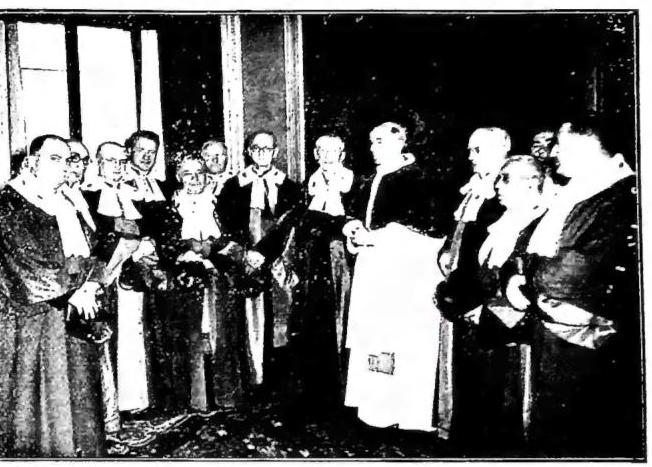
(Alinari photograph)
The prelate auditors currently serving on the tribunal number fifteen; they are presided over by the dean, « qui primus est inter pares » (can. 1598 § 1). When the office of dean is vacant, it is held ipso iure by the person « qui primam sedem post decanum obtinet » (art. 3 § 2 of the Normae). The order of precedence of the u. at sessions is as follows: after the dean sits the person whose appointment is the older; where appointments are of equal antiquity, the person who previously received priestly ordination; and where ordinations are of equal date, the older in age.
The members of this college must, in addition to being priests, possess at least a degree in utroque iure (can. 1598 § 1), be mature in age, of upright life, and distinguished for prudence and legal learning (art. 2 § 1 Normae). They are elected exclusively by the Roman Pontiff and, generally, may not be removed from office except through promotion or upon reaching the age of seventy-five; in the latter case they become emeriti. Before the u. is invested with office, he must take the customary oath « de munere fideliter implendo » before the entire college, and he is strictly bound to preserve official secrecy.
The college of Rota u. is divided into panels of three judges, or it may decide videntibus omnibus (can. 1598 § 4); in special cases, the Pontiff may also establish a different number of members for a panel. Each panel constitutes an equal section of the same tribunal and at the same time serves as a court of appeal for decisions issued by the preceding panel. Each judging panel has a ponent, designated by the dean, who, utpote praeses turni, directs the entire process. The dean represents the tribunal, and decisions of the supreme Tribunal of the Apostolic Signatura are addressed to him; he assigns cases to the various panels, arranges for the replacement of incapacitated u., and also examines in limine, together with the first two u., whether cases are to be dealt with administratively or judicially.
IV. The matters judged by this authoritative Tribunal concern: 1) cases falling within its jurisdiction at second instance, which have already been decided at first instance either before an episcopal tribunal or before the tribunal of the Vicariate of Rome; 2) cases to be heard at third instance, which have already been examined at first and second instance either by the Rota itself or by lower tribunals, with a judgment not yet final; 3) cases called by the Holy Father to his tribunal and remitted by pontifical commission to the Rota for trial at first instance (can. 1599); in addition to petitions for restitution in integrum.