
UDINE, DIOCESI di. — City and diocese in eastern Venetia, on the borders with Yugoslavian Carniola and Austrian Carinthia. It has a population of 534,700 inhabitants, of whom 534,500 are Catholics, distributed among 488 parishes, served by 816 diocesan priests and 80 religious; it has two seminaries, 12 male and 140 female religious communities (Ann. Pont. 1953, p. 437).
U. is first mentioned among the castles donated by Otto II in 983 to the patriarch of Aquileia, Rodoaldo. As a result, it was governed by a patriarchal gastald until the family of the Savorgnani, of ministerial nobility, acquired prominence there. The walls of the castle descended into the plain below, expanding until they included several small villages in the fifteenth century. The patriarch resided there intermittently, as in his other castles, and encouraged the formation of the Commune; Patriarch Bertoldo of Andechs granted it a public market in 1248. It also received its statutes in the fourteenth century, gradually becoming the principal community of Friuli, when, especially from 1420 onward, it became the residence of the lieutenant who governed the territory of Friuli in the name of Venice. At first it was merely a simple parish church of the patriarchal diocese, whose mother church was the castle church; in the thirteenth century the parish church became a collegiate church and had its own church with a cemetery on the plain near the old market. When the patriarchate was given in commendam in the fifteenth century, the patriarchal vicar resided there, and by the end of the sixteenth century the patriarch had his ordinary residence there. On 19 January 1753, as a consequence of the division of the patriarchate decided upon by Benedict XIV, U. became the seat of an archbishopric that comprised the Venetian part of the ancient patriarchal diocese, retaining metropolitan authority over the Venetian-Istrian bishops formerly dependent upon the patriarchate. Under the Napoleonic administrative arrangement, U. was the administrative center of the department of Passariano, and it remained so during Austrian rule, for the province of Friuli, and later under the national government. Following the Concordat of 1 May 1818 between Austria and the Holy See, however, U. was reduced to a simple bishopric in the ecclesiastical province of Venice, until Pius IX made it an archbishopric once again on 14 March 1847, though without suffragans. Meanwhile,
Gregory XVI had detached Cadore from the diocese on 30 April 1846 in order to unite it with that of Belluno. Without taking account here of other territorial changes of lesser importance, it will suffice to recall that of the Tarvisiano, removed from the diocese of Gurk on 10 February 1933 and annexed to that of U.
In the city, the Romanesque-Gothic Cathedral (begun in 1236) underwent Baroque alterations in the eighteenth century; the same occurred with the two Gothic churches of S. Francesco (formerly belonging to the Conventuals) and S. Pietro martire (formerly belonging to the Dominicans). In the fifteenth century the Commune built its Gothic Venetian-style loggia and palace, and in the sixteenth rebuilt opposite them the church of S. Giovanni, with the clock tower and elegant loggia. The remarkable paintings in the church of the Purità and those in the Archbishop’s Palace are by Tiepolo. The latter houses a library rich in rare works, incunabula, and manuscripts. The Municipal Library, in addition to modern works, preserves parchments, memoirs, and various documents of the greatest importance for the history of the country and the city. The Chapter Archive, with its parchments from the ancient patriarchate, is of great importance; to it must be added the Library of S. Daniele
with its codices. A sanctuary visited by devotees from all Friuli since the fifteenth century is that of the Virgin of Grace, in the city.
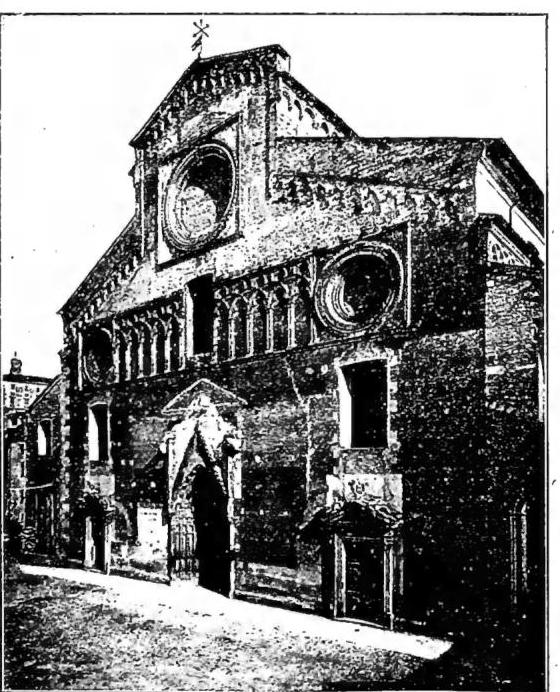
UDINE, DIOCESI di — Façade of the Cathedral (thirteenth century) — Udine
In addition to the abbey of Sesto, of Lombard origin, the two Benedictine abbeys of Moggio and Rosazzo held great importance in the feudal Middle Ages; both were subject to the patriarch and, like Sesto, had a voice in the Parliament of the Patria among the ecclesiastics. S. Gallo of Moggio arose on a hill in the Fella Valley, overlooking the road leading to Carinthia, toward the end of the eleventh century, through the donation of a local lord. It passed in commendam at the beginning of the fifteenth century, and for a brief period its commendatory abbot was Carlo Borromeo. It was suppressed by the Venetian Senate on 2 January 1773, and the fief was sold by auction (cf. A. Battistella, L'abbazia di Moggio, Udine 1903). S. Pietro of Rosazzo was built on a wild hill not far from Cormons through benefactions from the Eppenstein dukes of Carinthia and the counts of Gorizia, who were buried there; it was initially given to the Canons Regular of S. Agostino, but in 1019 passed to the Benedictines who came from Millstatt. It had under its authority the hospital of S. Egidio near Aquileia for the poor and lepers (cf. P. Paschini, Sulla fondazione dell'abbazia di Rosazzo, Udine 1912). In 1392 it was Pileo (v.) of Prata, until in 1753 it was united with the archiepiscopal mensa of U. (cf. Memorie Storiche Forogiuliesi, 21 [1925], p. 109 ff.; 23 [1927], p. 23 ff.).
The sanctuary of S. Antonio at Gemona del Friuli is venerated. The church dedicated to the Saint was consecrated as early as