
COMUNE. — In the history of Italy, as in that of the whole of the West, the c. is of great importance, that is, the autonomous government established not only in cities but also in smaller settlements, with powers more or less extensive according to the development permitted by particular local circumstances.
In southern Italy, the establishment of the c., which had already begun to take shape during the decline of Byzantine rule and at the beginning of Norman rule, was halted in its development by the policy of restoring state powers pursued with great energy by various sovereigns of the Kingdom of Sicily. Consequently, municipal autonomies, apart from certain particular cases, did not achieve broad development there. In northern and central Italy, on the other hand, the progressive weakening and then dissolution of the bond with the Empire, and the state of weakness into which the temporal power of the pontiffs fell for very long periods, meant that many c. attained, if not in law then at least in fact, complete independence and became true States. Wherever the c. reached such full development, it indeed possessed all the powers of an independent state; but even where its powers were restricted by the ascendancy of a prince, in much of Italy it nevertheless had legislative powers and military and financial jurisdictions that constituted a distinctive system of its own. In this respect, the c., which from the standpoint of the classes dominating it during the period of its complete development constituted the antithesis of the feudal system, was instead a continuation of the particularism introduced by feudalism into the structure of the Carolingian Empire.
The problem of the origins of municipal autonomy is highly controversial because of the scarcity of historical sources for the formative period of this autonomy, which falls approximately between the 11th and 12th centuries.
Naturally, this development is closely connected with the revival of trade that took place in western Europe when the raids of the Hungarians and Saracens ceased and maritime exchanges in the Mediterranean were resumed. This, however, is not enough to explain how the city separated itself from the surrounding territory and established its own autonomous government. In Italy the problem differs from that which arose in France and Germany, where, in general, the Roman cities were destroyed and the new ones were formed through the development of boroughs inhabited by merchants, at the foot of a comital or episcopal castle, at a particular site or at the crossing of important roads. In Italy this occurred only exceptionally; moreover, here the development of urban administration in the lands subject to Lombard-Frankish rule, which broke the continuity of Roman institutions, differed from that which developed in the lands that remained entirely free of it, or at least remained free of it for a long time. Yet even in the latter, as in the former, the municipal institutions of the later Empire disappeared, and the Byzantines placed military commanders at the head of urban administration: dukes in the larger cities, counts or tribunes in the smaller ones.
These men were chosen from the local aristocracy and governed with the cooperation of a restricted group of citizens. Violent conflicts often occurred; thus, for example, in Venice those doges or dukes who had sought to make the supreme dignity hereditary in their families frequently met a bloody end, until around the middle of the 11th century the power of the doges was greatly restricted and they governed under the supervision of Councils that expressed the interests of the landowners, navigators, and merchants in whom the economic life of the great commercial emporium of the lagoon was concentrated. Likewise, at Naples, at a not very different historical moment, a duke named Sergio bound himself by a pact neither to make peace nor war nor to impose new taxes without the consent of an elevated class of citizens who, to protect themselves more effectively, had formed a societas which the duke promised to respect; he also promised to protect trade by land and sea and the markets.
In the Lombard-Frankish territories, power in the city belonged to military officials who, whether dukes, marquises, or counts, very often entered the feudal system. However, beginning at the end of the Carolingian period, the emperors and kings of Italy, irritated by the rebellions and disloyalty of the great feudal lords, placed the cities in the hands of the bishops, either by having them replace the counts altogether or by granting them extensive powers over the city itself and over a small territory surrounding its walls.
During this period the urban population—or, more precisely, the lesser feudal lords assigned to defend the city, the owners of houses and lands, and the wealthiest merchants—always exercised particular functions, both military, because of their obligation to defend the walls, and judicial, because they took part in the judgment or « placitum » of the count or bishop, or of the particular officials whom these men maintained in the city.
This class, either through the gradual abandonment of its authority by the superior power, especially when that power was the bishop, or, more rarely, through revolts, succeeded in concentrating power over the city in the hands of its leaders. These leaders therefore took command of the urban forces, safeguarded order—that is, the « peace » or the « tre-wa »—in the city, which, being always fortified, was protected by the penalty of the royal « banno » against anyone who disturbed II. Thus these leaders presided over urban justice, at first often sharing it with the officials of the count or bishop, but later exercising it alone.
It cannot be said that contemporaries generally attached excessive importance to this transfer of power, nor that municipal autonomy was always viewed with hostility by royal authority. On the contrary, there are diplomas issued by emperors or kings—such as those of Henry IV for Pisa and Lucca, Henry V for Bologna, and Conrad III for Genoa—that demonstrate the opposite; and there are c. whose existence was recognized at their origin by princes, as, for example, Udine in 1248 by the patriarch of Aquileia. In Italy, however, bourgeois privileges were not as numerous as they were beyond the Alps. There were also cases of violent conflict, as occurred at Benevento, where the Lombard prince Pandulf III was driven out in 1042 by a coniuratio formed among the citizens and the communitas was established; or, as happened a century later at Rome, where a bloody rebellion by the citizens led to the formation of a Council, the fulcrum of the c., which, in classical reminiscence, was called the « senate ». Of these unions among citizens, a typical example is the « compagna » of Genoa, which appears to have been formed by men fit to bear arms in order to defend the structure of the c. and protect trade, maintain peace among the citizens, and punish those who harmed them. Despite these examples, it is difficult to demonstrate either that similar associations were generally formed and constituted the foundation of the municipal bond, or that the origin of the c. was ordinarily connected with violent rebellions.
The first municipal structure was very simple. At the head of the city were consuls, whose number often corresponded to the city’s internal divisions, its quarters or sestieri. They were its military and administrative leaders and exercised that portion of jurisdiction which, step by step, came into the possession of the c. They were assisted by a very small council called the « di credenza », which was composed of persons drawn from certain groups.
from some of the more prominent urban families. Only for matters of great importance was the general assembly of citizens possessing full political capacity convened; initially, these were few, because a large part of the population lacked such capacity, being of servile or semi-servile origin or composed of peasants who had moved into the city. On the other hand, high-ranking feudal lords residing in the cities were excluded from the civic bond because they were not subject to civic dues and did not take the oath that bound citizens to obedience to their leaders and to customs and statutes. Ecclesiastics, too, were often excluded, since their immunity protected them from civic burdens.
The market constituted a separate sphere, with its own jurisdiction and special privileges, and in certain places it long remained under the authority of the bishop. During this period the struggle took place between the Lombard communes and Frederick Barbarossa, because the emperor wished to recover the “regalian” rights (such as the appointment of municipal magistrates, the mint, rights over waters and markets, etc.) that the principal communes had appropriated. This is not the place to discuss that celebrated conflict, but it is interesting to note that in the Peace of Constance (1183) Frederick recognized the cities’ right to appoint consuls, who nevertheless were to receive their investiture from the emperor or the bishop; indirectly, he also recognized the validity of the customs embodied in the statutes. Medieval jurists therefore regarded this document as the fundamental basis of civic autonomy and incorporated it into the Corpus iuris civilis, with commentaries by celebrated authors such as Odofredo and Baldo.
After this first phase of the commune, struggles soon began for its conquest by urban classes that had been kept away from the government, in which the lesser feudal lords and the wealthiest landowners and merchants had long prevailed. Retail merchants and owners of artisan workshops took advantage of political developments to secure broad participation in power.
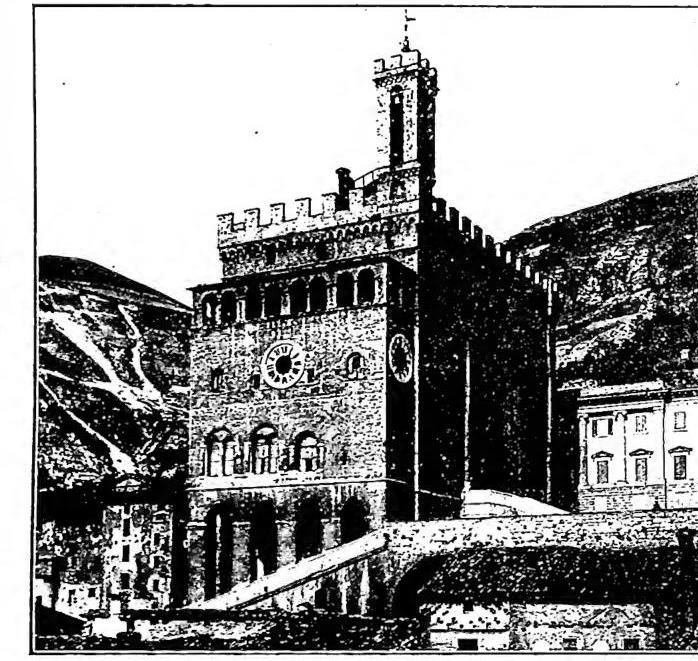
(Alinari photograph)
COMUNE - Consuls’ Palace, built by Angelo da Orvieto (1332) - Gubbio.
They regarded this document as the fundamental basis of civic autonomy and incorporated it into the Corpus iuris civilis, with commentaries by celebrated authors such as Odofredo and Baldo.
After this first phase of the c., struggles for its conquest soon began on the part of those civic classes that had been excluded from the government, in which the lesser feudal lords and the wealthiest landowners and merchants had long prevailed. Retail merchants and owners of artisan workshops took advantage of political developments to obtain broad participation in power.
The emperor Otto IV promoted an agreement in Milan, subsequently imitated in many other cities, whereby the city councils were divided equally between the milites, that is, the wealthiest men who served on horseback, and the pedites, that is, the rest of the people. Elsewhere, however, these disputes led to the replacement of the consuls by a podestà summoned from outside, unaffiliated with the city factions, who arrived accompanied by judges in order to guarantee impartial justice and serve as arbiter between the parties, and to the formation of a numerous Council, called the greater or large council (in Florence, the “Council of Five Hundred”), in which the various civic classes were broadly represented. This council truly became the arbiter of communal life, and it was there that the statutory legislation was formulated, of such importance for the formation of Italian law.
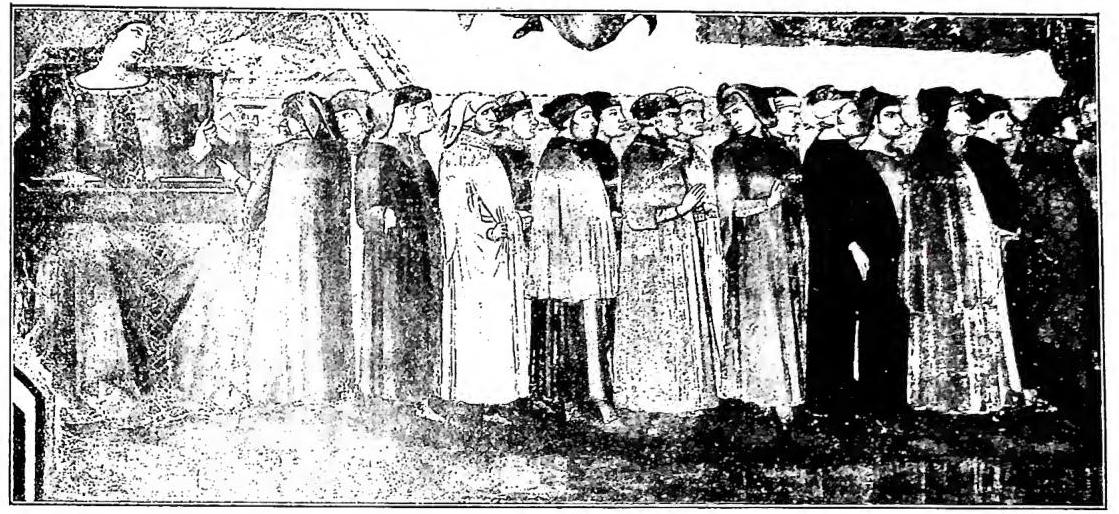
In some cities, foremost among them Bologna and Florence, this led to the ordinances against the « magnates » and to the establishment of the « c. of the people », in which the elders or priors appointed by the arts governed the city. Most of the c. of Emilia, Romagna and central Italy adopted similar ordinances. Elsewhere, by contrast, the leading families of the city—wealthy merchants, navigators, and owners of houses and lands—formed themselves into closed circles, and the c. assumed an oligarchic character: Venice and Genoa were particularly important in this type of development. The Venetian constitution, centred on the Great Council, formed by all the adult members of the families enrolled in the patriciate and regarded as sovereign of the State; on the Council of the « pregadi » (or senate); and on a restricted college of wise men who formed a kind of ministry, was regarded by political writers in the 16th and 17th centuries as an unsurpassed model of wisdom.
During the 13th and 14th centuries many c. were transformed into signorie. This was a profound change in substance but not in form, since the institutions of the c. remained almost unaltered: everything in the city, however, depended on the will of the signore, that is, a party leader who had succeeded in becoming the ruler with the support of his faction. Many signori had themselves acclaimed podestà or captains of the people for life by the city parliament, thereby legitimising their power. They subsequently sought a title conferred by a higher authority, having themselves created imperial vicars, as the Scaligeri in Verona and the Carraresi in Padua; or even dukes, as Gian Galeazzo Visconti, who, in 1395, received from the emperor Venceslao the title of duke of Milan.
The existence of the c. continued during the 16th–18th centuries, since absolute governments respected local autonomies, allowing the cities to preserve their statutes, jurisdictions and gabelle; the c., however, lost their political and military functions, since these belonged exclusively to the sovereign, whether he was a prince or a « dominant » city. With such subjection, however, the principal characteristics of the « city-state » were lost.
Rural c. had a different character: they were subject to feudal lords or ecclesiastical bodies that had allowed them to establish a communal organisation with limited autonomy. In most cases the rural c. had statutes granted to them by the lord, and these statutes contained provisions concerning rural policing, essential commerce, and the use of woods and meadows belonging to the inhabitants. In the Alpine regions such statutes were often called « regole » or « favore ».