
UCRAINA. —
I. GEOGRAPHY
One of the 16 federated Republics of which the U.S.S.R. is composed, it entered the Union on 30 December 1922 (abbreviation: U.S.S.R.). Its territory, which covered 445,300 sq km in 1939, grew to the present 576,000 sq km (more than one-tenth of European Russia) through the annexations that took place after the Second World War of Galicia (from eastern Poland), Transcarpathian Russia (from Czechoslovakia), Bessarabia, and northern Bukovina (from Romania).U. corresponds to a natural region marking the transition from the broad-leaved forest of southern Russia to the arid steppes of the southeast, from the Central European plain to the territories of the lower Don, which herald nearby Asia; at the same time, it is a historical region, at the boundary between the Mediterranean and Slavic worlds, between Catholicism and Russian Orthodoxy, and a battlefield between Europeans and Asians; taken as a whole, it is a country of recent colonization.
Its landscape is that of a vast plain, descending with an imperceptible slope toward the Black Sea, scarcely disturbed by the ravines carved by the watercourses flowing toward the Dnieper, the Don, and the Donets; it corresponds to the area in which average annual precipitation remains at 300–450 mm, that is, a subarid sector whose characteristic spontaneous vegetation—the steppe—tends to become progressively poorer toward the southeast. To the northwest, by contrast, the steppe gives way to the broad-leaved forest of central Russia, which accounts for more than one-fifth of the surface area of present-day U. (the provinces of Kiev, Chernigov, and Volhynia).
Within the U.S.S.R., as previously in tsarist Russia, U. represents above all a reserve of agricultural products. The original steppe was long ago converted into one of the most productive grain-growing regions of Eastern Europe, thanks to the fertility of its soil, the Chernozem
(or black earth): occupying scarcely one-seventh of the area devoted to grain cultivation in the Soviet Union, U. alone supplies more than one-quarter of the production (100 million quintals; in addition to 30 million quintals of rye, 35 million of barley, 25 million of maize, etc.). Also significant, and recently expanding, are the cultivation of cotton (one-seventh of the area cultivated in the U.S.S.R.) and sugar beet, as well as those of flax, tobacco, sunflower, and fruit trees. Livestock breeding, by contrast, is relatively modest in importance, although it includes 8 million head of cattle, 3–4 million sheep, and an equal number of horses.
No less important, however, is U.’s share in the industrial production of the U.S.S.R. The southern regions of U. in fact possess considerable mineral resources. The Donbass, or Donets Basin (covering 23,000 sq km), although retaining only 6% of the Union’s hard-coal reserves, supplies two-thirds of its production; somewhat to the west, in the Kryvyj Rih sector (Dnieper), iron is extracted (21 million tons available), while manganese is extracted in the Nikopol sector; there is also bauxite near Mariupol, graphite at Uman, and lignite in various places, not to mention the petroleum of Galicia. Industrial expansion is further favored by the availability of electric power, whose vast installations (Dnieper, with 800,000 HP of installed capacity) are likewise located near the mines from which the necessary raw materials are extracted. The dominant industries are metallurgy (38% of the pig iron, 25% of the steel, and 26% of the rolled products manufactured in the U.S.S.R.) and engineering (tractors, agricultural machinery, railway equipment, etc.), but other branches are also represented, among which the food-processing and chemical industries deserve mention for their importance.
The average population density (71 per sq km) is the highest among the Soviet Federated Republics; in the southeastern industrial district, between the Dnieper and the Donets, its local indices rise to more than 150–200 inhabitants per sq km, an exceptional figure within the U.S.S.R. The population is increasingly tending to concentrate in the industrial regions and, generally, in the large urban centers, whose number has now reached about twenty. Two of them each have more than one million inhabitants: Kiev, the historic capital, and Kharkov, the industrial capital; three have more than 500,000 inhabitants: Odessa, the most important port on the Black Sea, Dnepropetrovsk, and Stalino, both large industrial complexes; and at least six have more than 200,000: Leopoli, in Galicia, Zaporoje, Makeevka, Mariupol, Vorošilovhrad, and Kryvyj Rih.
By virtue of its geographical position and its history, U. is, of all the federated units of the U.S.S.R., the closest to Europe, and the one which, more than the others after the Great Russians, possesses the characteristic elements (tradition, culture, language, and literature) of a distinct nationality within the ethnic mosaic of the Soviet Union.
II. CIVIL HISTORY
1. Name
Over the course of the centuries, the name of this territory has changed several times for internal or external political reasons (Rusj, Ukraina, Malorossija). Herodotus calls it Scythia; from the 4th century onward it appears under the name Sarmatia. In the 2nd–3rd centuries A.D. it is called Roksolania. On Italian geographical maps of the 14th–16th centuries it is called Cumania, Comania, but also Sarmatia, Ruthenia, Russia (cf. the maps of Mario Sanuto 1320, Paolo Torlani 1565, etc.). But the names that remain valid today are: Rusj (Russia) and Ukraine.The patriarchs of Constantinople use the terms Magna Russia (Μεγάλη Ρώσια) for the north, and Parva Russia (Μικρά Ρώσια) for the Ukrainian south. This administrative-ecclesiastical distinction was subsequently adopted by some writers; only after the federation of U. with Muscovy in 1654 did the tsar call himself tsar of “Great and Little Russia” (from the Greek
Ρώσια, not from the ancient Rusj). Over time this name became increasingly unwelcome to the Ukrainians. After Russia, from the 17th century onward, officially changed its name from Muscovy to Russia (Russia), the name U. gradually became more and more established. There are official documents in which almost all the Ukrainian provinces are occasionally designated by this name (letters and appeals of the kings of Poland). It was already in use among the Cossacks from the beginning of the 17th century (Konasevyč, 15 February 1622). In 1654 (3 January) it is called “U.—our homeland”; in 1658 “Rusj” and “U.” are identified (Vyhovskyj in negotiations with the Swedes). Writers of the 19th century commonly use it (Šavčenkov). With the proclamation of the independence of the Ukrainian People’s Republic (20 November 1917; 22 January 1918), and of the People’s Republic of Western U. (1 November 1918), and subsequently with the creation of the Ukrainian Soviet Socialist Republic, it also received official recognition. Following the proclamation of independent Carpathian U. (15 March 1939), the name U. officially embraced the entire ethnographic territory.
2. Position and ethnography
Between the 21st and 45th eastern meridians and the 43rd and 53rd northern parallels. It borders the Black Sea, from the mouths of the Danube to the Caucasus (approximately 1,800 km). All its other geographical frontiers are open. Ethnographically, it borders the Romanians (900 km), Hungarians (100 km), Slovaks (200 km), Poles (approximately 550 km), Belorussians (approximately 1,000 km), Russians (700 km), and Don Cossacks (750 km). The mixed Ukrainian territory borders, beneath the Caucasus, the Kalmyks (400 km), Dagestan (250 km), and the peoples of the Caucasus (approximately 600 km). These frontiers, dating from before 1930, underwent considerable shifts over the centuries. The political frontiers and ethnographic boundaries of U. have never coincided during the last millennium. The State of Kiev (10th–12th centuries) extended beyond the ethnographic boundaries (under Vladimir, approximately 3 million km²). The Ukrainian Cossack State (17th–18th centuries) comprised 200,000–300,000 km². In the period 1917–21, U. covered more than 630,000 km²; today’s U.S.S.R. 576,000 km², including three-fourths of the entire ethnographic territory and four-fifths of the population, among its 41 million inhabitants. The entire ethnographic territory, whether inside or outside the U.S.S.R., together with the mixed territories, comprises 945,000 km², with 55 million inhabitants. Approximately another 5 million Ukrainians live in Asia, Central and Western Europe, and America, as settlers or political émigrés.3. Historical development
U. was inhabited from prehistoric times onward. Written sources speak of the Cimmerians, then, from the 7th century B.C., of the Scythians; from the 6th century, dense Greek colonies were established along the shores of the Black Sea. From as early as the 4th century A.D., the local population is known by the name Antes; Jordanes and Procopius speak of them in the 6th century. Their organization is uncertain; possibly an oligarchy of tribal princes. After another two obscure centuries, the Antes withdrew farther north. In the 9th century various tribes appear in history, later forming the Rurikid State of Kiev and developing into three different ethnic and state groups: U., Russia, and Belorussia. In the second half of the 9th century, the Scandinavian Normans descended along the Dnipro and settled halfway along it, at Kiev. The first historical prince of Kiev was Oleh (882–912), who occupied Kiev (882), fought the Byzantines (907, 911), and left the State of Kiev to his son Ihor (912–45). In 944 the latter signed a commercial and political agreement with Byzantium. His widow, Olha (945–64), attended to internal affairs. The advance of Christianity in Kiev led her to Baptism (955–57), but her son Svjatoslav I restored paganism while fighting against the Bulgarians and Greeks. After his tragic death (972), the kingdom was divided among his sons, and following a fratricidal struggle, Volodimiro (972–1015) emerged victorious and induced his people to accept baptism (987–90). After his death, his state (approximately 3 million km²) was again divided among his sons, until Jaroslav the Wise reunited it while fighting the Byzantines, Poles, and Mongols. In 1054, his sons resumed their quarrels and internal wars: Izjaslav I relied on the West, the princes of Perejaslavl on Byzantium, while the princes of Černyhiv were already seeking ties in the north. In 1075 Gregory VII crowned Izjaslav’s son, Jaropolk, in Rome. But toward the end of the 11th century, the branch of the Byzantinophile Vsevolod prevailed. His son Volodimiro Mononach restored the state to its former glory, but his successors were unable to maintain his conquests. In 1145–55, a struggle took place between the southern and northern regions of Vladimir. Shortly afterward, the North prevailed over the South, and Kiev was sacked (1169). Kiev’s glory declined irreparably despite the efforts of certain princes (e.g., Romano of Halyč [1199–1205], Svjatoslav III [1175–94]), and the history of the individual regions began. The invasion of the Tatars, victorious for the first time in 1223, prevented the restoration of the ancient State of Kiev. Then, in 1237–41, they irreparably divided this territory into two parts, northeastern (Moscow) and southwestern (U., Halyč). The prince of the latter endeavored to resist with the support—unfortunately only moral—of the West (coronation by Innocent IV, 1253), and despite defeats and humiliations, he succeeded in organizing the State of Galicia and Volhynia, which lasted until the middle of the 14th century. The northern princes saved themselves by collaborating with the Tatars.The princes of Halyč, who ruled over the Ukrainian territory almost as far as Kiev and beyond, succeeded in developing the Ukrainian State through continuous struggles with the Tartars, Lithuanians, and Poles. However, once the dynasty became extinct, Lithuania and Poland politically took over the territory. Lithuania, in turn, was considerably influenced by U. culturally. The union of Lithuania with Poland ecclesiastically attached Lithuania to the Latin West. The Union of Horodlo (1413) between Poland, Lithuania, and U. aimed at a federation under the Jagiellonian dynasty (1377–1433), which reigned until 1572. U. remained partly under the Lithuanian grand dukes and partly under the kings of Poland. With the ecclesiastical Union of Florence (1439), U. also sought to bring itself into line in religious matters. The union failed and collapsed of its own accord in the first decades of the 16th century, under the political, cultural, and religious pressure of Latin Poland-Lithuania, until the Union of Lublin (1569) transformed the personal union between Poland and Lithuania into a real union, and many Ukrainian lands were ceded by Lithuania to Poland, remaining open to Polish influence.
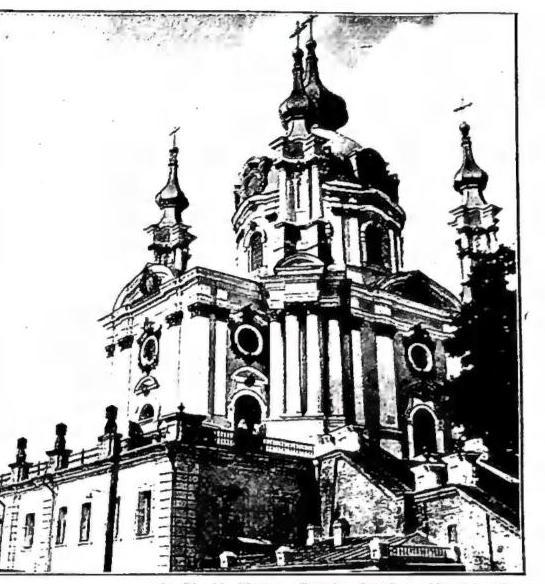
(from M. N. Kelley, Russia, London 1958, fig. 22)
UKRAINA – Church of St Andrew, built by the architect B. Rastrelli (18th century) – Kiev.
eastern Latin rite, and fought against the Union of Berest (1596), as an instrument of Poland; in the period 1648–50 they demanded its abolition from Poland as compensation for political peace.
Giovanni Mazeppa (1687–1709), relying on Moscovia, which at the time of this union began habitually to call itself “Russia,” reorganized the territory, promoted cultural development and a certain prosperity, creating, in a sense, a ruling class. During the war of Tsar Peter I (1687–1725) against King Charles XII of Sweden, he remained on the sidelines, seeking an opportunity to break away from Moscovia and proclaim his independence. On the eve of the Battle of Poltava he joined Charles XII and, after the defeat, fled to Turkey. His successor, Filippo Orlyk (1710–40), later became Catholic and unsuccessfully sought to interest Europe in the fate of U. Peter I restored the hetmans obedient to Russia, then entrusted the government of subjugated U. to a so-called “Collegium” under the presidency of Moscovite generals. Elisabetta (1640–62) restored the hetmanate (C. Rozumovskyj, 1750–64), but Caterina II suppressed that semblance of independence (1764) and aimed at the complete suppression of Ukrainian national and social liberties.
The part of U. on the right bank of the Dnipro, excluding Kiev, returned to Poland after the Peace of Andrusiv between Poland and Moscovia (1667). The development of Ukrainian Catholicism in that region saved it from complete assimilation into Polish administration and culture. The head of the nation was the metropolitan of the Ukrainian Church. But increasingly insistent social and administrative pressure provoked a popular uprising in U. during the second half of the 18th century (hajdamaččina, 1768), which was suppressed by Poland and Moscovia. Moscovia occupied the part of the Ukrainian territory that had been subject to Polish rule since 1667. A small part came under Austrian rule (1772) and from then on had a history of its own.
A few years later the territory was divided into gubernias, and the land, together with the peasants, was assigned to the Tsarina’s favorites. Toward the end of her reign, the Ukrainian Catholic Church was also liquidated, just as in 1685 the non-united Ukrainian Church had been made subject to the Patriarch of Moscow. The reigns of Paolo I and Alessandro I brought some lessening of the centralization of U., but under the reign of Nicola I (1825–55) the watchword was absolutism, Orthodoxy and nationalism. At the same time, the national revival began: patriotic traditions began to be cultivated, and the powerful song of Ševčenko made itself heard, although it was later stifled by the prohibition of publication in the Ukrainian language (1876). Secret societies arose (the Society of Cyril and Methodius), as did a revolutionary movement, while the peasants demanded land (1861). After the revolution of 1905, political parties emerged (democratic, republican, radical, socialist, etc.), and after the fall of the tsars (1917) they entered the political life of U.
Western U. under Austria experienced difficulties in coexistence with the Poles and the government of Vienna, which now favored one and now the other. In 1848, following the abolition of serfdom, the “springtime of the peoples” also made itself felt among the Ukrainians; it had already been prepared during the first half of the century through elementary and higher schools, the literary revival (1837), and the creation of the Metropolia of Halvč. In the second half of the century this revival was impeded by Polish pressure on the government of Vienna and by the Russophile movement, encouraged and developed by Russia. Nevertheless, a national press began, and political parties arose (radical, popular, national-democratic, social-democratic). Parliamentary life (1867) and the struggle for a Ukrainian University in Leopoli began and developed. The same occurred, though with a slight delay, in Carpathian U. under Hungarian rule and in Bucovina.
Toward the end of the First World War, the realization of national independence seemed imminent both in Kiev and in Leopoli. Beginning in March 1917, congresses of the various parties succeeded one another in Kiev. The Central Council was established, followed by trade-union congresses. After the Communists seized power in Moscow, the full independence of U. was proclaimed, a separate peace was signed with the Central Powers (9 November 1918), and the Communist threat was repelled with the help of the Germans (the period of Skoropadskyj). But with the demobilization of the Germans, the Communists advanced. During the same period, in the western part, subject to Austria, after the collapse of the Habsburg Empire, the Western Ukrainian Republic was proclaimed; on 22 January 1919 it united with the eastern part, joining its defensive efforts against the Bolsheviks, Polish aggression and the Russian tsarist generals. In 1920 an agreement was signed with Poland and Kiev was reconquered. But a new Communist advance drove the Ukrainian armies toward the west. Warsaw was threatened and saved through joint efforts. Poland made peace with the Communists at Riga (18 November 1922). Galicia and Volhynia passed under Polish rule; eastern U. became the Ukrainian Soviet Socialist Republic, with its own government, which was gradually reduced to the status of a satellite of Russia, and joined other Soviet Socialist Republics in the Soviet Union (10 May 1925); in these circumstances Carpathian U. joined Czechoslovakia with a guarantee of autonomy (10 September 1919). Bucovina was assigned by the Paris Peace Conference to Romania.
In Soviet U., after the famine of 1921–22 and the New Economic Policy (NEP), collectivization and industrialization took place, followed by the famine of 1933 and the purges of the bourgeoisie, the “nationalists” and the deviationist Communists.
In Poland, every attempt to obtain autonomy remained fruitless. Despite Warsaw’s centralized regime, cultural and economic life nevertheless developed in the country. In Czechoslovakia, the promised autonomy was not realized; a Russophile movement also developed there. But the national movement too was able to organize its forces, so that in 1938–39 it could assume power in the country and, after the fall of Czechoslovakia, proclaim independence (15 March 1939). In Bucovina, Romanian pressure was perceptible.
At the beginning of the Second World War, western U. was occupied for the most part by Soviet troops and incorporated into the U.S.S.R.; and Carpathian U. was occupied by Hungary. After 22 June 1941, almost the entire Ukrainian territory was occupied by the Germans and their allies and placed under military or civil administration (General Government, Commissariat of U., Transnistria). With the advance of the Soviet armies in 1943–44, U. was reoccupied and reconstituted as a Soviet Republic together with Carpathian U. (29 June 1945). Thus the U.S.S.R. united almost all the Ukrainian lands. From the remnants left outside the borders, the population was transferred to U. The Communist regime was fully reestablished. The Catholic Church was destroyed, and the partisan movement was fought and driven back into the mountains. Part of the political emigration took refuge abroad, developing and reorganizing the parties and establishing a Ukrainian National Council.
The question of the self-determination of the Ukrainian people thus remains open as a national and international legal problem.
BIBL: per più ampie e recenti referenze biblio: V. L'Euclapedia dell'U., Monaco-Parigi 1949-51. Inoltre: K. Edinger, Russlands älteste Beziehungen zu Deutschland, Frankreich und der römischen Kurie, Halle 1911; C. Hallendorf, Carl XII i Ukraine, Stoccolma 1915; B. Nolde, L'Ukraine sous protectorat Russe, Parigi 1915; T. Wojnarowskyj, Das Schicksal des uhr, Volkes unter polnischer Herrschaft, Vienna 1921; V. Singulović, La questione della Galizia, Roma 1922; M. Rostowzeff, Les orig. de la Russie Kievienne, in Rev. des études slaves, 2 (1922); B. Leib, Kiev et Byzance à la fin du XIe siècle, Parigi 1924; F. Dwornik, Les Slaves, Byzance et Rome au IXe siècle, ivi 1926; E. Borschak, Le mouvement national ukraine au XIXe siècle, ivi 1930; R. Martel, La politique nationale des Soviets en Ukraine, in Le monde slave, 3 (1930); 2 (1934); M. Korduba, Les théories les plus récentes sur les orig. de la Rothénie, in Le monde slave, 3 (1931); E. Borschak-Rene Martel, Vie de Mazepe, Parigi 1931; R. Tisserand, La vie d'un peuple, L'Ukraine, ivi 1933; E. Borschak, L'Ukraine dans la littér. de l'Europe occid., ivi 1935; H. Schumann, Der Hetmonstaat 1643-1764, Berlino-Breslau 1936; M. Korduba, La littér. histor. soviet.-ucraienne, Varsavia 1938; E. Borschak, L'Ukraine à la Conférence de la Paix, Parigi 1938; R. Bondioli, U., La terra martire ed indoma, Roma 1939; E. Onatskyj, Studi di stor. e di cultura ucraina, ivi 1939; B. Krupnyckyj, Die histor. Wissenschaft der Sowjet-Ukraine 1921-41, Breslavia-Berlino 1941; D. Doroshenko, Ukrainian history since 1912, in The Slavic Review, 3 (1942), fasc. 7; A. Jakowliw, Das deutsche Recht in der Ukraine, Lipsia 1942; E. Winter, Byzance und Rom im Kampf um die Ukraine, ivi 1942; G. Vernadsky, Kievan Russia, Nuova Heaven 1948; I. Mirchuk, Ukraine and its people, Monaco 1949; C. A. Manning, Twentieth century Ukraine, Nuova York 1951. Alfonso Gregorio Welykyj
### III. STORIA ECCLESIASTICA: V. KIEV.
IV. LITERATURE
At the end of the 10th century the development of Ukrainian literature began. Until the 18th century, the Old Church Slavonic language was used; it had been introduced into U. together with Christianity and profoundly altered over the centuries in its vocabulary, phonetics, and morphology. From the 11th century onward, translations from Greek and Church Slavonic spread in U.: liturgical and moral books, aphoristic, hagiographic, apocryphal, and historical works, as well as tales and romances of Eastern provenance, transmitted in some manner through Bulgaria. In the literature of the origins, ecclesiastical oratorical prose is distinguished above all: sermons by St. Theodosius of the Caves, by the metropolitan of Kiev Ilarion, by Cyril of Turiv (12th century), and by Serapion of Kiev, bishop of Vladimir (13th century). Also noteworthy are the Exhortations to the sons of Prince Vladimir Monomach (12th century). Among the hagiographic works are the Life of the ss. Boris and Hlib, the Life of St. Theodosius of the Caves, and above all the Patericon of the Caves of Kiev (13th century), a collection of biographies of the holy monks of Kiev and information concerning the foundation of the monastery. Of greater importance are the chronicles (up to the 12th century), and particularly those of Galicia and Volhynia, which provide extensive and varied material on the events of U. Among the narratives of an epic character, the Song of the Host of Ihor (ca. 1087), by an unknown author, stands out for its poetic merits: it is full of national feeling, imbued with images from pre-Christian mythology, and interesting for its fusion of folkloric colors and literary sophistication (v. RUSSIA, letteratura).After a period of literary depression in the 14th and 15th centuries, literature was reborn with the struggle for independence under Chmelnyckyj. From the end of the 16th century and throughout the 17th and 18th centuries, Baroque predominated. This phase includes the numerous polemical treatises and pamphlets (connected with the Union of Berest of 1596) by Metropolitan I. Potij, G. Smotryckyj, M. Smotryckyj, Z. Kopystenskyj, and J. Boreckyj; the sermons of J. Galatovskyj, L. Baronovyč, A. Radyvylovskyj, and others; and the collections of tales by Kosov, A. Kalnofojskyj, and D. Tuptalo. From the 18th century, the so-called Cossack Chronicles of Samovydec, G. Hrabianka, and S. Velyčko have been preserved. Rich Baroque poetry in verse of a spiritual character arose (K. T. Stavroveckyj), followed later (with the collection Announcer of God, 1790) by poetry of a patriotic, panegyric, philosophical (G. Skovoroda), and amorous-lyrical character. Baroque drama (17th and 18th centuries) is represented by D. Tuptalo, T. Prokopovyč (Vladimir, 1705), the anonymous Grace of God (1728), G. Konyskyj, and others. The Easter dramas, dramas about saints, and moralities contain comic interludes and extensively document the popular language (for example, the comic dialogues of Ivan Kraševyč from the end of the 18th century). In the burlesque poem Eneida (1798–1849) by Ivan Kotlarevskyj, Ukrainian literature abandoned the Church Slavonic language in favor of the living popular language. With this and other works, Kotlarevskyj earned the deserved title of “father of Ukrainian literature.” In the 19th century, the burlesque and pre-Romantic tales (Muruja) of Kvitka-Osnovjaneko appeared.
Romanticism, during the period 1830–50, linked to admiration for popular song and national antiquity, gave an impetus to Ukrainian literature. The lyrics of L. Borovykovskyj, L. Hrebinka, M. Petrenko, and A. Mohyla-Metlynskyj; the poems and tragedies of M. Kostomarov; the tales of O. Storoženko; and, in western U., the collection Nymph of the Dniester (1837) by the priest M. Šaškevyč, I. Vahylevyč, and I. Holovackyj, drew their inspiration from popular song, introducing elements of European poetry into Ukrainian literature. With Nymph of the Dniester, a new age began in the literature of western U. In the figure of Ševčenko (1814–61), Ukrainian literature found its greatest poet: noteworthy is the depth of his analysis of the historical past of U., while the suffering of the Ukrainian people is deeply felt in his verse. Among his finest and best-known works are Dream; The Great Ravine; Caucasus; Message. In him, thematic and ideological richness is joined to artistic perfection. Pantelejmon Kuliš, poet (tales Dawn, 1893; Country Poems, 1882; The Bell, 1893), historical novelist (The Black Council, 1857), short-story writer, dramatist, critic, and translator of Byron and Shakespeare, enriched Ukrainian literature with ideas and elements drawn from Western literatures. In the transition from Romanticism to Realism, Marko Vovčok (pseudonym of M. Vilinska-Markovyč), with her Folk Tales (1837), deserves mention, as do the poet and prose writer F. Pedjkovyč; the poets S. Rudanskyj and L. Hlibov; and the poets of realistic inspiration O. Pčika, B. Hrinčenko, I. Mandžura, and P. Hrabovskyj, who sang of the hard fate of the people. Realistic-popular prose is represented by A. Svydnyckyj (Ljuboracki, 1862); I. Nečuj-Levyckyj (Mykola Dzerja and other novels about the life of peasants and intellectuals: The Clouds); and P. Myrnyj (novels, The Lost Forces, The Harlot). A remarkable and complex figure is Ivan Franko (1856–1916), describer of the social underworld (Boa Constrictor and Boryslavride) and of the life of intellectuals (Crossed Paths). In poetry, he oscillates between Realism, lyrical notes, and philosophical elements (The Withered Leaves; My Emerald and others).
Impressionism in modern prose manifested itself in M. Kociubynskyj (Fata Morgana; The Shadows of Forgotten Ancestors), O. Kobyljanska, K. Hrynkevyč, M. Ceremšyna (pseudonym of Ivan Semeniuk), G. Chotkevyč, W. Stefanyk (Maple Leaves; My Word), S. Vasylčenko, A. Teslenko, M. Jačkiv, B. Lepkyj, and others. Some poets belong to the sphere of psychological Realism: A. Krymskyj, I. Dnieper Gull, (pseudonym of L. Vasylevska), and V. Samijlenko. The modern orientation is also reflected in the poets of the group The Young Muse: P. Karmanskyj, V. Pačovskyj, and others, such as B. Lepkyj. Also worthy of mention is the singer of the national revolution O. Olesj (pseudonym of Kandyba), and finally M. Filanskyj and V. Vorona (pseudonym of Laryssa Kosač, 1871–1913), who, in lyric poetry (On the Wings of Song; Isolda Whitehand), and in dramatic poems (Babylonian Greeting; On the Ruins; Orgy; The Stone Master; The Forest Song and others), enriched Ukrainian poetry with inspiration from world history and literature, also exalting the resistance of the Ukrainians against their oppressors. The Soviet regime increasingly made its pressure felt on Ukrainian cultural and literary life.
Symbolism created in U. a fusion of popular tradition with modern sensibility. In this connection, P. Tyčyna (Sun Clarinets; Plough) deserves mention; under pressure from the regime, he ultimately became the official poet of the Kremlin. The same fate befell M. Rylskyj (Under the Autumn Stars; Blue Horizons; The Thirteenth Spring). From the group of the Neoclassicists, M. Zerov (The Kamena), the most important of them, was liquidated together with P. Fylypovyč and M. Draj-Chmara. Their work was continued in western U. by J. Klen, M. Orest, and S. Hordynskyj. Among the other poets, V. Svidzinskyj, E. Plužnyk, T. Osmačka, B. I. Antonyč in Western U., and M. Bažan, who became the official poet in 1934 (Carved Shadow; The Constructions), stand out.
The historical themes were treated with philosophical insights by the group of poets from Western U. or among the émigrés, collaborators of the journal Visnyk (1930): E. Malaniuk (The Earthly Madonna); O. Olžyč (Shadow; The Towers); O. Ljaturynska, L. Mosendz, O. Teliha, J. Lypa, P. Stefanovyč, and others; in prose, the best known are: G. Kosynka, M. Chvylovyj (Autumn), A. Lubčenko (The Path of the Storm; She); J. Janovskyj (The Master of the Ship; The Four Sabres); V. Pidmodrynj (The Problem of Bread; The City); M. Ivčenko (The Working Forces); B. Antoneko-Davydovyč; in Volhynia, U. Samčuk (Volhynia; Maria). Among dramatists, first place belongs to M. Kulič (Myna Mazailo; The Pathetic Sonata). The Communist persecutions against Ukrainian literature assumed particular proportions in 1933–38. During this period approximately 100 Ukrainian writers were shot or deported; others were transformed into instruments of Soviet propaganda, without any possibility of deviating from the official line of so-called «socialist realism».
In Western U. too, new paths were sought in the first postwar period. The entire literary life of Galicia, Volhynia, and the émigré community gathered around four journals: The New Ways, pro-Soviet in orientation, with its exaltation of the work of the Soviet Union; The Messenger, of national orientation, headed by E. Malaniuk and O. Olžyč in poetry and R. Jendyk and U. Samčuk in prose; Us (in Warsaw), with a group of writers linked to the past; the fourth group, gathered around the journal Encounter, included the names of J. Kosač, S. Hordynskyj, and others. Catholic writers were grouped around Bells (Lviv), where the poetry of B. I. Antonyč and the prose of N. Koroleva stood out. The group of women writers K. Hrynereyčeva, N. Koroleva, I. Wilde, H. Zurba, and U. Kravčenko should also be noted.
In Bukovina, literary life in the postwar period almost did not exist. There was greater vitality in Carpathian U., however, with the young writers V. Grendža-Donskyj, Zoreslav, I. Irlavskyj, and A. Harasevyč.
After the Second World War, all literary activity outside Soviet U. took place in Western Europe. America produced little or nothing of significance. Within the «Ukrainian Artistic Movement», the process of rapprochement between writers from Eastern and Western U. began. New names emerged, with contemporary, universal, and traditional historical themes (H. Schidnyj, B. Domontovyč, I. Kosteckyj; M. Orest, V. Barka, L. Poltava, etc.). - Vedi tav. LNV.
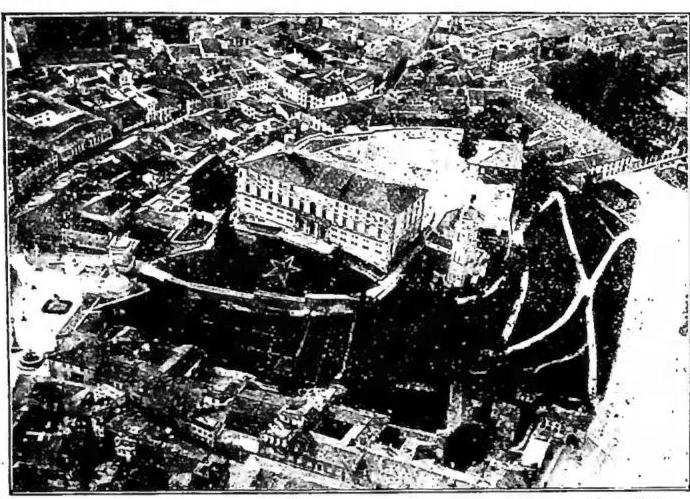
UDINE, DIOCESI of - Aerial view of the city center with the Castle (mid-16th century) (phot. Euit) - Udine.
B. Lepkyi (1909), M. Vozniak (1920-24), S. Jefremov (1923), L. Bileckyj (1931), A. Beleckyj (1940), V. Petrov (1946), O. Doroškevyč (1924), A. Samraj (1927), R. Radzykevyč, M. Hlobenko, etc. D. Tschizevskyj, Gesch. der altrussischen Literatur in XI., XII. und XIII. Jahrh. Kiever Epoche, Frankfurt 1948, etc. Mykola Hlobenko