
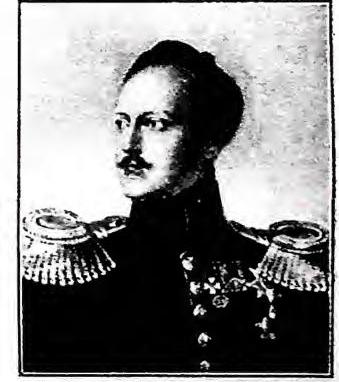
NICOLA I Romanov, tsar of RUSSIA. — N. was born at Tsarskoye Selo on 25 June (7 July) 1796 and died at St Petersburg on 17 (29) February 1855. Following his brother’s renunciation of the throne, he proclaimed himself emperor on 14 (26) December 1825. Taking advantage of this circumstance and of various rumours deliberately spread, the members of several secret associations of liberal and radical inspiration decided to take action: they were almost exclusively young officers, who refused to swear allegiance to N. I and, at the head of several army units, resolutely rose in revolt.
It was the first revolt that was not a mere palace conspiracy, but expressed clear discontent with the autocracy and in which vague “socialist” demands made themselves felt. The revolt took place on 14 (26) December 1825 and, from the Russian name for December (dekabr'), was called the Decembrist revolt. This event, closely connected with his coronation, helped to shape in N. a rigidly absolutist attitude, which found practical expression in the struggle against revolution both domestically and internationally. He was an advocate of protectionism. During his reign, an important monetary reform was carried out. The question of abolishing serfdom kept him occupied for a long time, although no genuine solution to the problem was ever reached. An advocate of an economy perhaps not unjustly called “pre-capitalist” by certain historians, he also gave considerable impetus to the railways, thereby contributing to the development of modern capitalism. In foreign policy, N. was above all a staunch defender of legitimist policy in Europe, without neglecting the Eastern Question. During his reign, Russian expansion in the Balkan region continued, along with the defence of the Christian populations: while not disregarding Russian interests in those lands and the situation created by the oppression of Christians at the hands of the Crescent, he showed, in the name of his absolutism, significant hesitation in supporting revolutions, even when inspired by Slavic and Christian ideals. In the war of 1853–55 against the Western powers, N.’s Russia revealed its serious internal weaknesses. Russian intervention in 1849 against the Hungarian revolution was insufficient to win Austrian gratitude. Domestically, the country’s economic and technical development had not been such as to prevent unpleasant surprises of various kinds during the military campaign. N. had deluded himself into believing that he could halt revolutionary ideas at the frontiers of the Russian Empire; but a strictly unyielding censorship and police had failed to prevent those ideas from entering the country: indeed, in the absence of a climate of legality, the young intellectual generation absorbed the most advanced ideas of the West with fanaticism and an extremist spirit. At the beginning of his reign, N. I had suppressed the first revolutionary attempt in modern Russia. At the end of his reign, Russia was defeated and isolated, troubled throughout all its social strata by unrest and an intense fever for reform, while the first wave of “nihilism” was beginning to spread across the entire country. N. was not lacking in skill and cunning on certain occasions: during the Polish revolt of 1830–31, his policy sought to influence the Pontiff against the Polish “rebels,” presented as nothing more than allies of all the other European revolutionaries.
He did everything possible to keep the Pontiff’s protests against the situation of Catholicism in Russian Poland hidden from the Russian public. In the other parts of the Empire as well, he was hostile to Catholicism and to the return of schismatics to Catholicism.
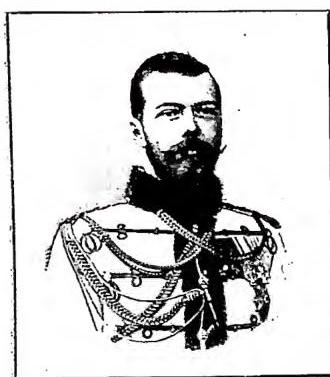
A man of peaceful character, from the day of his coronation (27 May 1896) he adopted the project of avoiding international conflicts by peaceful means and through disarmament. He nevertheless had to undergo two bloody wars (that against Japan, 1904–1905, and the First World War), both of them unfortunate for Russia. His reign was marked internally by numerous innovations: 1) the stabilization of the finances through the adoption of the gold standard; 2) freedom of conscience; 3) the parliamentary system (the Imperial Duma), introduced on 30 October 1905; 4) the outline of a far-reaching agrarian reform; 5) compulsory education.
A convinced and fervent Christian, N. planned the reform of the laws governing relations with the Vatican, which was intended to bring great advantages to both parties. Having married Princess Alice of Hesse-Darmstadt (Empress Alexandra), he had five children by her. Forced to abdicate on 15 March 1917, N. was arrested together with his family and deported first to Tobolsk in Siberia and then to Ekaterinburg in the Urals, where on 17 July 1918 he was massacred with his entire family by order of the Bolsheviks.